

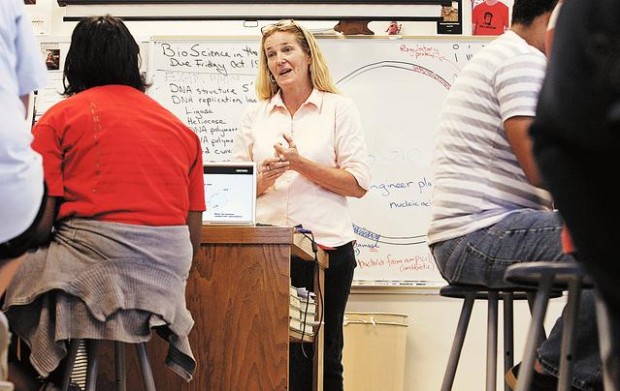
An award-winning teacher at Tucson Magnet High School is taking an innovative approach to teaching, a model that has brought her students repeated success and a foot in the door at the University of Arizona.
Margaret Wilch's students are learning hands-on lab skills in biotechnology and applying them through collaborations and internships, working in UA facilities and laboratories alongside professionals.
"I don't think anyone goes into science to read textbooks," Wilch said. "Science should be fun and intellectually and creatively engaging."
Wilch matches her students with mentors, usually graduate students, allowing the students to become part of research teams at the UA.
A few of Wilch's former students have co-authored papers in science journals through their partnerships. Her students consistently compete in regional, national and international science fairs and many have been awarded college scholarships.
People are also reading…
"Some students who began working at UA as juniors and seniors in high school are now working in the same labs as juniors and seniors in college," said Wilch, who has taught at Tucson High since 1992.
Wilch remembers going out into the field for her own high school biology class and working on original research projects. She thinks her approach to teaching likely stems from the experience, though she says she didn't fall into teaching until she moved to Tucson in 1985 with her husband and their first daughter.
"I wanted to work and be with her so I started working in a day care," Wilch said. "While I have always valued education, never in my early or young adult life did I think I would be a high school teacher.
"Never say never."
Wilch and her husband now have three children, and all of them have been in Wilch's classes at Tucson High. Her youngest, Henry, is in her biotechnology class now.
Wilch got a master's in general biology from the UA in 1999 and says much of her honors research methods class is based on work a college student would do for a master's thesis, for which students must read background literature, propose projects, test hypotheses and present findings.
Angela Schlegel, 17, a senior, is in Wilch's research methods and biotechnology classes. She researches much of her project at a UA Bio5 Institute laboratory, where she is working on sequencing and expressing genes in a biochemical pathway of an herb.
"It's really great. The people in the lab are extremely helpful. This is my first time in a chemistry lab, so I'm learning about a whole new field," said Schlegel, who said she is considering enrolling at the UA and working in the same lab.
"You would have a hard time finding a high school science teacher who is as dedicated to exciting students about science," said Kevin Vogel, a Ph.D. student at the UA studying ecology and evolutionary biology.
Vogel helped teach both Wilch's research methods courses and the biotechnology courses last year through a program that pairs graduate students with K-12 teachers in the classroom, another partnership in addition to those in UA labs.
"Because of the amount of work required to do scientific research, an educator really has to get students excited about it, and Margaret is very talented in this respect," Vogel said. "She excels at communicating very complex scientific concepts to students and doing it in a way that really ignites their enthusiasm for science."
Students say the class is much different from others they've taken.
"We would go out working in labs for months at a time, often making slow or no progress working on things that none of us really understood. But Ms. Wilch trusted us to go out and make our own way. She also had an infectious enthusiasm for science that made the hard work we were attempting, and often failing at, seem easy and fun," said Jake Wintermute, one of Wilch's former students who is now a Ph.D. student in the systems biology program at Harvard University.
Her teaching earned Wilch this year's Arizona Bioindustry Association's Bioscience Educator of the Year Award. She also was named Top Teacher at Southern Arizona Regional Science and Engineering Fair this year and has won the award in previous years, too.
"Science isn't all dry facts. There's room for creativity," Wilch said. "My hopes are to pull the curtain back and show students that experience.
"I'm fortunate to have students who are willing to challenge themselves," she said. "It's remarkable to see the lights go on and watch the students grow and become successful."
Latest Student Successes
Two of Margaret Wilch's students will be honored at the 2008 Governor's Celebration of Innovation Awards.
Steven Fan and Adrian Laurenzi will be lauded as the Best of the Best in the Arizona Engineering and Science Fairs for the year 2007-08 school year.
Each student will receive a $1,000 scholarship and has been invited to a dinner at the Dodge Theatre in Phoenix later this month.


