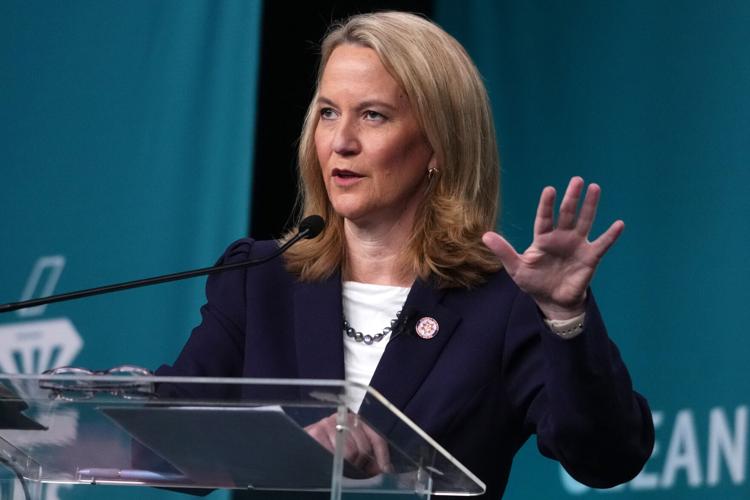
The proposed SpaceX data center in Cochise County will require close to 20% of Arizona's total current electric generating capacity and could have major effects on overall energy reliability in the state, Attorney General Kris Mayes says.
She issued that warning in a letter to the Cochise County Planning and Zoning Commission, urging it to delay acting at its Dec. 9 meeting on SpaceX's proposed $50 billion data center project near Willcox.
Mayes' Nov. 19 letter to the commission said a delay is needed to "ensure that the county does not begin authorizing a project with potentially far-reaching impacts on the region’s energy reliability, water availability, and resident health and safety until it has been thoroughly vetted by the relevant state and federal regulatory authorities."
SpaceX, in a letter to the commission responding to Mayes, said the project won't pose a risk to Arizona's electric power supply. It will be able to get plenty of power for the center from Arizona's existing electric grid, the company said. As the center's operations expand, it will also be able to take advantage of new power lines to supply additional electricity, SpaceX Vice President Sheila McCorkle wrote, although the company's letter didn't specify the lines.
People are also reading…
In her letter, Mayes wrote, "The scale of this project is unprecedented for Cochise County and the entire state."
She noted that the center would consume six gigawatts of power annually. That would make it the third largest data center in the U.S. for electricity consumption, Mayes wrote, citing statistics from the privately run U.S. AI Data Center Atlas.
"Six gigawatts is equivalent to the demand of the entire Phoenix metro area on a mild winter day," said Mayes' chief of staff Richie Taylor.
Mayes backed up her claim that the six gigawatts represent nearly 20% of Arizona's total power-generating capacity by citing a report from the U.S. Energy Information Administration, a division of the U.S. Department of Energy.

Mayes
"The company’s application leaves much about the project uncertain. The sheer scale of its power demand and physical size presents exorbitant risks," Mayes wrote. "Prior to authorizing any approval of a facility of this potential magnitude based on a mere 55-page application (already amended several times), the county should have the benefit of all studies, analysis and authorizations of the facility by state and federal agencies."
The Dec. 9 consideration and possible vote by the commission would come about five weeks after the aerospace company made its proposal publicly known by submitting the application to build the data center on 747 acres along U.S. 191 near Willcox. SpaceX CEO Elon Musk calls the project Colossus 3.
Cochise County's chief development official declined to comment on Mayes' letter, but the Development Services Department's planning manager said he saw no reason for a delay of the commission's vote.
The Planning and Zoning Commission is aware of Mayes' letter and her recommendations, which will also be included in the Dec. 9 commission packet under public comments, Development Services Director Christine McLachlan wrote in a Nov. 23 email to the Star. She was referring to a packet of materials the department and commission compiled in advance of the commission's impending vote on a special use permit for the data center.
"The commission and Development Services have no other comments at this time," McLachlan wrote.
Matthew Taylor, the department's planning manager, told the Star, "I'm assuming that it will move forward Dec. 9. I can't really say. There's no reason for us not to proceed with the Dec. 9 meeting.
"The SpaceX application does address some of the issues identified in that letter; I don’t think what the letter says would require a delay of project," said Taylor in a brief phone conversation.
Officials of the nonprofit Sulphur Springs Valley Electric Cooperative, which will deliver power to the center, declined to comment on Mayes' letter, with cooperative spokeswoman Mary Davis saying, "This isn't really for SSVEC to address, and is more appropriate for Cochise County to answer."
Patrick Ledger, CEO of the Arizona Electric Power Cooperative, commonly known as AEPCO, which will deliver electricity to the Sulphur Springs cooperative on a wholesale basis, for similar reasons declined to comment on Mayes' letter, other than to point out what he called inaccuracies in its statements about the project's power supplies, explained below.
Here are specifics from Mayes' letter:
Energy use
The data center's use of 1.5 gigawatts in its initial operations, "let alone the full 6.0 GW, will have large, and as yet almost entirely unknown, impacts upon the reliability of the electricity supply for all of Arizona," Mayes wrote.
SpaceX identifies AEPCO as its source of power, but AEPCO’s Apache Generating Station currently generates roughly 625 megawatts (MW), about one-tenth of what the SpaceX campus will eventually need.
"The initial power demand of 1.5 GWs is 62 percent larger than AEPCO’s entire owned and contracted generation fleet," Mayes wrote. "Since Sulphur Springs Valley Electric Cooperative is one of AEPCO’s members, a reduction in available capacity may impact the cooperative’s ability to maintain affordable and reliable electrical service in the area."
SpaceX has provided no details about how it plans to close that capacity gap, Mayes wrote.
Perhaps SpaceX plans to purchase capacity on the Southline Transmission Project, "a recently built power line running through the area of the plant," she wrote.
But using that line's power would still be inadequate for SpaceX and would leave Tucson with inadequate power because the Southline project passes through Tucson, she said.
Because of that, SpaceX may instead have to build new, natural gas-generating facilities, possibly at AEPCO's Apache Generating Station, Mayes wrote.
But, Apache Station's generating capacity won't directly serve the SpaceX center, the company said. Instead, SpaceX will work with the station's owner, the Arizona Electric Power Cooperative, to obtain wholesale power from across the Western electric grid. The power company, also known as AEPCO, will deliver that regional power through its transmission system to the Sulphur Springs Valley Electric Cooperative to provide retail service to the data center, SpaceX said.
"Remember, AEPCO will not be providing any power. We will go to the market and get the power for them," Ledger said of the data center. "SpaceX is procuring its own resources. They will buy whatever they can off the market."
Ledger has said that new power transmission line or lines will have to be built to serve the data center when it's operating at full capacity.
Responding to Ledger, Taylor, Mayes' chief of staff, wrote to the Star, "SpaceX says it will power the project with power imported on the interstate transmission system. But that system has constraints and bottlenecks as it is, and the Attorney General’s Office has not identified sufficient available transmission capacity to meet SpaceX’s initial 1.5 gigawatts of demand — let alone 6.0 gigawatts. SpaceX should clarify its power supply plans to inform public discussion, including how it will address constraints and competing demand for transmission capacity running through Cochise County."
Whatever course SpaceX pursues for getting electricity, it "will surely need to demonstrate resource adequacy and grid reliability through technical studies and investment assurances to the Arizona Corporation Commission and the Western Electricity Coordinating Council," said Mayes. She was referring to a nonprofit corporation that has been designated by the federal government as the entity to ensure a reliable electric system in the Western United States.
Water use
Because the data center will be cooled by air instead of water, SpaceX's application says it will only use 7 to 10 acre-feet of water annually for its operations, Mayes noted. (Ten acre-feet is the equivalent of enough to serve about 40 typical Tucson homes for a year.)
But that doesn't account for the water that is likely to be used to meet the facility’s energy demand, Mayes added.
"Just one natural gas plant, generating one GW of power and running continuously requires between 3.6 million and 6.8 million gallons of water per day," she said.
"The project thus has the potential to use an enormous quantity of water in a supply-constrained area" — the Willcox Basin, where unregulated agricultural pumping has already dramatically lowered the region's aquifer and dried up many homeowners' drinking wells, Mayes said.
"As you no doubt recognize, the project will be located within the Willcox Active Management Area," a state-run political subdivision. "The Willcox AMA was designated two years ago to stop severe, unchecked aquifer depletion and dangerous land subsidence. The Arizona Department of Water Resources has established a management goal of reducing groundwater overdraft in the basin by 50 percent by 2075."
Taylor added, "Since SpaceX has not provided adequate detail about where its energy supply will come from, it is plausible — perhaps probable — that some demand will be met with new natural gas-fired generation at or near the site. In Tennessee, for example, SpaceX deployed dozens of temporary gas-fired generators to power a data center before constructing more permanent gas generating capacity."
SpaceX countered, "That estimate has no bearing on the water use of the campus before the commission," because no gas plant is planned. The company proposes no new production well in the Willcox for industrial groundwater use, it said.

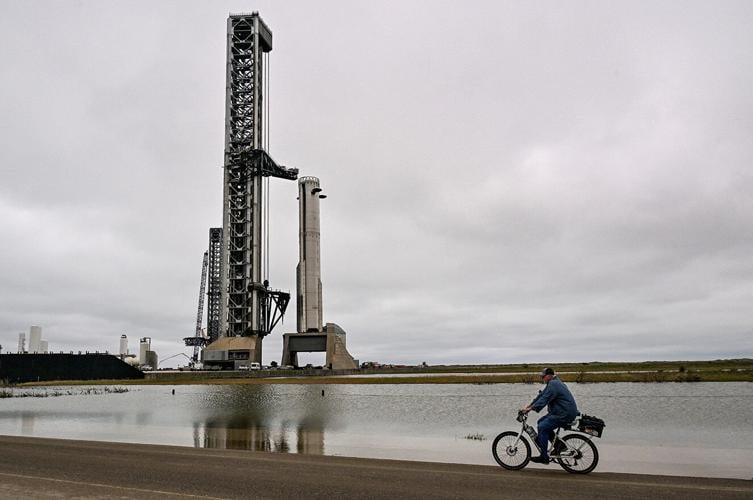
A launch complex in Starbase, Texas, for SpaceX test flights. SpaceX has said it plans to invest $50 billion in a supercomputing data center complex in Cochise County.
Fire risks
SpaceX's permit application says backup energy will be provided by 24 gigawatt-hour lithium-ion phosphate batteries, Mayes noted. This translates into 6,150 Tesla Megapack battery units, she said.
"If a Megapack catches fire due to a manufacturing defect, electrical fault, or extreme heat, local fire and first responders may need additional tools and training to adequately address the situation," she wrote.
"The entire proposed campus is located outside a fire district. While battery fires are rare and can be mitigated, it is not clear that the (SpaceX) application will provide sufficient resources to contain a fire were one to start on-site."
But SpaceX said the center will have a dedicated fire-water tank with redundant fire pumps and a private set of hydrants. Wet-pipe sprinklers and voice/strobe alarms will be in each building, and other sprinklers and smoke detection equipment will be in every computing hall at the center, wrote SpaceX Vice President McCorkle.
Traffic issues
The data center's 5,500 estimated employees at peak construction will strain area roads without some sort of mitigation to add capacity for construction work, she said. Construction will require civil crews, concrete workers, ironworkers, electricians and heavy equipment operators, Mayes wrote.
Building nine 493,000-square-foot buildings for the center, installing roughly 6,150 Megapack battery containers, and upgrading nearby substations will generate sustained semi-truck and oversized-load traffic for concrete, steel, transformers, and cooling units, she said.
A Megapack is a utility-scale battery that provides reliable energy storage to stabilize the grid and prevent outages, according to the website of Tesla, Musk's electric car manufacturing company.
The construction work will very likely increase wear on rural two-lane stretches of U.S. 191 and surrounding county roads, Mayes wrote.
"To protect the safety of its citizens and the integrity of its existing transportation networks, the county should commission a third-party study of the traffic impacts and develop a plan to ensure upgrades will be in place before construction begins," Mayes wrote.
SpaceX, however, said its data center application already calls for a traffic impact analysis that would be reviewed by the Arizona Department of Transportation and construction of turn, acceleration and deceleration road lanes when required by the state agency. In addition, SpaceX said it will fund an independent review of the traffic impact analysis.
Interference with military activity
The Willcox Playa, which borders the data center site, is also used by Fort Huachuca and the U.S. Army Electronic Proving Ground for live fire and outdoor electronic testing, Mayes wrote. The military uses the playa’s interference-free environment to test GPS jamming, radar systems, unmanned aerial systems and communications equipment, she wrote.
"The U.S. military may need to evaluate the impacts of the data center’s intense electromagnetic footprint to ensure it does not interfere with this unique low radio frequency environment," Mayes wrote.
SpaceX replied in its letter to county officials, "The campus consumes electricity; it does not transmit. It proposes no communications towers other than building-mounted antennas for security and operations. Its computing equipment sits inside metal buildings next to an existing generating station and existing high-voltage lines."
Other approvals needed
Taylor of Mayes' office noted that the company's application to Cochise County cites eight different state approvals that will be needed to move the project forward. Up to three federal approvals likely also will be needed, including one if a new power line or natural gas transmission line has to be built for the project.
If any of the new infrastructure for this project is built on federal lands, "the appropriate federal land agency will have to be consulted," Mayes wrote. "Each of these reviews, consultations and approvals can provide the County with critical information to better understand the application’s impacts. Prior to acting on the SUP Application, the County should have the benefit of those studies to understand how the project will impact local energy reliability and whether its projected energy demand can feasibly be met by Arizona’s bulk power system."
SpaceX, however, said a special use permit authorizes construction of the project but does not "energize it." Before it can be built, all the follow-up approvals by other agencies that are necessary must be carried out," McCorkle wrote to the Cochise County Planning and Zoning Commission.
"Those reviews follow a land-use decision. Delaying the hearing would not produce them sooner; it would only push them later," she wrote.
If the county commission decides to move forward with the project, Mayes recommended that it impose the following conditions:
Delay the permit's effective date until SpaceX receives all relevant state and federal government approvals, and condition the issuance of county building permits on those approvals.
Prevent SpaceX from obtaining "piecemeal" authorizations of various county approvals as it moves through the project's phases.
Prevent SpaceX from seeking to “phase in” a larger data center through piecemeal applications and authorizations. The project will be built in four phases, and "the County should assess its total, cumulative impacts — not piecemeal its review of the various construction phases," Mayes wrote.
Require SpaceX to hold additional public meetings as necessary in all local areas affected by the project's construction and operations.
Contact Tony Davis at 520-349-0350 or tdavis@tucson.com. Follow Davis on Twitter@tonydavis987.

Tony Davis
Reporter