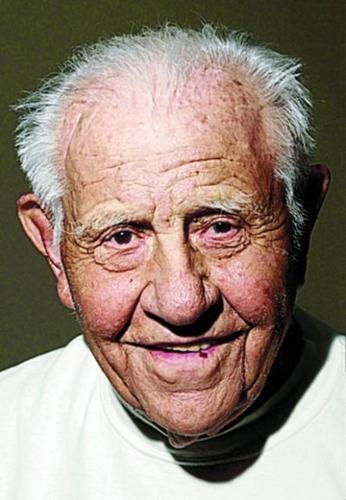
Richard "Dick" Giebner believed the best soccer officials are those nobody remembers when the game is over.
Good referees can manage a game without pulling warning cards or ejecting players from the game, and without calling undue attention to themselves, he told the many officials he mentored through the years.
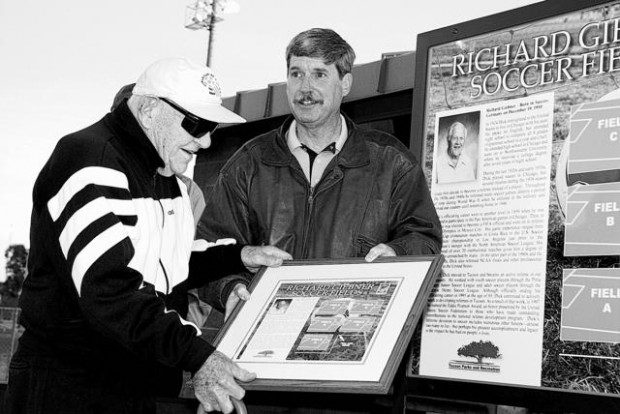
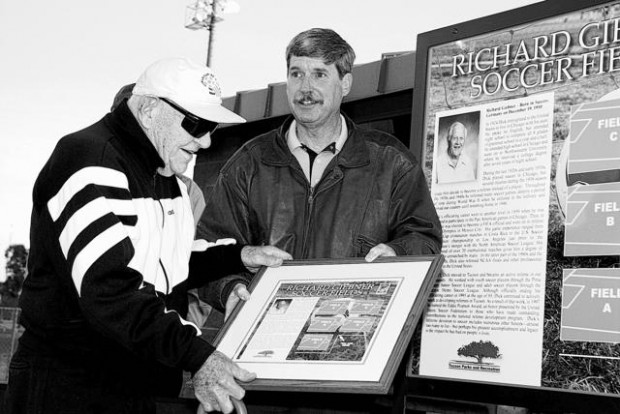
Despite his belief that the soccer fans' focus should be on the players, not the officials, Giebner himself was one of the best known soccer officials in Southern Arizona and the state. Earlier this year, the soccer fields at Golf Links Park were named for him. Friends and fellow officials say his death, Oct. 5 at age 96, leaves a hole in the heart of Tucson's soccer community.
"He was really Mr. Soccer in Arizona," said Dan Christy, state referee administrator for the United States Soccer Federation, the nation's parent body for referee licensing.
People are also reading…
Giebner's reputation in soccer circles wasn't limited to Tucson, though. At one point, he was among the top 10 referees in the country, running the pitch at world-class matches, Christy said.
Giebner was born in 1910 in Saxony, Germany. An orphan at age 14, he immigrated to the United States to live with his aunt and uncle in Chicago.
"He came over and he landed at Ellis Island, but he had to spend almost a week there because he wouldn't give up his (identification) papers," Giebner's daughter, Mitzi Brown, said. "He was told never to give up his papers. They were sewn into his coat. When they (immigrants) came to America, they just weren't trusting in the 1920s. This was new to them."
Eventually, his uncle went for him and took Giebner to Chicago.
Giebner played soccer during his boyhood in Germany — "they played in their bare feet if they didn't have any shoes," his daughter said.
As a young man, he joined a Chicago sports club and played in local matches. It was at the club that Giebner met a handball player named Hedi who would become his wife in 1934.
A year later, their daughter was born, followed by three sons. Giebner was still playing club soccer in 1936, when he took a kick to the mouth that required stitches. His wife insisted he quit playing. That's when he turned to officiating games on Sundays while he worked as a loan officer during the week.
After serving in the Army during World War II, Giebner returned to the pitch. By 1959 Giebner's skill as an official allowed him to work top matches, including the Pan American Games in Chicago. In 1963, he was elected as an official for the Fédération Internationale de Football Association (FIFA), the highest level a referee can attain, Christy said.
"There are about 130,000 referees in the United States and of that maybe 10 referees at any one time have that FIFA ranking," he said. "Those are the referees who would go to the World Cup matches and be doing the big international matches."
Giebner's career included officiating at the Olympics in Mexico City, the World Cup elimination games in Costa Rica and other professional matches and NCAA finals. In all, he officiated at more than 20 international matches.
In a 2004 Arizona Daily Star article, he said one highlight of his career came in 1967 at the U.S. Soccer Association championship in L.A., where he officiated a playoff game between the Los Angeles Wolves and the Washington Whips in front of nearly 18,000 soccer fans. The Wolves won 6-5 in sudden death.
A year later, Giebner had another career high when he officiated at a game in Kansas City, Mo., in which Brazilian soccer great Pelé played.
During this time, Giebner was still working as a bank officer in Chicago. After he retired from the bank in 1977, he and his wife moved to Tucson, where he became active in the local soccer community.
He officiated matches through the Pima County Junior Soccer League and the adult Tucson Metro Soccer League until 1995 when, at 85, he felt he could no longer keep pace with the players.
But that didn't end Gieb-ner's involvement in the sport. For years, he also had been a FIFA assessor, evaluating the performance of referees during matches. Eventually, he attained the status of inspector, the highest level an assessor can achieve, and he was the designated FIFA inspector at the 1994 World Cup.
Giebner received many accolades, including the 1997 Eddie Pearson Award, the highest honor given by the U. S. Soccer Federation. But it was working with the next generation of referees that gave Giebner the most satisfaction.
A dozen years ago, Cornelius Mercea was working as an official on the local level when he confided to Giebner his desire to become a national referee with the U.S. Soccer Federation. Giebner agreed to advise him, and the assessor's first lesson at one of Mercea's games proved the most memorable.
In an effort to teach Mercea "game management," Giebner took away the referee's yellow cards, which serve as warning to players who violate rules, and his red cards, which signal a player is ejected.
At game's end, Mercea realized, "game management is more about managing players than the cards themselves."
Lou Spivack, the U.S. Soccer Federation official for Arizona, learned the same lesson from his friend and mentor.
"He never liked to hear that you had to give a lot of cards," he said. "For Dick, if you started with 22 players, he wanted you to end with 22 players. He wanted you to manage the game with your brain. He wanted us to be out there thinking on the field and not just throwing cards."
Giebner mentored Rahm Rodriguez, now 24, when he began officiating youth games at age 13. In recent years, Gieb-ner's eyesight was failing, but it didn't impair his advice.
"He always seemed to pick up on stuff," Rodriguez said. "He'd be able to identify a problem even if he couldn't see. He could feel the game and know how the game was going just by the way he heard you call the game."
Sarah Pierce, 21, also began officiating as a teen and had Giebner as an adviser.
"He would never be harsh," she said. "There are some assessors who would be critical, but he would always be positive. He would say, 'How do you think you can improve?' He lifted your spirits up even if you had a bad game.
"Papa Giebner was always there. He was like a grandfather to the sport."
Find a photo gallery of this Life Story at azstarnet.com/slideshows
Life Stories
This feature chronicles the lives of recently deceased Tucsonans. Some were well-known across the community. Others had an impact on a smaller sphere of friends, family and acquaintances. Many of these people led interesting — and sometimes extraordinary — lives with little or no fanfare. Now you'll hear their stories. Past "Life Stories" are online at go. azstarnet.com/lifestories


 Tucson's newest Shake Shack gets neighbors