

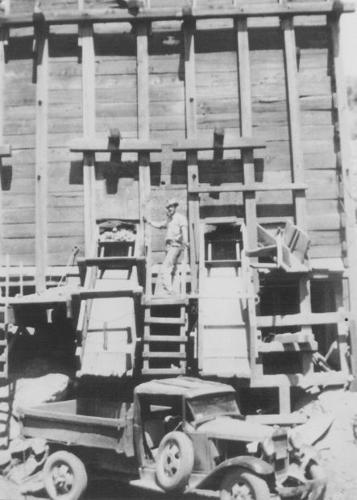
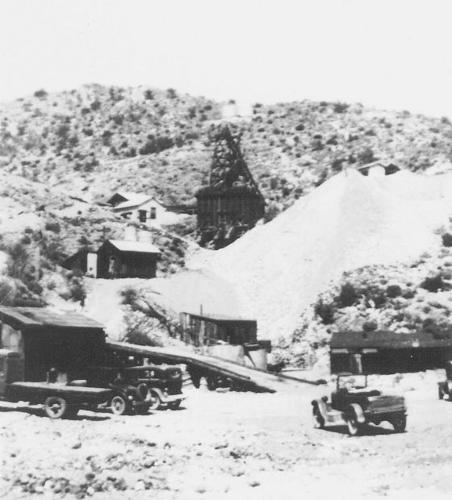
The Seventy-Nine Mine, located 7ƒ miles north of Hayden in southern Gila County, was discovered in 1879 by Mike and Pat O’Brien.
Christened after the year of its discovery and part of the Banner Mining District in the Dripping Spring Mountains, the mine is 2 miles northwest of the 4,483-foot Tornado Peak, named for a devastating tornado in the area and a nearby gold strike made in 1927 by the Tornado Mining Co.
The first major mining operations at Seventy-Nine occurred in 1919 with the Continental Commission Co., which worked the Discovery ore body at 50 tons of lead carbonate ore per day.
Ore was transported by burro to the railway at Hayden Junction. A road was built in the 1920s to expedite the transport of ore by truck and then rail to the Douglas smelter.
Depressed mineral prices and litigation factored into the mine’s intermittent operation over the years.
People are also reading…
The Seventy-Nine Lead-Copper Co. assumed control of the property in 1928. A 60-ton concentrator built onsite treated 10,483 tons of zinc-lead ore from the Discovery and Massive Pyrite ore bodies.
By 1940 the Shattuck-
Denn Mining Co. took over the mine with a production rate of 500 tons of lead zinc sulfide ore a month. Shipments of sulfide ore, including lead, zinc, copper and silver, were sent to a flotation mill in Bisbee. The lead concentrate was sent to the El Paso smelter and the zinc concentrate to the Amarillo smelter in Texas.
Between 1919 and 1947, the mine produced $4 million in metals, ranking first in lead production and 13th in silver production in 1929 and carrying several ounces of silver per ton.
By the 1950s, the property was leased by the Callahan Zinc-Lead Co Inc., reaching a depth of seven levels and including over 9,000 feet of workings while having produced 1.5 million tons of ore that included 2.4 percent copper. Water encountered beneath the seventh level, 500 feet below the surface, plus the lack of a pump, hindered deeper exploration.
Limestone, shale and quartzite make up the deposit. Hypogene mineralization was formed from ascending aqueous solutions including hydrothermal waters deep in the earth whose mineralization occurred over the past 50 million years. Examples of such minerals include pyrite, chalcopyrite, galena and sphalerite.
Supergene mineralization, formed by descending ground waters as mineral or ore deposits, include anglesite, azurite, brochantite, malachite and wulfenite.
Although the property today is closed to mineral collectors, many highly collectible mineral specimens owe their provenance to the Seventy-Nine Mine, including the world’s finest specimens of aurichalcite.
Latin for “yellow copper ore,” a secondary mineral found at the mine, is prized among collectors for its sprays of sky-blue and green-blue acicular (needle-like) crystals.
The mineral itself does not occur in sufficient quantities nor allow for easy extraction of the metals it contains to be profitably mined on its own. Additional rare secondary minerals affiliated with the Seventy-Nine Mine include descloizite, ktenasite, murdochite and plattnerite.
Descloizite, a lead zinc vanadate hydroxide, occurs at the mine as tiny wedge-shaped crystals on hemimorphite.
Ktenasite, a copper zinc sulfate hydrate, occurs as blue crusts in the 31 stope area. Murdochite, a lead copper oxide, occurs with tiny black cubic crystals. The lead oxide plattnerite occurs as tiny acicular tetragonal crystals, which are noted for their bright metallic luster.
The mine also is known for cuprian (green) smithsonite, wulfenite and hemimorphite.
William Ascarza is an archivist, historian and author of six books including “Southeastern Arizona Mining Towns,” “Arizona-Sonora Desert Museum” and “Tucson Mountains,” available at Antigone Books, Cat Mountain Emporium, the Arizona-Sonora Desert Museum and the Arizona Geologic Survey’s Arizona Experience Store. Email him at mining@tucson.com
Sources: J.W. Anthony, S.A. Williams, R.A. Bideaux and R.W. Grant. (1995) Mineralogy of Arizona. University of Arizona Press, Tucson; Arizona Zinc and Lead Deposits Part II. Arizona Bureau of Mines, Geological Series No.18, Bulletin 158, Tucson, University of Arizona, 1951; Will C. Barnes. (1988) Arizona Place Names: Tucson. University of Arizona Press; George A. Kiersch. 1949. Structural Control and Mineralization at the Seventy-Nine Mine, Gila County, Arizona, Society of Economic Geologists, Inc. Economic Geology, v 44; Clyde P. Ross. 1925. Geology and Ore Deposits of the Saddle Mountain and Banner Mining Districts, Arizona. U.S. Geological Survey Bulletin 771. Washington, Government Printing Office.


