
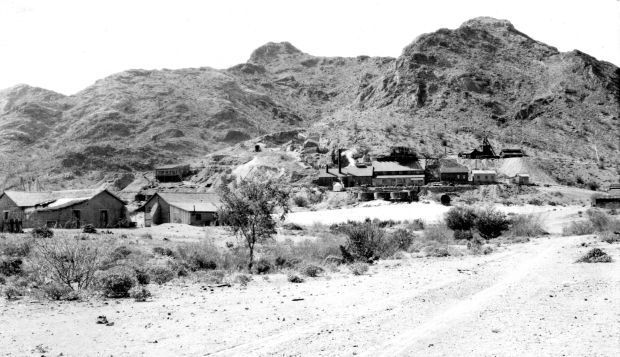
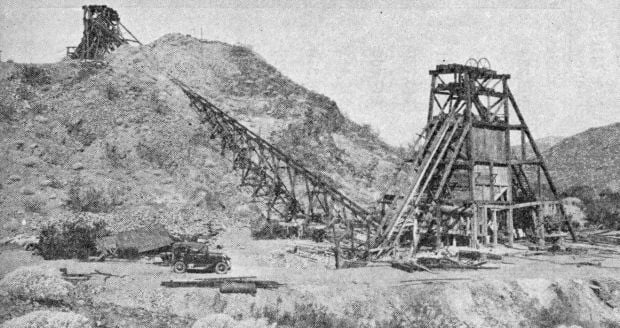
At 5,691 feet, Harquahala Peak in the Harquahala Mountains is the highest point in Southwest Arizona. Mohave for “running water,” Harquahala was named by the Mohave Indians for a plentiful spring in the area.
Prospecting in the Harquahala Mountains began with the Spanish in 1762. However, hostile Indians halted their endeavors to find riches. The discovery of the Harquahala gold deposit 125 years later, when gold ore ran $500 to the ton, renewed interest in the area.
Major mines in the district included the Bonanza and the Golden Eagle mines. The Harqua Hala Gold Mining Co. acquired the property in 1893.
Other notable mines in the Harqua Hala or Ellsworth district included the Alaskan, Critic, Hercules, San Marcos and Socorro. A stageline to the nearby town of Sentinel was established along with multiple stores, saloons and a newspaper aptly named the “Harqua Hala Miner” operated by Capt. John McCasey.
People are also reading…
A 20-stamp amalgamation mill was built at the site. Concern about theft of 20-ounce gold ingot molds led to a practical solution: the mill began turning out bars too heavy to steal.
Although the 400-pound ingots proved an effective theft deterrent, they could at times prove challenging to transport to Phoenix.
Over time the mines played out, and by 1929 the Harquahala mines were abandoned after producing $2.5 million in gold. The mines had also produced copper, lead and silver.
Another significant gold deposit 90 miles southwest of Harquahala, 25 miles southeast of Yuma, was the La Fortuna (“fortune” in Spanish) gold mine. Charles W. Thomas, William H. Halbert, Peter Farrell and Laurence Albert in 1894 discovered the La Fortuna gold-quartz vein deposit, located near the Camino del Diablo, a 150-mile stretch of dry, barren desert notorious for claiming the lives of gold rush parties.
The Fortuna mine, at 775 feet above sea level at the western base of the Gila Mountains, is composed of schist and gneiss and intruded by granite, amphibolites and pegmatite. It was sold in 1896 to Charles D. Lane, a major stockholder in the Bonanza Mine near Harquahala. Shortly after that, the La Fortuna Gold Mining and Milling Co. was formed, employing former miners who worked at Harquahala.
Territorial Geologist William P. Blake reported that the Fortuna deposit yielded “free gold” — gold in its natural state not mixed with other metals such as copper. Blake also noted the quality of water at the nearby town of La Fortuna as saline to the taste and “capable of eating holes in wrought and cast iron.”
The operation comprised two inclined shafts, including one at 1,000 feet depth and several hundred feet of drifts and stopes. A 100-horsepower pump at the Gila River provided water through a pipeline to the mine. A 20-stamp mill with stamps weighing 13,500 pounds each operated at the site from 1897 until 1904.
Employed to collect the gold were long silver plates and a 150-foot, long-tailed sluice box, while mercury amalgam was used to chemically recover the gold. enabling 80 percent gold recovery.
Accumulated tailings running $5 per ton were later treated by a 100-ton cyanide plant providing 16 percent gold recovery. Heightened security for transport necessitated the production weight of 150-to 200-pound gold bars. The Elan Mining Co. briefly operated the mine in 1924 until the loss of the ore vein forced the mine’s closure.
A total of 124,239 ounces of gold was produced at the mine from 1896 through 1926. Further development of the mine occurred in 1939 by William B. Maitland involving reworking the tailings and underground work.
Guido E. Cagliere Jr. and ZA Inc. acquired seven of the eight patented Fortuna claims, encompassing 234 acres, in 1966. Today the mine is located within the Barry M. Goldwater Gunnery Range owned by the Bureau of Land Management and administered by the U.S. Marine Corps.
William Ascarza is an archivist, historian and author of six books. Email him at mining@tucson.com
For a list of the sources used in this story, see the online version at tucson.com