

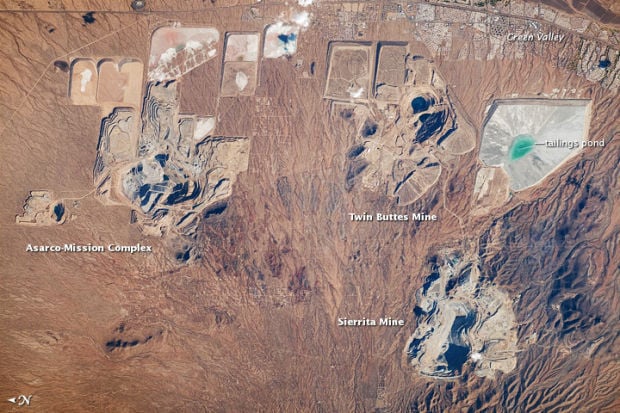
Mining activity along the eastern flank of the Sierrita Mountains, 20 miles southwest of Tucson, involved silver prospecting by early Spanish explorers, followed by scattered underground mining operations producing lead-silver and copper since the 1870s.
Heightened interest among mining companies — including the Banner Mining Co., later incorporated into Cyprus-Pima, Pima Mining Co., Anaconda Copper Mining Co. and Asarco — ensued by the mid-20th century with the discovery of disseminated copper ore bodies buried under alluvium sediments in the Santa Cruz Valley.
Mining engineers Walter E. Heinrichs Jr. and Robert E. Thurmond are credited with having initiated the geophysical exploration field program, backed by Herbert Hoover Jr., that ultimately led to discoveries that later became known as the Mission ore deposit, east of Banner Mining Co.’s copper production at Mineral Hill in 1951, and the Twin Buttes pit, east of the original Twin Buttes Mine. These were the first major ore bodies in Arizona discovered by purely geophysical methods.
People are also reading…
Geophysical exploration involved magnetic surveys conducted by the United Geophysical Co., which mapped a magnetite rich skarn zone from Mineral Hill to the Daisy Mine. Active development of the site began with the Pima Mining Co. in 1952, with the sinking of the 600-foot Alpha shaft and the discovery of oxidized ore at 209 feet and primary sulphides at 255 feet.
Over the next three years, 67,000 tons averaging 6 percent copper ore were shipped to the Asarco smelter in El Paso.
Discovered in 1954 by American Smelting and Refining Co. (Asarco), the Mission deposit, located northeast of the Pima Mine, involved extensive diamond drilling and exploratory work.
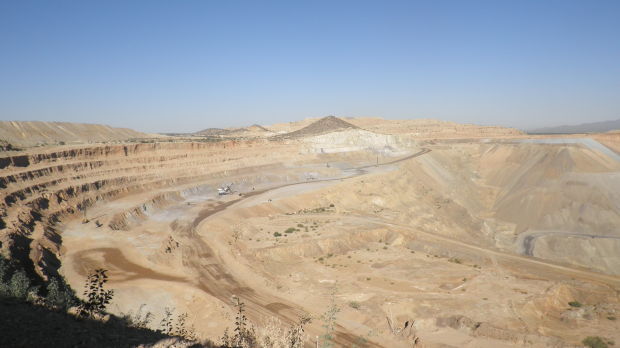
In 1958, Asarco began to develop the Mission Mine — formerly known as the East Pima Mine — investing in a 15,000-ton concentrating mill and the stripping of overburden for open pit operations necessary due to economics: low grade of ore running on average at 0.67 percent copper per ton and rising costs for underground mining.
Commercial production began in 1961 and contributed to Pima County’s top copper producer status in Arizona the following year. Because of the lack of smelting operations in its immediate vicinity, all the concentrates were shipped by rail to the smelter at Hayden.
The Mission Project included a primary crusher, ore storage area, secondary and tertiary crushers and a concentrating mill.
The Pima and Mission open pits operated separately until they were merged in 1985. Over the past several decades, concentrator expansion has continued, to include a 544-ton annual operational capacity molybdenum plant.
Today the Asarco Mission Mine, with a reserve life estimated at 2033, is 2 miles long, 1ƒ mile wide and 1,200 feet deep.
It comprises the Pima, Mission, Mineral Hill, South San Xavier, Palo Verde and Eisenhower properties on 20,000 acres.
With an annual production of 475,000 tons of concentrated copper, the ratio between waste rock and ore at the Mission Mine is 3 to 1.
Concentrates from the Mission Mine are sent by rail to the Asarco Hayden smelter. Tours that cover the mine’s daily operations are open to the public through the Asarco Mineral Discovery Center at the Mission Complex in Sahuarita.
Located southwest of the Pima Mission Mine, the Sierrita Open Pit Mine — currently operated by Freeport McMoRan Copper and Gold — produces copper and molybdenum, which also includes associated minerals of gold, silver, lead and zinc.
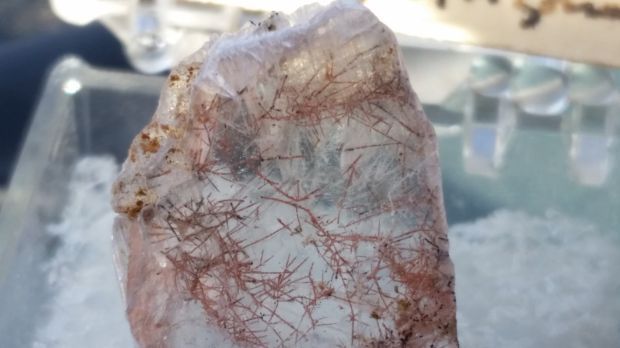
Developed by the Duval Sierrita Corp. in 1967, the Esperanza ore body includes molybdenum that contains the rare metal rhenium used in the manufacturing of high-temperature alloys for jet engine parts and in high-octane, lead-free gasoline.
The Sierrita Mine and Rio Tinto’s Bingham Canyon Mine in Utah are currently the only two sites in the United States that produce rhenium.
The molybdenum concentrate of 18 million pounds from this locality contributed to Arizona ranking second in its production in 2010. Copper cathode is currently plated at the Twin Buttes electrowinning plant.
Sources
- Briggs, David F. Discovery of Pima-Mission Copper Mine, Pima County, Arizona published by Mining and You in Tucson Citizen on Oct. 19, 2013
- Cooper, J.R., 1960. Some geologic features of the Pima mining district. Pima County, Arizona, USGS Bulletin 1112-C
- Kalt Jr., William D. 1968. “Awake the Copper Ghosts! The History of the Banner Mining Company and the Treasure of Twin Buttes.” Banner Mining Co. U.S.A.
- Mineral and Water Resources of Arizona. Arizona Bureau of Mines Bulletin 180, Tucson, University of Arizona, 1969.
William Ascarza is an archivist, historian and author. His latest book, “The Chiricahua Mountains: History and Nature,” is available at Barnes and Noble online. Email him at mining@tucson.com


