


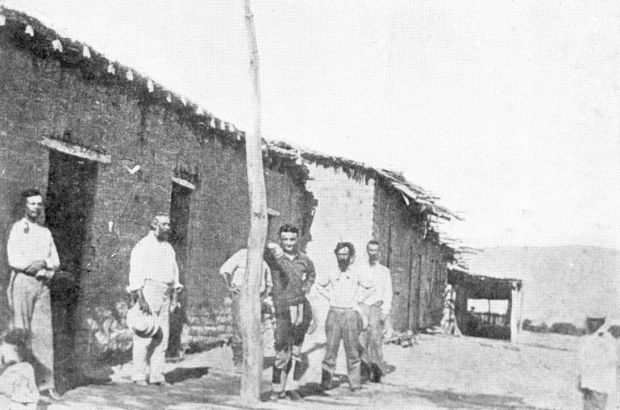
The growth of mining in Arizona led to the establishment of wagon roads and stage stations to open the territory to commerce.
Stage or freight companies maintained local routes, providing passenger and mail service. Overland stagecoach stops functioned as way stations for travelers to eat, buy food and rest. They also served as way stations for the mines.
Some stage stops evolved into mining towns. Those included Octave (Antelope Station), Stanton, Bumble Bee, Cordes and Mayer in Central Arizona.
Created by James Birch in 1857, the first single-contract overland mail route to California — commonly known as the “Jackass Mail” because its passengers rode muleback between Yuma and San Diego — covered 1,476 miles between San Antonio, Texas, and San Diego.
At a cost of $350 between destinations, passengers were limited to 30 pounds of baggage excluding blankets and firearms. Beans, fried salt pork and coffee were the standard staples.
People are also reading…
The line consisted of 87 stations and many campsites, including one in Tucson where Ohioan Phocion R. Way, a passenger, arrived to work for the Santa Rita Mining Co. in 1858.
Supplanting the Jackass Mail and named for John Butterfield, one of the founders of the American Express Co., the Butterfield Overland Mail was made up of drivers, horses, mules and stages and was financed through a partnership with Wells, Fargo & Co. and a $600,000 government subsidy.
The Butterfield Overland Mail Route ran 2,800 miles from St. Louis, Missouri, to San Francisco through El Paso, Tucson and Los Angeles. Renowned metallurgist and geologist Raphael Pumpelly traveled west on the Butterfield Overland stagecoach to Tucson in 1860 before he was employed as an engineer for the Santa Rita Mining and Milling Co.
Stage stations were an average of 25 miles apart and included 27 notable stagecoach stops along the way in 437 miles of Arizona. Point of Mountain and Bluewater served as supply depots for Anglo-American travelers between Tucson and the Gila River. Maricopa Wells, located at the Pima Indian Villages 35 miles south of Phoenix, was known as a good water source among travelers journeying north to Phoenix and Prescott.
Many of these stations contributed to Arizona history. A stage stop in the Dragoon Mountains was well-known, as three of its architects — James Hughes, James Laing and William Cunningham — were murdered by Mexican laborers in August 1858.
Another incident at a noted location involved an Apache ambush of a contingent of Capt. Sherod Hunter’s Confederate soldiers en route from Tucson to Texas on May 5, 1862.
Apache Pass near Fort Bowie served as a gateway for travelers into Southern Arizona and also hosted a stage stop that proved a focal point in the Apache Wars between Apache Chief Cochise and the U.S. military.
Established in 1864, the Overland Road connected Antelope Springs — later known as Flagstaff — to Prescott and covered 85 miles.
Used for commercial and military purposes until the Atlantic & Pacific Railroad 20 supplanted it years later, this route over the Mogollon Rim in an area known among the Spaniards in 1570 as Tierra Incognita (unknown land) connected Northern Arizona to the gold fields in the Central Highlands region.
Challenges in stage lines included hostile Apache raids, robberies committed by highwaymen, and cost. Because of the perils of the operation, stagecoach drivers earned an average of $65 a month in 1860. Passengers were expected to repel Apache incursions.
By the mid-1870s, Pedro Aguirre’s Arizona & Sonora Stage Line serviced the silver mines in Arivaca down to the Oro Blanco mining camp near the Mexican border. Other stagecoaches ran from Tucson through Starr Pass in the Tucson Mountains out to the silver mines in Quijotoa and the Silverbell mines.
By 1880, many of the stagecoach companies faced declining revenue due to the arrival of the railroad, which could move greater supplies, mail and passengers at lower rates. The demise of the stageline was also brought about by the proliferation of rail branch lines servicing the mining communities.
William Ascarza is an archivist, historian and author. His latest book, “The Chiricahua Mountains: History and Nature,” is available at Barnes and Noble online. Email him at mining@tucson.com For a list of the sources used in this story, see the online version at tucson.com


