

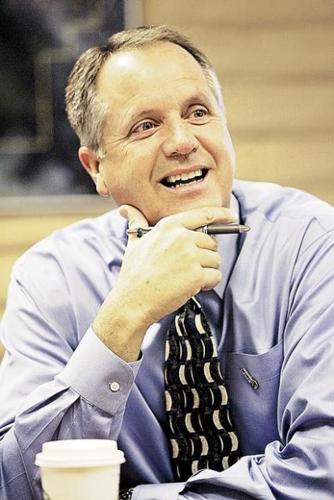
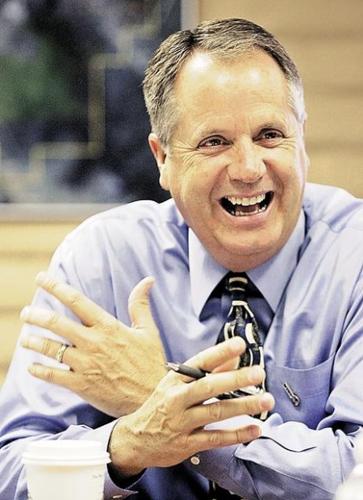
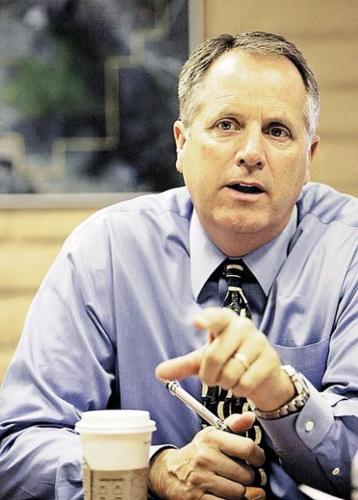
New Superintendent Doug Wilson wants the Marana Unified School District to operate in the open.
He wants parents to know how their children are being educated.
He wants taxpayers to know how the district is spending their money.
Wilson, who started July 1, sat down with the Star last week to discuss his first three months at the helm.
"I'm having the time of my life," he said. "I have great staff, people who are very committed and dedicated to the well-being of students. I have a board that individually are different, but they all have their hearts in the right place."
Wilson has found community members to be supportive even when they don't always agree with the district's decisions.
"People have been very genuine in their concerns and questions," he said.
People are also reading…
Personalizing education, ushering in new and useful technology, and adding more creativity and innovation to classrooms are priorities for Wilson.
Student achievement also is a top priority for Wilson.
He wants individual schools to be accountable for school achievement plans, as it is teachers and staff who know the needs of their particular school.
Wilson had worked as the assistant superintendent of human resources for the Pueblo City Schools district in Pueblo, Colo., before joining Marana.
He also worked as a superintendent and principal in the Agua Fria Union High School District in Avondale, which is southwest of Phoenix, from 2002 to 2006.
Q&A
with Doug Wilson
Question: What most surprised you about the Marana school district?
Answer: This district has done some outstanding things and just continues to do wonderful things, but one of the things they have been a little bit behind in the curve, in comparison to other outstanding districts, is technology.
They've done a lot without having the aid of technology. That has been one of the things on the radar screen for everybody — moving in that direction.
The surprise was how far the down the road the district is without that. The encouraging piece is how much further down the road we will be when we get that piece in place.
Q: The state Legislature has put a freeze on building renewal funds and money to build new schools. How does this affect the district and what is the district doing to maintain adequate facilities?
A: Right now, and probably in the next year or two, we don't have a need to build. We are actually seeing a slight decline in our enrollment. It's been fairly flat the last few years. So that's not on our immediate radar screen.
The renewal funds, when those aren't there that is a concern. If you don't pay attention to those buildings, eventually you are going to have a bigger bill to take care of.
Bob Thomas (the district's director of facilities management) and Dan Contorno (the district's chief financial officer) are outstanding in what they do — evaluating where the needs are and making sure if we have to adjust capital funds to take care of that.
I don't think at this point in time we have any need to go out to our taxpayers and ask for a bond.
Q: What do you believe is the biggest challenge facing public education?
A: The standards movement is one, I think, that has been a good thing for public schools across the country to identify interventions, become target-oriented and to look at the data and utilize it.
The problem with standards is the perception that we tend to become so focused on teaching to the standards. We are concerned that we are raising a generation of students that will not have the ability to discover — that creativity piece.
It has separated the United States from the world. We are lagging behind in science and math. We have become so stoic in that.
Q: Is there a solution?
A: What we do is we continue to personalize (education). I see that in classrooms.
In totally focusing on standards, we tend to be about an inch deep and a mile wide.
There's very little teaching for understanding and very little understanding if you don't see the dialogue from kids.
We talked about some of those systems — the Japanese and the Singapore model.
If you look at the classrooms there, even in math classes there is a lot of dialogue.
They're not so concerned with having these standards taken care of by this time. They are actually having some dialogue and deeper understanding.
I think by just giving teachers permission sometimes and giving them the tools to allow them to teach to a deeper understanding and not be so surface-oriented that they have to have 24 of these standards taught by Oct. 10.
Q: What was your toughest subject in school?
A: I never liked English. I don't know why. I love to read.
My favorite teacher in school was my English teacher, but I hated it. My English teacher was very patient with me.
I didn't work real hard in school. It was something that was not real difficult. Math was an easy subject.


