

Since moving to SaddleBrooke five years ago, Kathee Johnson has made it a point to play golf at least three times a week.
That all changed earlier this month when pain from a decades-old shoulder injury got the best of her, sending the retired high school teacher off the course.
"I'm going into withdrawal," said Johnson, 55, who had surgery for a dislocated shoulder 32 years ago. "I have to get this fixed, or else I'll have no social life."
Good thing for Johnson that Dr. Abraham Rasul Jr. had just recently gotten his dream practice off the ground.
Rasul, the medical director for rehabilitation at Northwest Medical Center Oro Valley, just opened the Arizona Golf Medicine Institute in Rancho Vistoso, 12460 N. Rancho Vistoso Blvd.
"I've been thinking about this for 10 years," said Rasul, an avid golfer since his days as a resident at a hospital in the Washington, D.C., area. "My interest was always in human locomotion, but first I went into orthopedics and sports medicine."
People are also reading…
In treating patients for a variety of injuries, both sports-related and not, while at Northwest Medical Center or his Metro Rehab — located in the same office building as the Arizona Golf Medicine Institute — Rasul said he began to notice that many injuries were a result of one or more muscles in a person's body working either too hard or not hard enough.
"I'm treating golfers with injuries, and I'm trying to see if I can prevent the injury by seeing how their muscles contract," he said. "Each and every golfer has a sequence of events that triggers every movement. It's mainly analyzing the sequence."
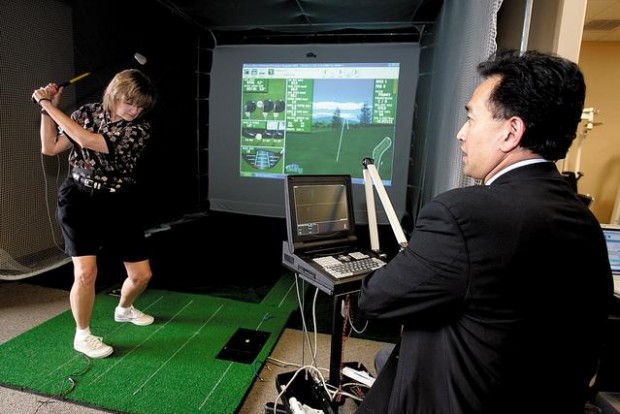
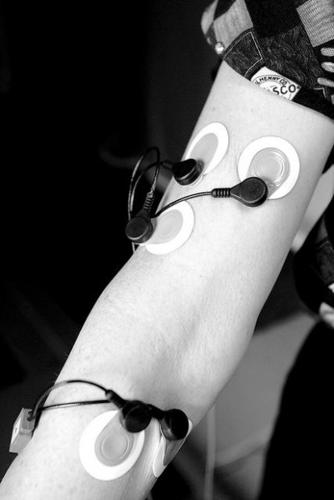
After first dealing with the pain, usually through laser treatment, Rasul then hooks up his patients to a series of machines that can record the sequence of muscle movement that occurs during a particular motion, such as a golf swing.
In Johnson's case, her swing causes excess stress on her left shoulder, making it necessary for her to tweak that stroke.
"I can't follow through all the way anymore," Johnson said.
Once the injury has healed, Rasul said the next step is to either strengthen the muscles that are acting improperly, or teach them to act differently. He said it is possible to train slow-twitch muscle fibers, also known as Type I muscle fibers, into almost becoming fast-twitch (Type II) fibers.
Type I fibers are typically used for endurance activities, such as cycling, swimming and long-distance running, while Type II fibers are meant to provide a shorter and faster burst of power.
The "coaching" of muscles to operate differently is done through weight training, Rasul said. His office has six circuit-style machines.
Then, to test what the weight training has accomplished, Rasul's patients also spend time on a golf simulator. They hit an actual ball off a tee with a real club, and the simulator charts on a screen where the shot was likely to go.
Rasul says the overall process takes about six weeks, depending on how long the injury needs to heal and how much strength a golfer is trying to add to his or her game.
"The long-term goal is, you could come in here and want a fade or a draw (on their golf swing), or people could want to get more distance or power," Rasul said. "We'll take a look at you and see which muscles are too active or which muscle is too slow."


