

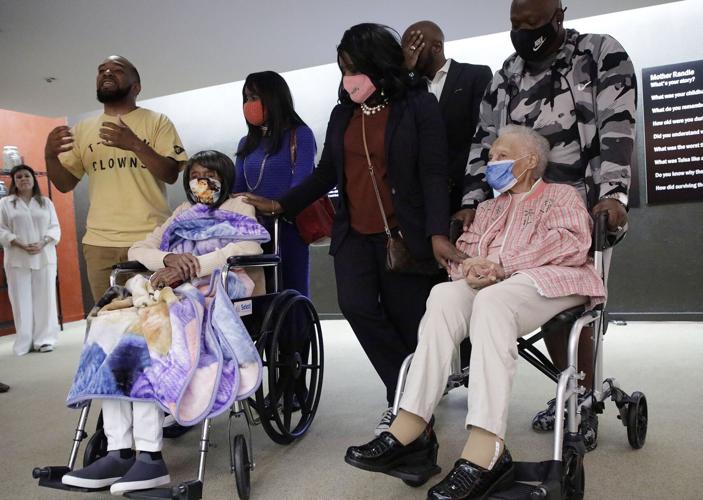
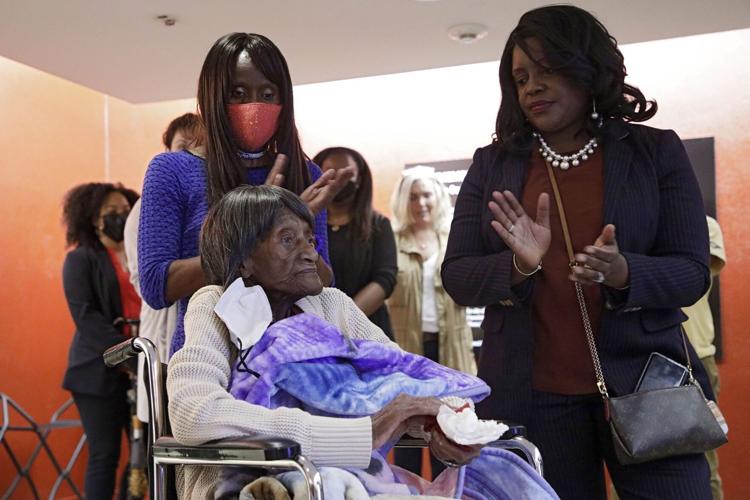
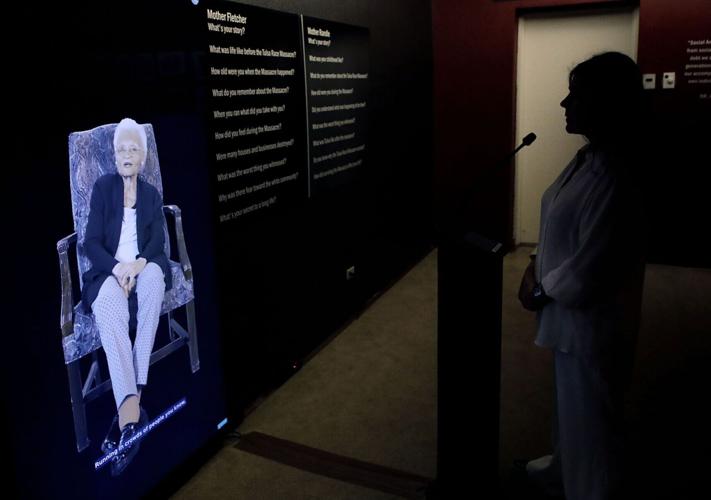
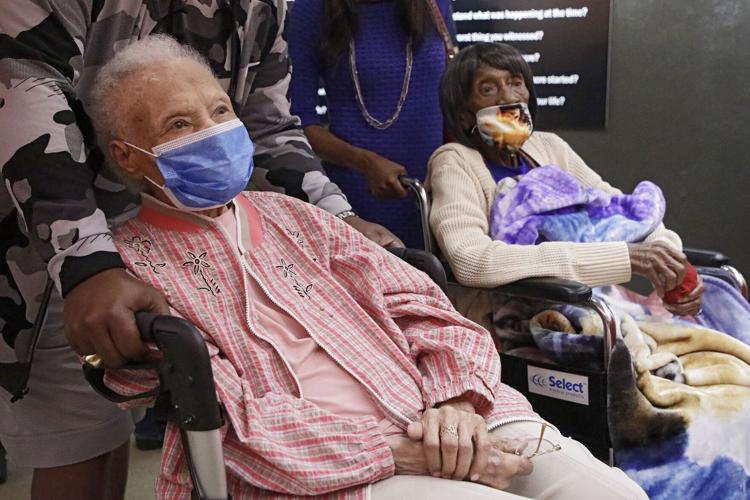
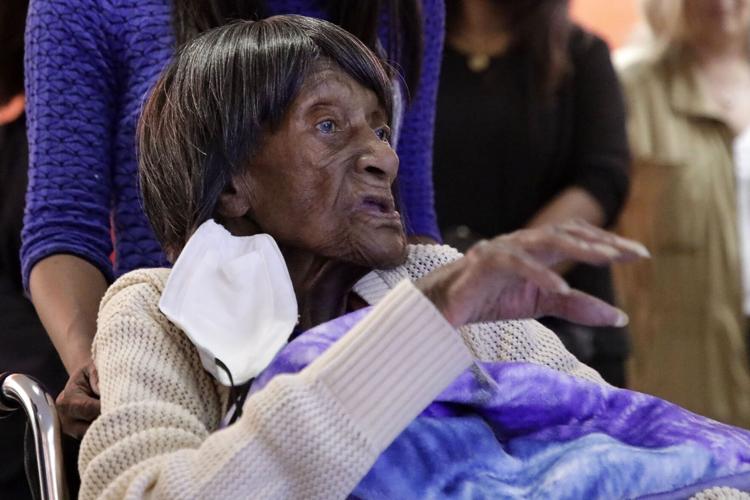
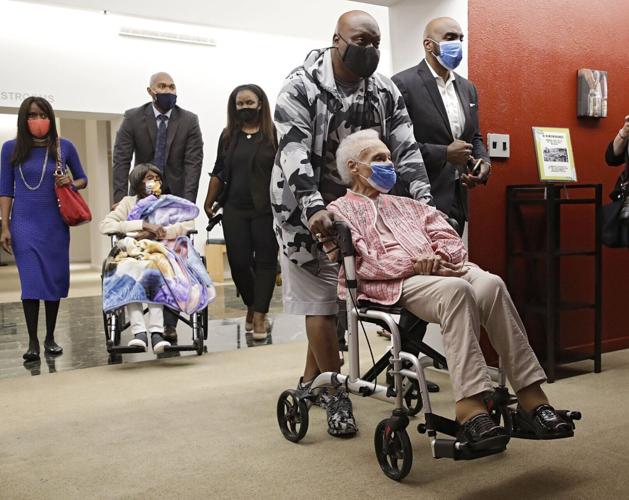
Asked what she thought of a new exhibit in her honor, Lessie Benningfield “Mother” Randle got laughs from those assembled at the Gilcrease Museum on Thursday when she started her response by complimenting the image of Viola “Mother” Fletcher on the screen in front of her.
But then, turning serious, she confirmed the accuracy of Fletcher’s statements within the exhibit about what took place during the 1921 Tulsa Race Massacre.
“I was a small child, but I can remember all these things that she’s talking about there,” Randle, 106, said of Fletcher, 107. “I don’t know just why they said that this had to happen, but it did, and people were slayed and mistreated.
“So much went on that shouldn’t have gone on, and I just wonder if there is forgiveness for those people. ‘Cause they need it.”
Fletcher and Randle were the guests of honor Thursday afternoon at Gilcrease Museum, which in partnership with the Terence Crutcher Foundation, the Black Wall Street Legacy Festival, or Legacy Fest, and StoryFile opened an interactive installation that features both women.
People are also reading…
StoryFile CEO Heather Smith said the women were gracious enough to preserve their stories for future generations by sitting down for “hours and hours” of questioning about the entirety of their lives, after which the company used its artificial intelligence technology to compile life-size interactive conversational videos of them.
Visitors to the “Legacy of Survival” installation can press a button to ask Fletcher and Randle questions, which organizers said will make guests feel like they are speaking directly to survivors of a historic event.
Fletcher’s grandson, who helped StoryFile during the interview process, tested out the installation by asking the virtual Fletcher her age, to which the real Fletcher — seated behind him — said “107 years old” to laughs from the audience.
Fletcher was 106 when she recorded the interview, which Smith said was done in a way that ensures anyone viewing will see Fletcher’s and Randle’s stories in the exact way they were told.
“Dr. (Tiffany) Crutcher came to me maybe four weeks ago and said, ‘I have this compelling story. I have this opportunity. It does not have a home. Would you listen to me?’” Susan Neal, executive director of Gilcrease Museum, said of plans for the exhibit. “We met on a Sunday afternoon for a little over an hour and a half, and this is the remembrance and the leadership that you are getting to see today.”
Of Fletcher and Randle, Neal said, “I don’t know that we have ever been graced with two more important people. If there was ever a place that this story should be honored and told as part of American history, it’s here.”
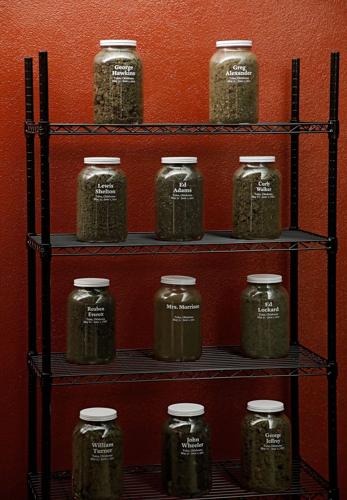
The exhibit, which runs from Friday through July 4, also features “In Remembrance: Lynching in America: The Tulsa Community Remembrance Project,” which includes displays of jars of soil collected from lynching sites in Tulsa, an effort of the Tulsa Community Remembrance Coalition and the Equal Justice Initiative.
“A lot of victims (of the massacre) were dumped into mass graves. They were dumped into the Arkansas River, no documentation, left to be forgotten, erased from the history books,” Crutcher said. “They were forced into silence. They were afraid to tell their stories, because they said if you said anything you would be next.”
Crutcher, the founder and executive director of the Terence Crutcher Foundation, commended Fletcher and Randle for their courage in going public with their experience as survivors of the Tulsa Race Massacre. Crutcher is also the lead organizer of Legacy Fest.
“The survivors dealt with internalized grief, and they held it in for so long. They were afraid to speak,” she said. “But I’m so honored to know that these two individuals, at 107 years old and 106 years old, they finally have the courage to tell the world as we encroach on the 100-year anniversary of the worst terror attack on U.S. soil, they finally have the courage to speak out and tell their stories with all of you all.”
Crutcher went on to say that “I want to make it very, very clear: If there is anyone attacking these survivors, these heroes, you’re not only gonna have a problem with them.
“You’re gonna have a problem with the Black community here in north Tulsa and with Black communities across the United States of America,” she said. “We will not allow anyone to attack their character and say that this didn’t happen to them. And so I’m standing here today making it very, very clear: We will honor these people.”
Gilcrease Museum is open from 11 a.m. to 4 p.m. on Wednesdays, Fridays, Saturdays and Sundays, as well as from noon to 8 p.m. on Thursdays. It is closed Mondays and Tuesdays.
Featured video:
Video from May 19, 2021 via C-SPAN. Viola Fletcher, who just turned 107, said in an address that she is "asking my country to acknowledge what happened in Tulsa in 1921."


