A lot of people are down on Tucson these days.
After I wrote a somewhat arcane argument three weeks ago on the windshield view of Tucson, many people responded, happy that someone finally pointed out how ugly things have become as we drive around town.
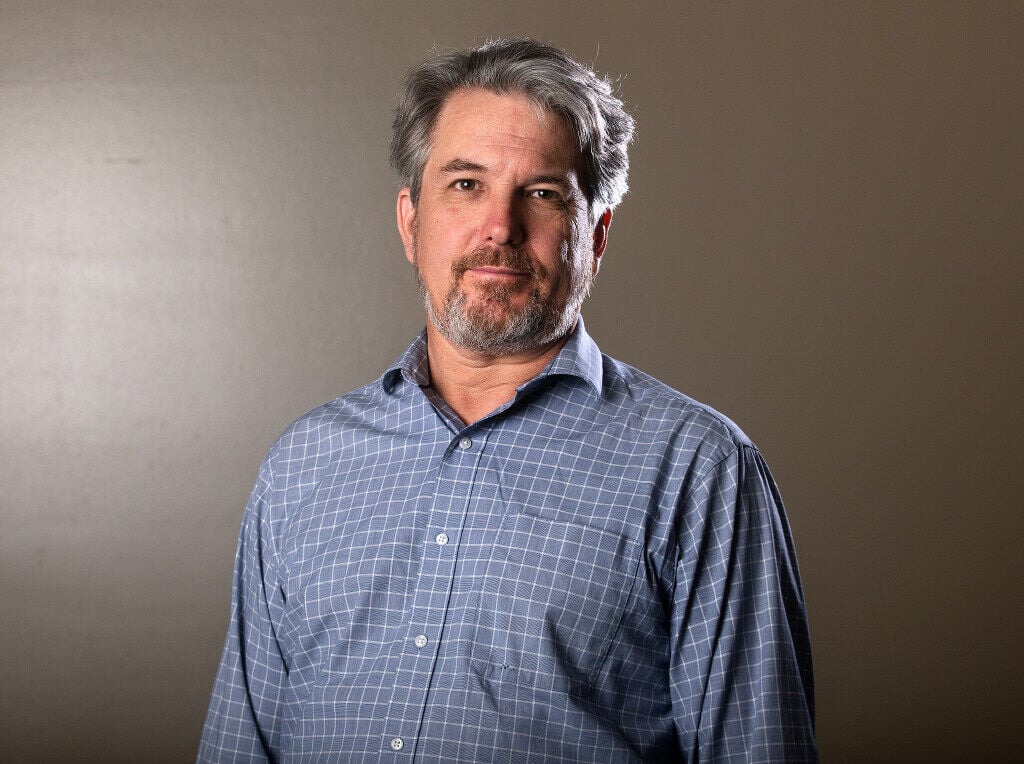
Arizona Daily Star columnist Tim Steller
Mostly, they were talking about street people, and they didn't pay much attention to my broader argument about car culture.
Then the Star published guest opinions on two consecutive days from people arguing, if you mash the two pieces together, that Tucson is getting worse, the government is doing little about it and we could tip into failure if we're not careful.
"A city lives because productive citizens believe it is worth staying," Tucson resident and business owner Taylor Davidson wrote. "It lives because families form, children play in safe parks, workers ride buses without fear, police remove bad actors from the streets, and taxpayers see their money returned in order, cleanliness, safety, and competence.
People are also reading…
"By that standard, Tucson is failing."
Ted Maxwell, president and CEO of the Southern Arizona Leadership Council, wrote, "Tucson doesn’t need perfection. It needs leadership willing to rise to this moment, see reality as it is, and respond to it directly."
What I find frustrating about many of these arguments, printed and not, is that people are speaking largely about vibes. They're talking about how they feel when they see homeless or addicted people along the streets they travel, or in the parks. Or they take it as a sign of how awful Tucson has become when they read a report of a shooting.

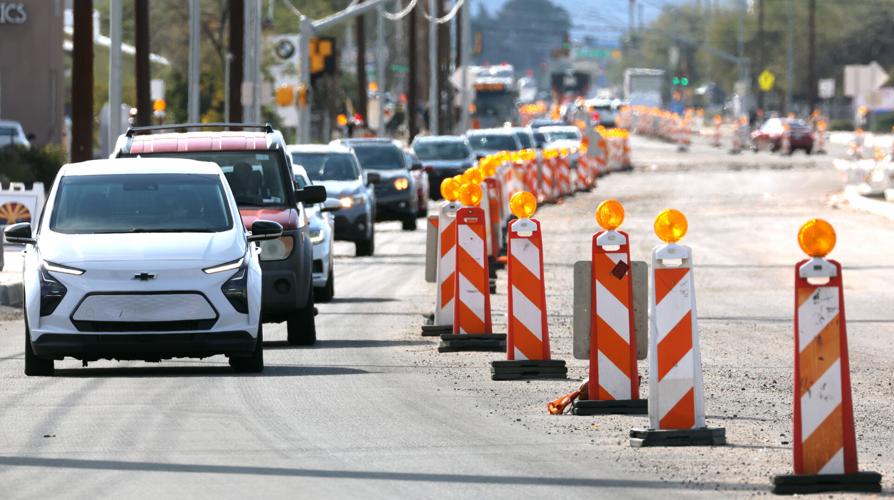
While being stuck in stop-and-go traffic along a chunk of East Grant Road during the past several months can be frustrating for drivers, the major project is a good sign that Tucson is addressing its roadways woes.
Few people go further and question whether their experiences are part of an upward or downward trend, not to mention learn what local government agencies are doing about it. If you follow the meetings of the Pima County Board of Supervisors or the Tucson City Council, you'll see they are constantly taking actions related to homelessness, addiction and public safety, among other problems.
Rather than relying on vibes, we should be asking which way the trends are going, what governments are doing, and whether it's working. So here's my effort to evaluate a little more deeply four areas of concern: the economy; road conditions; public safety; and homelessness and addiction.
Economy
This may be the factor with the clearest data, and it's not good. Overall employment in Tucson had risen unevenly but steadily since the pandemic recession in 2020, state data show. Then, in November 2025, employment peaked at 481,105 jobs, and by April this year had dropped to 471,696, a decrease of 9,409 jobs during the normally busy winter visitor season.
Even in 2025, the Tucson area's job growth was an anemic 0.1%, according to the University of Arizona's Economic and Business Research Center. The center regularly compares metro Tucson's performance to that of 11 other regional metro areas. Tucson's job growth rate last year was better than four of them, worse than six of them, and tied with one, Denver.
The Project Blue experience in 2025 casts a shadow over efforts to stimulate new business activity and employment in Tucson. City officials encouraged the data-center developer Beale Infrastructure and came up with a plan for it to build a large water project in exchange for city water service and annexation of the site on the southeast side.
But when public opposition built into a movement, city officials first put the Beale officials through a gauntlet of public criticism sessions, then rejected the deal. I opposed the project, but that treatment was embarrassing, and discouraging to others considering doing business in Tucson.
A year later, the city just established a new Office of Community and Economic Impact. This office will bring together the city's pre-existing Office of Economic Initiatives with its equity office, climate programs, cultural affairs office and its joint prosperity initiative with Pima County.
Presumably, an economic office like this would not have been so welcoming to a data center project, which is OK, considering how that plan ended up. It's good to first filter ideas that Tucson's broader public will oppose so we don't have another Project Blue debacle.
But too much filtration of economic opportunities leads to stagnation like we have now. And I can imagine that by looking at every opportunity through a skeptical equity or climate lens, we could end up bypassing ideas the job-hungry public would welcome.
City Manager Tim Thomure more or less confirmed that sort of value judgment when I talked with him Friday: "It is important to attract the big factory or the big whatever, but only if it's compatible with our values and our natural resources."

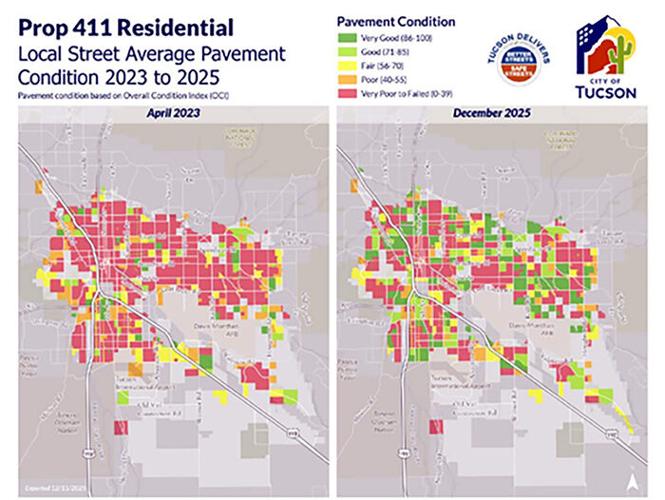
The increase in green dots between April 2023 to December 2025 shows an improvement in pavement conditions across the city.
Roads
This is where you find one of the most ironic of public perceptions. For years, people have rightfully complained about the deterioration of streets in the city of Tucson and unincorporated Pima County. Claims against the city for damage caused by potholes became a feature of life on our failed streets.
Now there is road construction everywhere. And what do people do? Complain about road work.
The inconvenience of construction is the crucible we have to pass through to get the significant improvement in our roads that we desperately need. And you can see it here and there throughout Tucson, as I do when I drive into the city's neighborhoods and unexpectedly find a newly paved area.
This is largely the result of Prop. 411, a half-cent-per-dollar sales tax that Tucson voters approved in 2022 to pay for road repairs focused on Tucson's neighborhoods. It continues until 2032.
The passage of the Regional Transportation Authority extension in March also has led to an acceleration in some longstanding projects, like the East Grant Road project that has been languishing for far too long.
Unincorporated Pima County also has had a road-improvement plan that has made a ton of progress on repairing the formerly failing pavement outside city limits.
It sucks running into the pervasive orange signs and cones, but they're a symbol of our area of most visible and clear local improvement.
Public safety
Tucson has long been a place with a steady drumbeat of upsetting violent crime along with a backbeat of regular property crime. Every time I hear of one of these awful crimes happening, it hits me, and I see people online saying the city is going to hell.
I'm not so sure things are getting worse in this area, though. I suspect that perception reflects wider awareness of serious incidents more than real changes in rates of crime. The pages following scanner traffic have made people more aware of the kinds of incidents police have seen happening for decades, and videos pop up on social media of every fight, car crash or argument in public places.
It's not a good look, but it happened before cameras were everywhere, too.
The data on violent crime is not 100% dependable. There is an unknown amount of unreported crime, and some reporting changes may have made it look better than it is, but still, violent-crime reports from the Tucson Police Department, as reported to the Arizona Department of Public Safety, dropped by 11.6% from 2021 to 2024, then plunged by 44% from 2024 to 2025.
I suspect that drop is exaggerated, but the spike in homicides that occurred after the pandemic has clearly dissipated. There were 93 homicides in Tucson in 2021 — a staggering amount — but that was down to 56 in 2025. This year, there have been 17 homicides so far in Tucson, as compared to 27 at this time last year.
Unfortunately, traffic deaths have continued to rise, hitting an unacceptable 96 in 2025. We're on pace to exceed that in 2026, with 46 traffic deaths in Tucson so far this year, as compared to 31 at this time last year.
This traffic-safety problem is what makes me consider public safety neither improving nor worsening in Tucson.
The good thing is, Tucson police and other officials have several initiatives intended to address traffic safety and gun violence. I have noticed increased traffic enforcement, and it's possible the anti-violence efforts are already bearing fruit.

Homelessness continues to be the issue facing Tucson that is most resistant to solution and subject to vibes-based judgments.
Homelessness and addiction
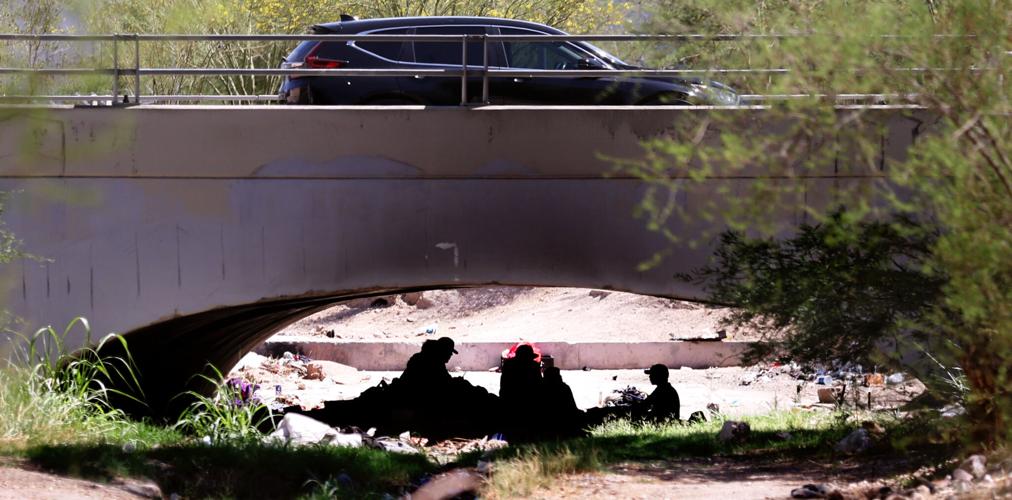
The issue most resistant to solution and subject to vibes-based judgments has been our persistent population of unhoused, addicted or seriously mentally ill people living on our streets.
In some cases, they represent a threat only to themselves and the appearance of the city. In other cases, there are people living on the streets victimizing others through violence, theft and other crimes.
I have not found adequate measures to show whether we're making progress in this area. The mayor's Safe City Initiative and Pima County's One Pima companion initiative are both intended to address the complex of issues causing these problems.
And it appears to me that Tucson police and other officials are using the city's initiative as a permission structure for pursuing wrongdoers on the streets more aggressively. Police Chief Monica Prieto reported in April that drug arrests were up 67% in the first quarter of the year as officers dig into trouble spots.
I sat in Friday on part of a meeting of Tucson's Safe City Task Force. They are putting together an online tracker that will allow people to see how the city is doing on eight measures.
Those include gun violence in Tucson's Violence Interruption and Vitalization Action (VIVA) zones, Sun Tran safety incidents, positive exits from city-owned shelters and other measures of success or failure.
After years of city efforts at directing people into housing and treatment, it's not clear they've made real progress yet, but Thomure is pretty sure it's beginning to happen. That's in part because of the money from the opioid settlements going into programs to help drug-addicted people and programs such as the new $2 million-per-year Sun Tran safety effort, which uses money from the Regional Transportation Authority.
"We've got a lot of good momentum going that is not yet solving the problem, nor is it yet adequately managing the symptoms of the problem," Thomure said. "Having said that, it's making progress."
In the end, we will be the judges of whether Tucson and Pima County are making adequate progress on all of these issues — the economy, roads, public safety and the complex of issues around addiction and homelessness.
But to have a kneejerk reaction that things are getting worse is not justified. Things are getting better, worse, and staying the same all at once, while local officials try to solve those problems in ways that may or may not succeed over the long run.
Contact columnist Tim Steller at tsteller@tucson.com or 520-807-7789. On Bluesky: @timsteller.bsky.social

Tim Steller
Columnist


 Tim Steller's column: Spanish Trail cleanup in South Tucson could go further