More than 350,000 acres of national forest in Southern Arizona would be open to road building for the first time in 25 years under a Trump Administration proposal to repeal an earlier rule that led to the ban on new roads in 44 million acres nationwide.
The U.S. Forest Service proposal, made Aug. 20, has sparked intense opposition from environmental groups both here and nationally.
Supporters of the repeal say what's known as the roadless rule is outdated and unresponsive to changing forest conditions. But opponents fear it will lead to widespread grading of what is now untrammeled wildlife habitat, much of which plays host to endangered and threatened species including jaguars, ocelots, Mexican spotted owls and Chiricahua leopard frogs.

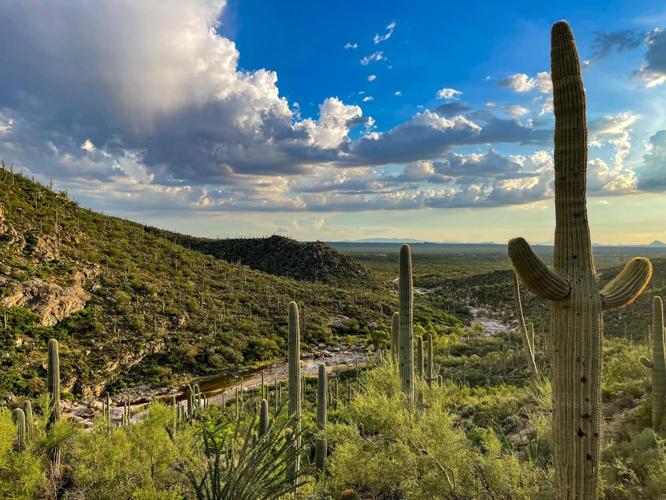
The Butterfly Roadless Area in the Rincon Mountains and Coronado National Forest.
Repeal of roadless status would mean roadbuilding would be allowed in the 350,000 acres in Coronado National Forest and about 1.2 million acres of Forest Service land statewide where it's now forbidden.
People are also reading…
In particular, opponents are concerned this action could lead to a wave of new timber-cutting on federal lands when that has been dramatically reduced in recent decades to protect Mexican and northern spotted owls who live in the forests’ old-growth trees.
And while supporters of the rule change say it will give federal officials more flexibility in preventing and fighting wildfires, opponents say opening up more national forest lands to roadbuilding will increase those fires.
"Agriculture Secretary Brooke Rollins and the Trump Administration are trying to spin a move to subsidize the timber industry as a wildfire mitigation strategy, but a study shows repealing the roadless rule could actually increase wildfire risk," said Kate Groetzinger, communications director for the Center for Western Priorities environmental group.
Timber, mining groups support change
The past designations of these lands as off-limits to roadbuilding have frustrated many federal land managers over the decades. Most recently, they include Trump Administration officials who are seeking to reduce regulatory constraints on all kinds of activity on public lands, including logging, grazing and mining. Timber and mining industry groups are supporting the push to repeal this rule.
The U.S. Forest Service says repeal of the roadless rule is needed to improve federal officials’ abilities in response to changing environmental conditions and to provide more local control over federal lands.
“Under the current administration, the Agriculture Department (the Forest Service’s parent agency) has refocused policies, programs, and resources on increasing rural economic opportunity, decreasing federal regulation, and streamlining federal government services,” the department wrote in a Federal Register notice announcing the proposed rule change.
President Donald Trump has said the U.S. has an abundance of timber resources that are more than adequate to meet our domestic timber production needs, “but heavy-handed federal policies have prevented full utilization of these resources,” the Federal Register notice said.
Supporting that stance is Nick Smith, spokesman for a timber industry advocacy group, who says, “In our opinion, the roadless rule has been an outdated, one-size-fits-all policy that’s really not up to the challenges we are facing in 2026: wildfire; climate change drought and an epidemic of dead trees on federal forest lands.”
“We think it’s time for a more modern approach to managing federal lands. Repealing the roadless rule is one step towards that,” said Smith, public affairs director for the American Forest Resource Council.
'A huge setback for the wildlife'
Opponents of the repeal note that even Forest Service scientists have written in the proposal’s draft environmental impact statement that removal of the roadless rule will have negative impacts on soils, imperiled species, landslide potential, scenery and backcountry access.
“At its core," said Taylor McKinnon, Southwest director for the Tucson-based Center for Biological Diversity, "this is a proposal by the Forest Service to strip protections from some of the last best wildlife habitat in our national forest system — places without roads, places where wildlife are free from disturbance by motorized vehicles and the people that they bring. It would be a huge setback for the wildlife, including many of the endangered species that live in these places.”
The Center for Biological Diversity's analysis found that 16 of the Coronado National Forest's roadless areas contain federally designated critical habitat for six endangered and threatened species.
Nationally, the environmental impact statement for this rule change said it's likely to "adversely impact" 327 endangered and threatened species and 71 designated critical habitats.
“Gutting the roadless rule would be the single largest rollback of public land conservation in our nation’s history," said Mike Quigley, Arizona state director for the Wilderness Society. "Arizona's roadless areas include some the state's most iconic landscapes — safeguarding clean drinking water, protecting wildlife habitat and preserving the freedom to experience pristine public lands. What we protect today will shape what future generations inherit."
Financial issues
The Forest Service’s environmental impact statement also acknowledges that finding the money to build all the new roads that could be built if the roadless rule goes away will be a challenge.
Whatever increased revenues flow into the federal treasury from new timber sales made possible by the rule’s repeal will not cover the total cost of building the new roads needed to accommodate them, the environmental impact statement said.
As of 2024, the Forest Service had a backlog of deferred, needed maintenance work on its roads of about $6.9 million, the statement said. Federal appropriations for needed road work on Forest Service lands have dropped from $234 million in 2004 to $73 million in 2024.
If this proposal is approved and survives likely court challenges, management of individual roadless areas will be turned over to the national forests in which they are located.

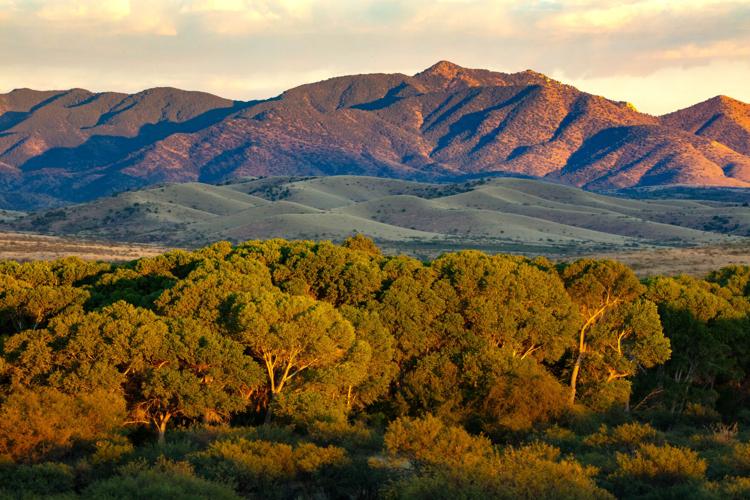
The roadless area in the Whetstone Mountains southeast of Tucson.
In Southern Arizona, that means Coronado National Forest, which manages federal lands in Pima County and five others including Pinal, Cochise and Santa Cruz counties to the north, east and south of Tucson. A section of Coronado National Forest also extends into Hidalgo County in southwest New Mexico.
About 92,000 acres of roadless areas lie within Pima County’s “Sky Islands” in the Catalina, Rincon and Santa Rita mountains, according to an analysis of federal data done by the Center for Biological Diversity. (Mountain ranges in Southern Arizona are known as Sky Islands because they rise high above deserts below.)
The lack of roads in these areas means they are “unfragmented, functioning whole ecosystems,” McKinnon said. “When you build roads through them, you fragment them. An analogy is a quilt. Take a beautiful quilt, chop it up into many different pieces — those remaining pieces are of less value to the quilt. The whole is greater than the sum of its parts.”
'Critical to expanding' copper production
Two Arizona mining industry advocacy groups support repeal of the roadless rule.
A group called AMIGOS, which represents companies that supply the industry with infrastructure and services, said it favors “replacing broad federal prohibitions with science-based management by local, Arizona-based forest managers who understand the Copper State's unique landscapes."
“Restoring flexible road access is critical to expanding domestic production of copper and other essential minerals needed for national infrastructure and energy security,” said Sydney Hay, the group’s president.
The Arizona Mining Association said the flexibility the roadless rule repeal would offer forest managers is increasingly important as Arizona’s forests “face drought, insect infestation, excessive fuel loads and severe wildfire risk.”
Forest restoration and thinning are important tools for reducing hazardous fuels and improving forest health, said Steve Trussell, the group’s president.
“Rescission would not dictate how forests are managed. It would give local managers greater ability to respond to conditions on the ground while remaining subject to applicable federal environmental laws and public involvement,” Trussell said.
Better or worse for wildfire prevention?
Probably the most divisive flash point in the roadless area issue is the impact of either abandoning or preserving the roadless rule on wildfire risks. That’s because it’s generally agreed that wildfire risks on national forests already are much greater today than a quarter-century ago, due to hotter, drier weather, a buildup of small trees in the forests due to past fire suppression, and a continuing incursion of private development on lands surrounding national forests.
That expansion of what fire experts call the “wildland urban interface” has been particularly noticeable in Pima County, where housing development has crept steadily closer over the decades to national forest lands in the Catalina, Rincon and Santa Rita mountains.
Trump Administration officials say repeal of the rule will give them more flexibility to quickly respond to growing wildfire threats by building roads into overgrown forest lands where past fire suppression has allowed a potentially dangerous buildup of fuels in both trees and shrubs. Nick Smith, of National Forest Products Association, calls roadless areas “fuel preserves.”
Opponents of repeal, however, say scientific research has proven that wildfires are more likely to be set off in areas along roads.
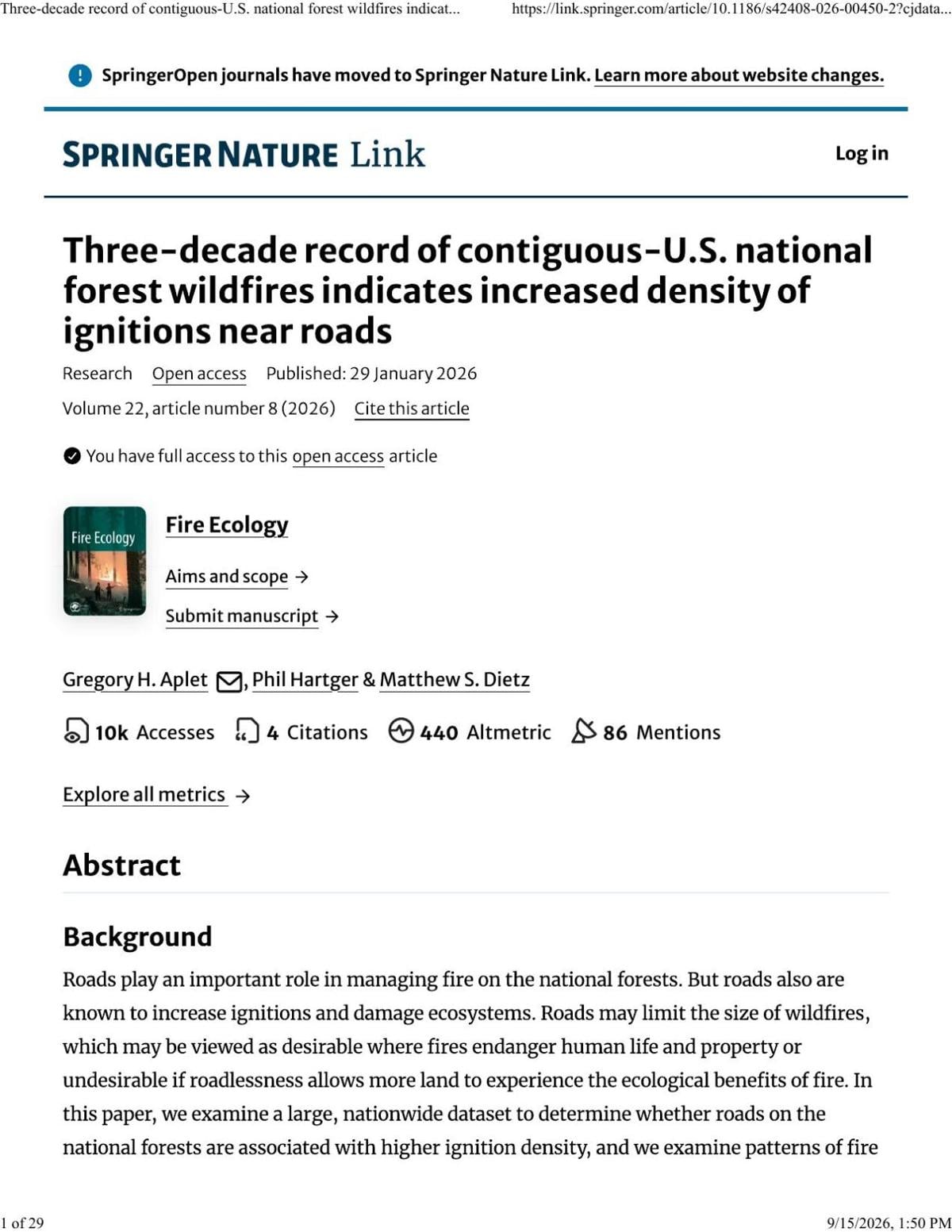
They cite a study, published this year, that examined three decades of wildfire records and concluded wildfires are more likely to ignite in areas close to where roads exist than in areas farther away. The study covered wildfires from 1994 through 2024 in all eight Forest Service regions in the lower 48 U.S. states. It was conducted by three researchers who work for the Wilderness Society.
From 1992 to 2024, in all eight regions, wildfire-ignition density — the concentration of wildfires in a given area of land — was lowest in designated wilderness areas, where road building has always been forbidden, followed closely by roadless areas, the study found.
The highest wildfire-ignition density was in lands within about 150 yards of roads, and the second highest was in other national forest lands outside of that area, but not in wilderness or roadless areas, the study said.
“For human-caused, natural, and undetermined fires, wildfire-ignition density decreased as distance to road increased, irrespective of designation categories such as 'wilderness' or 'roadless,'” the new study said.
But simply counting the number of times wildfires ignite doesn’t say much about fires that grow large, said Smith of the timber industry group.
“It’s like focusing on the match while ignoring the gasoline,” Smith said.
Contact Tony Davis at 520-349-0350 or tdavis@tucson.com. Follow Davis on Twitter@tonydavis987.

Tony Davis
Reporter


 Female jaguar confirmed in Sonora near US border, researchers say