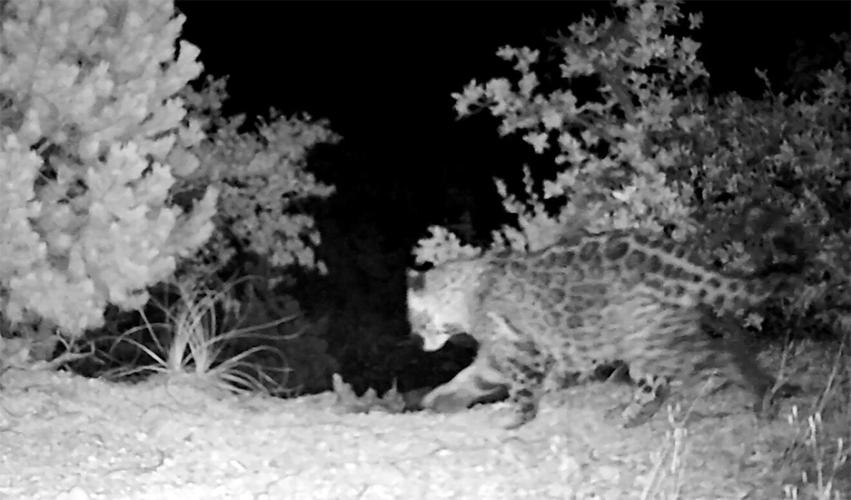
One or possibly two female jaguars have been videoed roaming in Sonora just five miles south of the U.S. border, biologists involved with the research said.
The discovery of females that close to the border would be a groundbreaking event, biologists have said. That's because no female jaguars had been reported closer than 100 miles south of the Arizona border in northern Mexico in recent decades, let alone in the U.S.
Both jaguars were captured on video via remote cameras operating in a large network run by Tucson biologist Ganesh Marín. The cameras were placed inside a large preserve spanning Sonora and Chihuahua, run by Cuenca Los Ojos, a Tucson-based nonprofit conservation group.
The two jaguars were photographed in separate years in locations less than a mile apart, about five miles south of Sonora's border with New Mexico. Although most of Sonora borders Arizona, a small section extends to an area south of the New Mexico border.
People are also reading…

This image of a female jaguar was taken in April 2023 about five miles south of the U.S.-Mexico border in Sonora, and retrieved from the field in September 2025. The sighting marks the northernmost confirmed record of a female jaguar in decades, says researcher Ganesh Marín.
The hope among many jaguar experts is that if female jaguars do come close to the U.S. border, one or more could eventually mate with male jaguars that have been known to be living in Southern Arizona off and on since the mid-1990s.
That could possibly begin to establish a sustaining jaguar population that hasn't existed in the U.S. for many decades, the experts say.
"The discovery raises the possibility that naturally recolonizing jaguar populations, including breeding females and males, could return to the United States sooner than expected, if the region’s remaining binational wildlife corridors remain connected," Marín wrote in an email to the Star, adding that the ongoing border wall construction threatens those corridors.
However, representatives of two Tucson-based jaguar organizations, the Northern Jaguar Project and the University of Arizona Wild Cat Research Center, said they aren't yet ready to accept that these two jaguars were females, saying more evidence is still needed to prove that.
Marín, a conservation biologist, set up a network of 85 remote cameras six years ago on the Cuenca preserve. Over the next few years, the images captured on camera confirmed that one jaguar recorded on video was a female and that another one was likely a female, he said.
Those discoveries were first reported last week in the New York Times.
The jaguars were both found in rugged terrain in the foothills of the San Luis Mountains, barely 300 yards west of the border of the state of Chihuahua. Those mountains lie at the northern edge of the Sierra Madre Cordillera, a major system of Mexican mountain ranges that forms part of the Americas' western backbone.
Area may soon be cut off by border wall
Marín and environmentalists said they're concerned that if the U.S. government finishes its ongoing construction of the U.S.-Mexico border wall in the Southwest, there will be no way for jaguars in Mexico of either sex to reach the United States.
Wall construction contracts have been awarded for 66 miles along the Arizona border to the New Mexico border, and the wall is under construction across much of the New Mexico-Mexico border, although it hasn't quite reached the border of Cuenca Los Ojos, officials from the preserve told the Star.
If the wall is finished across all of southeast Arizona and across New Mexico's "boot heel" area, "it would be game over for all large animal movement, including black bear, mountain lion, jaguar, bighorn sheep and deer," said Myles Traphagen, a Cuenca Los Ojos researcher.
"This is an opportunity for jaguars," Marín said. Of the federal government, he said, "They don’t have to do anything. They don’t have to invest any money. They can have jaguars if they leave the corridor open.
"It will not only benefit jaguars, it will benefit other species: bears, deer, puma, bobcats. Of the camera traps I set, less than 1% of the images were of jaguars. For every jaguar, you have thousands of other animals, using the same landscape," said Marín.
'Teenagers don't go far from mom'
Marín set up his first remote cameras in 2020 while working on his PhD at the University of Arizona. He finished his PhD work and obtained his doctorate in December 2025.
He captured video in 2021 of the first of six male jaguars seen by his remote cameras. In Southern Arizona and Southwest New Mexico, nine males have been captured on remote cameras since 1996, including five found in Southern Arizona since 2011.
Two of those six males "looked young at that point. That was a good indication. They were like juveniles. That means they hadn’t gone that far — teenagers don’t go far from mom. That meant females were not that far away," Marín said.
The jaguar Marín confirmed to be a female, whom he nicknamed Lola, was captured on camera in April 2023. But Marín said he didn't discover the video image of the animal until September 2025 because he hadn't had time to check that camera and a lot of the others on the Cuenca preserve, as he was too busy wrapping up work on his PhD dissertation.
"The camera was sitting there for two years. I had to write and do all my stuff. It takes awhile," he said.
In December 2025, he and his PhD adviser, Professor John Koprowski of the University of Wyoming — a former UA professor — determined that the jaguar was probably a female. But Marín first thought it was the same big cat as another female he had already captured on video in April 2022, which he named Adela, he said.
But in a few months, Marín and Koprowski said, they were able to confirm from the 2023 video record that Lola was a female and a different jaguar than Adela. The female determination was made because the video clearly showed the big cat had no testicles, Marín said.
The likely female nicknamed Adela also showed no testicles in videos he obtained, but he and Koprowski said they have not yet confirmed that Adela is a female. She was first captured on video in 2022, but that video's evidence of her sex was inconclusive, he said.
7 scientists 'agreed it was female'
Marín sent the photo of Lola in March 2026 to Brett Dickson, chief executive officer and a wild cat specialist with Conservation Science Partners, a nonprofit research organization.
“I was struck right away that I was likely looking at a female," Dickson told the New York Times.
He forwarded the video to jaguar experts, said Dickson, and "seven of the nine scientists agreed it was female. Two are unsure.”
The video also shows the cat has skin folds that look like mammary glands, he said. The possibility that this could be a lactating female “cannot be ruled out,” Dickson told the Times.
Marín said, "The mammary glands on Lola were swollen."
"The video (of Lola) shows the genital area, and it looks like female genitalia," he added.
Marín, who is 34, did much of his research work while employed by Conservation Science Partners. Currently, he works as a conservation strategist for Borderlands Restoration Network, of Patagonia in Santa Cruz County.
He noted, "We have a lot of videos of males. You can see testicles on all of them. On these two (Lola and Adele), you can’t see testicles."
Lola and Adela were captured on video within one kilometer, or barely half a mile, of one another, he said.
"For jaguars that’s nothing," Marín said. "I would say that's the same area. Jaguars can move that far in less than an hour."
While males typically roam hundreds of miles during adulthood, females do not, sticking close to where they were born.
Jaguars slowly returning to borderlands
What the videos also show is that jaguars are slowly returning to the area of the borderlands in both northern Mexico and the southern U.S., he said.

Ganesh Marín
"They're coming, because they used to be here. This is part of their habitat. Naturally, they are not very abundant. They were always at a pretty low density, pretty scattered, moving a lot. But I think that they were part of the ecosystem. That's why they are coming back," Marín said.
"(And) it's not just that they're coming back. This is something Americans forget: There have been a lot of efforts in Mexico to recover the habitat and working with ranchers, to reduce conflicts with them and jaguars."
The Cuenca Los Ojos preserve has 32 miles of frontage along the U.S.-Mexico border — 15 miles in Arizona and 17 miles in New Mexico, said Traphagen, a longtime environmental researcher in the borderlands who now works as a GIS specialist for Cuenca Los Ojos.
Of those 32 miles, all but a 1.8-mile sliver of the Arizona side is already walled off, and wall construction is approaching that area, he said.
None of the New Mexico frontage bordering Cuenca Los Ojos is walled. But the wall construction in that stage is now 10 miles east of the Cuenca property, said Traphagen, who at his previous job for the Wildlands Network mapped the entire length of the border wall from California to Texas that the Trump Administration built during its first term from 2017 into January 2021.
Asked about how close border wall construction is to the area directly north of where the jaguars were videoed, a Customs and Border Protection spokesman would say only, "Border wall construction is already underway in both Arizona and New Mexico."
That agency's Smart Wall website, which maps progress on the border wall project, shows that a 60-mile section of wall in Hidalgo County, New Mexico, just east of Arizona, is under construction. Contracts have been awarded for a 66-mile stretch of wall through Cochise County just west of the Arizona-New Mexico border, the Smart Wall site said.
The borderland area directly north of where Lola and Adele were captured on video is now fenced off with older vehicle barriers that are much shorter and more penetrable for people and wildlife than the 30-foot-tall border wall that the Trump Administration's CBP is now building.
"Where the (confirmed female) jaguar was seen they will soon have a full wall," said Valerie Gordon, executive director of the nonprofit foundation that runs the Cuenca preserve. "The last time I was there, they were working in Chihuahua, just east of us. I’ll bet they are nibbling at the edge of Cuenca now."
The vehicle barriers "are something either you or I or a jaguar could crawl under," said Peter Winsor, Cuenca Los Ojos' conservation director. "Once the full border wall is in place (the jaguars) will have no way of crossing."
The federal government is creating openings in the wall at various spots for wildlife — small wildlife passages of 8 by 11 inches, too narrow for a jaguar or other large mammals to get through, environmentalists and biologists have said.
Asked about wildlife issues with the border wall, the CBP spokesman said, "For wildlife areas, CBP coordinates with the U.S. Fish and Wildlife Service and other stakeholders to minimize impacts to wildlife and sensitive habitats, while still meeting operational requirements.
"Wildlife passages have been part of border wall designs since 2007, and CBP will continue collaborating on their placement. Drainage gates in the barrier can be left open to allow large animal movement when operational conditions permit," the spokesman said.
Others say more evidence needed
Leaders of two other Tucson-based organizations that research jaguars weren't ready to accept the conclusion of Marín and Koprowski that Lola is a female.
The Northern Jaguar Project, which has identified 81 individual jaguars in 20 years of remote camera work on and near its preserve, said in a statement that it can't conclude the jaguar identified as Lola is actually a female because the group's scientists don't believe one photo is enough to make such a determination. A hundred miles south of the U.S.-Mexico border, females have been seen and recorded at another major preserve in Sonora, run by the Tucson-based Northern Jaguar Project, also a nonprofit group.
"We have not participated in the identification process and are not aware if additional images from 2023 or after exist. Confirming sex is challenging and requires repeated photographic evidence," the group said in a statement to the Star.
"Likewise, we are not aware if there are further photos or videos after that initial sighting, which are key to supporting that this individual is a permanent resident," said the jaguar project, which says it's collected over 3,000 records of jaguars.
Perhaps more significantly, published data exist from another 2025 study confirming the presence of five individual jaguars in the region of Janos, Chihuahua, during the same period that the jaguar video was collected at Cuenca Los Ojos, the jaguar project said. Janos lies in a grassland area, very near the U.S. border and about 50 miles southeast of Cuenca Los Ojos.
Three of those individuals are of unknown sex, with the other two known to be males, meaning more study is needed of those three jaguars to verify their sexes, the project said. The remote camera study was conducted by three Mexican researchers, using images collected between May 2020 and September 2023.
Susan Malusa, director of the University of Arizona's Wild Cat Research and Conservation Center, said she also isn't ready to say that the Cuenca-based research project found one or more females until she can review the data and the context of that data collected by Marín.
"I really want to say this would be wonderful to hear that females are being detected. This is what everybody wants, moving the needle in the direction we need to be moved in," said Malusa.
The center has collected "250-plus" remote camera images of jaguars, Malusa said.
"But when you are making a very important claim, we have to have context. I don't see the context. That’s concerning. I see them monitoring a particular site. But the data in front of it, the data behind it — what does that jaguar co-occur with in the biological community? A data point doesn’t contribute to science that much when it’s completely out of context," Malusa said.
Kopwrowki said he and Marín plan to submit a report based on their research to a scientific journal this week and hope it will be published by the end of 2026. Besides jaguars, that study will also report on Marín's research on bears and pumas, he said.
"I don’t want to steal his thunder, but female jaguars are part of the information that is coming out," said Koprowski, dean of the University of Wyoming's Haub School of Environment & Natural Resources.
He credited Marín with making a "Herculean effort to monitor so many cameras in some of the most challenging conditions."
"I’ve been incredibly impressed with his work ethic, his commitment to collecting high quality data and his ability to stay with it in these kind of challenging conditions. You're walking in 107 degrees, you are out in the field, it's very remote areas, hiking dozens of miles a day, in exposed kinds of landscape," said Kopowski.
He and Marín think the one photo of Lola is convincing and hope they can convince outside researchers, he said.
"But that’s the nature of science. Without having DNA evidence, folks will always argue a little bit about these kinds of things," Koprowski said. "We feel like the photographic evidence is very solid."
Marín said, "Yes, the identification process can be challenging, but we think Lola's video provides sufficient evidence that we are looking at a female jaguar. Regarding Adela, I can only say that there are multiple records, and the details will be published in the scientific publication."
Collection: Read more on big cats seen in Southern Arizona
Over the years, readers of the Arizona Daily Star have sent in photos of bobcats. They've seen bobcat families, bobcats drinking, bobcats napp…

Two new sections of 30-foot-high border wall will be the end of the line for jaguars in Arizona, environmentalists and a former federal official say.

Tucson wildlife: A bobcat and its baby were caught on camera multiple times playing together in a backyard on Tucson's southeast side this wee…
Jaguars need our protection.

Mountain lion sightings are frequently reported in the foothills surrounding Tucson and nearby neighborhoods.

The company that hopes to build Rosemont Mine declines to comment on ongoing litigation.

Like the other six wild jaguars discovered in Arizona and New Mexico since 1996, this one is a male.

A Chiricahua Mountains jaguar Thursday became the second wild jaguar in Southern Arizona to enter the video world.
It's the first confirmed jaguar sighting ever at Fort Huachuca.

Notice means the Center for Biological Diversity may sue in 60 days if they don't get favorable agency decisions on the mine.

A male jaguar was photographed in the Santa Rita Mountains 118 times over three years.
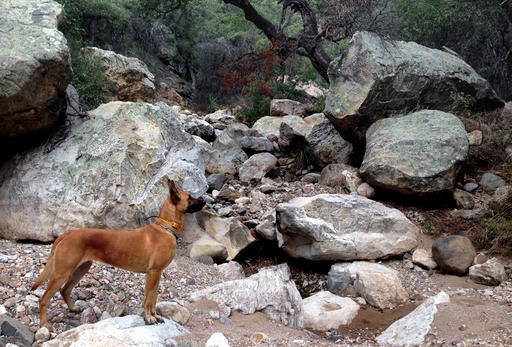
Dog works with a carnivore biologist to study El Jefe's movements.
Remote sensor cameras record footage of "El Jefe" roaming the Santa Rita Mountains.

A bobcat kitten plays with its mother in the backyard of a Tucson residence throughout the month of July. These videos were captured and share…

Researchers and residents get a look at how an urban bobcat raises her young.
Contact Tony Davis at 520-349-0350 or tdavis@tucson.com. Follow Davis on Twitter@tonydavis987.

Tony Davis
Reporter




 Roadless areas in Coronado National Forest could see road building again