

PHOENIX — The state Court of Appeals rejected efforts to void a border measure approved by voters.
In a new ruling Thursday, the judges upheld Proposition 314. Approved by voters in 2024 by a margin of 62.5 to 37.5, it allows police to arrest people who cross the border with Mexico at a location other than a port of entry, who can then be charged with a state misdemeanor.
In 2025, the organization Living United for Change in Arizona (LUCHA) sued, saying the law has provisions that violate federal and state constitutional protections, ranging from possible discriminatory enforcement to whether the measure failed to provide for a new source of revenue for enforcement.
People are also reading…
But Judge David Weinzweig, writing for the unanimous three-judge panel, said that, in the end, that is irrelevant: He said the challenge fails if for no other reason than LUCHA lacks standing to sue in the first place.
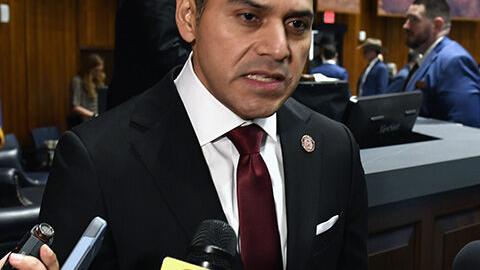
The ruling drew an angry reaction from Alejandra Gomez, executive director of the community organizing group.
"We are appalled that the Court of Appeals has allowed Proposition 314 to stand at a moment when immigrant communities are already being terrorized by an increasingly aggressive federal immigration enforcement apparatus,'' she said.
Gomez said no decision has been made whether to seek Arizona Supreme Court review.
The most visible part of the law allows state and local police to arrest border-crossers.
But the law is written in a way designed to convince the border-crossers to agree to be deported in return for having the charges dropped, rather than to incarcerate them.
LUCHA argued that provision is worded in a way more likely to affect its members who share the "race, ethnicity or national origin of the immigrants who enter Arizona from the southern border'' and that they are more "vulnerable to misapplication'' than the public at large.
Weinzweig, however, said the possibility the law may be misapplied in the future doesn't allow LUCHA to try to ask courts to halt enforcement.
"Declaratory relief should be based on an existing set of facts, not those which may or may not arise in the future,'' he wrote.
That conclusion parallels a similar ruling in July by U.S. District Court Judge Michael Liburdi. He tossed a challenge to Prop. 314 brought by the Florence Immigrant Rights and Refugee Project, noting that the organization had failed to show anyone had yet been affected by the new law.
In Thursday's state appellate court ruling, Weinzweig also rejected the claim that the standards allowing police to arrest border-crossers ignore constitutional requirements.
The law provides three options: an officer's own observation, a recording, or "any other constitutionally sufficient indicia of probable cause.'' While the last provision is not defined in Prop. 314, Weinzweig said those are the same standards already required for arrest under the Fourth Amendment, which protects against illegal search and seizure.
LUCHA fared no better with a parallel argument on how Prop. 314 would be funded.
The challengers pointed out that the Arizona Constitution says any ballot measure that proposes the mandatory spending of state revenues must also provide a new source of money to pay for it.
Put another way, a ballot measure is invalid if it simply says that any required costs will be picked up through already existing taxes or other sources. It applies regardless of whether the proposal was referred to voters by lawmakers — as was the case here — or was put on the ballot through an initiative petition of Arizona voters.
In this case, the challengers noted, Prop. 314 requires the state Department of Corrections to transport to the border those who agree to leave the country. That is an obligation to spend state resources without a commensurate increase in new dollars, they said.
Weinzweig wasn't buying it.

The U.S. border with Mexico in Arizona. An appeals court declined Thursday to stop enforcement of a new state law that allows police to arrest people who cross the border at other than a port of entry, who can then be charged with a state misdemeanor.
He said the measure is written so the mandatory obligation to transport people to the border falls on local law enforcement agencies whose anticipated new expenses are not covered by the state constitutional requirement. The only time costs will be borne by the state is if the local agency does not have the capacity to hold someone pending voluntary deportation, the judge said.
"This is a contingency, not a mandate,'' Weinzweig wrote.
Finally, he said there's nothing inherently illegal about Arizona lawmakers, who wrote Prop. 314 and placed it on the 2024 ballot, making enforcement of the proposal contingent on what happens in another state.
The sections about arresting border crossers and deportation are modeled after Texas' SB 4. The Arizona statute spells out that these provisions in Prop. 314 could not be enforced here until there was a final federal court ruling on the legality of the Texas measure.
Challengers said that amounts to Arizona lawmakers illegally surrendering their authority to events elsewhere.
A federal appeals court upheld the Texas law, but legal questions remain about whether it is now enforceable. Weinzweig, however, said the status of SB 4 is irrelevant.
It is true, he said, that the Arizona Legislature may not delegate its power to make laws. But he rejected the claim that what's in Prop. 314 is an illegal delegation or amounts to lawmakers here ceding their power to what happens with the Texas law.
Gomez, in her statement, said the ruling comes as the Trump administration "continues expanding the reach of immigration enforcement into more parts of everyday life.''
"Proposition 314 threatens to pour gasoline on that fire,'' she said.
"It gives Arizona another vehicle to target immigrant communities, drag state and local institutions deeper into immigration enforcement, and force taxpayers to bankroll a reckless law with no clear way to pay for it,'' Gomez said.
Howard Fischer is a veteran journalist who has been reporting since 1970 and covering state politics and the Legislature since 1982. Follow him on X, Bluesky and Threads at @azcapmedia or email azcapmedia@gmail.com.






 Roadless areas in Coronado National Forest could see road building again

