

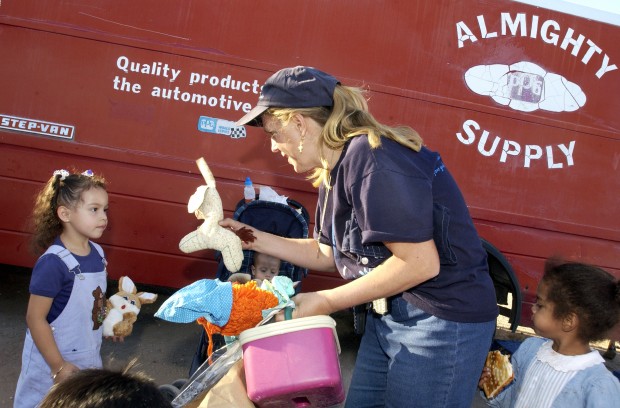
A Tucson charity that shut down after an Arizona Daily Star investigation has re-emerged — but its questionable business practices haven’t changed, two homeless clients say.
“It’s doing nothing but exploiting us,” said single mother Rachel Qually. She and her 1-year-old son are facing homelessness after abruptly leaving the Grace Home shelter last week. The shelter, at 4734 E. Andrew St., was previously operated by the now-defunct Giving Tree Outreach Program. The Pima County Assessor’s Office still lists the owner as Carlo Giovingo, the husband of longtime Giving Tree director Libby Wright.
The Giving Tree closed its doors in July 2012 after a Daily Star investigation found that it served expired and potentially unsafe food to needy kids, charged clients hundreds of dollars a month to live in overcrowded rental homes and at least twice made a public display of giving kids gifts at holiday parties, only to take them back later.
People are also reading…
The revelations led to the loss of most of the charity’s financial support and preceded Wright’s retirement and departure. A new board tried to start over, but members said it had lost too much money and good will to stay afloat.
Then in January, Jere Pedrazza, a former Giving Tree employee, incorporated a nonprofit called Cross Country Outreach. The Character of Affairs statement says its purpose is “transitional housing, meals, clothing distribution, job training.”
And in March, Pedrazza and Giovingo, Wright’s husband, incorporated Shop 4 A Cause thrift store at 5140 E. Speedway . The store’s purpose is described in state records as to “own and operate a retail shop and provide support for nonprofit work.”
The Star made attempts to reach Wright on Friday, including two phone messages, two visits to the thrift store and one visit to Grace Home. At both places, employees accepted messages for Wright. One said she was out of town but another said Wright had been at the thrift store Friday afternoon.
Referral doubted
Two former clients of Grace Home said they found out about the shelter through the Gospel Rescue Mission, but a pastor there said they would not have officially referred clients to the charity. The women probably received a list of all local agencies with open beds, he said.
“Based on history (of The Giving Tree,) we would absolutely want to check them out before we made any referrals,” said Pastor Scott Munro. “I would welcome any organization that truly has the best interest of those they’re serving at heart. Unfortunately, there’s still people that prey on the poor.”
Former client Qually said Grace Home requires a weekly contribution of $50 cash or 20 hours of unpaid work at Shop 4 A Cause. Residents are expected to give $100 a month from their food stamps or other government benefits, like WIC vouchers, Qually said. They get one meal a day, but not diapers or formula, she said. Toilet paper is 25 cents a roll.
When the Star ran its investigation in 2009, The Giving Tree also required homeless clients staying in its homes to work without pay in its thrift stores and to hand over their food stamps while also paying rent in exchange for a place to stay. Social service experts at the time said requiring residents to use their food stamps to cover meals in a shelter could be illegal in some circumstances — for example, if residents were forced to turn over their personal identification numbers, as at least one client said she was.
Wendy Ascher, director of intake and managing attorney at Southern Arizona Legal Aid, said last week that a charity that provides food to residents can ask for food stamps to help pay for that food. One question, though, is whether the food provided to clients justifies the amount of food stamps taken from them, she said.
“The food stamps are for the benefit of the person who receives them, so are they getting $100 worth of food?” she asked.
To Munro, the question of the practice’s legality is secondary to the question of right and wrong.
“In my opinion, it’s unethical,” he said. “The benefit was given to that individual, not to that organization.”
Former Grace Home resident Christina Brown said a “house parent” at the shelter would ask residents when they were getting their food stamps and record the dates.
“She would get in our face every night with a piece of paper,” Brown said. “She’d go to every girl and say, ‘When do you get your food stamps? I’ll take you to store and you have to buy $100 in food for the whole house.’ ”
Charging rent or mandating volunteer week is “unusual in the homelessness community,” said Patti Caldwell, executive director of Our Family, which provides shelter and support to homeless children and families.
“I have concerns for any program that isn’t allowing residents to have sufficient time to get themselves back on their feet or to retain the resources they need ... that would allow them to actually get out of shelter,” Caldwell said.
Brown said she was once “punished” for leaving a Bible study session, held weekly at the back of the thrift store. She had to work eight hours that day instead of her regular four-hour shift, which she worked five times a week, she said.
Wright, she said, “treats us like her little minions.”
Mom, infant separated
Qually, 36, said she ended up at Grace Home three months ago after she left an abusive boyfriend and moved to Tucson with her 1-year-old son, David.
“I had to get away from him and I had to start somewhere, and that’s what I’m trying to do,” she said.
She said she and her son spent six weeks at the Gospel Rescue Mission, then went to Grace Home. They left after Qually returned from a required church service Sunday and noticed her son’s arm was injured. She said Wright had been dragging the boy in an attempt to get him to walk, which Wright thought he should be doing by age 1.
Qually said she took her son to Tucson Medical Center , where she was told she should file a police report, which she said she did on Tuesday. The Star was unable to get a copy of the report on Friday.
She left Grace Home that night, but was unable to find a shelter that had two beds open. She stayed at the Gospel Rescue Mission and David stayed at Casa de los Niños, she said.
“I woke up the next morning just devastated. How do me and my son deserve this? Why do we need to be separated?” she asked.
St. Vincent de Paul has arranged for the mother and son to spend four nights at a motel. But Qually said she has no idea where she and her son will stay after she checks out this morning.
“I have nowhere to go,” she said. “All the shelters are full.”
Brown, 38, said she went to Grace Home after her three months with the Gospel Rescue Mission. But she was kicked out of Grace Home after three weeks when she refused to give her food stamps to the charity, she said.
That was two weeks ago. She’s been living on the streets or at a shelter near St. Vincent de Paul ever since, she said.
The need for new homeless shelters is enormous, Gospel Rescue Mission’s Munro said. His organization expanded from 17 to 60 beds three years ago, but “we’re still turning people away,” he said.
Grace Home could serve an important function if the parent charity’s practices have improved, he said. Giving Tree operated for 14 years as a faith-based mission to help the homeless and needy children. It once housed up to 120 people at a time in numerous houses and served outdoor weekend and holiday meals to those in need on a dirt lot near East 22nd Street between South Columbus Boulevard and South Swan Road.
“If they’ve cleaned up their act, it would be a wonderful thing,” he said. “We need facilities that have a loving heart, but we just don’t need people to take advantage of people when they’re down.”
Reporter Becky Pallack contributed to this report. Contact reporter Emily Bregel at 807-7774 or ebregel@azstarnet.com

Emily Bregel
Border reporter


