WASHINGTON — The Supreme Court seemed intent Thursday on keeping a block on President Donald Trump's restrictions on birthright citizenship while looking for a way to scale back nationwide court orders.
It was unclear what such a decision might look like, but a majority of the court expressed concerns about what would happen if the Trump administration were allowed, even temporarily, to deny citizenship to children born to people who are in the United States illegally.
The justices heard arguments in the Trump administration's emergency appeals over lower court orders that kept the citizenship restrictions on hold across the country. Nationwide, or universal, injunctions emerged as a check on Trump's efforts to remake the government and a mounting frustration to the Republican president and his allies.

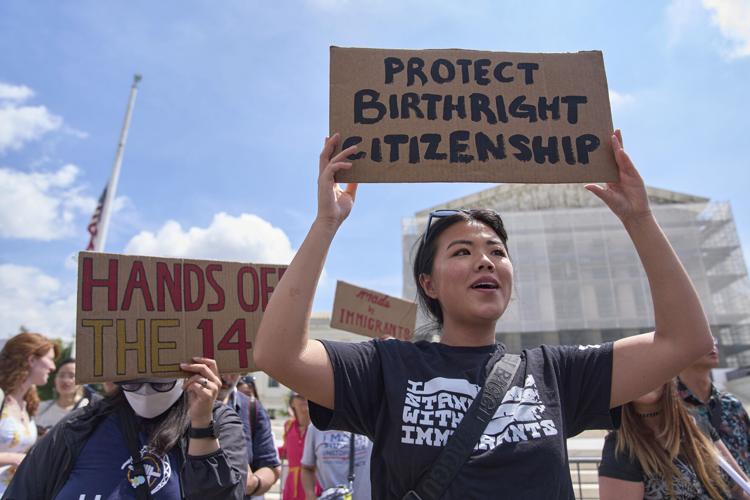
Hannah Liu, 26, of Washington, holds up a sign in support of birthright citizenship Thursday outside the Supreme Court in Washington.
Judges issued 40 nationwide injunctions since Trump began his second term in January, Solicitor General D. John Sauer told the court at the start of more than two hours of arguments.
People are also reading…
Birthright citizenship is among several issues, many related to immigration, that the administration asked the court to address on an emergency basis.
The justices are also considering the Trump administration's pleas to end humanitarian parole for more than 500,000 people from Cuba, Haiti, Nicaragua and Venezuela and to strip other temporary legal protections from another 350,000 Venezuelans.
The administration remains locked in legal battles over its efforts to swiftly deport people accused of being gang members to a prison in El Salvador under an 18th century wartime law called the Alien Enemies Act.
Trump signed an executive order on the first day of his second term that would deny citizenship to children who are born to people who are in the country illegally or temporarily.
The order conflicts with a Supreme Court decision from 1898 that held that the Citizenship Clause of the 14th Amendment made citizens of all children born in the U.S. with narrow exceptions that are not at issue in this case.

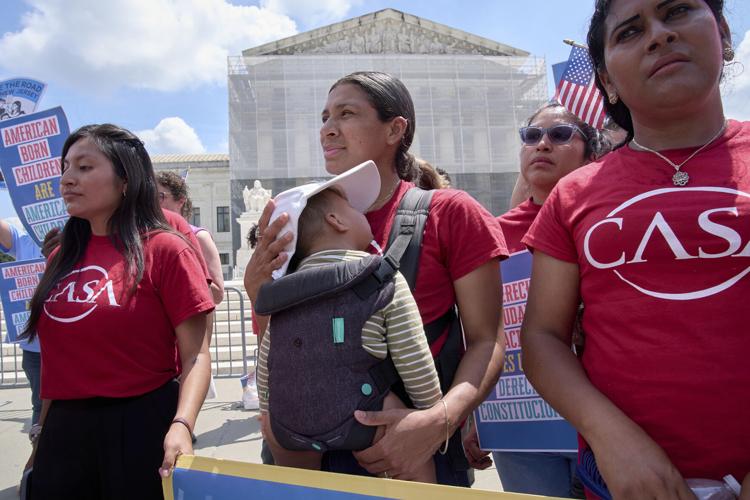
A woman from CASA Maryland holds her 9-month-old baby Thursday as she joins others in support of birthright citizenship outside the Supreme Court in Washington.
States, immigrants and rights groups sued almost immediately, and lower courts quickly barred enforcement of the order while the lawsuits proceed.
The current fight is over the rules that apply while the lawsuits go forward.
The court's liberal justices seemed firmly in support of the lower court rulings that found the changes to citizenship that Trump wants to make would upset the settled understanding of birthright citizenship that existed for more than 125 years.
Birthright citizenship is an odd case to use to scale back nationwide injunctions, Justice Elena Kagan said.
"Every court has ruled against you," she told Sauer.
But if the government wins on today's arguments, it could still enforce the order against people who haven't sued, Kagan said.
"All of those individuals are going to win. And the ones who can't afford to go to court, they're the ones who are going to lose," she said.

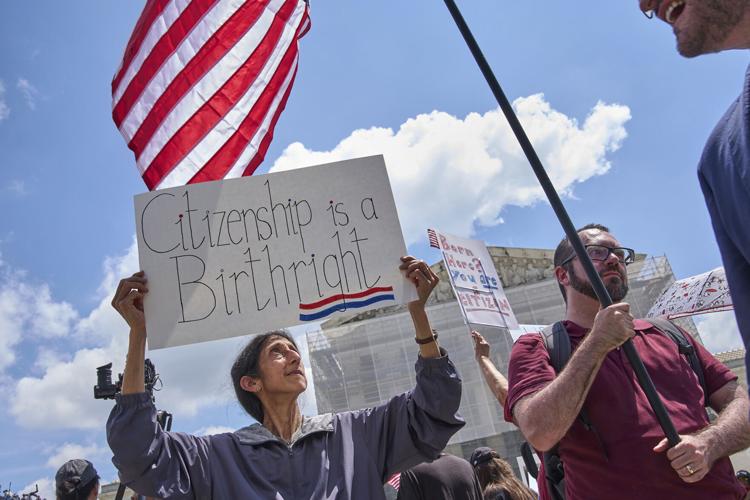
Tanjam Jacobson, of Silver Spring, Md., holds a sign saying "Citizenship is a Birthright" on Thursday outside the Supreme Court in Washington.
Several conservative justices who might be open to limiting nationwide injunctions also wanted to know the practical effects of such a decision as well as how quickly the court could reach a final decision on the Trump executive order.
Justice Brett Kavanaugh pressed Sauer with a series of questions about how the federal government might enforce Trump's order.
"What do hospitals do with a newborn? What do states do with a newborn?" he said.
Sauer said they wouldn't necessarily do anything different, but the government might figure out ways to reject documentation with "the wrong designation of citizenship."
Kavanaugh continued to press for clearer answers, pointing out the executive order gave the government only about 30 days to develop a policy. "You think they can get it together in time?" he said.
The Trump administration complained that judges are overreaching by issuing orders that apply to everyone instead of just the parties before the court.
Picking up on that theme, Justice Samuel Alito said he meant no disrespect the nation's district judges when he opined that they sometimes suffer from an "occupational disease … 'I am right, and I can do whatever I want.'"
But Justice Sonia Sotomayor was among several justices who raised the confusing patchwork of rules that would result if the court orders were narrowed and new restrictions on citizenship could temporarily take effect in more than half the country.
Some children might be "stateless," Sotomayor said, because they'd be denied citizenship in the U.S. as well as the countries their parents fled to avoid persecution.
New Jersey Solicitor General Jeremy Feigenbaum, representing 22 states that sued, said citizenship could "turn on and off" for children crossing the Delaware River between Camden, New Jersey, where affected children would be citizens, and Philadelphia, where they wouldn't be. Pennsylvania is not part of the lawsuit.

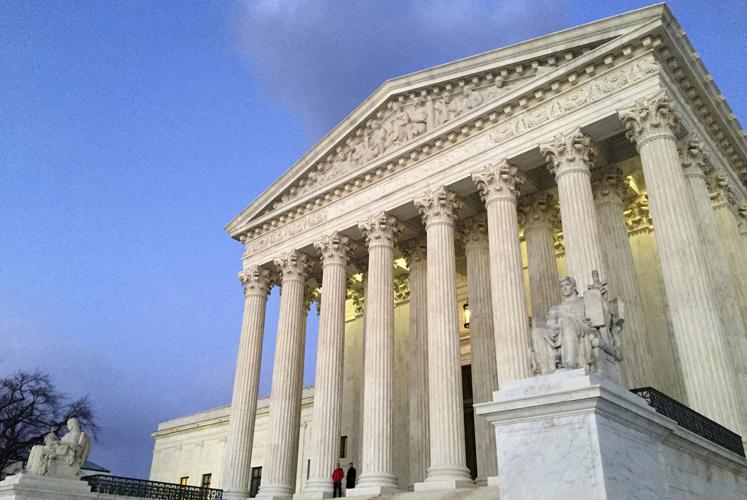
The Supreme Court is pictured Feb. 13, 2016 in Washington.
One possible solution for the court might be to find a way to replace nationwide injunctions with certification of a class action, a lawsuit in which individuals serve as representatives of a much larger group of similarly situated people.
Such a case could be filed and acted upon quickly and might even apply nationwide.
But under questioning from Justice Amy Coney Barrett and others, Sauer said the Trump administration could well oppose such a lawsuit or potentially try to slow down class actions.
Supreme Court arguments over emergency appeals are rare. The justices almost always deal with the underlying substance of a dispute.
But the administration didn't ask the court to take on the larger issue now and, if the court sides with the administration over nationwide injunctions, it's unclear how long inconsistent rules on citizenship would apply to children born in the United States.
A decision is expected by the end of June.
How US birthright citizenship emerged, endured
THE 14TH AMENDMENT

FILE - In this May 13, 2004, file photo, Jose Aguilar, and his wife, Maria, read a book with their children Jose Jr.,7, and Jennifer, 9, at their home in National City, Calif. The Aguilar children are U.S. citizens by virtue of their American birth, but their parents face deportation back to their homeland of Mexico. U.S. citizenship through birth comes via the 14th Amendment, which was ratified after the Civil War to secure U.S. citizenship for newly freed black slaves. It later was used to guarantee citizenship to all babies born on U.S. soil after court challenges. (AP Photo/Sandy Huffaker, File)
President Donald Trump said Tuesday he wants to end a constitutional right that automatically grants citizenship to any baby born in the United States. Trump, in an interview with "Axios on HBO," said his goal is halting guaranteed citizenship for babies of noncitizens and unauthorized immigrants.
U.S. citizenship through birth comes via the 14th Amendment, which was ratified after the Civil War to secure U.S. citizenship for newly freed black slaves. It later was used to guarantee citizenship to all babies born on U.S. soil after court challenges.
In the aftermath of the Civil War, radical Republicans in Congress sought to push through a series of constitutional protections for newly emancipated black slaves. The 13th Amendment, which was ratified in December 1865, outlawed slavery. The 14th Amendment, ratified in July 1868, assured citizenship for all, including blacks. And the 15th Amendment, ratified in February 1870, awarded voting rights to black men, stating those rights should not be denied based on "race, color or previous condition of servitude."
"All persons born or naturalized in the United States and subject to the jurisdiction thereof, are citizens of the United States and of the State wherein they reside," the 14th Amendment says. "No State shall make or enforce any law which shall abridge the privileges or immunities of citizens of the United States."
During a debate over the 14th Amendment, U.S. Sen. Edgar Cowan of Pennsylvania said birthright citizenship could result in "a flood of immigration of the Mongol race." He was referring to immigrants from Mongolia and China.
By extending citizenship to those born in the U.S., the amendment nullified the Supreme Court's 1857 decision in Dred Scott v. Sandford, which held that those descended from slaves could not be citizens.
Dred Scott and his wife Harriet were slaves who sued for their freedom after they were taken from the slave state of Missouri to the non-slave territories of Wisconsin and Illinois where slavery had been prohibited by the Missouri Compromise.
FIGHT FOR CITIZENSHIP

FILE - This March 9, 2012, file photo shows a photograph of Miguel Trujillo of Isleta Pueblo, N.M., and his daughter on display for an exhibit at the Indian Pueblo Cultural Center in Albuquerque, N.M. Trujillo fought in 1948 for the right of American Indians to vote in New Mexico and came decades after the 14th Amendment of the U.S. Constitution grants all people born in the U.S. citizenship. (AP Photo/Susan Montoya Bryan, File)
Despite the Citizenship Clause and equal protections afforded under the 14th Amendment, Native Americans were consistently denied the benefits of U.S. birthright citizenship and it took decades for them to receive full citizenship, according to the nonpartisan National Constitution Center.
Native Americans who remained under tribal structures were not considered in determining the number of representatives for states in Congress. And if Native Americans left tribal structures, they weren't eligible for naturalization under the general naturalization laws because only whites could become naturalized citizens, Rutgers University School of Law professor Earl M. Maltz told the National Constitution Center in a conversation about citizenship.
Congress finally granted citizenship to all Native Americans born in the U.S. in 1924.
The idea that the children of immigrants born in the U.S. were automatically U.S. citizens remained unclear until 1898. That's when the U.S. Supreme Court ruled that San Francisco-born Wong Kim Ark was a U.S. citizen because he was born in the U.S. The federal government had tried to deny the son of Chinese immigrants re-entry in the U.S. after a trip abroad on grounds he wasn't a citizen under the Chinese Exclusion Act.
Still, U.S.-born Mexican-Americans in the 1930s were denied citizenship protections when authorities in California and Texas deported them to Mexico during the Great Depression. U.S.-born Japanese-Americans were denied citizenship protections when they were forced into Japanese internment camps during World War II.
AN EXECUTIVE ORDER

FILE - In this Sept. 16, 2015 photo, in Sullivan City, Texas, a woman who is in the country illegally plays with her 2-year-old daughter who was born in the in the United States but was denied a birth certificate. Lawyers for immigrant families denied birth certificates for their U.S.-born children by Texas health officials who refuse to recognize as valid certain forms of identification will argue for a federal judge to intervene against the state. U.S. citizenship through birth comes via the 14th Amendment, which was ratified after the Civil War to secure U.S. citizenship for newly freed black slaves. It later was used to guarantee citizenship to all babies born on U.S. soil after court challenges. (AP Photo/Eric Gay, File)
Geoffrey Hoffman, director of the Immigration Clinic at the University of Houston Law Center, says some proponents of immigration restrictions have argued the words "subject to the jurisdiction thereof" in the 14th Amendment allows the U.S. to deny citizenship to babies born to those in the country illegally.
However, Hoffman said those arguments are false since any person in the U.S., besides diplomats, would be subject to U.S. laws regardless of immigration status.
Any executive order by Trump or any president could be subjected to a judicial challenge and there are many articles in the Constitution that would make a fight against the Citizenship Clause difficult.
Besides the 14th Amendment itself, Hoffman said an executive order banning the Citizenship Clause would violate Article 2 of the Constitution, which states the president "shall take Care that the Laws be faithfully executed."
Hoffman said such an executive order would violate laws of denaturalization and would attempt to strip citizenship retroactively — another violation of the Constitution.
___
Associated Press Writer Russell Contreras is a member of the AP's race and ethnicity team. Follow Contreras on Twitter at twitter.com/russcontreras.