BOSTON — Patriotic mobs and harbor tea-dumping returned to Boston on Saturday as the city marked the 250th anniversary of the revolutionary protest that preceded America’s independence.
The commemoration of the Boston Tea Party included scheduled reenactments of the throwing of tea leaves into the city’s harbor and community meetings that preceded the defiant act on Dec. 16, 1773. City officials expected thousands of visitors for the celebration.
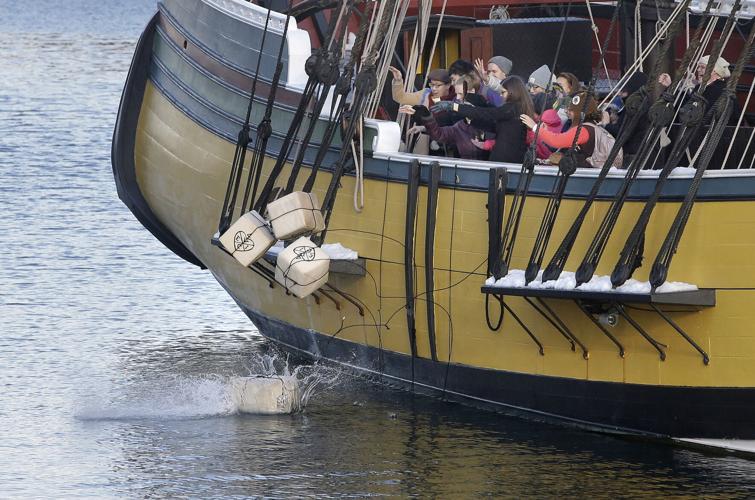
Crowds who gathered to watch the reenactment quickly joined in, shouting “Huzzah!” along with the costumed actors as boxes of tea were dumped in the harbor. Later, they resoundingly booed an actor who read King George III’s order closing the bay, and they cheered as narrators detailed the drafting of the Declaration of Independence.

Visitors to the Boston Tea Party Museum throw replicas of historic tea containers into Boston Harbor on Dec. 11, 2017, from aboard a replica of the vessel Beaver in Boston.
Tea for the reenactment was being supplied by the East India Co., the same British company that was at the center of the raucous dispute.
People are also reading…
Protesting “taxation without representation,” members of the Sons of Liberty and others boarded East India Co. ships and dumped their valuable haul — some 92,000 pounds of tea worth almost $2 million today — into the murky waters of Boston Harbor.
The British responded with military rule and other sanctions on Massachusetts, stoking American opposition to colonial rule.
The Tea Party is considered a pivotal event leading the Revolutionary War.

The Boston Tea Party of 1773 is depicted in an undated engraving.
“It’s a reminder for all of us, not just here in the United States but all over the world, that democracy is in action: Doing what’s right, no matter the odds, for our friends, our families, our homes, our future,” Boston Mayor Michelle Wu said at a news conference Friday previewing the anniversary.
Top national news for the week of Dec. 10
6 dead, nearly 2 dozen injured after severe storms tear through Tennessee
NASHVILLE, Tenn. — Severe storms that tore through central Tennessee killed six people Saturday and sent about two dozen to the hospital as homes and businesses were damaged in multiple cities.
Three people, including a child, were killed after an apparent tornado struck Montgomery County north of Nashville near the Kentucky state line, county officials said in a news release. And the Nashville Emergency Operation Center said in a post on a social media account that three people were killed by severe storms there. Montgomery County officials said another 23 there were treated for injuries at hospitals.
Photos posted by the Clarksvillle fire department on social media showed damaged houses with debris strewn in the lawns, a semitrailer flipped on its side on a highway and insulation ripped out of building walls.

A semitrailer is overturned by an apparent tornado Saturday on West Main Street in Hendersonville, Tenn.
"This is devastating news and our hearts are broken for the families of those who lost loved ones," said Clarksville Mayor Joe Pitts in a statement. "The city stands ready to help them in their time of grief."
No other information about the victims was immediately available.
The Montgomery County Sheriff's Office said in a statement that a tornado touched down about 2 p.m. A shelter was set up at a local high school.
Residents were asked to stay at home while first responders evaluated the situation. In a briefing shared on social media, Pitts said there was extensive damage.
"So please, if you need help, call 911 and help will be on the way immediately. But if you can, please stay home. Do not get out on the roads. Our first responders need time and space," he said.

A business destroyed by a tornado Saturday on West Main in Hendersonville, Tenn.
Shanika Washington said that as soon as she heard the storm sirens going off in her Clarksville neighborhood, she took her children, ages 5 and 10, to a windowless bathroom in the basement of her townhouse.
“The lights were flickering, so I knew it was somewhere close in the vicinity,” she said. “I just kept praying to God as it was going on. It was very terrifying and scary.”
During their 20 harrowing minutes in the bathroom, Washington hovered over her children as a protective shield.
“The back door absolutely did fly open, and you just heard a bunch of wind,” she said. “The blinds and stuff were like shaking really bad. I could tell that we were dead smack in the middle of a storm.”
When she came out of the bathroom, she looked out of a window and saw the destruction: Debris swept onto cars that had their windows broken out. Shutters ripped from homes. Some roofs were ripped off townhouses. Air conditioning units and backyard grills were tossed like toys, and wooden dividers between townhouses were missing.
Because the power in the area was out, Washington took her children to a hotel for the night.
“I’m still shaken up a little bit, so I probably won’t get much sleep tonight,” Washington said. “I’m still trying to just kind of like process it all."

A car is buried under rubble Saturday on Main Street after a tornado hit Hendersonville, Tenn.
Allie Phillips, who lives in Clarksville, said she was grabbing lunch when she began receiving notifications of the tornado that was quickly approaching her neighborhood.
"It was excruciating watching the live stream and not knowing if my house was still there," she said. "When we finally decided to leave, the road to my home was shut down because so many power lines were on the road and we had to take a detour."
Phillips said her home survived with minimal damage — noting her daughter's toys were banged up and a neighbor's dog kennel hit the back of her home — but she was saddened to see that her neighbor's house was missing a roof and a home up the block had all but completely disappeared.
"This doesn't happen enough that you're ever prepared for it," she said.
The National Weather Service issued multiple tornado warnings in Tennessee, and said it planned to survey an area where an apparent tornado hit in Kentucky.
About 85,000 electricity customers were without power in Tennessee on Saturday night, according to PowerOutage.us.
The storm came nearly two years to the day after the National Weather Service recorded 41 tornadoes through a handful of states, including 16 in Tennessee and eight in Kentucky. A total of 81 people died in Kentucky alone.
What might a second Trump presidency look like? Political journalists shift attention to Jan. 20, 2025
NEW YORK — Even before anyone has cast a vote in a 2024 presidential primary, the attention of many political journalists has shifted to Jan. 20, 2025.
There has been a flurry of recent stories about the implications of a potential second presidency for Donald Trump, and his team's planning for Inauguration Day and beyond. Polls show his continued dominance over Republican rivals and the likelihood of a close general election.
The New York Times reporting team of Charlie Savage, Jonathan Swan and Maggie Haberman has been mining that topic since the summer, and last week wrote in depth about the former president's authoritarian impulses, and the possibility of fewer checks on his power. On Sunday, they examined whether Trump would leave NATO.

FILE - Former President Donald Trump speaks at a campaign rally in Hialeah, Fla., Nov. 8, 2023. Even before the 2024 presidential primary, the attention of many political journalists has shifted to Jan. 20, 2025. There's been a flurry of recent stories about the implications of a second presidency for Trump, and his team's planning for Inauguration Day and beyond, with polls showing his continued dominance over Republican rivals and the likelihood of a close general election. (AP Photo/Lynne Sladky, File)
A special issue of The Atlantic magazine released last week collected essays by 24 writers on how a Trump presidency would affect things like foreign policy, immigration, journalism and climate change. Editor Jeffrey Goldberg wrote that people should read every one, "though perhaps not in one sitting, for reasons of mental hygiene."
Among several other pieces:
1. The Washington Post outlined plans by Trump and allies to use the federal government to punish opponents, and Editor-at-large Robert Kagan suggested that a Trump dictatorship was "increasingly inevitable."
2. The Associated Press has written extensively about the implications of Trump's campaign rhetoric. Also, detailed planning by conservative groups for a second Trump term was outlined by AP.

3. Politico's Jack Shafer wrote about Trump's "recipe for a shockingly raw power grab."
4. Axios collected speculation on the possible staffing of a second Trump administration. Can you say Vice President Tucker Carlson?
TOO MUCH? EVEN TRUMP'S PEOPLE PRESCRIBE CAUTION
The volume of stories had reached the point where the Trump campaign at the end of last week sent a memo calling on allies and former aides to cool it, saying messages about a potential second term from anyone but the former president and his team were "an unwelcomed distraction."
"The stakes are high," said David Halbfinger, politics editor at the Times. "We saw on Jan. 6 of 2021, when we cover politics, we don't just cover elections. We cover democracy now. Everybody has to take their jobs seriously, and it's good to see that everybody is."
For decades, journalists have been criticized for concentrating too much on the "horse race" aspect of politics: who's winning, who's losing and the machinations of campaigns. With the Republican and Democratic nomination processes uncompetitive so far, there's less taste for it.
Much of the recent reporting is an emphatic example of what New York University journalism professor Jay Rosen calls "stakes journalism," or examining the potential consequences of an election.
As Trump talks about retribution and his challengers fail to dent his popularity, the story line about threats to democracy "becomes more and more plausible," Rosen said. "Horse race coverage feels more and more trivial. At least it does to me."
At the same time, reporters have discovered the extent to which Trump allies have been specifically planning for a return to power, Halbfinger said. Journalists have learned — or should learn — to take seriously what the former president says while campaigning.
"The skeptics who might have consoled themselves about the first term of Trump, saying that he's too incompetent to get things done, they can't console themselves by saying Trump and his people don't know what they're doing this time," he said. "They've learned a lot and they're preparing."
Goldberg said in an interview that he began thinking of The Atlantic's special issue when reporting this summer for a piece on General Mark Milley's actions in the waning days of the Trump administration. He said he saw the value of putting in one place all of the potential impacts of Trump 2.0 — in what The Atlantic labels "a warning."
While he has no specific metrics about reader response, Goldberg said "I didn't think it would be so galvanizing."
MORE SUCH COVERAGE? OR IS IT BIASED?
Rosen and Margaret Sullivan, who hosts the podcast "American Crisis: Can Journalism Save Democracy?", have repeatedly urged for more of this coverage. Journalists should report "with far more vigor — and repetition — than they do about Biden being 80 years old," Sullivan wrote last month in a column for The Guardian.
Both Sullivan and Rosen said they were encouraged by the recent reporting. Not surprisingly, that's not the case among Trump supporters.
Jordan Boyd said in the Federalist last week that corporate media was trying to "gaslight Americans" and are leading a coordinated effort to paint a potential 2024 Trump victory as the beginning of a cruel and unyielding dictatorship.
There's a "whole new level of panic" in the media about polls that have shown Trump matching up well against President Joe Biden, said Tim Graham, director of media analysis at the conservative watchdog group Media Research Center.
"There's a frustration with, 'Why can't we destroy this guy?'" Graham said. "I think everyone figured that 91 indictments would do the trick and it did the opposite."
The question remains whether the new reporting will be noticed by people who rely mostly on conservative media.
"I'm just not sure it's sinking in to the public in general," said Sullivan, incoming executive director of a journalism ethics center at Columbia University. "There's a lot of people who understand there's a threat to democracy that comes with a second Trump presidency and there are a lot of people who continue to think that it's a normal presidential contest. I don't think that's the case."
Goldberg said he hopes people hand a copy of The Atlantic to "their on-the-fence uncle" over the holidays.
"We have to do whatever we think is right and we have to try as hard as we can to advance the ideas that we think are true and good," he said. "If people listen, great. And if people don't listen, we still have to do it. That's our role. We also want to be able to tell our grandchildren that we tried hard."
___
The 2024 presidential field, in the order they've announced
Donald Trump, Republican

Donald Trump, Republican
Former President Donald Trump, aiming to become only the second commander-in-chief ever elected to two nonconsecutive terms, announced in November that he is seeking the Republican presidential nomination in 2024.
“In order to make America great and glorious again, I am tonight announcing my candidacy for president of the United States,” Trump told a crowd gathered at Mar-a-Lago, his waterfront estate in Florida, where his campaign will be headquartered. - CNN
Nikki Haley, Republican

Nikki Haley, Republican
Nikki Haley, the former South Carolina governor and United Nations ambassador, announced her candidacy for president on Feb. 14, becoming the first major challenger to former President Donald Trump for the 2024 Republican nomination.
The announcement, delivered in a video, marked an about-face for the ex-Trump Cabinet official, who said two years ago that she wouldn't challenge her former boss for the White House in 2024. But she changed her mind in recent months, citing, among other things, the country's economic troubles and the need for "generational change," a nod to the 76-year-old Trump's age.
"You should know this about me. I don't put up with bullies. And when you kick back, it hurts them more if you're wearing heels," Haley said. "I'm Nikki Haley and I'm running for president."
Vivek Ramaswamy, Republican

Vivek Ramaswamy, Republican
Vivek Ramaswamy, a biotech entrepreneur and author, launches his 2024 campaign Feb. 21.
“We’re in the middle of a national identity crisis,” his video announcement began. “Faith, patriotism and hard work have disappeared, only to be replaced by new secular religions like Covidism, climatism and gender ideology.”
He has voiced support for changing the overall U.S. voting age to 25, unless younger Americans fulfill at least six months of service in the military or as a first responder — or pass the same citizenship test administered to those seeking to become naturalized citizens.
Marianne Williamson, Democrat

Marianne Williamson, Democrat
Self-help author Marianne Williamson, whose 2020 White House campaign featured more quirky calls for spiritual healing than actual voter support, launched another longshot bid for the presidency March 4, becoming the first Democrat to formally challenge President Joe Biden for the 2024 nomination.
“We are upset about this country, we’re worried about this country,” Williamson told a crowd of more than 600 at a kickoff in the nation’s capital. “It is our job to create a vision of justice and love that is so powerful that it will override the forces of hatred and injustice and fear.”
Robert F. Kennedy Jr., Independent

Robert F. Kennedy Jr., Democrat
Robert F. Kennedy Jr., a member of one of the country’s most famous political families who has in recent years been linked to some far-right figures, kicked off his campaign in Boston on April 19 and likened his campaign to the American revolution.
“My mission over the next 18 months of this campaign and throughout my presidency will be to end the corrupt merger of state and corporate power that is threatening now to impose a new kind of corporate feudalism in our country,” Kennedy said.
Kennedy is a nephew of President John F. Kennedy and the son of his slain brother Robert F. Kennedy.
On Oct. 9, Kennedy dropped his bid for the Democratic nomination, deciding instead to run as an independent.
Larry Elder, Republican (dropped out)

Larry Elder, Republican
Conservative talk radio host Larry Elder, who sought to replace the California governor in a failed 2021 recall effort, announced April 20 he is running for the Republican presidential nomination in 2024.
Elder, 70, made the announcement on Fox News' “Tucker Carlson Tonight” and followed up with a tweet.
“America is in decline, but this decline is not inevitable. We can enter a new American Golden Age, but we must choose a leader who can bring us there. That’s why I’m running for President,” he wrote.
Elder announced Oct. 26, 2023, that he was ending his campaign and endorsing former President Trump.
President Joe Biden, Democrat

President Joe Biden, Democrat
President Joe Biden on April 25 formally announced that he is running for reelection in 2024, asking voters to give him more time to “finish this job” and extend the run of America’s oldest president for another four years.
Biden, who would be 86 at the end of a second term, is betting his first-term legislative achievements and more than 50 years of experience in Washington will count for more than concerns over his age. He faces a smooth path to winning his party’s nomination, with no serious Democratic challengers. But he’s still set for a hard-fought struggle to retain the presidency in a bitterly divided nation.
Asa Hutchinson, Republican

Asa Hutchinson, Republican
Former Arkansas Gov. Asa Hutchinson formally launched his Republican presidential campaign April 26, pledging to “bring out the best of America” and aiming to draw contrasts with other GOP hopefuls on top issues, including how best to reform federal law enforcement agencies.
Hutchinson kicked off his 2024 bid in his hometown of Bentonville, on the same steps where he launched an unsuccessful U.S. Senate campaign 30 years ago.
“I ran as a conservative Republican when being a Republican was like having a career-ending handicap,” Hutchinson said, adding, “And now, I bring that same vigor to fight another battle, and that battle is for the future of our country and the soul of our party.”
Tim Scott, Republican (dropped out)

Tim Scott, Republican
South Carolina Sen. Tim Scott launched his presidential campaign May 22, offering an optimistic message he hopes can contrast the two figures who have used political combativeness to dominate the early GOP primary field: former President Donald Trump and Florida Gov. Ron DeSantis.
Scott, the Senate's only Black Republican, made the announcement in his hometown of North Charleston at Southern University, his alma mater and a private school affiliated with the Southern Baptist Convention.
“Our party and our nation are standing at a time for choosing. Victimhood or victory?," he told cheering supporters, adding, "Grievance or greatness?"
Scott abruptly announced Sunday, Nov. 12, that he was dropping out of the 2024 race, a development that surprised his donors and stunned his campaign staff just two months before the start of voting in Iowa’s leadoff GOP caucuses.
Ron DeSantis, Republican

Ron DeSantis, Republican
Florida Gov. Ron DeSantis launched his 2024 presidential campaign May 24 with firm words but a disastrous Twitter announcement.
While he tried to project confidence, DeSantis' unusual decision to announce his campaign in an online conversation with Twitter CEO Elon Musk ultimately backfired. The audio stream crashed repeatedly, making it virtually impossible for most users to hear the new presidential candidate in real time.
“American decline is not inevitable — it is a choice. And we should choose a new direction — a path that will lead to American revitalization,” DeSantis said on the glitchy stream, racing through his conservative accomplishments. “I am running for president of the United States to lead our great American comeback."
Mike Pence, Republican (dropped out)

Mike Pence, Republican
Former Vice President Mike Pence opened his bid for the Republican nomination for president June 7 with a firm denunciation of former President Donald Trump, accusing his two-time running mate of abandoning conservative principles and being guilty of dereliction of duty on Jan. 6, 2021.
Pence is the first vice president in modern history to challenge the president under whom he served. While he spent much of his speech, delivered at a community college in a suburb of Des Moines, criticizing Democratic President Joe Biden and the direction he has taken the country, he also addressed Jan. 6 head-on, saying Trump had disqualified himself when he declared falsely that Pence had the power to keep him in office.
Pence dropped out of the race Saturday, Oct. 28, after struggling to raise money and gain traction in the polls.
Chris Christie, Republican

Chris Christie, Republican
Former New Jersey Gov. Chris Christie wasted no time going after Donald Trump while launching his presidential campaign June 6, calling the former president and current Republican primary front-runner a “lonely, self-consumed, self-serving mirror hog" and arguing that he's the only one who can stop him.
Kicking off his campaign with a town hall at Saint Anselm College, Christie suggested that other top Republicans have been afraid to challenge Trump or even mention his name much while campaigning — but made it clear he had no such qualms.
Doug Burgum, Republican (dropped out)

Doug Burgum, Republican (dropped out Dec. 4, 2023)
North Dakota Gov. Doug Burgum, a former software entrepreneur who enacted a slate of laws this year advancing conservative policies on culture war issues, highlighted his small-town roots and business experience as he announced his candidacy for the 2024 Republican presidential nomination on June 7.
The governor of the nation's fourth-least populous state kicked off his campaign in Fargo, near the tiny farm town of Arthur where he grew up.
“Small-town values have guided me my entire life,” Burgum told the crowd. “And frankly, big cities could use more ideas and more values from small towns right now.”
Burgum ended his campaign for the Republican presidential nomination on Monday, Dec. 4, after a stronger-than-expected showing fueled by a gift card-for-campaign donation gimmick that helped get him on the debate stage.
Francis Suarez, Republican (dropped out)

Francis Suarez, Republican (dropped out)
Miami Mayor Francis Suarez announced his bid for the Republican presidential nomination June 15, jumping into the crowded race just days after GOP front-runner Donald Trump appeared in court on federal charges in Suarez's city.
The 45-year-old mayor is the only Hispanic candidate in the race. He has gained national attention in recent years for his efforts to lure companies to Miami, with an eye toward turning the city into a crypto hub and the next Silicon Valley.
Suarez, who is married with two young children, is a corporate and real estate attorney who previously served as a city of Miami commissioner. He has also positioned himself as someone who can help the party further connect with Hispanics. In recent months, he has made visits to early GOP voting states as he weighed a possible 2024 campaign.
Will Hurd, Republican (dropped out)

Will Hurd, Republican (dropped out)
Former Republican Texas congressman Will Hurd suspended his presidential bid and endorsed fellow GOP primary candidate Nikki Haley, officially abandoning a brief campaign built on criticizing Donald Trump at a time when his party seems even more determined to embrace the former president.
Limits on abortion medication, Capitol riot charges at center of latest Supreme Court cases
WASHINGTON — The Supreme Court on Wednesday said it will hear an appeal that could upend hundreds of charges stemming from the Capitol riot, including against former President Donald Trump. It also agreed to take up a dispute over a medication used in the most common method of abortion in the United States, its first abortion case since it overturned Roe v. Wade last year.
The justices will hear appeals from the Biden administration and the maker of the drug mifepristone asking the high court to reverse an appellate ruling that would cut off access to the drug through the mail and impose other restrictions, even in states where abortion remains legal. The restrictions include shortening from the current 10 weeks to seven weeks the time during which mifepristone can be used in pregnancy.
The nine justices rejected a separate appeal from abortion opponents who challenged the Food and Drug Administration's initial approval of mifepristone as safe and effective in 2000.
The case will be argued in the spring, with a decision likely by late June, in the middle of the 2024 presidential and congressional campaigns.
Read more:
Capitol riot charges
The justices will also review an appellate ruling that revived a charge against three defendants accused of obstruction of an official proceeding. The charge refers to the disruption of Congress' certification of Joe Biden's 2020 presidential election victory over Trump.
That's among four counts brought against Trump in special counsel Jack Smith's case that accuses the 2024 Republican presidential primary front-runner of conspiring to overturn the results of his election loss. Trump is also charged with conspiracy to obstruct an official proceeding.
The court's decision to weigh in on the obstruction charge could threaten the start of Trump's trial, currently scheduled for March 4. The justices separately are considering whether to rule quickly on Trump's claim that he can't be prosecuted for actions taken within his role as president. A federal judge already has rejected that argument.

Former President Donald Trump speaks during the New York Young Republican Club's annual gala at Cipriani Wall Street, Saturday, Dec. 9, 2023. (AP Photo/Yuki Iwamura)
The obstruction charge has been brought against more than 300 defendants in the massive federal prosecution following the deadly insurrection on Jan. 6, 2021, when a mob of Trump supporters stormed the Capitol in a bid to keep Biden, a Democrat, from taking the White House.
A lower court judge had dismissed the charge against three defendants, ruling it didn't cover their conduct.
U.S. District Judge Carl Nichols found that prosecutors stretched the law beyond its scope to inappropriately apply it in these cases. Nichols ruled that a defendant must have taken "some action with respect to a document, record or other object" to obstruct an official proceeding under the law.
The Justice Department challenged that ruling, and the appeals court in Washington agreed with prosecutors in April that Nichols' interpretation of the law was too limited.
Other defendants, including Trump, are separately challenging the use of the charge.
Read more:
___
The 9 current justices of the US Supreme Court
Chief Justice John Roberts

Chief Justice John Roberts
Nominated to serve as chief justice by President George W. Bush
Took seat Sept. 29, 2005
Born Jan. 27, 1955, in Buffalo, N.Y.
Justice Clarence Thomas

Associate Justice Clarence Thomas
Nominated to serve as associate justice by President George H.W. Bush
Took seat Oct. 23, 1991
Born June 23, 1948, near Savannah, Georgia
Justice Samuel Alito
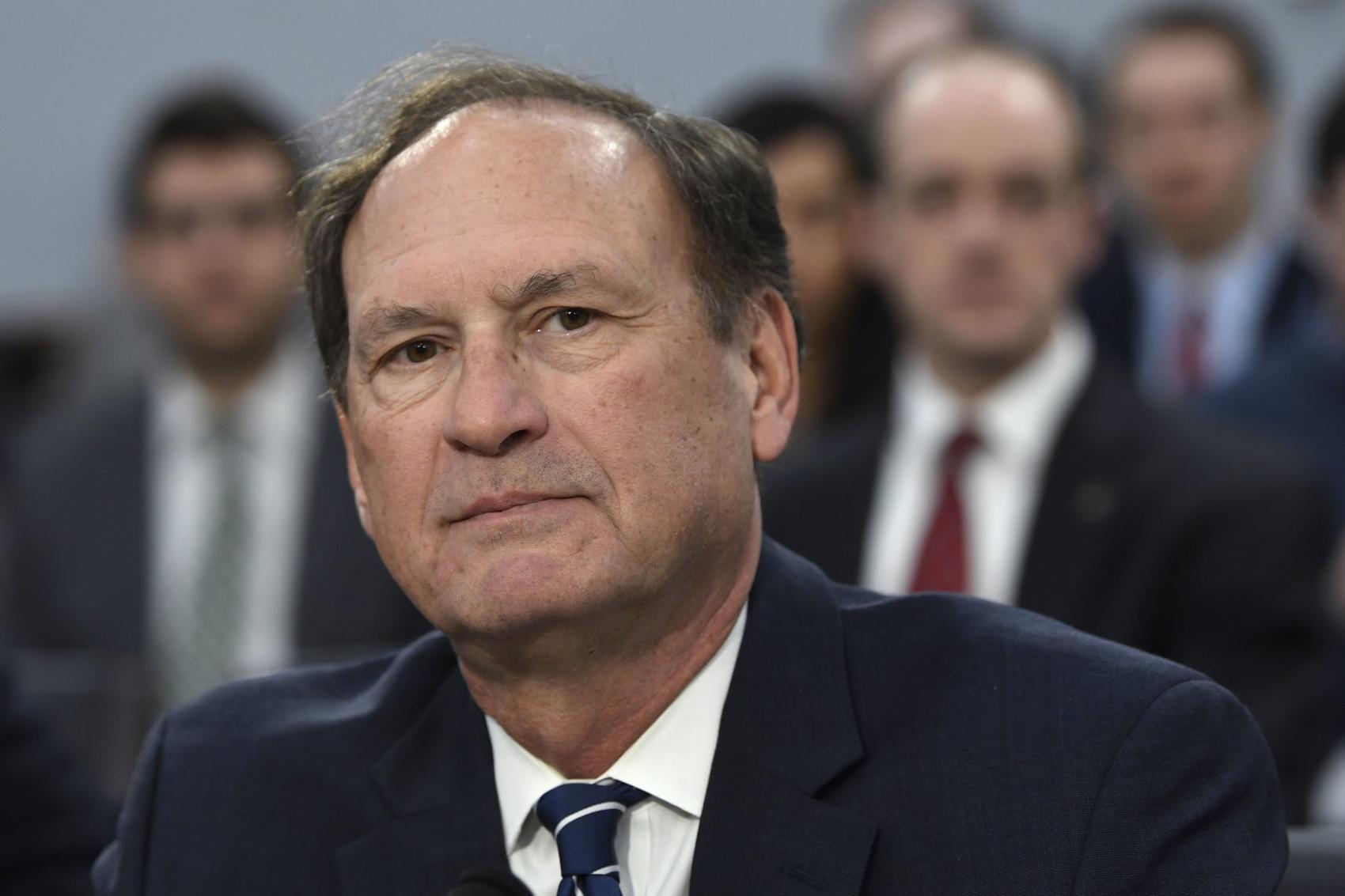
Associate Justice Samuel Alito
Nominated to serve as associate justice by President George W. Bush
Took seat Jan. 31, 2006
Born April 1, 1950, in Trenton, New Jersey
Justice Sonia Sotomayor
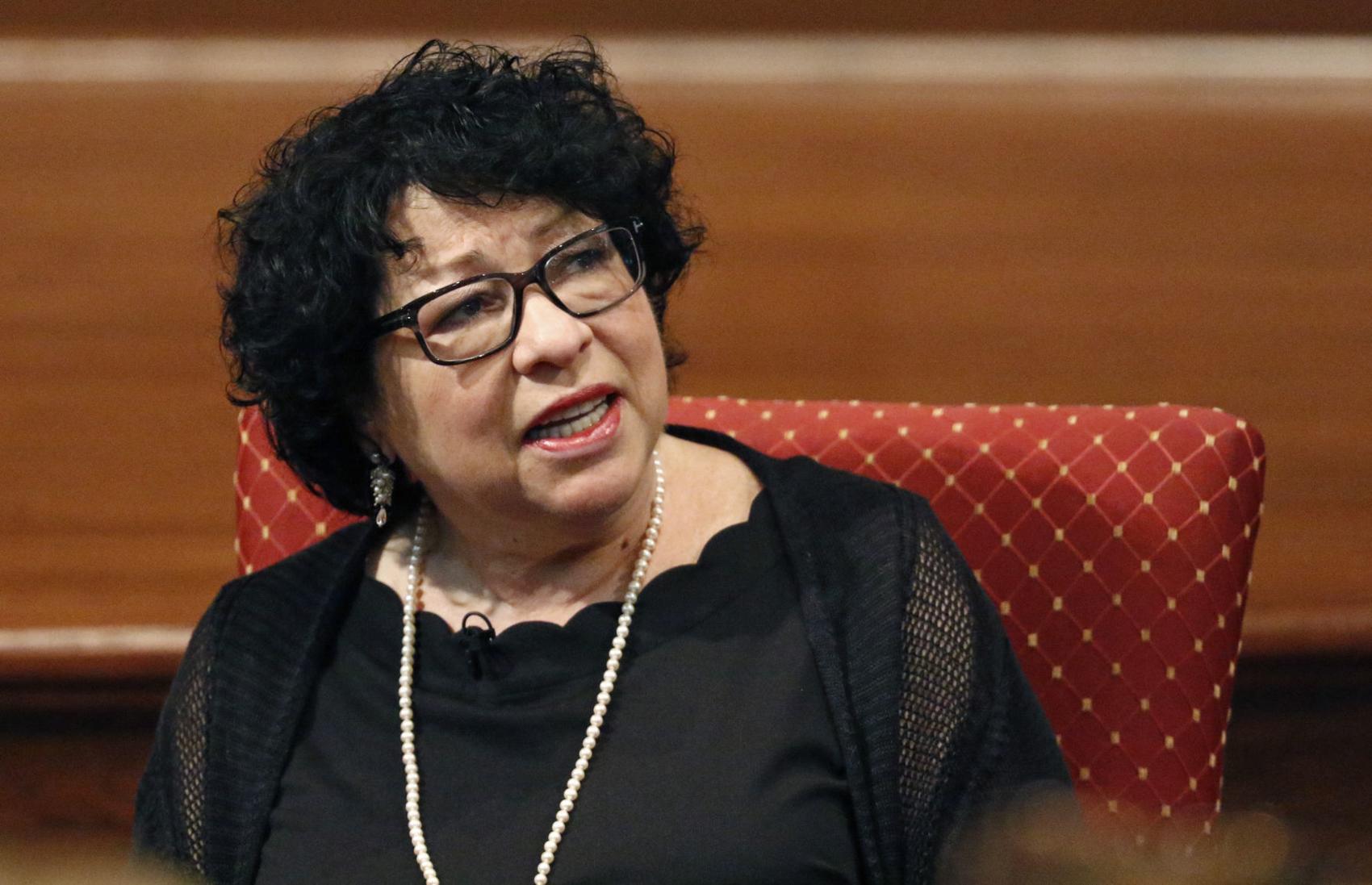
Associate Justice Sonia Sotomayor
Nominated to serve as associate justice by President Barack Obama
Took seat Aug. 8, 2009
Born June 25, 1954, in Bronx, New York
Justice Elena Kagan
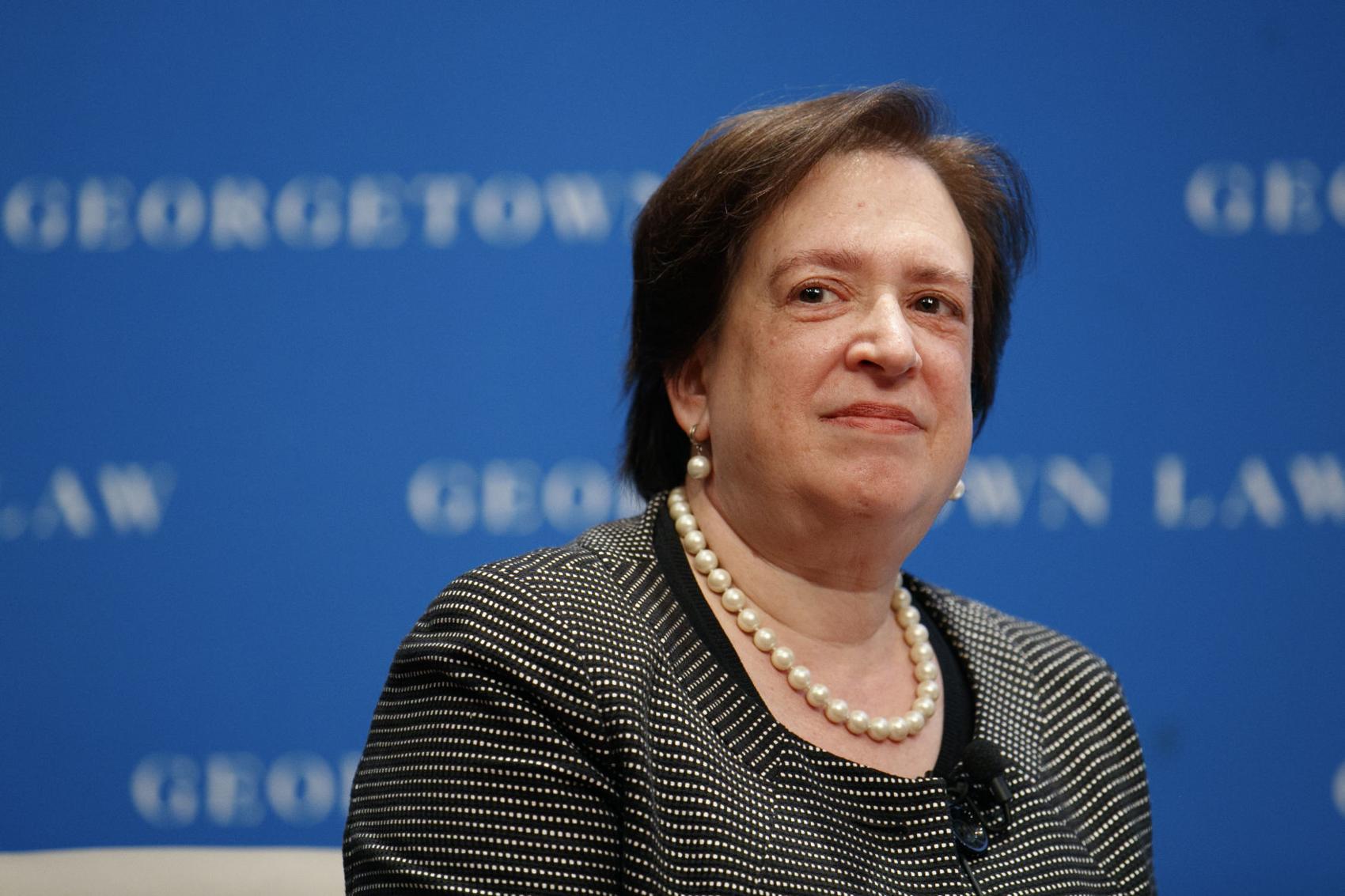
Associate Justice Elena Kagan
Nominated to serve as associate justice by President Barack Obama
Took seat Aug. 7, 2010
Born April 28, 1960, in New York City
Justice Neil Gorsuch

Associate Justice Neil Gorsuch
Nominated to serve as associate justice by President Donald Trump
Took seat April 10, 2017
Born Aug. 29, 1967, in Denver, Colorado
Justice Brett Kavanaugh

Associate Justice Brett Kavanaugh
Nominated to serve as associate justice by President Donald Trump
Took seat Oct. 6, 2018
Born Feb. 12, 1965, in Washington D.C.
Justice Amy Coney Barrett
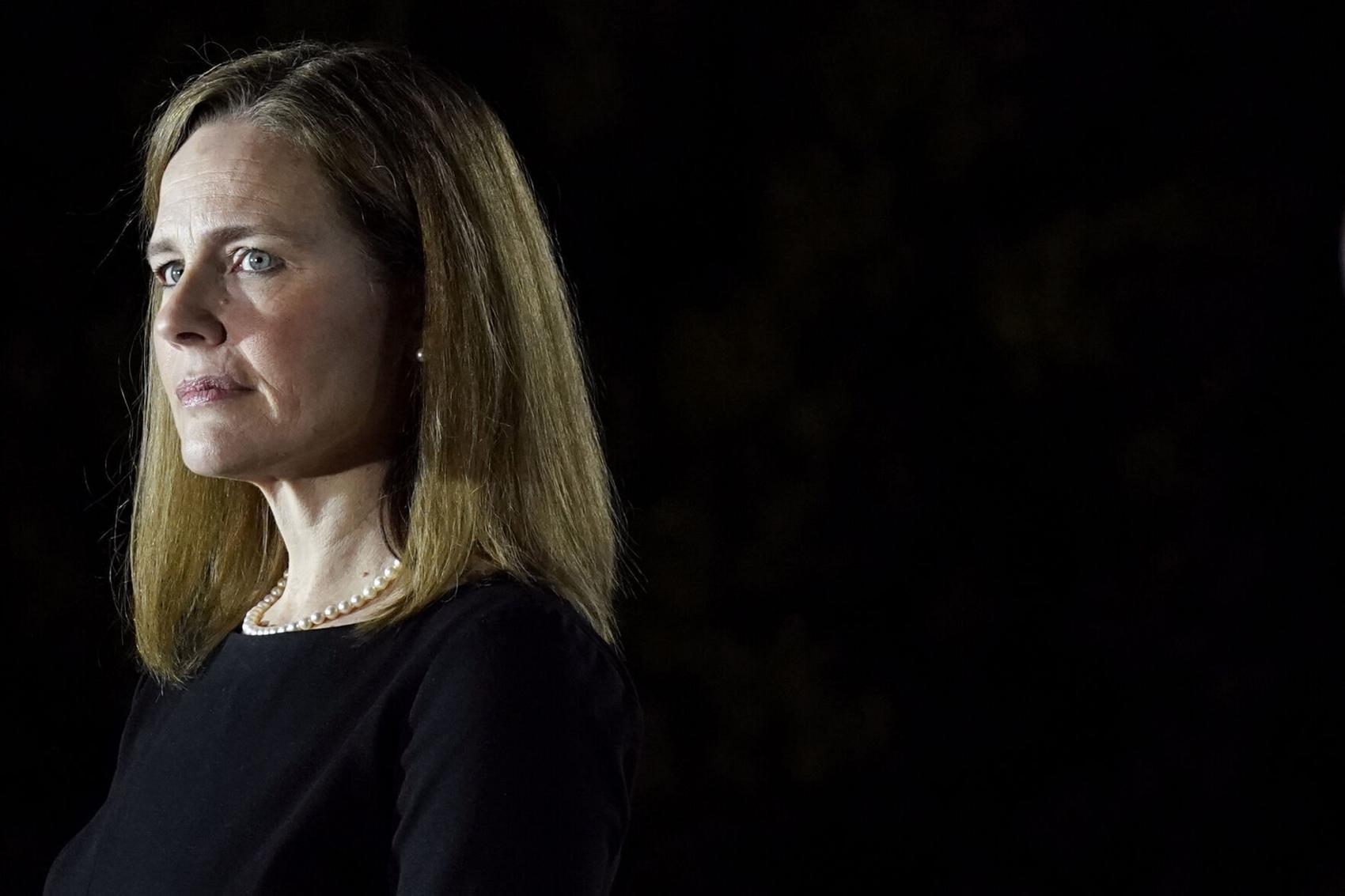
Associate Justice Amy Coney Barrett
Nominated to serve as associate justice by President Donald Trump
Took seat Oct. 27, 2020
Born January 28, 1972
Justice Ketanji Brown Jackson
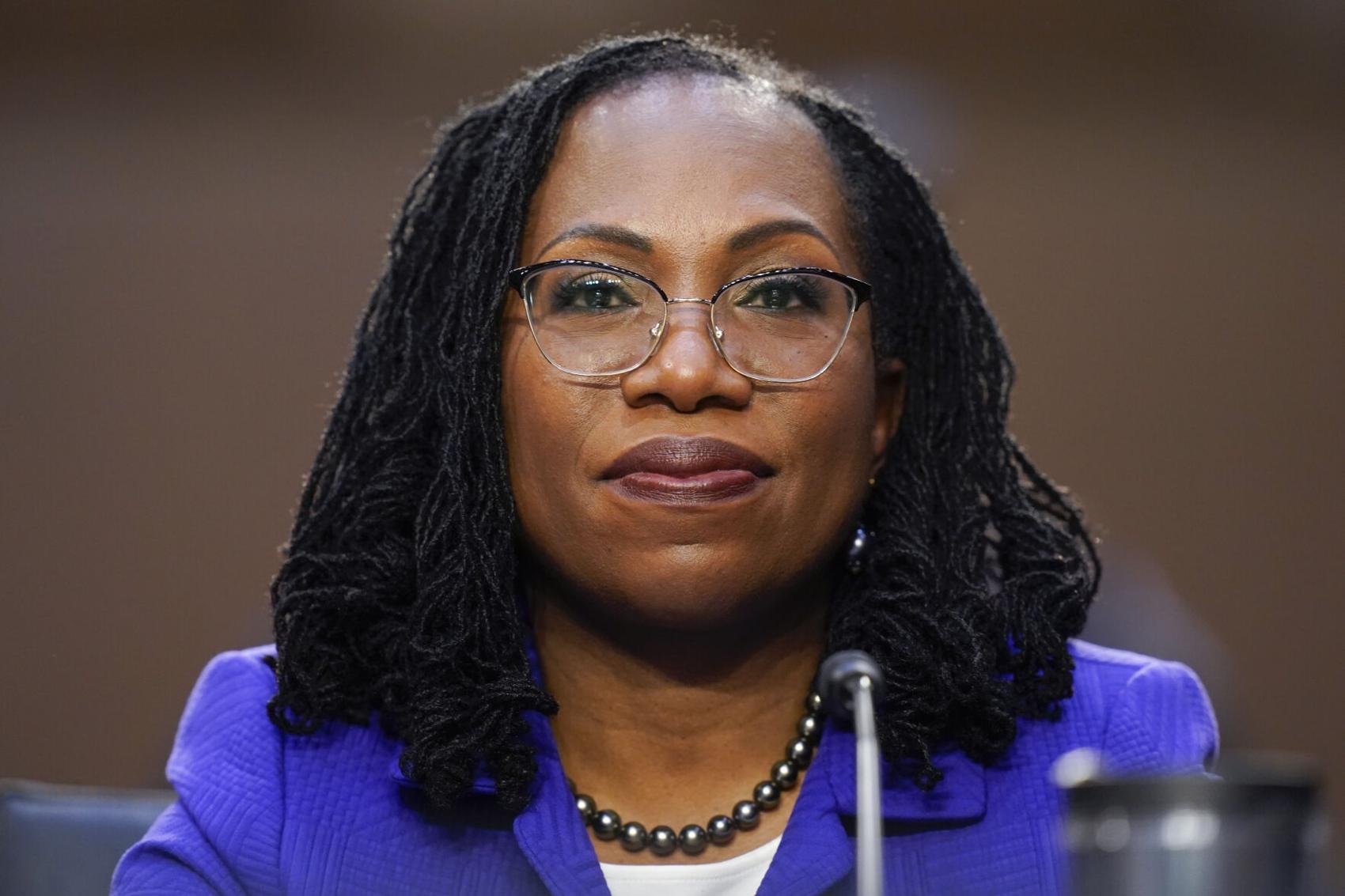
Associate Justice Ketanji Brown Jackson
Nominated to serve as associate justice by President Joe Biden
Took seat June 30, 2022
Born September 14, 1970
Two men charged with killing, selling bald and golden eagles
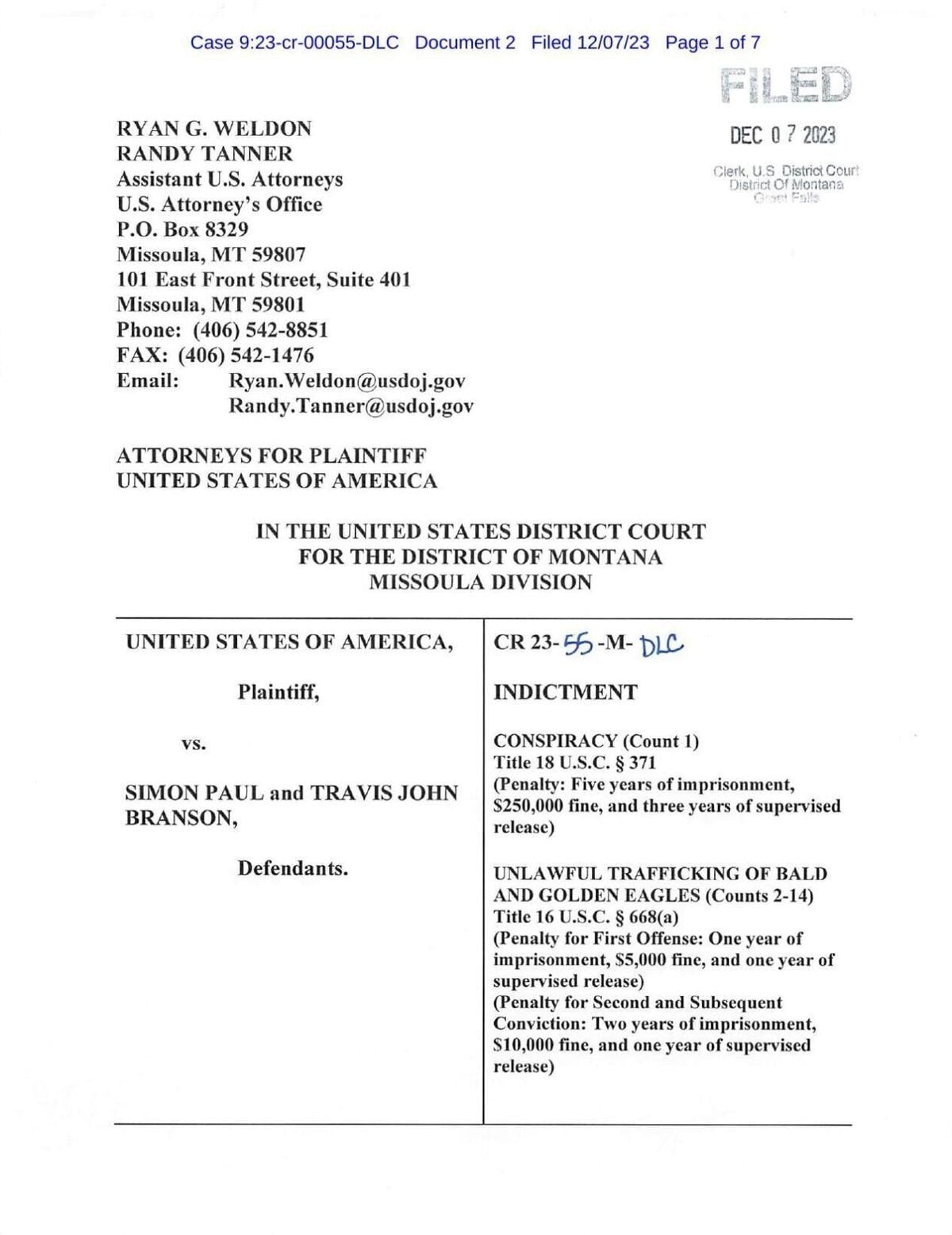
Two men were indicted last week on federal charges of illegally killing and trafficking numerous bald and golden eagles in Montana.
According to a grand jury indictment filed Thursday in U.S. District Court in Missoula, Simon Paul, Travis John Branson and "others" killed about 3,600 birds, eagles among them, during a self-described "killing spree" on the Flathead Indian Reservation north of Missoula and elsewhere. The pair allegedly sold the birds and parts of birds "for significant sums of cash" in the U.S. and internationally.
The events leading to the indictment were alleged to have occurred from about the start of 2015 through about March 2021. Branson allegedly told buyers he was "out (here) committing felonies," according to the indictment. Together, the pair are alleged to have sold whole bald and golden eagles, bald and golden eagle wings, and golden eagle tails.
The indictment charged each defendant with one count of conspiracy and one count of violating the Lacey Act, which prohibits trafficking illegally taken plants or animals. The conspiracy charge carries a penalty of five years in federal prison, three years' probation and a $250,000 fine. The Lacey Act violation is punishable by the same prison sentence and a $20,000 fine.
Additionally, Branson, of Washington state, was charged with eight counts of violating the 1940 Bald and Golden Eagle Protection Act. Paul, of Ronan, was charged with five counts of violating the act.
The law makes it illegal to kill, possess, transport, sell, purchase, import or export bald and golden eagles, their body parts, nests or eggs. The law was expanded in 1962 to cover golden eagles in addition to bald eagles. A first violation is punishable by one year in federal prison, one year of probation and a $5,000 fine. The prison term and fine are doubled for subsequent convictions on the same charge.
In June, a Hardin man was sentenced in federal court in South Dakota to three years in federal prison, one year of probation and $70,000 in restitution for killing 14 juvenile golden eagles and selling their parts. That man, Harvey Hugs, was previously convicted in 2012 of aiding and abetting eagle trafficking.
According to events outlined in last week's indictment, Branson traveled from Washington to the reservation in Montana from 2019 through March 2021 to shoot bald and golden eagles with Paul, who lived near Ronan on the reservation.
"When Branson arrived on the Flathead Indian Reservation," the indictment stated, "Paul would meet and help kill, transport, and ship bald and golden eagles for future sales on the black market."
In one particular incident, Branson allegedly texted a photo of a golden eagle tail to a buyer on Dec. 17, 2020, and received payment for the tail via PayPal the same day. Paul allegedly mailed the tail from St. Ignatius to Texas on Dec. 19. The indictment alleged that Branson received a text from the buyer two days later stating, "Got that thang from Simon. And the mirror feathers. Tnks."
Later, on March 13, 2021, the pair allegedly killed a golden eagle that was lured to a previously killed deer. Paul cleaned the animal, according to the indictment, and the pair "placed various golden eagle parts in the vehicle for transport."
Judge in Trump election case pauses court deadlines as appeal is heard on presidential immunity
WASHINGTON (AP) — Donald Trump’s 2020 election interference case in Washington will be put on hold while the former president further pursues his claims that he is immune from prosecution, the judge overseeing the case ruled Wednesday.
U.S. District Judge Tanya agreed to pause any “further proceedings that would move this case towards trial or impose additional burdens of litigation on Defendant.” But the judge said that if the case returns to her court, she will “consider at that time whether to retain or continue the dates of any still-future deadlines and proceedings, including the trial scheduled for March 4, 2024.”
This is an update. AP’s earlier story follows below:
A look at the 19 people charged in the Georgia indictment connected to Trump's election scheme
Key people in the Georgia election fraud case

Four of the 18 people charged alongside former President Donald Trump with participating in an illegal scheme to overturn the results of the 2020 presidential election in Georgia have now negotiated deals with prosecutors, pleading guilty to reduced charges in exchange for their truthful testimony in future trials.
Lawyer Jenna Ellis on Tuesday became the latest to turn against Trump, pleading guilty to a single felony charge in exchange for a sentence of probation rather than prison time. Fellow attorneys Sidney Powell and Kenneth Chesebro reached similar deals last week, just as their trial in the case was supposed to start because they had invoked their rights to a speedy trial. Bail bondsman Scott Graham Hall last month was the first to plead guilty.
Trump and the others charged in the case have pleaded not guilty.
The sweeping indictment, brought by Fulton County District Attorney Fani Willis, pictured, in August, capped an investigation that had lasted more than two years and marked the fourth criminal case brought against the former president. Its 41 counts include racketeering, violating the oath of a public officer, forgery, false statements and other offenses.
Here’s a look at the 19 people charged:
Donald Trump

Then-President Trump fixated on Georgia after the 2020 general election, refusing to accept his narrow loss in the state and making unfounded assertions of widespread election fraud there. He also called top state officials, including Gov. Brian Kemp, to urge them to find a way to reverse his loss in the state. In a Jan. 2, 2021, phone call with Georgia Secretary of State Brad Raffensperger, Trump suggested the state’s top elections official could help “find” the votes needed for him to win the state. Willis opened the investigation into possible illegal attempts to influence the election shortly after a recording of that call was made public.
Rudy Giuliani

During several legislative hearings at the Georgia Capitol in December 2020, the former New York mayor and Trump attorney promoted unsupported allegations of widespread election fraud in Georgia. Prosecutors have said Giuliani was also involved in a plan to have 16 Georgia Republicans serve as fake electors, falsely swearing that Trump had won the 2020 presidential election and declaring themselves the state’s “duly elected and qualified” electors.
John Eastman

Eastman, one of Trump’s lawyers and a former dean of Chapman University's law school in Southern California, was deeply involved in some of his efforts to remain in power after the 2020 election. He wrote a memo arguing that Trump could remain in power if then-Vice President Mike Pence overturned the results of the electoral certification during a joint session of Congress. That plan included putting in place a slate of “alternate” electors in seven battleground states, including Georgia, who would falsely certify that Trump had won their states.
Mark Meadows

Trump’s chief of staff visited Cobb County, in the Atlanta suburbs, while state investigators were conducting an audit of the signatures on absentee ballot envelopes in December 2020. Meadows obtained the phone number of the chief investigator for the secretary of state’s office, Frances Watson, and passed it along to Trump, who called her. He also participated in the Jan. 2, 2021, phone call between Trump and Georgia Secretary of State Brad Raffensperger.
Sidney Powell

A lawyer and staunch Trump ally, Powell was present for a now-infamous December 2020 meeting at the White House where participants hatched far-fetched schemes. She also was part of a group that met at the South Carolina home of conservative attorney Lin Wood in November 2020 “for the purpose of exploring options to influence the results of the November 2020 elections in Georgia and elsewhere,” prosecutors said. Additionally, prosecutors alleged Powell was involved in arranging for a computer forensics team to travel to rural Coffee County, about 200 miles southeast of Atlanta, to copy data and software from elections equipment there in January 2021.
Kenneth Chesebro
Prosecutors have said Chesebro, an attorney, worked with Republicans in numerous swing states Trump lost, including Georgia, in the weeks after the November 2020 election at the direction of Trump’s campaign. Chesebro worked on the coordination and execution of a plan to have 16 Georgia Republicans sign a certificate declaring falsely that Trump won and declaring themselves the state’s “duly elected and qualified” electors.
Jeffrey Clark

A U.S. Justice Department official who championed Trump’s false claims of election fraud, Clark presented colleagues with a draft letter pushing Georgia officials to convene a special legislative session on the election results, according to testimony before the U.S. House committee that investigated the Jan. 6, 2021, Capitol riot. Clark wanted the letter sent, but Justice Department superiors refused.
Jenna Ellis

The lawyer appeared with Giuliani at a Dec. 3, 2020, hearing hosted by state Republican lawmakers at the Georgia Capitol during which false allegations of election fraud were made. Ellis also wrote at least two legal memos to Trump and his attorneys advising that Pence should “disregard certified electoral college votes from Georgia and other purportedly ‘contested’ states” when Congress met to certify the election results on Jan. 6, 2021, prosecutors said.
Ray Smith
A Georgia-based lawyer, Smith was involved in multiple lawsuits challenging the results of the 2020 election in Georgia. He also gathered witnesses to provide testimony before Georgia legislative subcommittee hearings held in December 2020 on alleged issues with the state’s election.
Robert Cheeley
A Georgia lawyer, Cheeley presented video clips to legislators of election workers at the State Farm Arena in Atlanta and alleged the workers were counting votes twice or sometimes three times. He spoke to the lawmakers after Giuliani.
Michael Roman
A former White House aide who served as the director of Trump’s election day operations, Roman was involved in efforts to put forth a set of fake electors after the 2020 election.
David Shafer

The chairman of the Georgia GOP, Shafer was one of 16 state Republicans who met at the state Capitol on Dec. 14, 2020, to sign a certificate declaring falsely that Trump had won and also declaring themselves the state’s “duly elected and qualified” electors. He also joined Trump in a lawsuit challenging the certification of the 2020 election in Georgia.
Shawn Still
He was one of 16 Georgia Republicans who signed a certificate falsely stating that Trump had won the state and declaring themselves the state’s “duly elected and qualified” electors. Still was the finance chairman for the state GOP in 2020 and served as a Georgia delegate to the Republican National Convention that year. He was elected to the Georgia state Senate in November 2022 and represents a district in Atlanta’s suburbs.
Stephen Cliffgard Lee
Prosecutors say Cliffgard Lee, a pastor, worked with others to try to pressure Georgia election worker Ruby Freeman and her daughter after Trump and his allies falsely accused them of pulling fraudulent ballots from a suitcase during the vote count. Lee allegedly knocked on Freeman’s door, frightening her and causing her to call 911 three times, prosecutors said in a court filing last year.
Harrison William Prescott Floyd
Also known as Willie Lewis Floyd III, he served as director of Black Voices for Trump, and is accused of recruiting Lee to arrange a meeting with Freeman and Chicago-based publicist Trevian Kutti.
Trevian C. Kutti
Prosecutors allege Kutti, a publicist, claimed to have high-level law enforcement connections. They say Freeman met with Kutti at a police precinct, where she brought Floyd into the conversation on a speakerphone. Prosecutors say Kutti presented herself as someone who could help Freeman but then pressured her to falsely confess to election fraud.
Cathy Latham

Latham was one of 16 Georgia Republicans who signed a certificate falsely stating that Trump had won the state and declaring themselves the state’s “duly elected and qualified” electors. She was also chair of the Coffee County Republican Party. She was at the county elections office for much of the day on Jan. 7, 2021, and welcomed a computer forensics team that arrived to copy software and data from the county’s election equipment in what the secretary of state’s office has said was “unauthorized access” to the machines.
Scott Graham Hall
An Atlanta-area bail bondsman, Hall was allegedly involved in commandeering voting information that was the property of Dominion Voting Systems from Coffee County, a small south Georgia jurisdiction. Also charged in the scheme were Powell, Latham and former county elections supervisor Misty Hampton.
Misty Hampton
She was the elections director in Coffee County. Hampton was present in the county elections office on Jan. 7, 2021, when a computer forensics team copied software and data from the county’s election equipment. She also allowed two other men who had been active in efforts to question the 2020 election results to access the elections office later that month and to spend hours inside with the equipment.
Read the Trump indictment in Georgia
Giuliani ordered to pay $148M to Ga. election workers over 2020 vote lies; ‘absurd number,’ ex-NYC mayor says
WASHINGTON — A jury awarded $148 million in damages on Friday to two former Georgia election workers who sued Rudy Giuliani for defamation over lies he spread about them in 2020 that upended their lives with racist threats and harassment.
The damages verdict follows emotional testimony from Wandrea “Shaye” Moss and her mother, Ruby Freeman, who tearfully described becoming the target of a false conspiracy theory pushed by Giuliani and other Republicans as they tried to keep then-President Donald Trump in power after he lost the 2020 election.

Former Mayor of New York Rudy Giuliani arrives at the federal courthouse in Washington, Friday.
There was an audible gasp in the courtroom when the jury foreperson read aloud the $75 million award in punitive damages for the women. Moss and Freeman were each awarded another roughly $36 million in other damages.
“Money will never solve all my problems," Freeman told reporters outside Washington's federal courthouse after the verdict. "I can never move back into the house that I call home. I will always have to be careful about where I go and who I choose to share my name with. I miss my home. I miss my neighbors and I miss my name.”
Giuliani didn't appear to show any emotion as the verdict was read in Washington's federal courthouse after about 10 hours of deliberations. Moss and Freeman hugged their attorneys after the jury left the courtroom and didn't look at Giuliani as he left with his lawyer.
Giuliani told reporters outside Washington's federal courthouse that he will appeal, saying the “absurdity of the number merely underscores the absurdity of the entire proceeding."
“It will be reversed so quickly it will make your head spin, and the absurd number that just came in will help that actually,” he said.
Giuliani had already been found liable in the case and previously conceded in court documents that he falsely accused the women of ballot fraud. Even so, the former New York City mayor continued to repeat his baseless allegations about the women in comments to reporters outside the Washington, D.C., courthouse this week.
Giuliani’s lawyer acknowledged that his client was wrong but insisted that Giuliani was not fully responsible for the vitriol the women faced. The defense sought to largely pin the blame on a right-wing website that published the surveillance video of the two women counting ballots.
Giuliani’s defense rested Thursday morning without calling a single witness after the former mayor reversed course and decided not to take the stand. Giuliani’s lawyer had told jurors in his opening statement that they would hear from his client. But after Giuliani's comments outside court, the judge barred him from claiming in testimony that his conspiracy theories were right.
The judgment adds to growing financial and legal peril for Giuliani, who was among the loudest proponents of Trump’s false claims of election fraud that are now a key part of the criminal cases against the former president.
It's not clear whether Giuliani will ever be able to pay the staggering amount. He had already been showing signs of financial strain as he defends himself against costly lawsuits and investigations stemming from his representation of Trump. In September, his former lawyer sued him, alleging Giuliani had paid only a fraction of nearly $1.6 million in legal fees he racked up. His lawyer suggested that the defamation case could financially ruin the former mayor, saying “it would be the end of Mr. Giuliani.”
And Giuliani is still facing his biggest test yet: fighting criminal charges in the Georgia case accusing Trump and 18 others of working to subvert the results of the 2020 election, won by Democrat Joe Biden, in that state. Giuliani has pleaded not guilty and characterized the case as politically motivated.
Jurors in the defamation case heard recordings of Giuliani falsely accusing the election workers of sneaking in ballots in suitcases, counting ballots multiple times and tampering with voting machines. Trump also repeated the conspiracy theories through his social media accounts. Lawyers for Moss and Freeman, who are Black, also played for jurors audio recordings of the graphic and racist threats the women received.
The women’s lawyers asked for at least $24 million for each woman in defamation damages alone. They also sought compensation for their emotional harm and punitive damages.
On the witness stand, Moss and Freeman described fearing for their lives as hateful messages poured in. Moss told jurors she tried to change her appearance, seldom leaves her home and suffers from panic attacks. Her mother described strangers banging on her door and recounted fleeing her home after people came with bullhorns and the FBI told her she wasn’t safe.
“It’s so scary, anytime I go somewhere, if I have to use my name,” Freeman said, gasping through her tears to get her words out. “I miss my old neighborhood because I was me, I could introduce myself. Now I don’t have a name, really.”
Defense attorney Joseph Sibley told jurors they should compensate the women for what they are owed, but he urged them to “remember this is a great man.”
An attorney for Moss and Freeman, in his closing argument, highlighted how Giuliani has not stopped repeating the false conspiracy theory asserting the workers interfered in the November 2020 presidential election. Attorney Michael Gottlieb played a video of Giuliani outside the courthouse on Monday, in which Giuliani falsely claimed the women were “engaged in changing votes.”
“Mr. Giuliani has shown over and over again he will not take our client’s names out of his mouth,” Gottlieb said. “Facts will not stop him. He says he isn’t sorry and he’s telegraphing he will do this again. Believe him.”
The judge overseeing the election workers’ lawsuit had already ordered Giuliani and his business entities to pay tens of thousands of dollars in attorneys’ fees. In holding Giuliani liable, the judge ruled that the former mayor gave “only lip service” to complying with his legal obligations while trying to portray himself as the victim in the case.
This is a developing story and will be updated.
Read more:
A look at the 19 people charged in the Georgia indictment connected to Trump's election scheme
Key people in the Georgia election fraud case
Four of the 18 people charged alongside former President Donald Trump with participating in an illegal scheme to overturn the results of the 2020 presidential election in Georgia have now negotiated deals with prosecutors, pleading guilty to reduced charges in exchange for their truthful testimony in future trials.
Lawyer Jenna Ellis on Tuesday became the latest to turn against Trump, pleading guilty to a single felony charge in exchange for a sentence of probation rather than prison time. Fellow attorneys Sidney Powell and Kenneth Chesebro reached similar deals last week, just as their trial in the case was supposed to start because they had invoked their rights to a speedy trial. Bail bondsman Scott Graham Hall last month was the first to plead guilty.
Trump and the others charged in the case have pleaded not guilty.
The sweeping indictment, brought by Fulton County District Attorney Fani Willis, pictured, in August, capped an investigation that had lasted more than two years and marked the fourth criminal case brought against the former president. Its 41 counts include racketeering, violating the oath of a public officer, forgery, false statements and other offenses.
Here’s a look at the 19 people charged:
Donald Trump
Then-President Trump fixated on Georgia after the 2020 general election, refusing to accept his narrow loss in the state and making unfounded assertions of widespread election fraud there. He also called top state officials, including Gov. Brian Kemp, to urge them to find a way to reverse his loss in the state. In a Jan. 2, 2021, phone call with Georgia Secretary of State Brad Raffensperger, Trump suggested the state’s top elections official could help “find” the votes needed for him to win the state. Willis opened the investigation into possible illegal attempts to influence the election shortly after a recording of that call was made public.
Rudy Giuliani
During several legislative hearings at the Georgia Capitol in December 2020, the former New York mayor and Trump attorney promoted unsupported allegations of widespread election fraud in Georgia. Prosecutors have said Giuliani was also involved in a plan to have 16 Georgia Republicans serve as fake electors, falsely swearing that Trump had won the 2020 presidential election and declaring themselves the state’s “duly elected and qualified” electors.
John Eastman
Eastman, one of Trump’s lawyers and a former dean of Chapman University's law school in Southern California, was deeply involved in some of his efforts to remain in power after the 2020 election. He wrote a memo arguing that Trump could remain in power if then-Vice President Mike Pence overturned the results of the electoral certification during a joint session of Congress. That plan included putting in place a slate of “alternate” electors in seven battleground states, including Georgia, who would falsely certify that Trump had won their states.
Mark Meadows
Trump’s chief of staff visited Cobb County, in the Atlanta suburbs, while state investigators were conducting an audit of the signatures on absentee ballot envelopes in December 2020. Meadows obtained the phone number of the chief investigator for the secretary of state’s office, Frances Watson, and passed it along to Trump, who called her. He also participated in the Jan. 2, 2021, phone call between Trump and Georgia Secretary of State Brad Raffensperger.
Sidney Powell
A lawyer and staunch Trump ally, Powell was present for a now-infamous December 2020 meeting at the White House where participants hatched far-fetched schemes. She also was part of a group that met at the South Carolina home of conservative attorney Lin Wood in November 2020 “for the purpose of exploring options to influence the results of the November 2020 elections in Georgia and elsewhere,” prosecutors said. Additionally, prosecutors alleged Powell was involved in arranging for a computer forensics team to travel to rural Coffee County, about 200 miles southeast of Atlanta, to copy data and software from elections equipment there in January 2021.
Kenneth Chesebro
Prosecutors have said Chesebro, an attorney, worked with Republicans in numerous swing states Trump lost, including Georgia, in the weeks after the November 2020 election at the direction of Trump’s campaign. Chesebro worked on the coordination and execution of a plan to have 16 Georgia Republicans sign a certificate declaring falsely that Trump won and declaring themselves the state’s “duly elected and qualified” electors.
Jeffrey Clark
A U.S. Justice Department official who championed Trump’s false claims of election fraud, Clark presented colleagues with a draft letter pushing Georgia officials to convene a special legislative session on the election results, according to testimony before the U.S. House committee that investigated the Jan. 6, 2021, Capitol riot. Clark wanted the letter sent, but Justice Department superiors refused.
Jenna Ellis
The lawyer appeared with Giuliani at a Dec. 3, 2020, hearing hosted by state Republican lawmakers at the Georgia Capitol during which false allegations of election fraud were made. Ellis also wrote at least two legal memos to Trump and his attorneys advising that Pence should “disregard certified electoral college votes from Georgia and other purportedly ‘contested’ states” when Congress met to certify the election results on Jan. 6, 2021, prosecutors said.
Ray Smith
A Georgia-based lawyer, Smith was involved in multiple lawsuits challenging the results of the 2020 election in Georgia. He also gathered witnesses to provide testimony before Georgia legislative subcommittee hearings held in December 2020 on alleged issues with the state’s election.
Robert Cheeley
A Georgia lawyer, Cheeley presented video clips to legislators of election workers at the State Farm Arena in Atlanta and alleged the workers were counting votes twice or sometimes three times. He spoke to the lawmakers after Giuliani.
Michael Roman
A former White House aide who served as the director of Trump’s election day operations, Roman was involved in efforts to put forth a set of fake electors after the 2020 election.
David Shafer
The chairman of the Georgia GOP, Shafer was one of 16 state Republicans who met at the state Capitol on Dec. 14, 2020, to sign a certificate declaring falsely that Trump had won and also declaring themselves the state’s “duly elected and qualified” electors. He also joined Trump in a lawsuit challenging the certification of the 2020 election in Georgia.
Shawn Still
He was one of 16 Georgia Republicans who signed a certificate falsely stating that Trump had won the state and declaring themselves the state’s “duly elected and qualified” electors. Still was the finance chairman for the state GOP in 2020 and served as a Georgia delegate to the Republican National Convention that year. He was elected to the Georgia state Senate in November 2022 and represents a district in Atlanta’s suburbs.
Stephen Cliffgard Lee
Prosecutors say Cliffgard Lee, a pastor, worked with others to try to pressure Georgia election worker Ruby Freeman and her daughter after Trump and his allies falsely accused them of pulling fraudulent ballots from a suitcase during the vote count. Lee allegedly knocked on Freeman’s door, frightening her and causing her to call 911 three times, prosecutors said in a court filing last year.
Harrison William Prescott Floyd
Also known as Willie Lewis Floyd III, he served as director of Black Voices for Trump, and is accused of recruiting Lee to arrange a meeting with Freeman and Chicago-based publicist Trevian Kutti.
Trevian C. Kutti
Prosecutors allege Kutti, a publicist, claimed to have high-level law enforcement connections. They say Freeman met with Kutti at a police precinct, where she brought Floyd into the conversation on a speakerphone. Prosecutors say Kutti presented herself as someone who could help Freeman but then pressured her to falsely confess to election fraud.
Cathy Latham
Latham was one of 16 Georgia Republicans who signed a certificate falsely stating that Trump had won the state and declaring themselves the state’s “duly elected and qualified” electors. She was also chair of the Coffee County Republican Party. She was at the county elections office for much of the day on Jan. 7, 2021, and welcomed a computer forensics team that arrived to copy software and data from the county’s election equipment in what the secretary of state’s office has said was “unauthorized access” to the machines.
Scott Graham Hall
An Atlanta-area bail bondsman, Hall was allegedly involved in commandeering voting information that was the property of Dominion Voting Systems from Coffee County, a small south Georgia jurisdiction. Also charged in the scheme were Powell, Latham and former county elections supervisor Misty Hampton.
Misty Hampton
She was the elections director in Coffee County. Hampton was present in the county elections office on Jan. 7, 2021, when a computer forensics team copied software and data from the county’s election equipment. She also allowed two other men who had been active in efforts to question the 2020 election results to access the elections office later that month and to spend hours inside with the equipment.
Read the Trump indictment in Georgia
Falling gas prices helped ease inflation in November, but some costs kept rising
WASHINGTON — U.S. inflation ticked down again last month, with cheaper gas helping further lighten the weight of price increases in the United States.
At the same time, the latest data on consumer inflation showed that prices in some areas — services such as rents, restaurants and auto insurance — continued to rise uncomfortably fast.
Tuesday’s report from the Labor Department said the consumer price index rose just 0.1% from October to November. Compared with a year earlier, prices were up 3.1% in November, down from a 3.2% year-over-year rise in October.

A customer pumps gas at a Chevron station in Columbus, Miss., Monday, Oct. 23, 2023. (AP Photo/Rogelio V. Solis)
But core prices, which exclude volatile food and energy costs, rose 0.3% from October to November, slightly faster than the 0.2% increase the previous month. Measured from a year ago, core prices rose 4%, the same as in October. The Federal Reserve considers core prices to be a better guide to the future path of inflation.
The stickiness of inflation in the economy's service sector will likely keep the Federal Reserve on guard against inflation as it meets this week. Fed Chair Jerome Powell has been scrutinizing such costs as a guide to whether underlying inflationary trends are cooling.
Inflation remains above the Fed's 2% target. And while Powell has expressed optimism about slowing inflation, he said earlier this month that it was “premature” to assume that the Fed was done raising its benchmark interest rate or to speculate about rate cuts, which many on Wall Street expect as early as spring.
Michael Gapen, chief economist at Bank of America, said that persistent inflation in the service sector “fits the ‘wait and see and be careful’ narrative that the Fed is constructing.”
“In terms of building confidence that you’re in a disinflationary environment and opening the door to cuts," Gapen added, “I think you have to say, well, we need more time to assess where services inflation is is going.”

A sign highlighting the financing interest rate is displayed near the price sticker on an unsold 2023 vehicle at a Mercedes-Benz dealer on Thursday, Nov. 30, 2023, in Loveland, Colo. On Tuesday, the Labor Department issues its report on inflation at the consumer level in November. (AP Photo/David Zalubowski)
Prices for such services as hotels, health care and entertainment are heavily determined by wages because they are labor-intensive. And wages are still rising rapidly, though they've eased from pandemic-era peaks.
Restaurant prices are an example. They rose 0.4% from October to November for a third straight month, leaving them 5.3% more expensive than they were a year earlier. Rents are also fueling inflation: They accelerated slightly from October to November. Real-time data from companies like Zillow and ApartmentList, though, suggest that apartment rent growth is slowing. That slowdown has started to bring down the government's official measure of rents and should continue to do so in coming months.
Gas prices tumbled 6% just from October to November. From a peak of $5 about a year and a half ago, the national average has dropped to $3.14 a gallon, according to AAA.
And grocery prices are showing signs of further cooling, which should provide consumers with some relief for one of their most frequent purchases: Food prices ticked up just 0.1% in November and are only 1.7% higher than they were a year ago. Bread, beef, chicken and pork prices all dropped.
Many goods prices, including furniture, clothing and appliances, also fell last month. Used cars were an exception. Their average prices jumped 1.6% in November, though they're still down nearly 4% from 12 months earlier.
The sharp decline in goods prices reflects substantial improvement in global supply chains, which were severely disrupted by the pandemic. At the same time, Americans ramped up spending on cars, stationary bikes and furniture in 2021 and 2022, worsening the bottlenecks for many factory-made items.
In the past year or so, a slower economy and smoother production have helped reduce inflation pressures by making it easier and cheaper for companies to obtain supplies and find workers.
At Christmas Decor, a company that installs holiday decorations for homes and businesses, sales are still growing this year but at a less frantic pace than in the previous two years. In 2021, for example, Brandon Stephens, the company president, was so busy and customers were so willing to spend money on decorations that some people were willing to wait until after Christmas for his company to put up lights and ornaments.
“This year wasn't as feverish as it felt in the last two years,” Stephens said.
Stephens, who imports most of his Christmas lights, Santa statues and greenery, said that in 2021 shipping costs had jumped from $6,000 for a 40-foot container to as much as $30,000. He recommended to his roughly 275 franchisees that they raise prices by 7% to 9% that year to cover the higher costs.
With shipping prices having since dropped back to pre-pandemic levels, Christmas Decor is raising prices more slowly. Still, the cost of some goods and labor remains much higher than before the pandemic. A basic install at a home now costs about $2,300, Stephens said, compared with $1,700 before COVID.
The mixed picture in Tuesday’s inflation report will likely keep the Fed on track to leave its benchmark interest rate unchanged when its latest meeting ends Wednesday. Inflation still exceeds the Fed’s 2% annual target, which is why its officials are set to leave rates high. But inflation is also cooling faster than officials expected, a key reason they likely see no cause to further raise rates, at least for now.
If the Fed leaves rates where they are Wednesday, it will be the third straight time it has done so. The central bank last raised its key rate in July, which suggests that it's probably finished raising borrowing costs.
The central bank has pushed its key rate to about 5.4%, the highest level in 22 years, in a determined drive to conquer inflation. Its rate hikes have made mortgages, auto loans, business borrowing and other forms of credit much costlier, reflecting the Fed’s goal of slowing borrowing and spending enough to tame inflation.
Even if the central bank is done raising rates, it’s expected to keep its benchmark rate at a peak for at least several more months. The Fed raised its key short-term rate 11 times starting in March 2022.
According to a lesser-known inflation gauge that the Fed prefers, core prices rose 3.5% in October compared with 12 months earlier. That was less than the central bank’s forecast of 3.7% for the final three months of this year.
___
House approves impeachment inquiry into Biden as Republicans rally behind probe; president says effort ‘baseless’
WASHINGTON — The House on Wednesday authorized the impeachment inquiry into President Joe Biden, with every Republican rallying behind the politically charged process despite lingering concerns among some in the party that the investigation has yet to produce evidence of misconduct by the president.
The 221-212 party-line vote put the entire House Republican conference on record in support of an impeachment process that can lead to the ultimate penalty for a president: punishment for what the Constitution describes as “high crimes and misdemeanors,” which can lead to removal from office if convicted in a Senate trial.

President Joe Biden speaks Wednesday during a meeting of the National Infrastructure Advisory Council in the Indian Treaty Room on the White House campus in Washington.
Biden, in a rare statement about the impeachment effort, questioned the priorities of House Republicans in pursuing an inquiry against him and his family.
“Instead of doing anything to help make Americans’ lives better, they are focused on attacking me with lies,” the president said following the vote. “Instead of doing their job on the urgent work that needs to be done, they are choosing to waste time on this baseless political stunt that even Republicans in Congress admit is not supported by facts.”
Authorizing the monthslong inquiry ensures that the impeachment investigation extends well into 2024, when Biden will be running for reelection and seems likely to be squaring off against former President Donald Trump — who was twice impeached during his time in the White House. Trump has pushed his GOP allies in Congress to move swiftly on impeaching Biden, part of his broader calls for vengeance and retribution against his political enemies.
The decision to hold a vote came as Speaker Mike Johnson and his team faced growing pressure to show progress in what has become a nearly yearlong probe centered around the business dealings of Biden's family members. While their investigation has raised ethical questions, no evidence has emerged that Biden acted corruptly or accepted bribes in his current role or previous office as vice president.

Speaker of the House Mike Johnson, R-La., speaks Nov. 29 at the Capitol in Washington. The House on Wednesday authorized the impeachment inquiry into President Joe Biden, with every Republican rallying behind the politically charged process.
“We do not take this responsibility lightly and will not prejudge the investigation’s outcome,” Speaker Mike Johnson and his leadership team said in a joint statement after the vote. “But the evidentiary record is impossible to ignore.”
Authorizing the monthslong inquiry ensures that the impeachment investigation extends well into 2024, when Biden will be running for reelection and seems likely to be squaring off against former President Donald Trump — who was twice impeached during his time in the White House. Trump has pushed his GOP allies in Congress to move swiftly on impeaching Biden, part of his broader calls for vengeance and retribution against his political enemies.
White House: ‘baseless fishing expedition’
The decision to hold a vote came as Johnson and his leadership team faced growing pressure to show progress in what has become a nearly yearlong probe centered around the business dealings of Biden's family members. While their investigation has raised ethical questions, no evidence has emerged that Biden acted corruptly or accepted bribes in his current role or previous office as vice president.
Ahead of the vote, Johnson called it “the next necessary step" and acknowledged there are “a lot of people who are frustrated this hasn’t moved faster.”
In a recent statement, the White House called the whole process a “baseless fishing expedition” that Republicans are pushing ahead with “despite the fact that members of their own party have admitted there is no evidence to support impeaching President Biden.”
House Democrats rose in opposition to the inquiry resolution Wednesday.

Rep. Jamie Raskin, D-Md., ranking member of the House Oversight and Accountability Committee, speaks Wednesday during a news conference on Republican's impeachment inquiry into President Joe Biden at the U.S. Capitol.
“This whole thing is an extreme political stunt. It has no credibility, no legitimacy, and no integrity. It is a sideshow," Rep. Jim McGovern, D-Mass., said during a floor debate.
Some House Republicans, particularly those hailing from politically divided districts, had been hesitant in recent weeks to take any vote on Biden's impeachment, fearing a significant political cost. But GOP leaders have made the case in recent weeks that the resolution is only a step in the process, not a decision to impeach Biden. That message seems to have won over skeptics.
“As we have said numerous times before, voting in favor of an impeachment inquiry does not equal impeachment,” Rep. Tom Emmer, a member of the GOP leadership team, said at a news conference Tuesday.
Emmer said Republicans “will continue to follow the facts wherever they lead, and if they uncover evidence of treason, bribery or other high crimes and misdemeanors, then and only then will the next steps towards impeachment proceedings be considered.”
Most of the Republicans reluctant to back the impeachment push have also been swayed by leadership's recent argument that authorizing the inquiry will give them better legal standing as the White House has questioned the legal and constitutional basis for their requests for information.
Democrats unified in opposition
A letter last month from a top White House attorney to Republican committee leaders portrayed the GOP investigation as overzealous and illegitimate because the chamber had not yet authorized a formal impeachment inquiry by a vote of the full House. Richard Sauber, special counsel to the president, also wrote that when Trump faced the prospect of impeachment by a Democratic-led House in 2019, Johnson had said at the time that any inquiry without a House vote would be a “sham.”
Rep. Dusty Johnson, R-S.D., said this week that while there was no evidence to impeach the president, “that’s also not what the vote this week would be about.”
“We have had enough political impeachments in this country,” he said. “I don’t like the stonewalling the administration has done, but listen, if we don’t have the receipts, that should constrain what the House does long-term.”
Rep. Don Bacon, R-Neb., who has long been opposed to moving forward with impeachment, said that the White House questioning the legitimacy of the inquiry without a formal vote helped gain his support. “I can defend an inquiry right now,” he told reporters this week. "Let's see what they find out.”
House Democrats remained unified in their opposition to the impeachment process, saying it is a farce used by the GOP to take attention away from Trump and his legal woes.
“You don’t initiate an impeachment process unless there’s real evidence of impeachable offenses,” said Rep. Jerry Nadler, the ranking Democrat on the House Judiciary Committee, who oversaw the two impeachments into Trump. “There is none here. None.”
Democrats and the White House have repeatedly defended the president and his administration's cooperation with the investigation thus far, saying it has already made a massive trove of documents available.
Congressional investigators have obtained nearly 40,000 pages of subpoenaed bank records and dozens of hours of testimony from key witnesses, including several high-ranking Justice Department officials currently tasked with investigating the president's son, Hunter Biden.
While Republicans say their inquiry is ultimately focused on the president himself, they have taken particular interest in Hunter Biden and his overseas business dealings, from which they accuse the president of personally benefiting. Republicans have also focused a large part of their investigation on whistleblower allegations of interference in the long-running Justice Department investigation into the younger Biden's taxes and his gun use.
Hunter Biden is currently facing criminal charges in two states from the special counsel investigation. He’s charged with firearm counts in Delaware, alleging he broke laws against drug users having guns in 2018, a period when he has acknowledged struggling with addiction. Special counsel David Weiss filed additional charges last week, alleging he failed to pay about $1.4 million in taxes over a three-year period.
Democrats have conceded that while the president's son is not perfect, he is a private citizen who is already being held accountable by the justice system.
“I mean, there’s a lot of evidence that Hunter Biden did a lot of improper things. He’s been indicted, he’ll stand trial,” Nadler said. “There’s no evidence whatsoever that the president did anything improper.”

Hunter Biden arrived for a rare public statement outside the U.S. Capitol on Wednesday, saying he would not be appearing for his scheduled private deposition that morning. The president's son defended himself against years of GOP attacks and said his father has had no financial involvement in his business affairs.
His attorney has offered for Biden to testify publicly, citing concerns about Republicans manipulating any private testimony.
“Republicans do not want an open process where Americans can see their tactics, expose their baseless inquiry, or hear what I have to say,” Biden said outside the Capitol. “What are they afraid of? I am here.”
GOP lawmakers said that since Hunter Biden did not appear, they will begin contempt of Congress proceedings against him. “He just got into more trouble today,” Rep. James Comer, the House Oversight Committee chairman, told reporters Wednesday.
This is a developing story and will be updated.
Read more:
Photos: Biden impeachment inquiry hearings

Oversight Committee Chairman†James Comer, R-Ky., speaks during the House Oversight Committee impeachment inquiry hearing into President Joe Biden, Thursday, Sept. 28, 2023, on Capitol Hill in Washington. (AP Photo/Jacquelyn Martin)

Oversight Committee Chair James Comer, R-Ky., seated right, talks with Ranking Member Rep. Jamie Raskin, D-Md., before the House Oversight Committee begins an impeachment inquiry into President Joe Biden, Thursday, Sept. 28, 2023, on Capitol Hill in Washington. Seated left is Del. Eleanor Holmes Norton, D-D.C. (AP Photo/Jacquelyn Martin)

Rep. Jim Jordan, R-Ohio, speaks during the House Oversight Committee impeachment inquiry hearing into President Joe Biden, Thursday, Sept. 28, 2023, on Capitol Hill in Washington. (AP Photo/Jacquelyn Martin)

Ranking Member Rep. Jamie Raskin, D-Md., second right top, speaks on the Democratic side of the aisle, as the House Oversight Committee begins an impeachment inquiry into President Joe Biden, Thursday, Sept. 28, 2023, on Capitol Hill in Washington. Oversight Committee Chair James Comer, R-Ky., is seated top right. (AP Photo/Jacquelyn Martin)

Oversight Committee Chairman James Comer, R-Ky., speaks with Ranking Member Rep. Jamie Raskin, D-Md., during the House Oversight Committee impeachment inquiry hearing into President Joe Biden, Thursday, Sept. 28, 2023, on Capitol Hill in Washington. (AP Photo/Jacquelyn Martin)

Witnesses are sworn in before the House Oversight Committee impeachment inquiry into President Joe Biden, Thursday, Sept. 28, 2023, on Capitol Hill in Washington. From left are, Jonathan Turley, Shapiro Chair for Public Interest Law at the George Washington University Law School, Eileen O'Connor, former Assistant Attorney General at the Department of Justice, Bruce Dubinsky, with Dubinsky Consulting, and Michael Gerhardt, Burton, Craige Distinguished Professor of Jurisprudence, University of North Carolina at Chapel Hill,(AP Photo/Jacquelyn Martin)

Jonathan Turley, Shapiro Chair for Public Interest Law at the George Washington University Law School, speaks during the House Oversight Committee impeachment inquiry into President Joe Biden, Thursday, Sept. 28, 2023, on Capitol Hill in Washington. (AP Photo/Jacquelyn Martin)
An asteroid will pass in front of the bright star Betelgeuse to produce a rare eclipse visible to millions
CAPE CANAVERAL, Fla. — One of the biggest and brightest stars in the night sky will momentarily vanish as an asteroid passes in front of it to produce a one-of-a-kind eclipse.
The rare and fleeting spectacle, late Monday into early Tuesday, should be visible to millions of people along a narrow path stretching from central Asia's Tajikistan and Armenia, across Turkey, Greece, Italy and Spain, to Miami and the Florida Keys and finally, to parts of Mexico.
The star is Betelgeuse, a red supergiant in the constellation Orion. The asteroid is Leona, a slowly rotating, oblong space rock in the main asteroid belt between Mars and Jupiter.

This image made with the Hubble Space Telescope and released by NASA on Aug. 10, 2020 shows the star Alpha Orionis, or Betelgeuse, a red supergiant. The star, one of the biggest and brightest in the night sky, will momentarily vanish as an asteroid passes in front of it late Monday, Dec. 11, 2023, into early Tuesday. The event should be visible to millions of people along a narrow corridor stretching from central Asia’s Tajikistan and Armenia, across Turkey, Greece, Italy and Spain, all the way to Miami and the Florida Keys, and, finally, Mexico. (Andrea Dupree (Harvard-Smithsonian CfA), Ronald Gilliland (STScI), NASA and ESA via AP)
Astronomers hope to learn more about Betelgeuse and Leona through the eclipse, which is expected to last no more than 15 seconds. By observing an eclipse of a much dimmer star by Leona in September, a Spanish-led team recently estimated the asteroid to be about 34 miles wide and 50 miles long (55 kilometers wide and 80 kilometers long).
There are lingering uncertainties over those predictions as well as the size of the star and its expansive atmosphere. It's unclear if the asteroid will obscure the entire star, producing a total eclipse. Rather, the result could be a "ring of fire" eclipse with a miniscule blazing border around the star. If it's a total eclipse, astronomers aren't sure how many seconds the star will disappear completely, perhaps up to 10 seconds.
"Which scenario we will see is uncertain, making the event even more intriguing," said astronomer Gianluca Masa, founder of the Virtual Telescope Project, which will provide a live webcast from Italy.
An estimated 700 light-years away, Betelgeuse is visible with the naked eye. Binoculars and small telescopes will enhance the view. A light-year is 5.8 trillion miles.
Betelgeuse is thousands of times brighter than our sun and some 700 times bigger. It's so huge that if it replaced our sun, it would stretch beyond Jupiter, according to NASA.
At just 10 million years old, Betelgeuse is considerably younger than the 4.6 billion-year-old sun. Scientists expect Betelgeuse to be short-lived, given its mass and the speed at which it's burning through its material.
After countless centuries of varying brightness, Betelgeuse dimmed dramatically in 2019 when a huge bunch of surface material was ejected into space. The resulting dust cloud temporarily blocked the starlight, NASA said, and within a half year, Betelgeuse was as bright as before.
Scientists expect Betelgeuse to go supernova in a violent explosion within 100,000 years.
___
The Associated Press Health and Science Department receives support from the Howard Hughes Medical Institute's Science and Educational Media Group. The AP is solely responsible for all content.
___
50 images of the universe from the Hubble Space Telescope
50 images of the universe from the Hubble Space Telescope
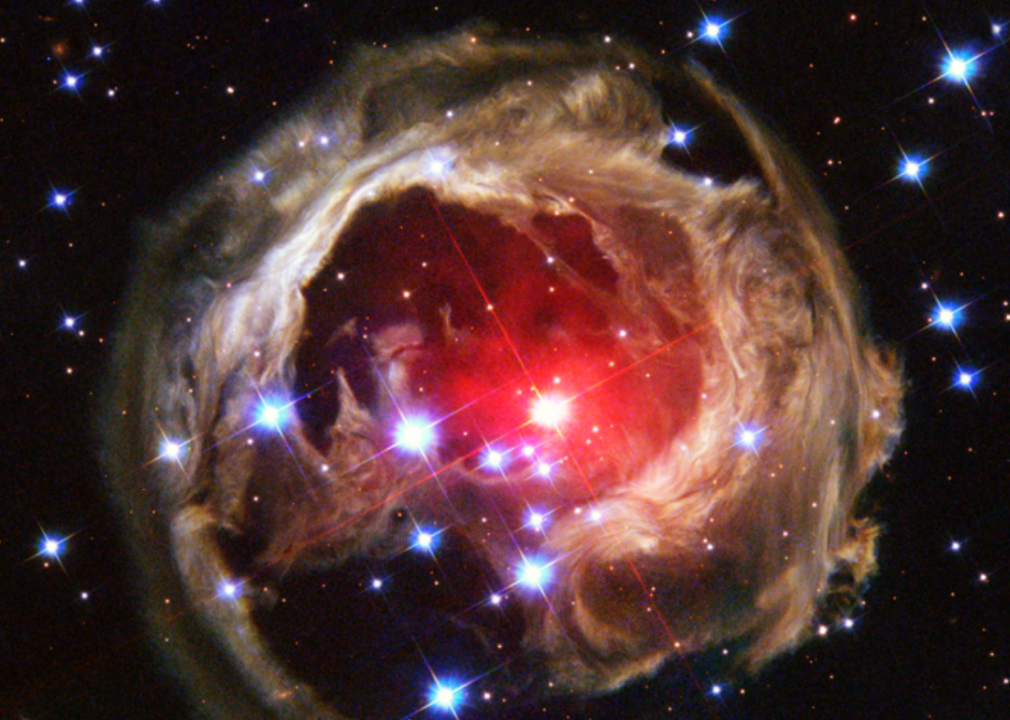
On April 24, 1990, the Space Shuttle Discovery launched, carrying the Hubble Space Telescope (HST, or just "Hubble"). This orbiting telescope was the first of NASA's Great Observatories. For more than 30 years, HST has provided astronomers with incredible scientific data on everything from solar system objects to some of the most distant galaxies in the cosmos. Hubble was named for American astronomer Edwin Hubble, who in the early 20th century helped establish that the universe is much bigger than the Milky Way and showed the cosmos is expanding.
Stacker collected 50 Hubble images, taken between 1990 and 2020, that express both the beauty of the universe and important scientific knowledge. HST is a bus-sized satellite containing a 2.4-meter-diameter mirror for focusing light from distant objects, along with a suite of instruments for photography, measuring light intensity, and taking the spectrum of various astronomical sources. Hubble is primarily an optical telescope, viewing the cosmos in the same type of light we can see, and it also has the ability to see into the infrared and ultraviolet parts of the spectrum of light. The size of the telescope and its location above Earth's atmosphere (with its pesky weather and distortions from air currents) make HST one of the best optical telescopes still in operation.
HST is jointly operated by NASA and the European Space Agency and was designed to be serviced by astronauts. Unfortunately, the Hubble needed to be repaired immediately after launch, when it turned out its mirror was slightly flawed. NASA astronauts installed additional mirrors to compensate for the flaws in 1993 and upgraded other scientific instruments on five different occasions, with the last upgrade being in 2009. Meanwhile, no plans are in the works to build an equivalent space telescope, so astronomers and nonscientists alike hope Hubble will continue to work indefinitely.
Click on for 50 images of the universe as seen from the Hubble Space Telescope.
You may also like: Space discoveries that will blow your mind

The Pillars of Creation (1995)
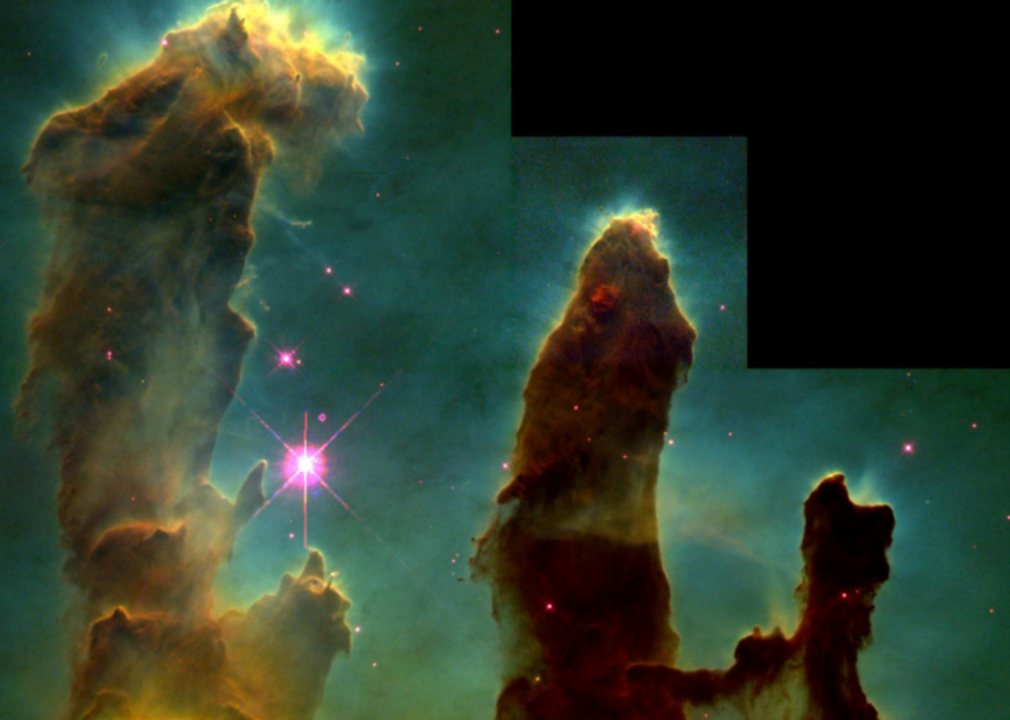
Perhaps Hubble's most popular image involves part of the Eagle Nebula known as the "Pillars of Creation." The Eagle Nebula is a star-forming region of the Milky Way, which means a cold cloud of gas and dust dense enough for gravity to take hold and collapse material into new stars. Ultraviolet light from these newborn stars erodes the nebula away, leaving the beautifully sculpted pillars in the image.
The Eagle Nebula in Infrared (2015)
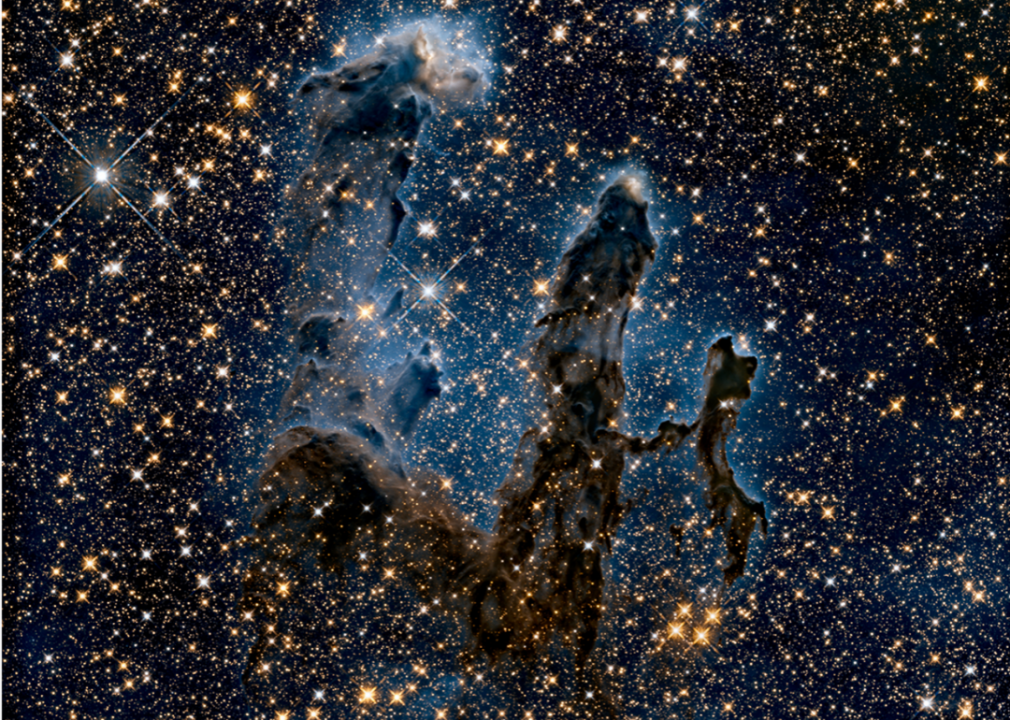
The dense gas and dust of the Eagle Nebula are opaque in visible light but transparent to infrared. Hubble's infrared vision of the Pillars of Creation reveals they are harboring additional baby stars swaddled in gas.
Prelude to a Cosmic Explosion (1995)
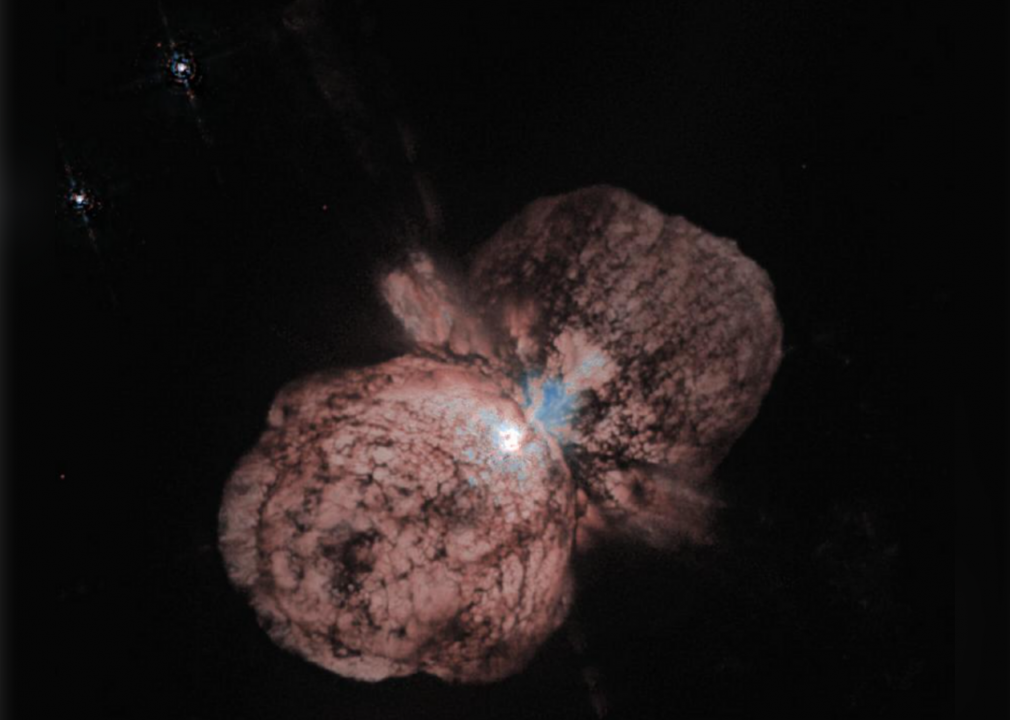
In the early 1800s, the unremarkable star Eta Carinae in the southern constellation Carina grew suddenly brighter, briefly becoming the second-brightest star in the entire sky before fading. Later observations, including the one that produced this famous Hubble image, showed that Eta Carinae is actually two very massive stars shedding matter in two huge lobes of gas. Astronomers think these stars are unstable and will eventually explode in a supernova.
The Giant Next Door (2015)

Andromeda Galaxy (also known as M31) is the closest large galaxy to our Milky Way, near enough for astronomers to distinguish individual stars. This Hubble mosaic of a portion of Andromeda is the biggest image the telescope has made (constructed of 7,398 individual exposures!), containing over 100 million visible stars. Like the Milky Way, M31 is a spiral galaxy, with many of its brightest stars clustered in arms winding out from the galactic center.
The King of Planets (2017)
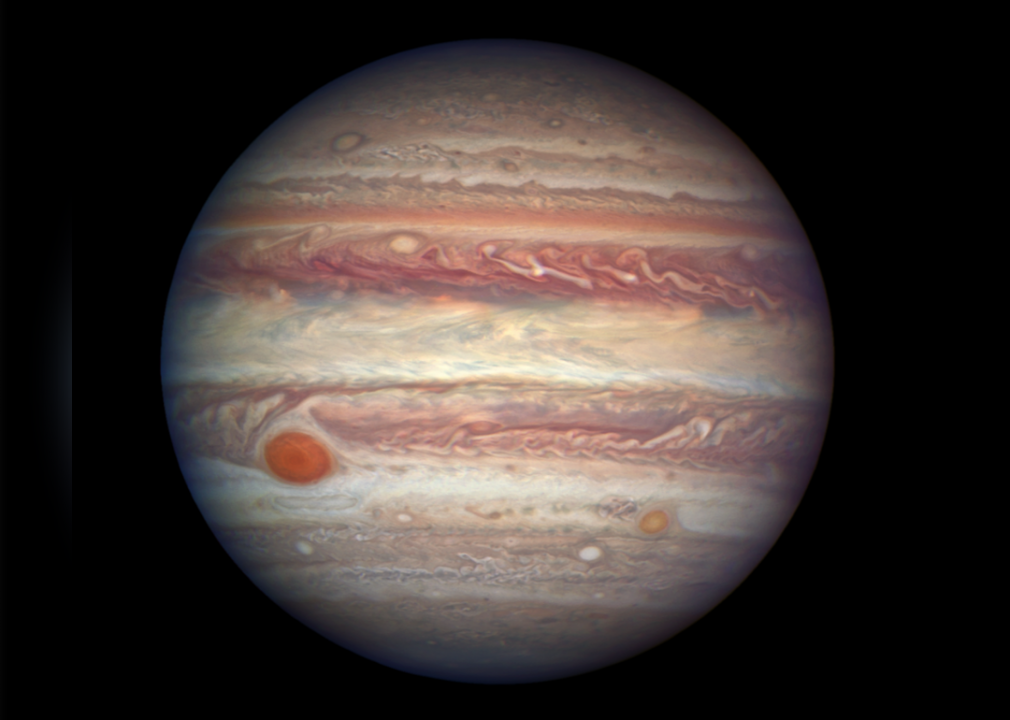
While much of Hubble's greatest work involves distant stars and galaxies, the observatory has also provided a wealth of information about our solar system. This 2017 image of Jupiter is part of an HST program to chart changes in the atmospheres of the giant outer planets. In particular, astronomers are watching the way Jupiter's famous Great Red Spot (known since the time of Galileo) is shrinking.
You may also like: The best streaming services in 2021
Jupiter's Auroras (2016)
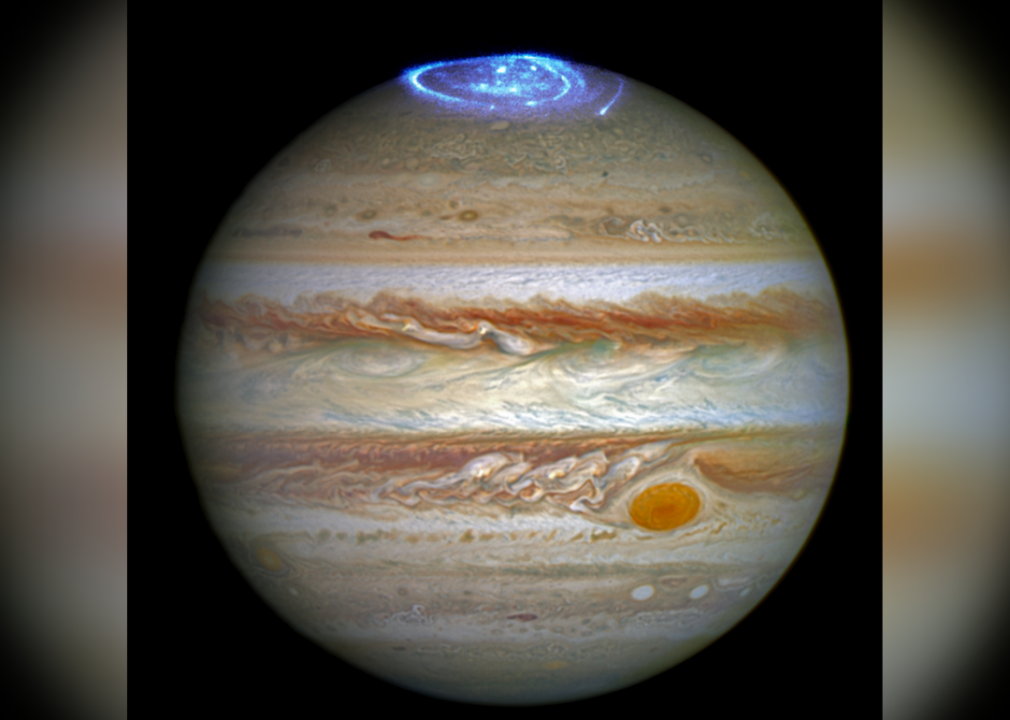
Auroras are caused when electrically charged particles cascade into a planet's atmosphere. On Earth, these are the northern and southern lights visible at high latitudes; Jupiter, being a much bigger planet with a huge magnetic field, has proportionally larger auroras. Hubble captured Jupiter's auroras using its ultraviolet instrument, and this picture was constructed by overlaying the UV image over a visible-light photo.
Galaxies in Collision (2010)
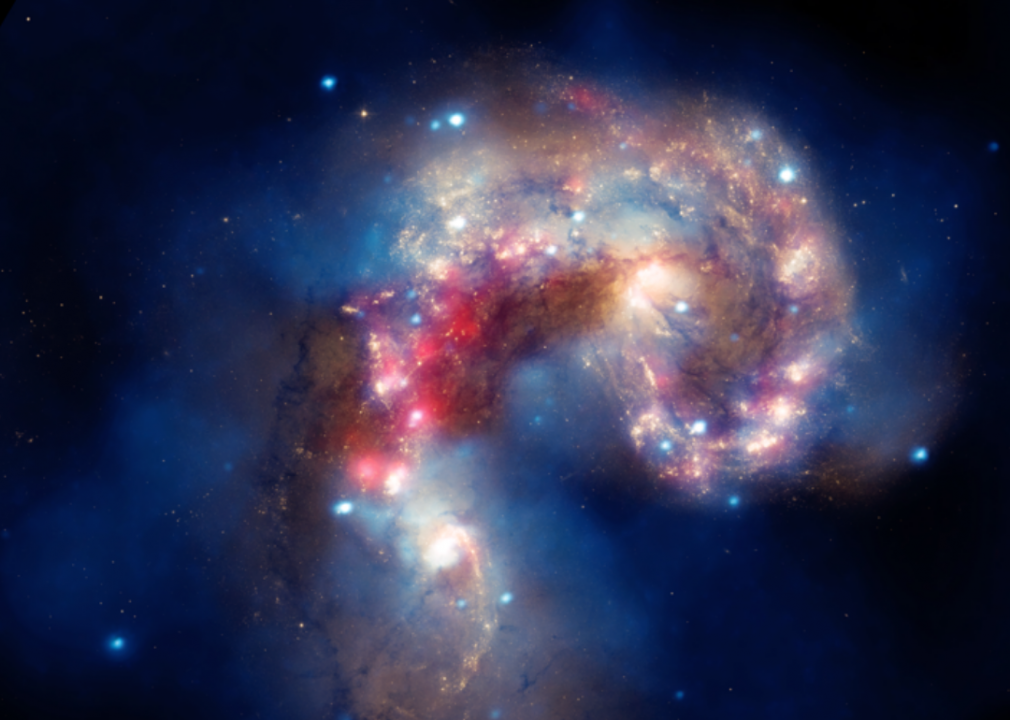
The Antennae Galaxies are a pair of galaxies in the process of colliding, a slow process taking hundreds of millions of years. This picture combines images from NASA's Great Observatories—Hubble (visible light), the Spitzer Infrared Observatory (infrared), and the Chandra X-ray Observatory (X-rays)—highlighting how these premiere space telescopes work together. The collision between the galaxies is producing new stars at a fast rate.
It's Full of Galaxies (1996)

In 1996, astronomers pointed HST at a small unremarkable spot on the sky nearly empty of stars and took pictures for 10 days to get a clear view deep into the cosmos. The 342 photos assembled from the project make up the Hubble Deep Field Survey and contain roughly 3,000 individual galaxies, some billions of light-years away. In fact, nearly everything you see in this image is a galaxy, revealing the diversity and evolution of galaxies over the history of the universe.
Echoes from an Explosion (2010)
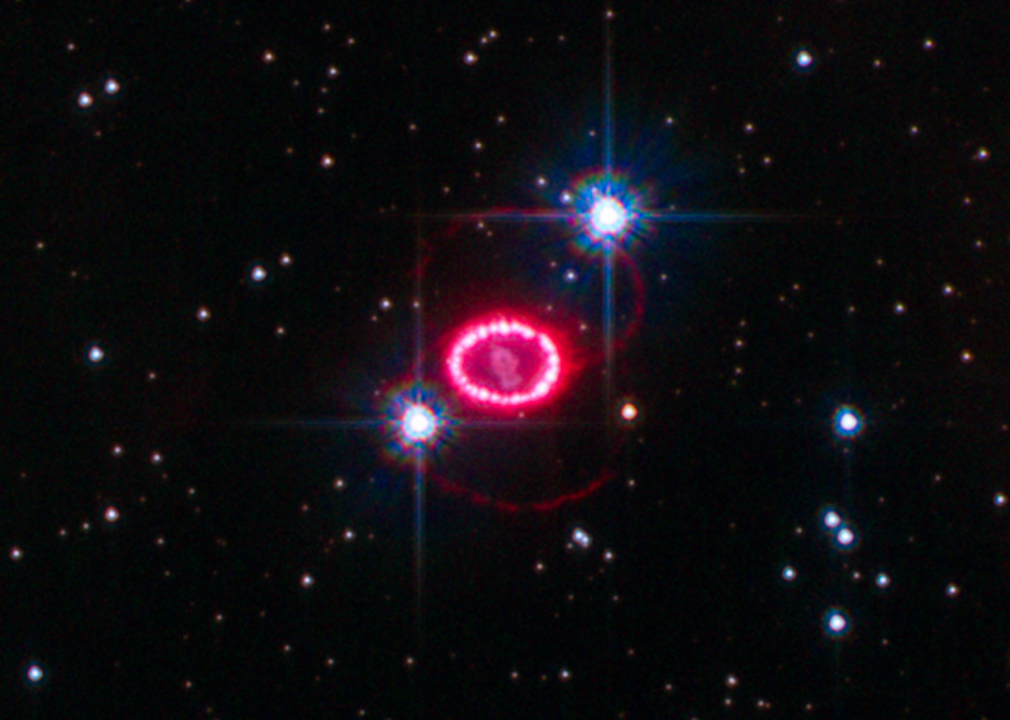
In early 1987, astronomers spotted a new bright point of light in the nearby galaxy in the Large Magellanic Cloud: Supernova 1987A, the explosion of a massive star. Because it is the closest supernova in modern times, astronomers have been able to track the aftereffects of the explosion. This 2010 Hubble image shows expanding bubbles of matter blasted away from the dying star, producing beads of light where the material slammed into clumps of gas in the surrounding region.
The First Image of Another Star (1996)

Despite the power of modern telescopes like HST, most stars other than the sun are too far away to be anything but points of light. However, Hubble captured the first details on another star in 1996: the red giant Betelgeuse, which is part of the constellation Orion. As the diagram shows, Betelgeuse is so huge it's no longer spherical; in 2020, material ejected from the star blocked enough of its light that it dimmed visibly.
You may also like: History of famous firsts in space
Seeing With Gravity's Telescope (2018)
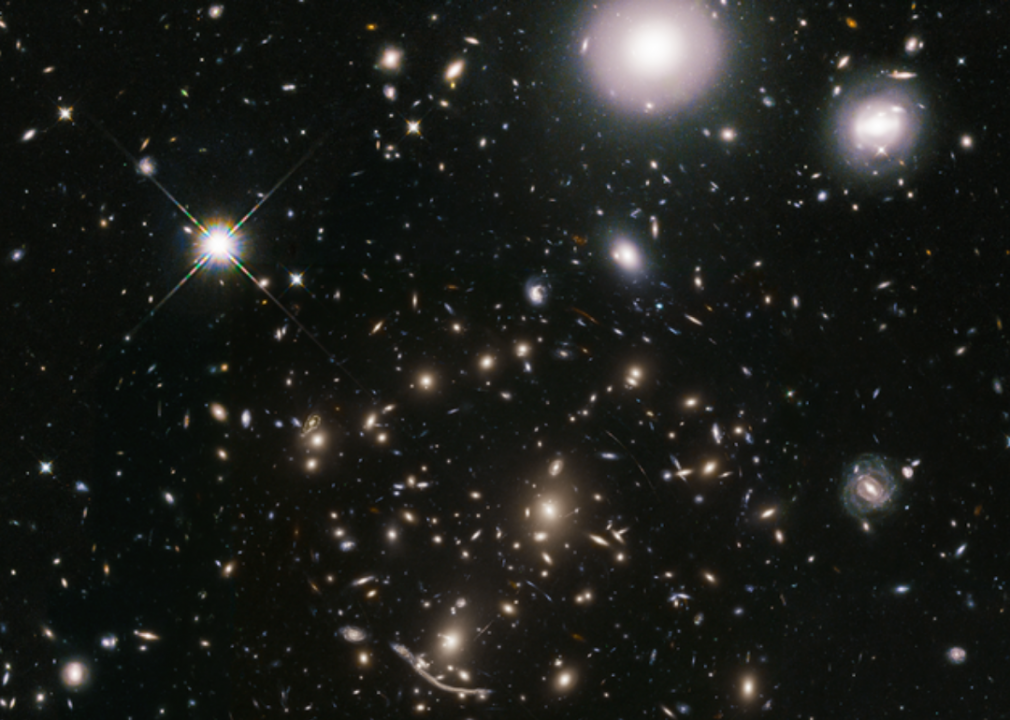
Galaxy clusters are the largest objects in the universe held together by gravity and can consist of thousands of individual galaxies. Abel 370 has so much mass (mostly in the form of mysterious invisible dark matter) that its gravity focuses light from more distant galaxies, producing magnified and distorted images of objects too far to be seen ordinarily. You can see some of those magnified galaxies in this HST image, appearing as smeared arcs of light.
Five Moons for Tiny Pluto (2012)

Before the New Horizons probe arrived on Pluto in 2015, astronomers turned HST to the dwarf planet to look for any potential hazards. This 2012 image shows Pluto's five moons, including a fifth previously unknown moon, now known as Styx. Hubble was also used to discover the moons Nix, Hydra, and Kerberos, which are too small to be seen with less powerful telescopes.
A Dying Star and an Hourglass (1996)

Smaller stars like our sun don't explode as supernovas but shed material as they die. Some of these form "planetary nebulas" like the Hourglass Nebula, which forms two interlinked bubbles of gas. The eerie effect here is because Hubble doesn't "see" color the way people do, so the image colors (and many other images in this slideshow) correspond to the presence of particular types of atoms or molecules: green for hydrogen, red for nitrogen, and blue for ionized oxygen.
The Horsehead Nebula in Infrared (2013)
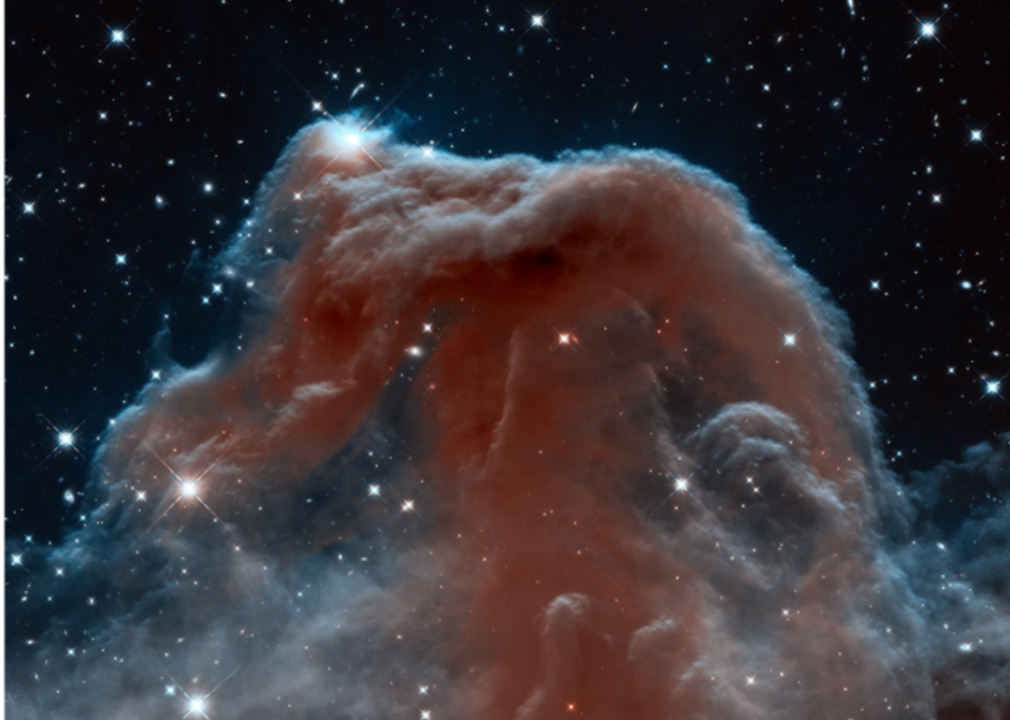
The Horsehead Nebula in the constellation of Orion is one of the most popular objects to look at through backyard telescopes, where it looks like a horse-shaped shadow against background stars. This HST infrared image shows newborn stars hiding inside the billowing nebula gas. Like the Eagle Nebula, the Horsehead is being eroded by ultraviolet light from nearby young, hot stars.
A Jet from a Black Hole (2010)
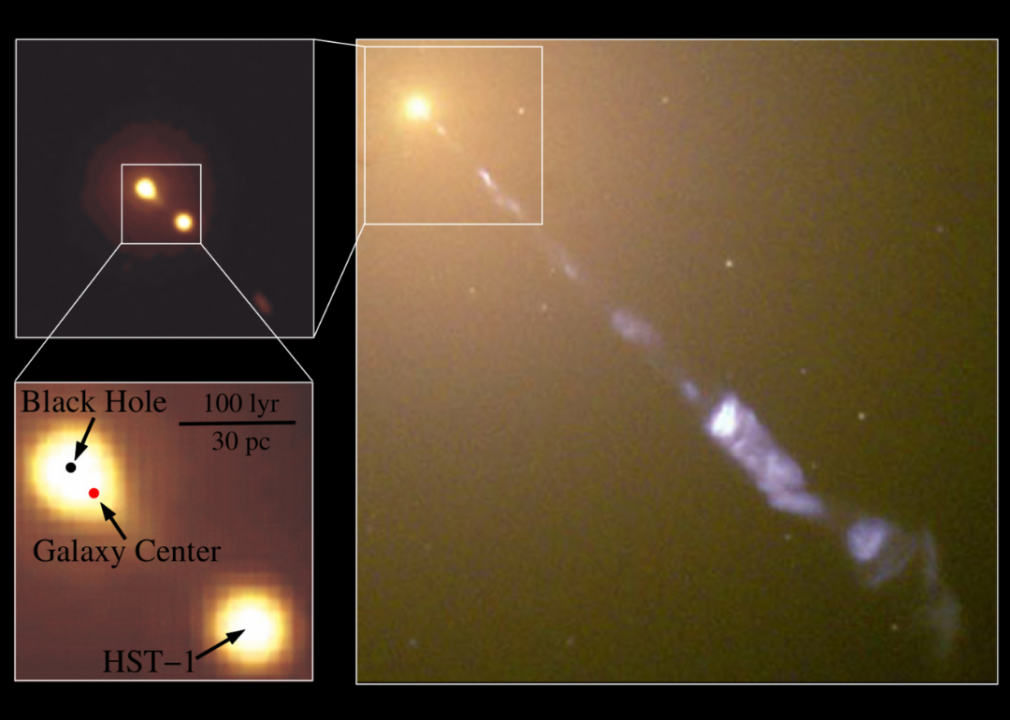
M87 is a giant elliptical galaxy (meaning: it has mostly old stars and no spiral arms) in the Virgo Cluster of galaxies. Like nearly every galaxy we know of, M87 harbors a huge black hole near its center, which was imaged by the Event Horizon Telescope in 2019. This set of HST pictures shows a jet of matter blasted out by that black hole, stretching out farther than the visible edges of M87.
You may also like: The best streaming services for sports in 2021
The Colorful Crab (2020)
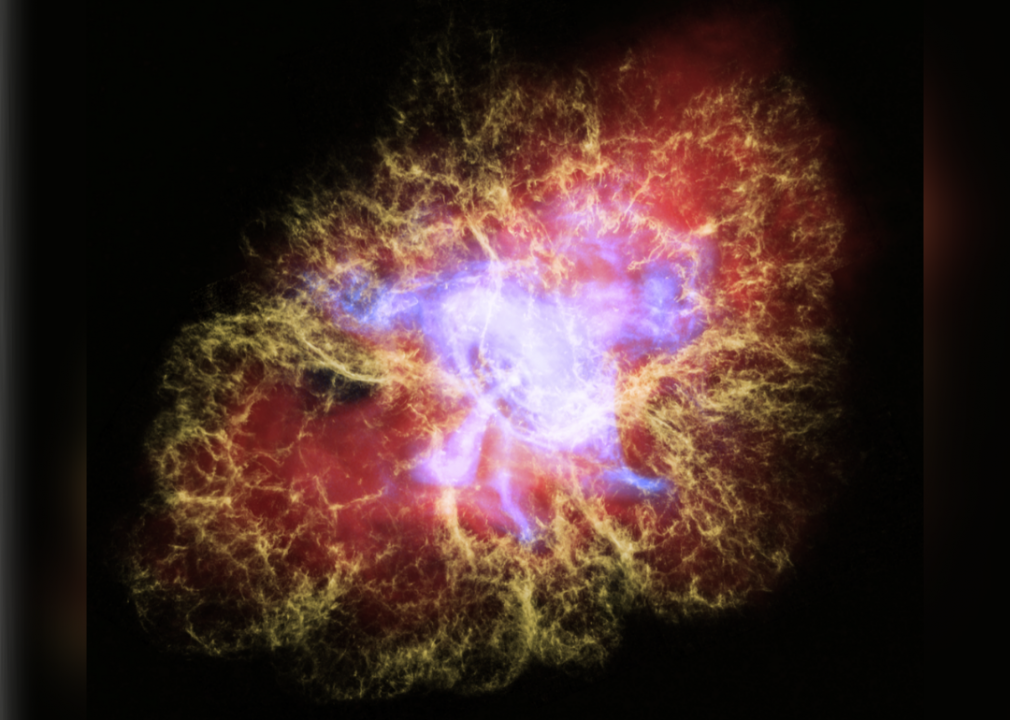
The Crab Nebula is the remains of a star that went supernova and which was observed across the world in 1054 C.E. This image combines optical light from Hubble (in yellow), infrared light from Spitzer (in red), and X-ray light from Chandra (in blue), revealing the complex internal structure of this centuries-old supernova remnant. Matter continues to collide inside the nebula even after all this time, explaining the tendrils and bubbles you see in the picture.
A Flickering Cosmic Candle (2013)
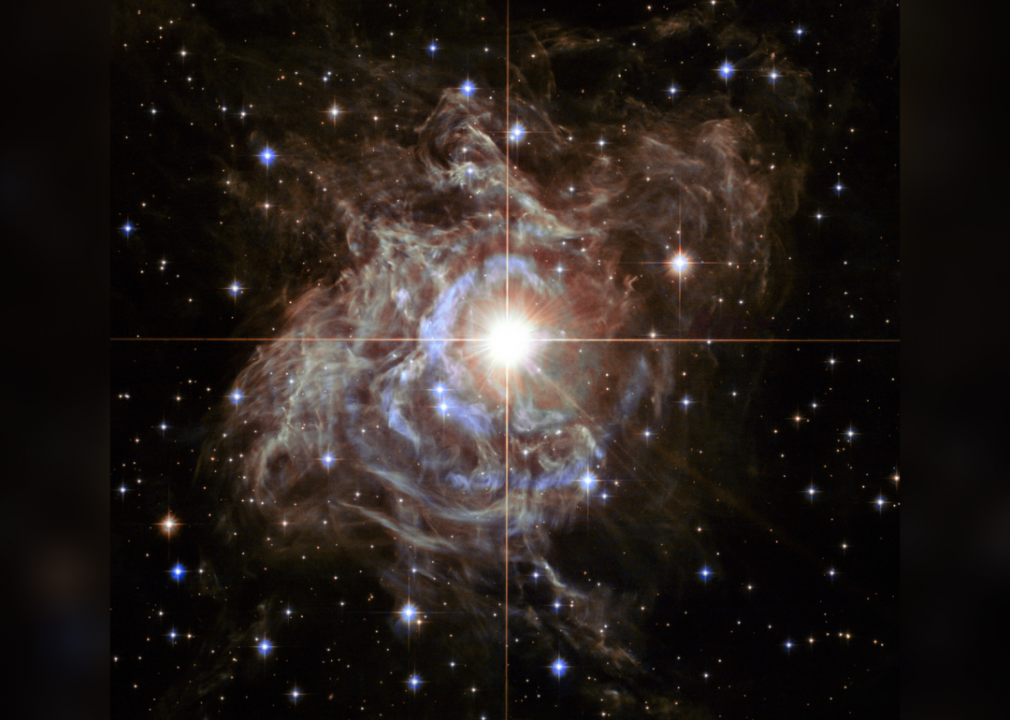
RS Puppis is a star known as a Cepheid variable: aging stars that pulsate, with predictable fluctuations in their light. This southern hemisphere star pulsates roughly every six weeks, creating "light echoes" in the surrounding gas. Early 20th-century astronomer Henrietta Swan Leavitt discovered that Cepheid variables have a connection between the frequency of fluctuations and their brightness, which allowed Edwin Hubble to make the first measurement of the distance to Andromeda Galaxy.
Saturn's Rings and Hexagon (2019)

As part of the giant planet monitoring program, HST captured this beautiful image of Saturn. Not only are the planet's famous rings shown clearly, but you can also see the hexagonal storm at Saturn's north pole, a feature not identified before the Cassini spacecraft mission.
Northern and Southern Lights, Saturn Style (2010)
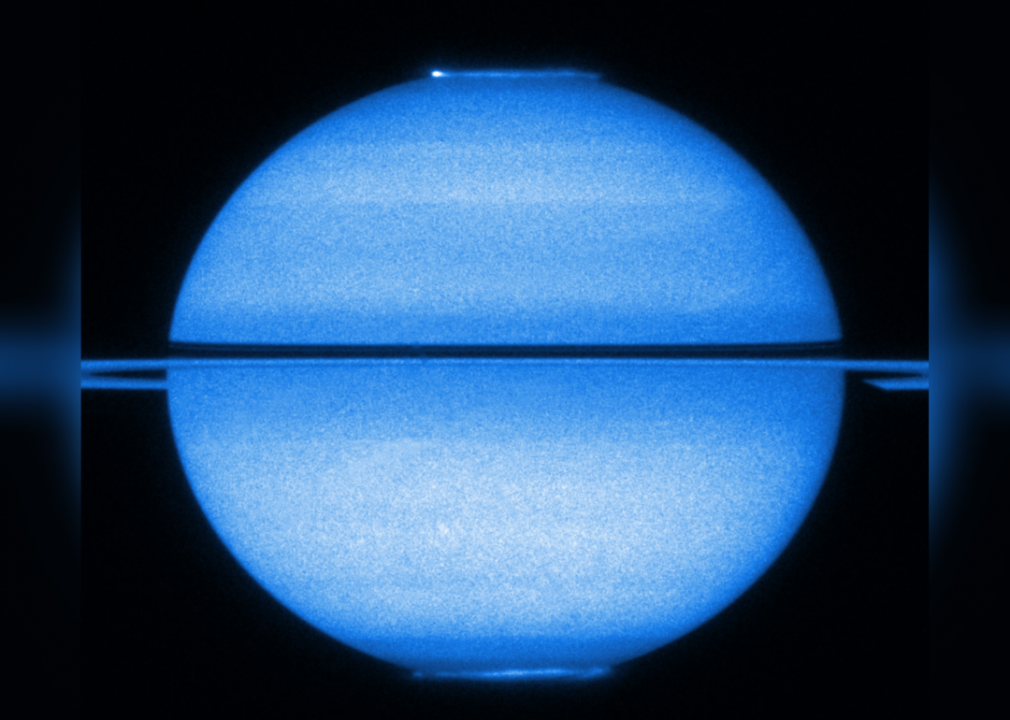
Earth's seasons are caused by the fact that our axis is tilted, so the north pole points toward the sun in the summer and away in winter. Saturn has an even stronger axial tilt, but Hubble captured this ultraviolet image near the planet's equinox so that both poles were nearly in view at once. That allows us to see the auroras—northern and southern lights—in a single image, a rare occurrence.
A Supernova in the Galactic Outskirts (1999)
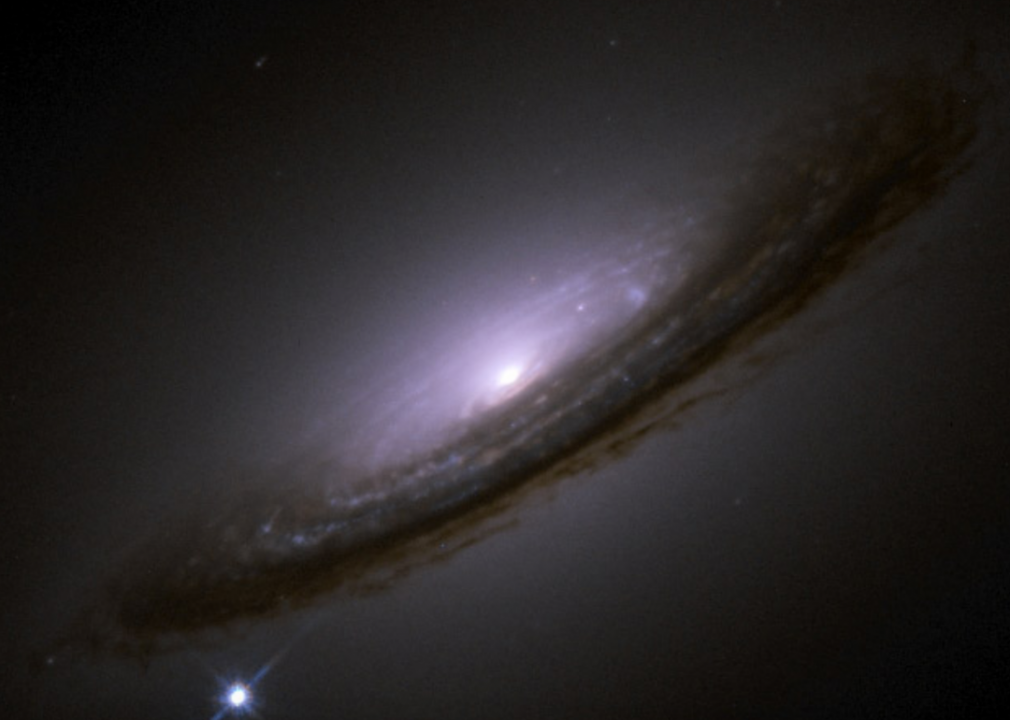
The bright star-light object toward the lower-left corner of this image is Supernova 1994D, on the outskirts of the galaxy NGC 4526. It's a Type Ia supernova, which is the explosion of a white dwarf (the remnant of the core of a star like our sun). Astronomers use Type Ia supernovas to measure the expansion of the universe because they're bright enough to be seen from billions of light-years away.
You may also like: 50 space terms for understanding the universe
A Galactic Whirlpool (2005)
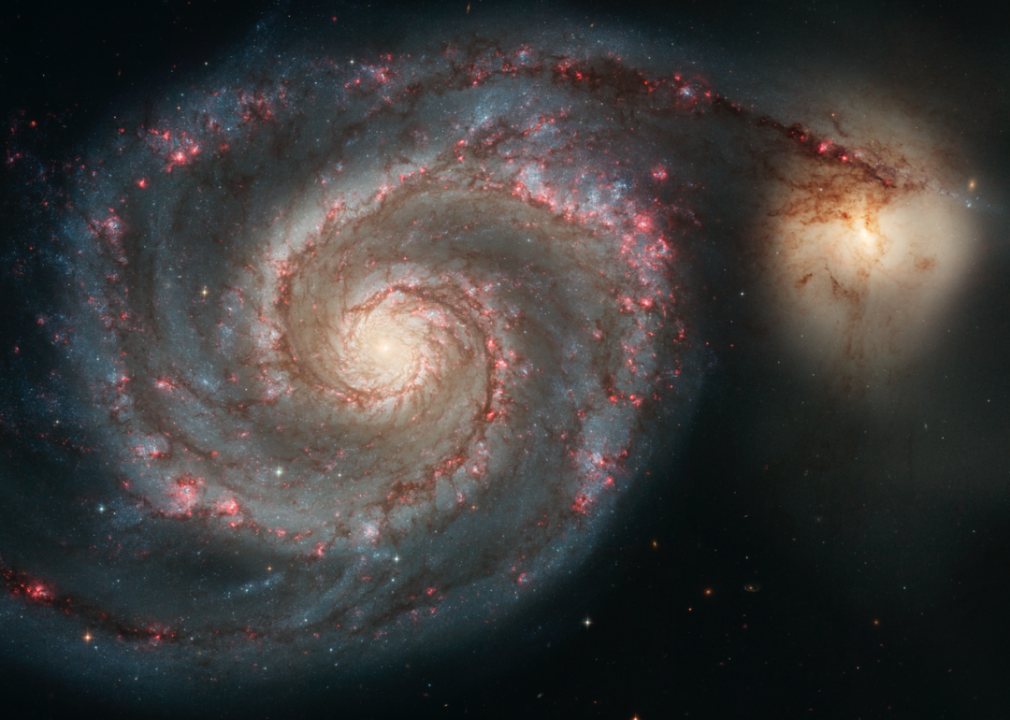
The Whirlpool Galaxy (M51) is a favorite galaxy for many people, and this Hubble image shows why. As a "grand design" spiral galaxy, the spiral arms are clearly defined, dotted with bright young blue stars and pink clouds where new stars are forming. Gravitational interactions with the smaller galaxy likely drive this star formation at the right side of the image.
A Ring of Bright Matter (2013)

The Ring Nebula is a planetary nebula, the shedded material from a dying sun-like star. We see this system from an angle that shows the ring structure, but this 2013 HST image reveals the blue part of the nebula is an oblong bubble that passes through the ring. At the Ring Nebula's very center, you can make out a white dot that is a white dwarf, the remnant of the original star's core.
Gonggong and Xiangliu

The two largest known objects beyond Neptune in our solar system are Eris and Pluto; the third-largest is Gonggong, discovered in 2007 and finally named in 2019. These HST images show how astronomers discovered its moon Xiangliu by comparing archival pictures and looking for how things changed. Gonggong, like other distant solar system worlds, is too small to be anything but a pinpoint of light in most telescopes, requiring observatories of Hubble's caliber.
What's Deeper than Deep? Ultra Deep (2004)

Following up on the earlier Hubble Deep Field Survey, astronomers upped the ante and conducted the Hubble Ultra Deep Field Survey, looking at one relatively empty patch of the sky for roughly 1 million seconds (nearly 12 full days). This longer exposure revealed 10,000 galaxies, including some of the most distant yet discovered.
The Invisible Made Visible (2009)
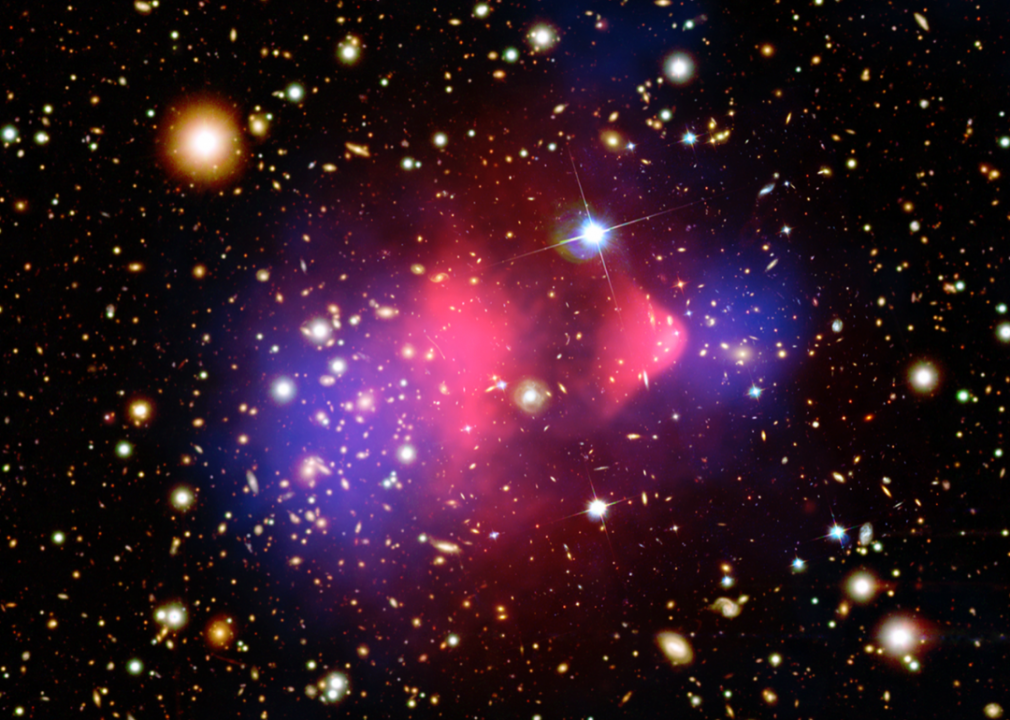
The Bullet Cluster is actually two galaxy clusters caught in the act of collision, where the "bullet" is a shockwave in X-ray emitting hot gas (from Chandra, shown in red). The visible light Hubble data allowed astronomers to measure where the mass from each cluster was concentrated (shown in blue). They found most of that mass was separated from the hot gas, meaning it's made up of invisible matter; this is one of the best direct measurements of the mysterious dark matter that makes up most of the matter in the cosmos.
You may also like: 32 groundbreaking NASA missions in photographs
Neptune's Dark Spot (2019)

The Voyager 2 spacecraft provided us with our first images of Neptune with its 1989 flyby, showing, in particular, a large dark-colored storm on the planet's blue disk. Later Hubble pictures didn't show this Great Dark Spot, meaning the storm had dissipated. However, a new Great Dark Spot formed in a different place on Neptune, as seen in this image; this behavior shows how huge storms form and break up on giant worlds.
Gravity Makes You See Quadruple (2020)

Quasars are supermassive black holes that heat up matter until it glows brightly. In these HST pictures, gravity from a foreground galaxy focuses and splits light from more distant quasars, making one quasar look like four. This effect is known as strong gravitational lensing, and astronomers use it to measure how far those quasars are from Earth by timing when each image flickers.
The Southern Pinwheel Galaxy (2014)
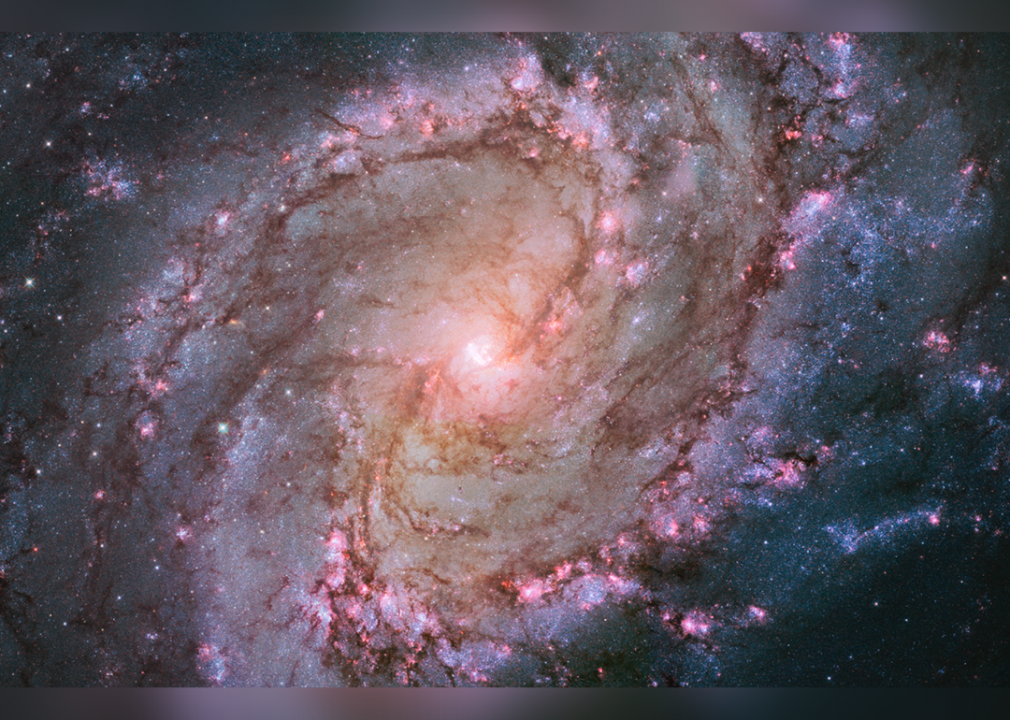
The Southern Pinwheel Galaxy (M83) is a "flocculent" spiral galaxy, meaning its spiral arms look fleecy thanks to the copious amounts of gas and dust they contain. This high-resolution image of M83 reveals the processes of star formation and cavities where stars exploded in supernovas.
A Stellar Shockwave (2002)

The Great Nebula of Orion is a star-forming nebula that can be seen on a dark night without a telescope in Orion's "sword." A young hot star in that nebula, LL Ori, is pumping out streams of charged particles known as stellar wind at speeds high enough to produce a shockwave in the surrounding gas. Though we can't see the whole thing, this shockwave surrounds the star, though not in a spherical shape.
A Cosmic Penguin (2013)
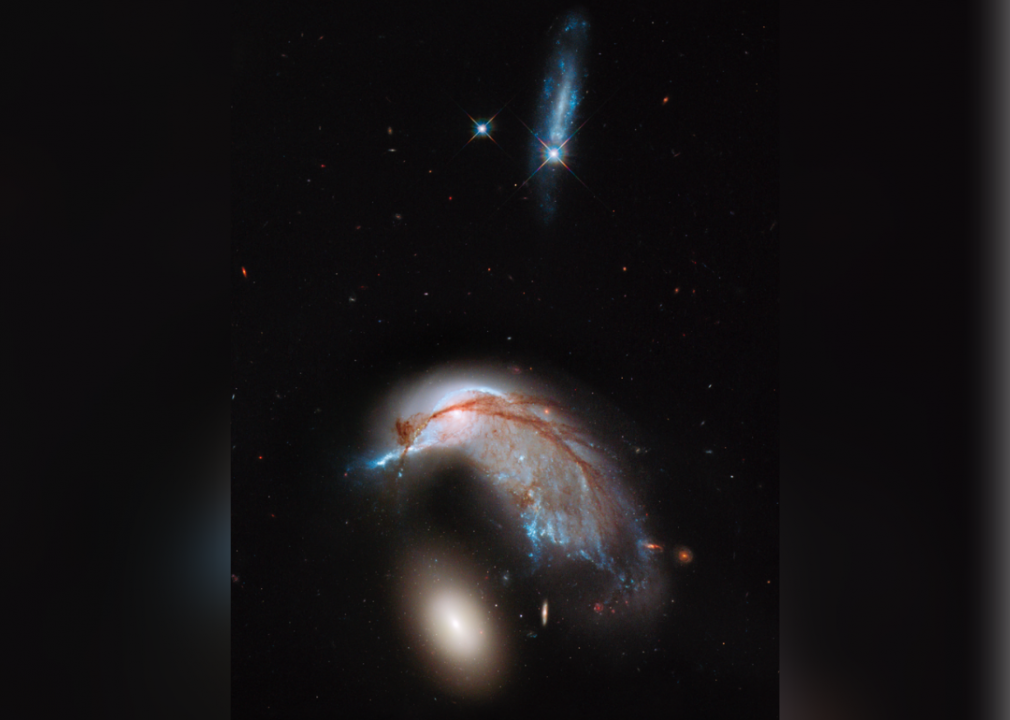
The two galaxies making up the object Arp 142 collided, their mutual gravity pulling one of the galaxies into a shape resembling a galactic penguin. This penguin was once a spiral galaxy like ours, but the encounter has disrupted its shape and driven the production of new stars. The second object is an elliptical galaxy, which consists of older stars and little gas, which may be why its shape hasn't been roughed up as much by the collision.
You may also like: U.S. Army history from the year you were born
Snapshots of Infant Star Systems (2006)

These two images show disks of dust and ice around newborn stars, which are thought to resemble the Kuiper Belt in the outer part of our own solar system. These protoplanetary disks, as they are called, form from the leftovers of the host star's birth. In these cases, there might be planets orbiting closer in, but even Hubble's capabilities aren't good enough to see something so relatively tiny.
Ancient Stellar Jewels (2015)
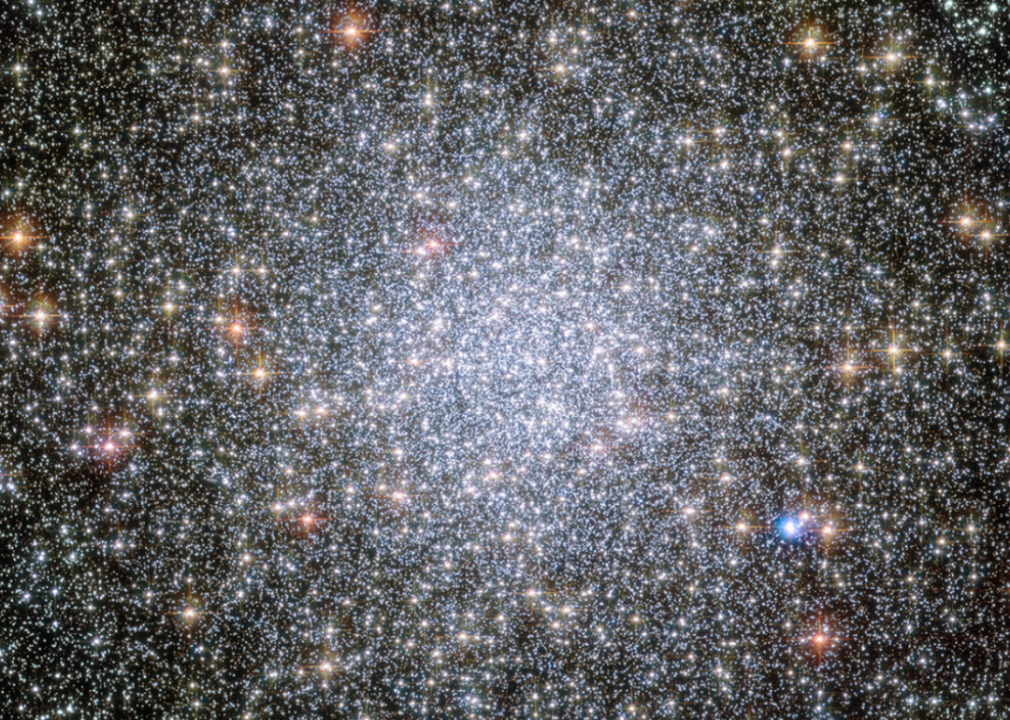
Globular clusters are roughly spherical collections of tens of thousands of stars, including some of the oldest stars we know of. The cluster 47 Tucanae (located in the southern constellation Tucan) is part of the Milky Way but is older than our galaxy by several billion years.
The Tarantula Nebula in Infrared (2014)
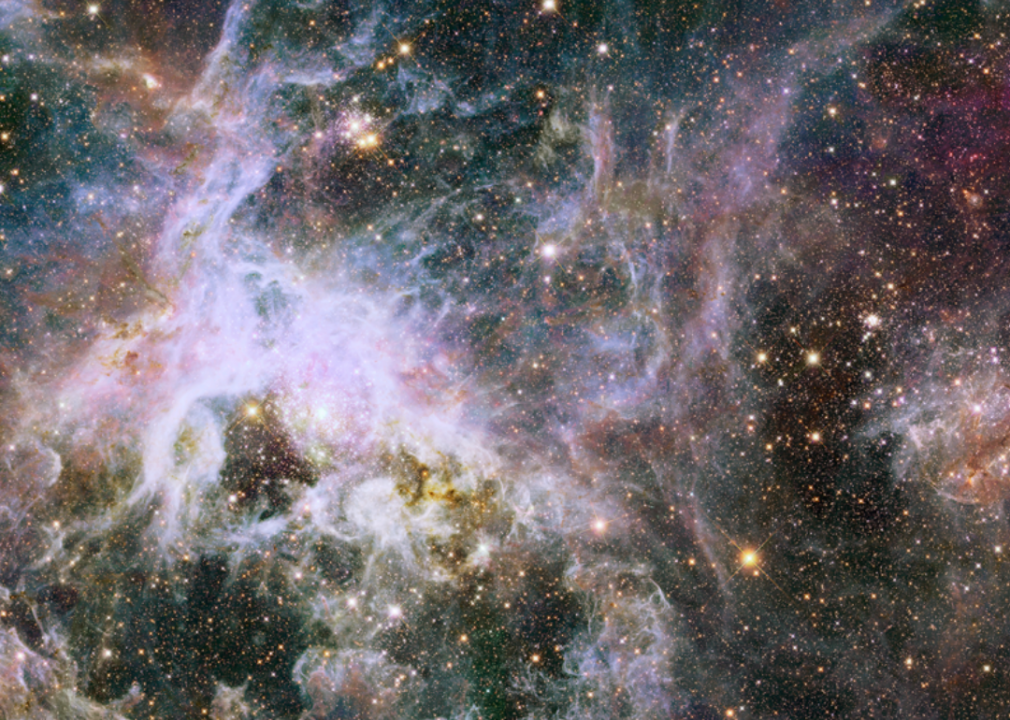
The Large Magellanic Cloud is the largest satellite galaxy of the Milky Way, and home to Supernova 1987A. It's also home to the huge star-forming region known as the Tarantula Nebula. Hubble's infrared camera revealed a staggering 800,000 stars and protostars inside the Tarantula, of which you can see more than a few in this image.
An Inbound Comet (2017)

The comet C/2017 K2 PANSTARRS (or more simply K2) was first seen by Hubble in 2017 when it was past the orbit of Saturn. Comets are made of rock and ices (including water ice, carbon dioxide ice, and others) that form the distinctive tails when heated by the Sun. Even at that distance, sunlight was enough to melt the outer layers of K2, making it the most distant active comet ever seen.
Our Next-Nearest Galactic Neighbor (2019)
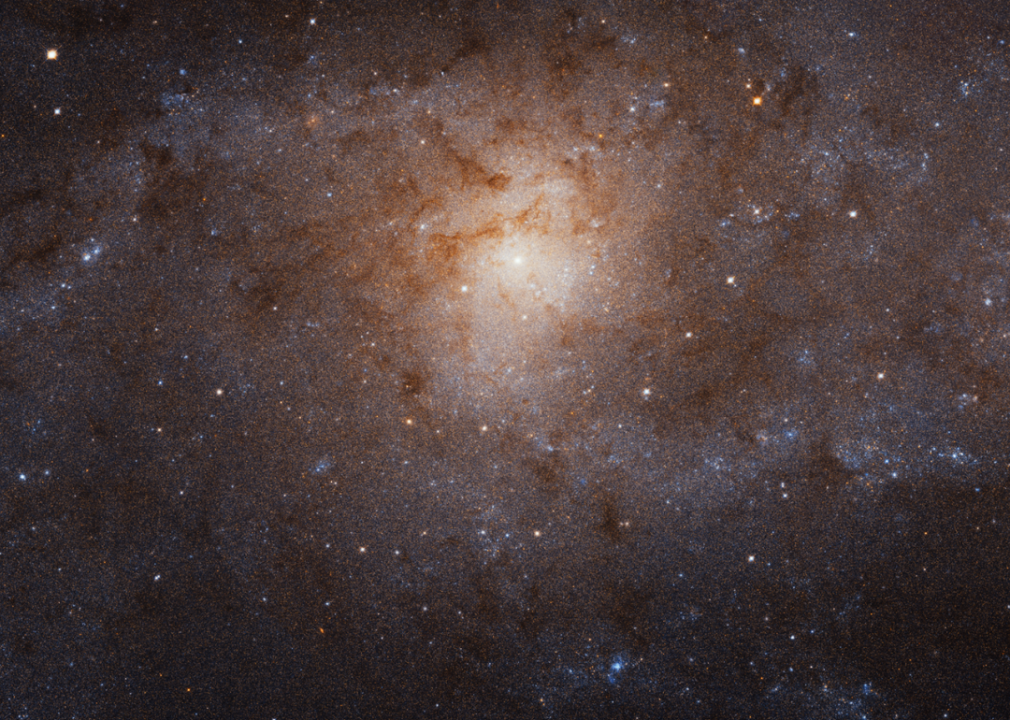
The Milky Way is one of three large galaxies in the small cluster known as the Local Group. The other two are Andromeda (the biggest of the group) and Triangulum (M33), a small spiral. Despite the fact that it's probably as old as its larger neighbors, Triangulum is producing new stars at a fairly high rate, which intrigues astronomers.
You may also like: 50 famous paintings and the stories behind them
A Galactic Rose (2011)
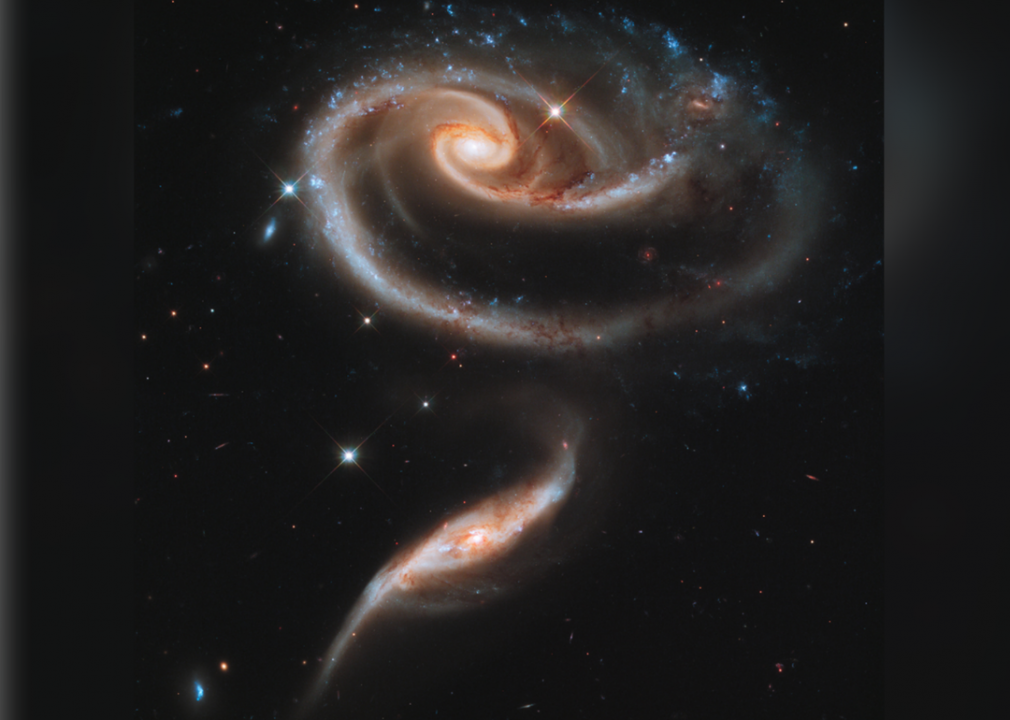
Galaxy collisions may seem violent, but they're one major way small galaxies grow into bigger ones, as they merge together. And undoubtedly galactic collisions are beautiful, as in with the galaxies of Arp 273, which HST captured to commemorate its 21st anniversary. As with other examples of interacting galaxies we've seen, Arp 273 shows star formation spurred on by each galaxy's gravitational tug on the other.
A Cap of Clouds (2019)

When Voyager 2 visited Uranus in 1986, the pictures it returned to Earth showed a green-blue planet nearly unblemished by clouds. By contrast, this recent Hubble image shows a stormy cap of clouds over Uranus' pole. Since Uranus has the most extreme axial tilt of all planets—essentially tipped on its side—it also experiences the most extreme seasons, which may drive weather in ways we don't fully understand yet.
When the Same Supernova Happens More Than Once (2015)

Supernovas, by definition, only happen once, since when a star blows up, there's nothing left to explode again. However, using strong gravitational lensing, astronomers were able to witness Supernova Refsdal four times when light from the explosion passed near a foreground galaxy. This effectively quadrupled the data from the supernova, providing both extra information about the explosion and a way to test the modern theory of gravity in new ways.
Blowing Stellar Bubbles (2016)

All stars—our sun included—produce "wind" in the form of electrically charged particles blowing off the surface. The star at the center of the Bubble Nebula is 45 times more massive than the sun, and its wind has carved out a cavity in the surrounding gas seven light-years across. The nebula itself is the beautifully illuminated shape made where the wind collides with that gas.
A Supernova on the Face of a Spiral Galaxy (2018)
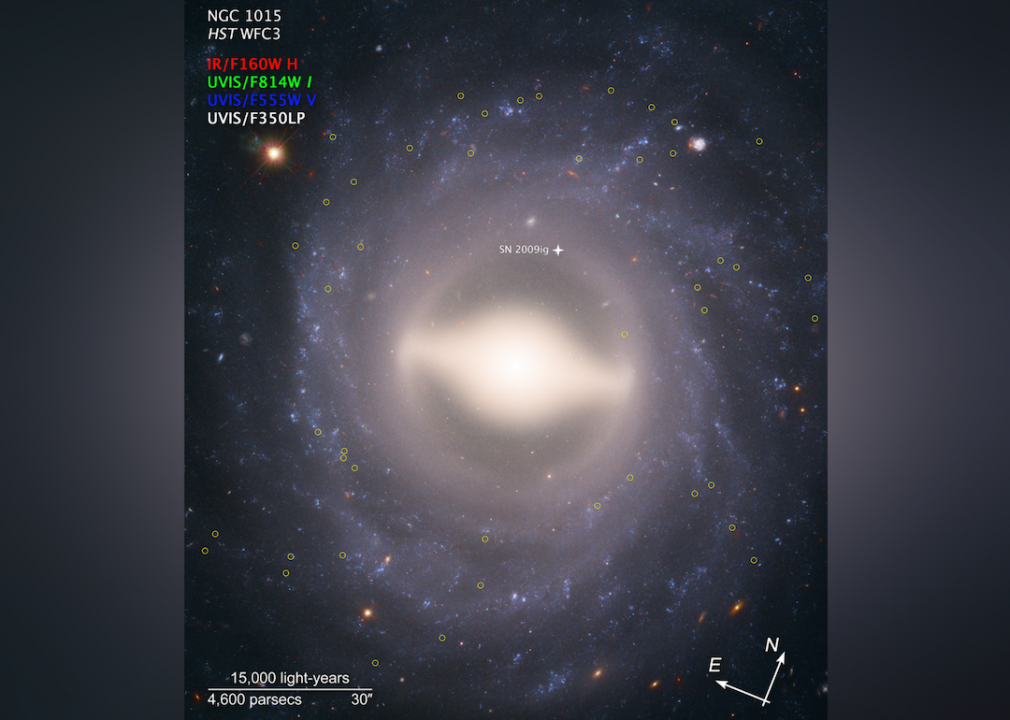
Spiral galaxy NGC 1015 has a striking appearance, in large part, because we see it almost perfectly "face on." The central part of the galaxy is marked by a bar of stars and gas, surrounded by a ring of matter. But this Hubble image also fortuitously includes Supernova 2009ig, a Type Ia supernova caused by the explosion of a white dwarf.
You may also like: Popular fashion trends the year you were born
The Red Rectangle Nebula (2004)
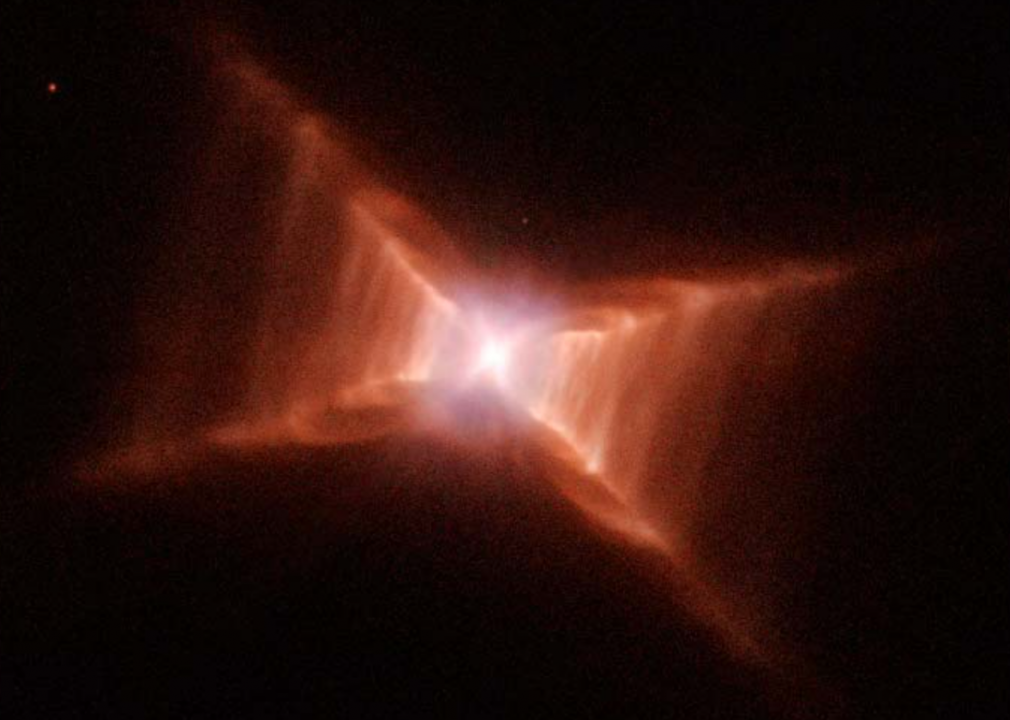
Most shapes in space are round or blobby, but the planetary nebula HD 44179 is boxy, giving it the popular name the Red Rectangle. This 2004 Hubble image shows that the fundamental shape of the matter being shed by a dying star is more like an X, which explains why the material looks rectangular from a distance.
A Moon for Makemake (2016)

Makemake is one of the dwarf planets in the outer solar system discovered within the past 20 years. Until 2015, astronomers couldn't tell if it had a satellite or not, but this Hubble image revealed a faint moon that might have been hiding in Makemake's glow previously. Named "S/2015 (136472) 1" and nicknamed "MK 2," the moon's presence helps astronomers measure important properties about Makemake, such as its mass.
Yeeting a Star From the Galaxy

This picture of a star looks downright mundane until you realize it's speeding out of our galaxy at a breakneck 1.6 million miles per hour. HE 0437-5439 is known as a "hypervelocity" star, and it was likely part of a multiple-star system that drifted too close to the Milky Way's supermassive black hole. The dance of gravity stripped HE 0437-5439 from its companions and kicked it out of the galaxy entirely.
The Sombrero Galaxy (2003)
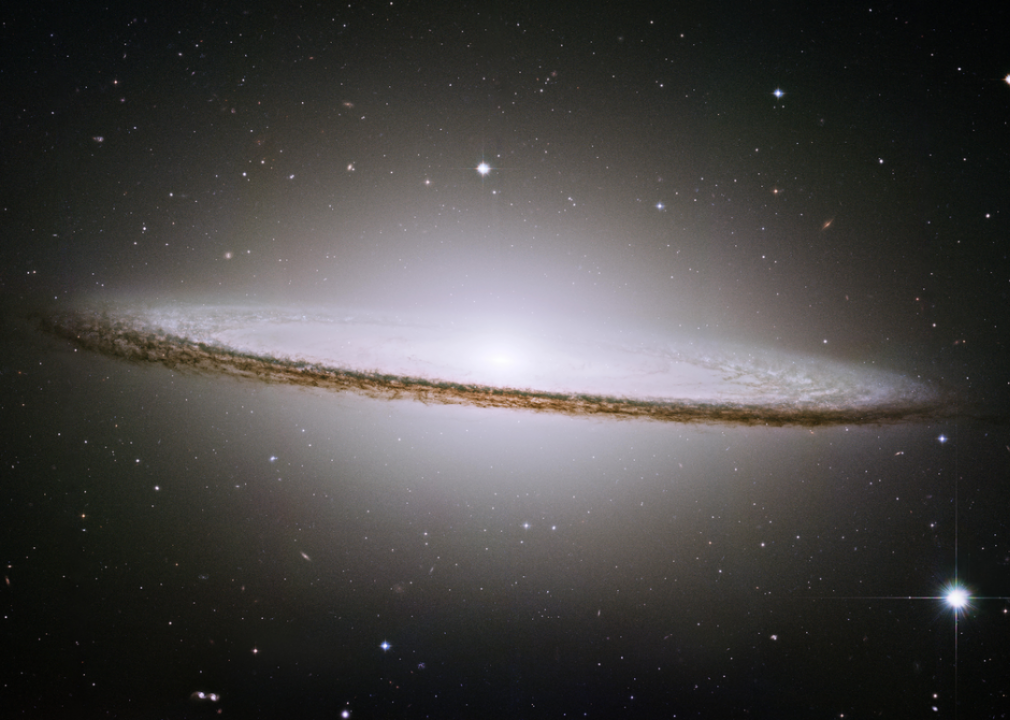
The Sombrero Galaxy (M104) is another of Hubble's greatest hits, thanks to its very bright disk surrounded by a ring of dust. Because we see the galaxy nearly edge-on, it's hard to distinguish a lot of its features. However, astronomers have used this Hubble image to identify 2,000 globular clusters of stars in and around the galaxy.
A Dusty Red Planet (2018)
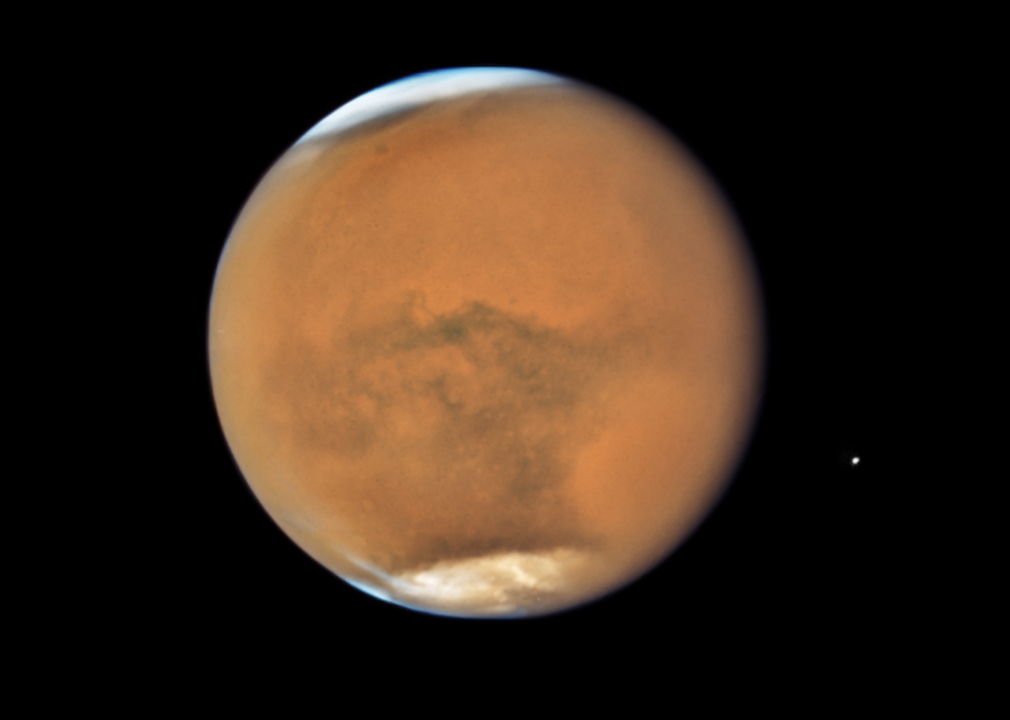
Mars can feel downright mundane compared to many of the other cosmic objects in Hubble's catalog, but astronomers have turned the telescope to look at our planetary neighbor many times in the past 30 years. This 2018 image shows the Red Planet with a winter cap of clouds over the north pole. You can also see Mars' two small potato-like moons, Phobos and Deimos, in the right and lower side of the photo, respectively.
You may also like: States doing the most for a clean energy future
A Deceptive Grouping (2009)
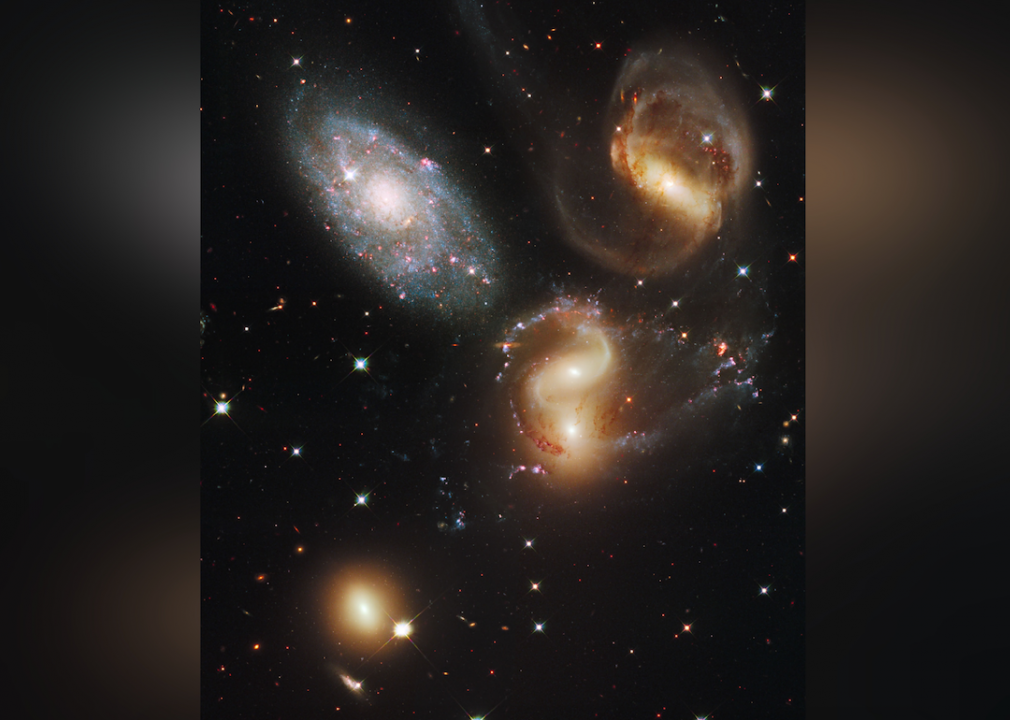
At first look, Stephan's Quintet seems to be five galaxies in collision. However, it turns out only three are actually interacting, and the bright galaxy in the upper left corner is seven times closer to Earth than the others. This optical illusion highlights the fact that occasionally things can look close together when they're actually very far apart, despite space being very big and mostly empty.
The Beauty of a Dying Star (2004)
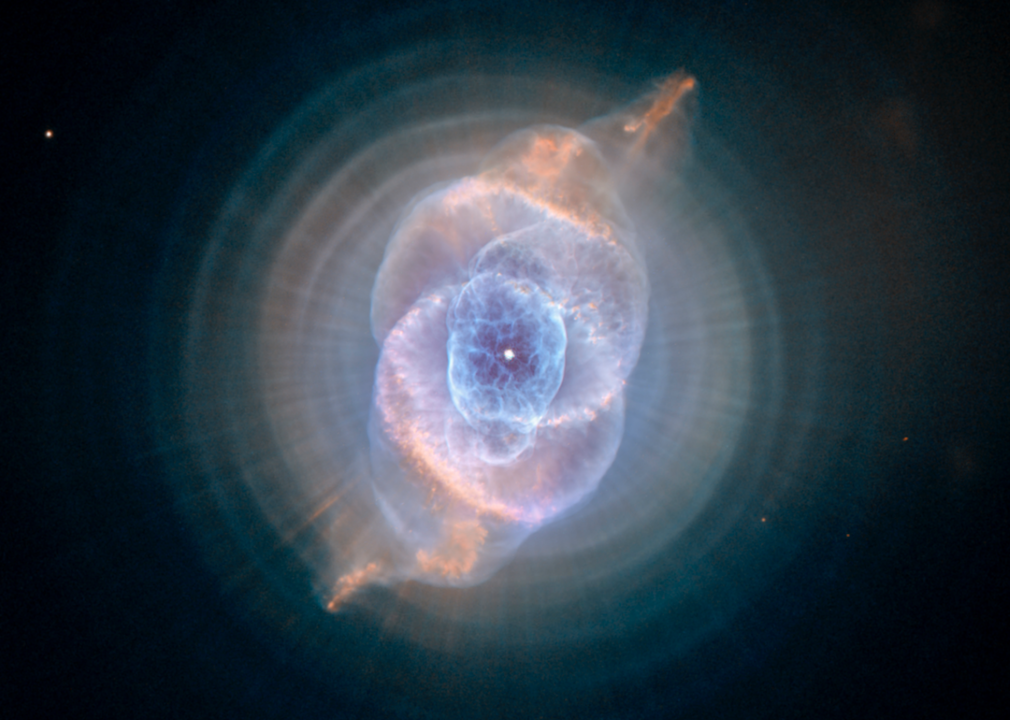
The Cat's-Eye Nebula may be another planetary nebula, but each star like our sun seems to die in its own beautiful and spectacular fashion. This nebula, in particular, is strikingly complex, with concentric layers of shed material overlapping bubbles and an almost spiral-arm structure.
A Breathtakingly Distant Galaxy (2016)
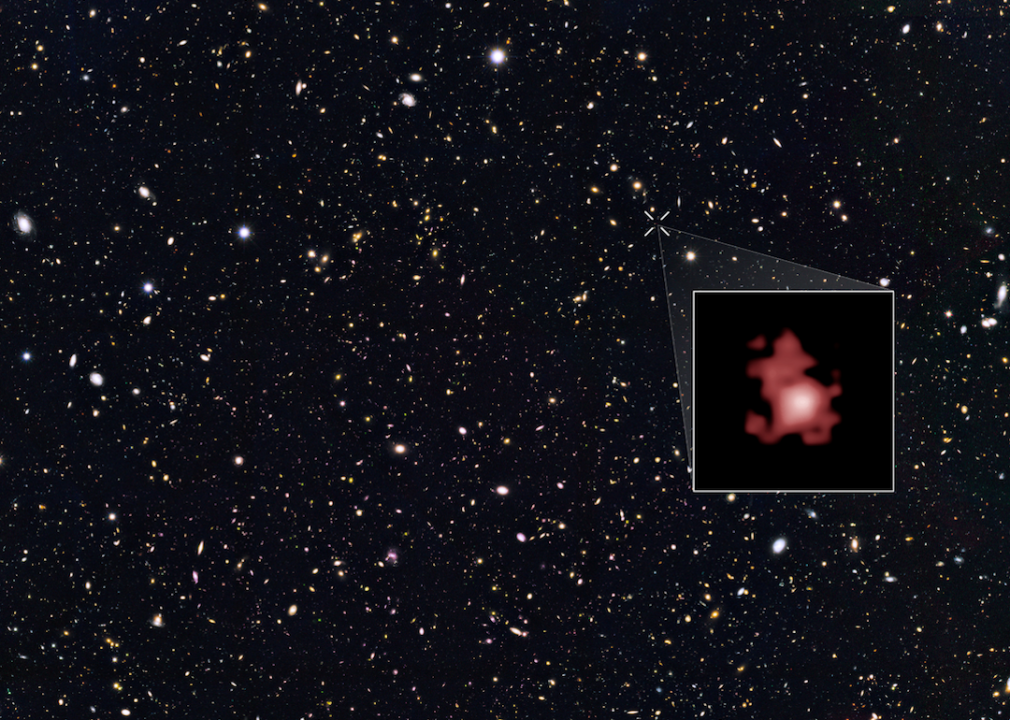
Galaxy GN-z11 just looks like a red blob in this HST image, but that's because it's a breathtaking 13.4 billion light-years away. Since the universe is only about 13.8 billion years old, this means GN-z11 formed about as early as any galaxy can exist. In fact, it was very bright blue 13.4 billion years ago, but as the light from it traveled, it got stretched into the red part of the spectrum, a phenomenon known as cosmic redshifting.
A Most Peculiar Star (2004)
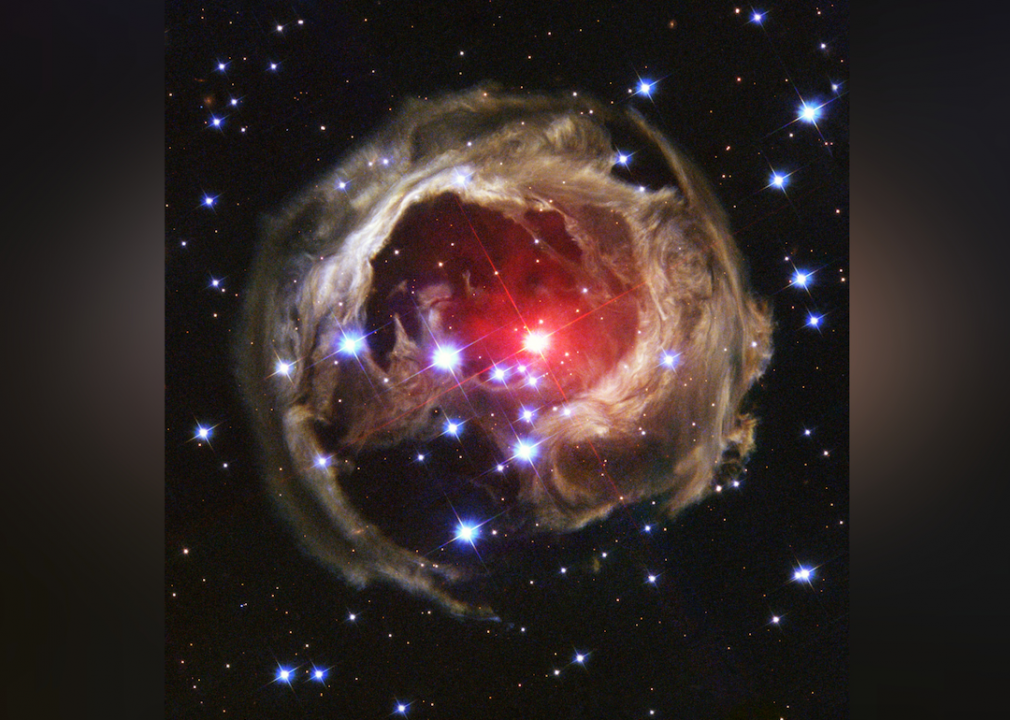
The star V838 Monocerotis (in the constellation Monoceros, or the Unicorn) brightened suddenly in 2002, then faded. Astronomers turned to HST to look at it and found an expanding shell of gas around the star. This image shows a Firefox-like swirl of material shed by the star, which was probably left over from an earlier outburst.
Hubble's Legacy (2019)

In 2019, Hubble astronomers collected 7,500 images taken over 16 years of observations to make the Hubble Legacy Survey. This mosaic includes infrared, optical, and ultraviolet data to provide a view of the cosmos, both deep and wide. With 265,000 galaxies in the field, you could spend your life looking at it and still find new things to discover, a worthy summation of Hubble's 30-year career so far.
You may also like: The best streaming services for football in 2021
50 images of the universe from the Hubble Space Telescope

On April 24, 1990, the Space Shuttle Discovery launched, carrying the Hubble Space Telescope (or just "Hubble"). This orbiting telescope was the first of NASA's Great Observatories. For more than 30 years, HST has provided astronomers with incredible scientific data on everything from solar system objects to some of the most distant galaxies in the cosmos. Hubble was named for American astronomer Edwin Hubble, who in the early 20th century helped establish that the universe is much bigger than the Milky Way and showed the cosmos is expanding.
In honor of National Space Day on May 6, Stacker collected 50 Hubble images taken between 1990 and 2020 that express the beauty of the universe and important scientific knowledge. HST is a bus-sized satellite containing a 2.4-meter-diameter mirror for focusing light from distant objects, along with a suite of instruments for photography, measuring light intensity, and taking the spectrum of various astronomical sources. Hubble is primarily an optical telescope, viewing the cosmos in the same type of light we can see, and it also has the ability to see into the infrared and ultraviolet parts of the spectrum of light. The size of the telescope and its location above Earth's atmosphere (with its pesky weather and distortions from air currents) make HST one of the best optical telescopes still in operation.
HST is jointly operated by NASA and the European Space Agency and was designed to be serviced by astronauts. Unfortunately, the Hubble needed to be repaired immediately after launch, when it turned out its mirror was slightly flawed. NASA astronauts installed additional mirrors to compensate for the flaws in 1993 and upgraded other scientific instruments on five different occasions, with the last upgrade being in 2009. Meanwhile, no plans are in the works to build an equivalent space telescope, so astronomers and nonscientists alike hope Hubble will continue to work indefinitely.
Click on for 50 images of the universe as seen from the Hubble Space Telescope.
You may also like: Space discoveries that will blow your mind