It was 1944.
The Manhattan Project, in top-secret laboratories deep in the Jemez Mountains of New Mexico, was racing to build the first nuclear weapons to turn the tide of World War II. And the U.S. government realized it needed uranium -- and lots of it.
At first, the project had relied on incredibly rich ore from a mine in the Belgian Congo, secretly shipped to New York by the mine owner. But soon, the bomb-builders needed more.
Conveniently for the scientists’ and generals’ ambitions, the answer lay in huge sections of the vast Colorado Plateau — much of it just a few miles away from those secret labs. A great portion of the nation’s uranium was to be found on the Navajos’ sprawling lands on the plateau, spanning some 27,000 square miles of New Mexico, Arizona and Utah.

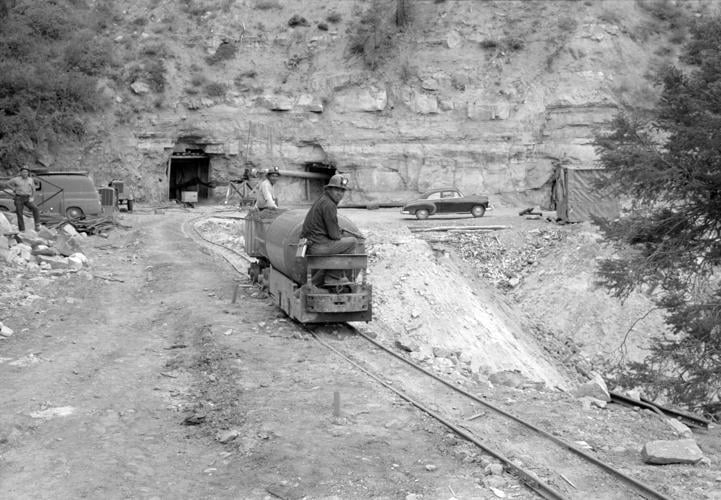
Navajo miners riding a small rail car at the Kerr-McGee uranium mine near Cove, Arizona, in 1952.
The government began buying all the uranium it could, incentivizing private-sector mining companies on the plateau — and the Navajo government — to provide ore to the military for the war effort. It’s estimated that the Manhattan Project used about 10,000 tons of uranium ore -- about 15 percent of which came from the new mining ventures on or near Navajo lands.
People are also reading…
It was after the war, when the Cold War ramped up and the country scrambled to build the world’s most fearsome nuclear arsenal, that demand for yellowcake -- processed uranium ore -- increased exponentially.
In 1948, the federal government announced that it would purchase all the uranium ore mined in the United States for a minimum of $3.50 a pound and also offered $10,000 bonuses for new high-grade ore finds. A mining boom on Navajo lands followed, and so did one of the deadliest — and most shameful — public-health disasters in the nation’s history.
It continues today.
Invisible danger
In the rush to cash in on the government’s offer, mining companies prospected across Navajo country, quickly establishing mines and expanding ones that showed the most paydirt.
Navajo men flocked to work in the mines. Professors Dean Brugge and Rob Goble, in their landmark 2002 paper on Navajo uranium mining, reported that copies of pay stubs from 1949 show hourly wages of $.081 to $1.00. (The federal minimum wage didn’t hit $1 until 1956).
For many Navajos, these were the first steady jobs, close to home, that paid so well, and they were very glad to have them.
Like most mining jobs, these were hard and dangerous, whether miners were digging shafts, mucking out blasted rock or running heavy equipment. But those obvious physical dangers were dwarfed by the danger the miners couldn’t see and didn’t know about.
Navajos knew absolutely nothing of the dangers of radiation. The entire concept, much less the specific risks associated with mining uranium, was unknown and foreign to the culture.
“The Navajo language had no word for radiation,” Brugge and Goble wrote. “Few Navajo people spoke English, and few had formal education. Thus, the Navajo population was isolated from the general flow of knowledge about radiation and its hazards by geography, language and literacy level.
“Today, the miners and their families say that they had no idea that there were long-term health hazards associated with uranium mining. Virtually all of the Navajo miners report that they were not educated about the hazards of uranium mining and were not provided with protective equipment.”
Untold impact, hazardous toll
While the miners didn’t know anything about the unseen dangers of uranium mining, the mining companies certainly did. By 1940, it was accepted as medical fact that uranium miners frequently developed lung cancer. Mining in Europe in the 1930s had conclusively demonstrated that.
By the early 1950s, industrial health scientists knew why. The culprit was radon -- an odorless, colorless gas that is formed from the breakdown of uranium. Ventilation is the answer, but until forced by regulations many years later, the mining companies weren’t interested in spending money to ventilate the mines.
The toll in Navajo mines was horrifying.

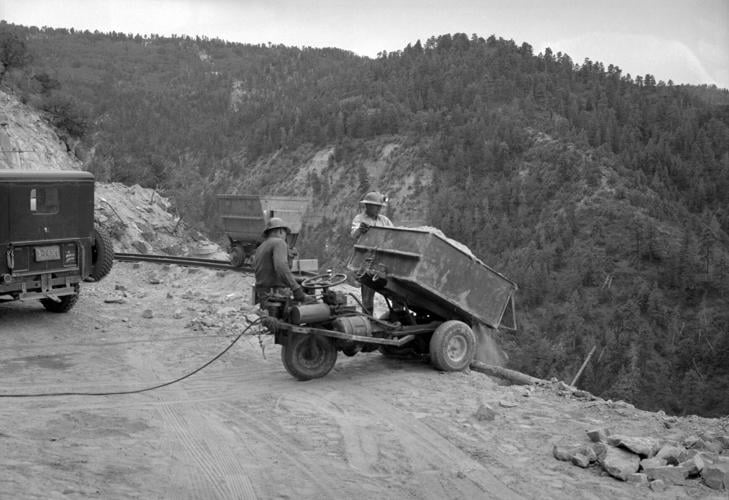
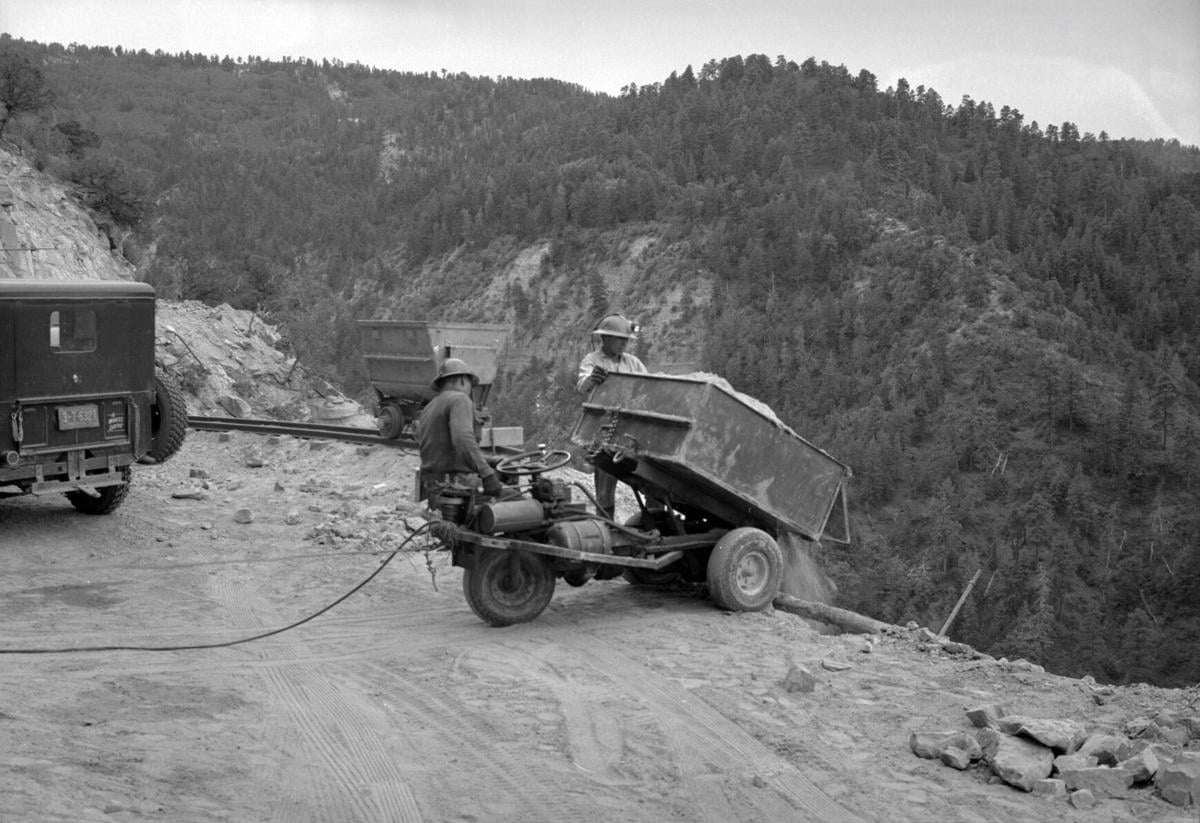
Navajo miners dump low-grade ore over the side of a mesa at the Kerr-McGee uranium mine near Cove, Arizona, July 23, 1952.
Exactly how many Navajo miners died of lung cancer will never be exactly known.
“There are no reliable numbers,” said Chris Shuey, senior environmental health specialist at the Southwest Research and Information Center in Albuquerque. “So many didn’t even have a paycheck. They worked for cash, and the companies hired trading-post operators to manage the miners’ payroll. So there was no record of them ever working and having exposure documentation.”
More than 10,000 men worked in the mines. Hundreds of them died of lung cancer. And others suffered from other cancers, kidney disease — uranium attacks the kidneys — nonmalignant respiratory diseases like silicosis and emphysema, autoimmune diseases, vascular disease and more.
According to a study of a group of 757 Navajo miners published in the American Journal of Public Health in 1995, many more Navajo miners than statistically expected died of tuberculosis and other nonmalignant respiratory diseases.
This was in line with the results of previous health studies of uranium miners.
Of those still living, the report said, “Twenty-three years after their last exposure to radon progeny, Navajo miners continue to face excess mortality risks from lung cancer and other respiratory diseases.”
Many of their family members got sick and died as well. Some miners took some of the remnants of the mining process, known as tailings, and made cement for foundations, rock fireplaces, even stucco for their houses. That meant their families were exposed, too.
In a tragic irony, for years doctors had marveled at how little cancer Navajos had as a people. There was much speculation about why. Was it genetic? Was it a lack of exposure to so many environmental hazards present in the urban world but not in the isolated environment they inhabited?
All of that talk died quickly in the 1960s and early 1970s when miners began to die of lung cancer.
As ex-Los Angeles Times journalist Judy Pasternak relates in her powerful book, “Yellow Dirt,” that was when the widows of miners began to talk to each other about the ways their husbands had sickened and died.
“The symptoms became familiar,” Pasternak wrote. “First a lump on the neck, then shortness of breath, then spitting up blood.”
Demand for uranium wanes
The federal government bought every bit of uranium mined on Navajo lands until 1971. After that, private companies continued to buy the ore until mining finally ended in 1987.
In four and a half decades, some 30 million tons of uranium ore were mined.
But then commercial demand waned — ironically due in large part to the Three Mile Island nuclear scare, not from the far larger release of nuclear materials from the Church Rock Mine tailings impoundment failure on the Navajo reservation. That happened the same year as Three Mile Island but was almost unknown nationally.
Left behind, dotted across far-flung Navajo lands like angry pustules, were abandoned uranium mines, mills, tailings piles, contaminated structures, streams and pasturelands. Rain and snow sped the heavy metal’s path into the groundwater.
Deadly radon gas emanated from the disturbed earth. The Colorado Plateau’s legendary dust storms spread contamination from tailings piles and abandoned mine sites.
And because of the latency period — the time it takes for cancer or other illnesses to develop after toxic exposure — deadly disease continued to grow, unseen and unchecked, in the lungs and the guts of men who wrested the poison from the ground.
Now, almost 40 years after the cessation of mining, many more of them have died. But the abandoned sites and their toxic dangers remain.