CHICAGO — James Lovell, the commander of Apollo 13 who helped turn a failed moon mission into a triumph of on-the-fly can-do engineering, died at age 97.
Lovell died Thursday in Lake Forest, Illinois, NASA said Friday in a statement.
“Jim’s character and steadfast courage helped our nation reach the Moon and turned a potential tragedy into a success from which we learned an enormous amount,” NASA said. “We mourn his passing even as we celebrate his achievements.”
One of NASA’s most traveled astronauts in the agency’s first decade, Lovell flew four times — Gemini 7, Gemini 12, Apollo 8 and Apollo 13 — with the two Apollo flights riveting the folks back on Earth.
In 1968, the Apollo 8 crew of Lovell, Frank Borman and William Anders was the first to leave Earth’s orbit and the first to fly to and circle the moon. They could not land, but they put the U.S. ahead of the Soviets in the space race. Letter writers told the crew that their stunning pale blue dot photo of Earth from the moon, a world first, and the crew’s Christmas Eve reading from Genesis saved America from a tumultuous 1968.
People are also reading…
But the big rescue mission was still to come. That was during the harrowing Apollo 13 flight in April 1970. Lovell was supposed to be the fifth man to walk on the moon. But Apollo 13’s service module, carrying Lovell and two others, experienced a sudden oxygen tank explosion on its way to the moon. The astronauts barely survived, spending four cold and clammy days in the cramped lunar module as a lifeboat.
“The thing that I want most people to remember is (that) in some sense it was very much of a success,” Lovell said during a 1994 interview. “Not that we accomplished anything, but a success in that we demonstrated the capability of (NASA) personnel.”
A retired Navy captain known for his calm demeanor, Lovell told a NASA historian that his brush with death affected him.
“I don’t worry about crises any longer,” he said in 1999. Whenever he has a problem, “I say, ‘I could have been gone back in 1970. I’m still here. I’m still breathing.’ So, I don’t worry about crises.”
The mission’s retelling in the popular 1995 movie “Apollo 13” brought Lovell, Fred Haise and Jack Swigert renewed fame — thanks in part to Lovell’s movie persona reporting “Houston, we have a problem,” a phrase he didn’t exactly utter.
Lovell had ice water in his veins like other astronauts, but he didn’t display the swagger some had, just quiet confidence, said Smithsonian Institution historian Roger Launius. He called Lovell “a very personable, very down-to-earth type of person, who says ‘This is what I do. Yes, there’s risk involved. I measure risk’.”
In all, Lovell flew four space missions — and until the Skylab flights of the mid-1970s, he held the world record for the longest time in space with 715 hours, 4 minutes and 57 seconds.
Aboard Apollo 8, Lovell described the oceans and land masses of Earth. “What I keep imagining, is if I am some lonely traveler from another planet, what I would think about the Earth at this altitude, whether I think it would be inhabited or not,” he remarked.
That mission may be as important as the historic Apollo 11 moon landing, a flight made possible by Apollo 8, Launius said.
“I think in the history of space flight, I would say that Jim was one of the pillars of the early space flight program,” Gene Kranz, NASA’s legendary flight director, once said.

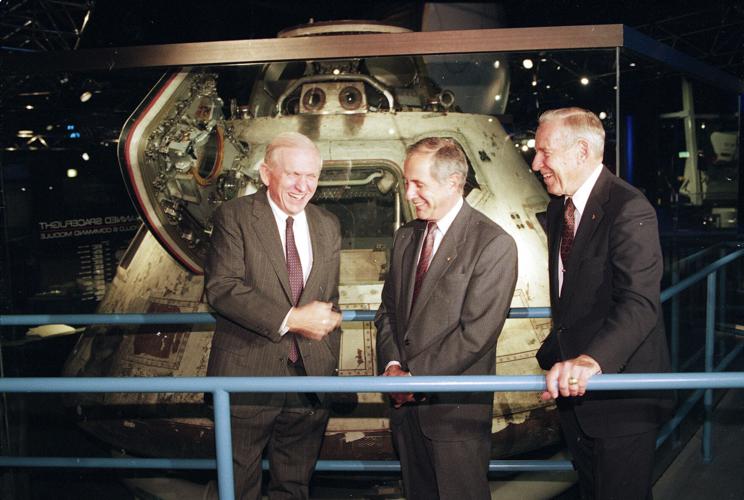
From left to right, Apollo 8 astronauts Frank Borman, William Anders and James Lovell Jr. gather Dec. 10, 1993, near their spacecraft at the Museum of Science and Industry in Chicago, Ill., to celebrate the 25th anniversary of their six-day mission to enter the lunar atmosphere and orbit the moon.
While historians may consider Apollo 8 and Apollo 11 the most significant of the Apollo missions, it was during Lovell’s last mission — immortalized by the popular film starring Tom Hanks as Lovell — that he came to embody for the public the image of the cool, decisive astronaut.
The Apollo 13 crew of Lovell, Haise and Swigert was on the way to the moon in April 1970, when an oxygen tank from the spaceship exploded 200,000 miles from Earth.
That, Lovell recalled, was “the most frightening moment in this whole thing.” Then oxygen began escaping and “we didn’t have solutions to get home.”
“We knew we were in deep, deep trouble,” he told NASA’s historian.
Four-fifths of the way to the moon, NASA scrapped the mission. Suddenly, their only goal was to survive.
Lovell’s “Houston, we’ve had a problem,” a variation of a comment Swigert radioed moments before, became famous. In Hanks’ version, it became “Houston, we have a problem.”
What unfolded over the next four days captured the imagination of the nation and the world, which until then largely was indifferent about what seemed a routine mission.
With Lovell commanding the spacecraft, Kranz led hundreds of flight controllers and engineers in a furious rescue plan.
The plan involved the astronauts moving from the service module, which was hemorrhaging oxygen, into the cramped, dark and frigid lunar lander while they rationed their dwindling oxygen, water and electricity. Using the lunar module as a lifeboat, they swung around the moon, aimed for Earth and raced home.
By coolly solving the problems under the most intense pressure imaginable, the astronauts and the crew on the ground became heroes. In the process of turning what seemed routine into a life-and-death struggle, the entire flight team created one of NASA’s finest moments that ranks with Neil Armstrong’s and Buzz Aldrin’s walks on the moon nine months earlier.
“They demonstrated to the world they could handle truly horrific problems and bring them back alive,” said Launius.
The loss of the opportunity to walk on the moon “is my one regret,” Lovell said in a 1995 interview with The Associated Press for a story on the 25th anniversary of the mission.
President Bill Clinton agreed when he awarded Lovell the Congressional Space Medal of Honor in 1995. “While you may have lost the moon … you gained something that is far more important perhaps: the abiding respect and gratitude of the American people,” he said.
Lovell once said that while he was disappointed he never walked on the moon, “The mission itself and the fact that we triumphed over certain catastrophe does give me a deep sense of satisfaction.”
Lovell clearly understood why this failed mission afforded him far more fame than had Apollo 13 accomplished its goal.
“Going to the moon, if everything works right, it’s like following a cookbook. It’s not that big a deal,” he told the AP in 2004. “If something goes wrong, that’s what separates the men from the boys.”

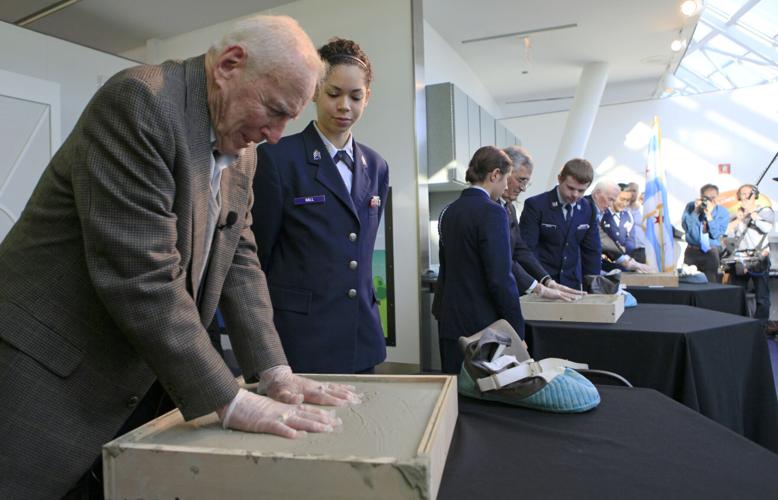
Apollo 13 astronaut James Lovell, left, and Apollo 17 astronauts Harrison Schmitt and Eugene Cernan press their hands down in wet concrete Nov. 13, 2012, at Adler Planetarium in Chicago. Their hand- and footprints were displayed in an exhibit celebrating the 40th anniversary of the Apollo 17 mission, the 11th and final manned flight to the Moon for NASA’s Apollo program.
James A. Lovell was born March 25, 1928, in Cleveland. He attended the University of Wisconsin before transferring to the U.S. Naval Academy, in Annapolis, Maryland. On the day he graduated in 1952, he and his wife, Marilyn, were married.
A test pilot at the Navy Test Center in Patuxent River, Maryland, Lovell was selected as an astronaut by NASA in 1962.
Lovell retired from the Navy and from the space program in 1973, and went into private business. In 1994, he and Jeff Kluger wrote “Lost Moon,” the story of the Apollo 13 mission and the basis for the film “Apollo 13.” In one of the final scenes, Lovell appeared as a Navy captain, the rank he actually had.
He and his family ran a now-closed restaurant in suburban Chicago, Lovell’s of Lake Forest.
His wife, Marilynn, died in 2023. Survivors include four children.
30 breathtaking images from NASA's public library
30 breathtaking images from NASA's public library

The National Aeronautics and Space Administration (NASA) in 2017 opened the digital doors to its image and video library website, allowing the public to access more than 140,000 images, videos, and audio files. The collection provides unprecedented views of space. Stacker reviewed the collection to select 30 of the most breathtaking images, curated here with further information about the captured scenes.
NASA officially began operations on Oct. 1, 1958, as the primary organization for U.S. civil aerospace research and development. In just 11 years, NASA in 1969 landed the first human on the moon. In the 1970s, the focus shifted to developing a space station. Skylab was launched, unmanned, in May 1973. Three crewed missions followed during the next seven months to repair the station and conduct experiments. The first international space station partnership was the Apollo-Soyuz Test Project in 1975, which brought American and Soviet crews together.
The space shuttle program became fully realized in April 1981 with the manned launch of the Columbia. In 135 missions flown with five shuttles, there were two catastrophic accidents—Challenger and Columbia. Discovery delivered the Hubble Space Telescope into orbit. The 30-year shuttle program was significant in setting the foundation for future Earth-to-orbit transportation and sustained space stays.
Shuttle technology led to the construction of the International Space Station, the largest structure humans have put into space. Two hundred thirty people from 18 countries have lived there since 2000, conducting experiments and documenting life in space.
Achievements like these make up the substance of the NASA Image and Video Library, featuring the best of the agency’s work in aeronautics, astrophysics, Earth science, human spaceflight, and more. Keep reading to see 30 of these stunning images.
You may also like: Space discoveries that will blow your mind
The moon from Apollo 11

On July 20, 1969, Apollo 11 astronauts Neil Armstrong and Edwin Aldrin made history by landing on the moon while pilot Michael Collins remained in lunar orbit. While returning home on July 21, the crew captured this picture of the full moon. Earth’s only natural satellite, it circles us from an average distance of 238,900 miles away.
Earth from the International Space Station

An astronaut aboard the International Space Station shot a picture of Earth from 250 miles over Australia. Airglow—the orange hue—comprises diffuse bands of light created by atoms colliding in the atmosphere near the interface of Earth and space. Studying airglow is helping scientists to understand the connections between Earth weather and space weather.
Hurricanes on Earth

Several large hurricanes were brewing in the Atlantic Ocean in September 2017. By assembling several images taken in one day by the Visible Infrared Imaging Radiometer Suite, NASA could provide a vibrant look at this weather pattern. Views like this help communities make decisions about disaster preparedness, response, and recovery.
Shuttle space walk

In 2006, NASA astronaut Robert L. Curbeam Jr. and European Space Agency astronaut Christer Fuglesang continued construction on the International Space Station (ISS). Below them lie New Zealand and Cook Strait in the Pacific Ocean. The ISS must be maintained and repaired regularly so that its inhabitants can complete missions and experiments through at least 2024.
Shuttle in silhouette

An ISS crewmember captured a picture of the space shuttle Endeavour as it neared docking in February 2010. It was Endeavour’s 10th flight to the ISS with the mission of delivering Tranquility (a berthing, life support, and exercise module) and Cupola (a robotics work station).
Eruption on the sun

NASA’s Solar Dynamics Observatory documented a dramatic solar event on March 2, 2012. This explosion, appearing on the right side of the sun in the photograph, is called a “prominence eruption.” The prominence is made up of plasma—matter in an ultra-high-energy state even more volatile than gas—and can loop thousands of miles into space.
Raikoke volcano eruption

Raikoke Volcano sits on the remote Kuril Islands in the Pacific Ocean. On June 22, 2019, an ISS crew member captured an image of the volcanic plume of Raikoke’s first eruption in almost one hundred years. NASA satellites tracked the plume for activity that might affect aviation and climate.
Rover selfie

The Curiosity Mars rover provided a selfie as part of its 1,065th day of work on Aug. 5, 2015. A combination of multiple images taken by its Hand Lens Imager, the picture shows Curiosity on a rock called “Buckskin” on Mount Sharp. The mission to drill into Buckskin and collect a sample for analysis yielded the discovery of silica, which may show that liquid water once existed on Mars.
Cargo craft docks

The unmanned Cygnus cargo craft—the SS John Young—was photographed attaching itself to the International Space Station in November 2018 with a delivery of 7,400 pounds of supplies. The spacecraft was named after John Young, NASA’s longest-serving astronaut, who was an integral part of missions to the moon and the space shuttle program.
John Young on the moon

As part of the first extravehicular activity of its mission, Apollo 16 commander John W. Young jumps off the lunar surface while saluting the American flag in April 1972. Apollo 16 spent more than 20 hours on the surface, drove 16.6 miles in the lunar rover, and returned with 210 pounds of samples.
Canadian aurora

The snowy Quebec landscape is illuminated by the stars, the moon, and the aurora borealis in this picture from February 2012. Taken from the ISS, the image also shows airglow along the horizon. The Manicouagan Crater, seen in the lower right, was created by an asteroid impact approximately 214 million years ago.
Helix Nebula

Launched in 2003, the NASA Spitzer Space Telescope is orbiting 353 miles above Earth. In 2007, it took an infrared image of the Helix nebula (sometimes referred to as the "Eye of God"). This nebula is in the constellation of Aquarius, 650 light-years away.
The cracking Brunt Ice Shelf

In January 2019, NASA captured an image of Antarctica’s Brunt Ice Shelf as it neared a substantial break that will release an iceberg twice the size of New York City. The crack, at the top right of the image, is called the “Halloween crack,” as it first appeared in October 2016.
Cassini’s capture of Saturn

Cassini was in space for 20 years on a mission to explore Saturn and its rings and moons. In 2016, it took several images with a wide-angle camera which were combined to create one full depiction of the planet. Cassini completed its work, having delivered images and science results, by plunging into Saturn’s atmosphere.
The heart of Madagascar

A 2018 photograph of the heart of Madagascar shows great landscape changes in the region as captured from the ISS by NASA astronaut Ricky Arnold. The world’s fourth-largest island is experiencing the decimation of rainforests because of the demand for its unique resources.
The last landing

In 2011, the 30-year space shuttle program ended as Atlantis touched down at NASA’s Kennedy Space Center. With five shuttles ad 355 space flyers, the program completed 135 missions. Today, Atlantis is on display at the Kennedy Space Center Visitors’ Center.
The eye of the hurricane

The International Space Station captured the eye of a Category 4 hurricane in September 2018. Moving across the Atlantic toward the Carolinas, the hurricane’s winds were clocked at 130 miles per hour. Florence reached landfall on Sept. 14 with a record-breaking storm surge and rainfall.
International Space Station

During their separation on July 19, 2011, space shuttle Atlantis took this photograph of the International Space Station. Russian cosmonauts Andrei Borisenko, Sergei Volkov, and Alexander Samokutyayev, Japan Aerospace Exploration astronaut Satoshi Furukawa, and NASA astronauts Mike Fossum and Ron Garan were all aboard the ISS. The shuttle astronauts were Chris Ferguson, Doug Hurley, Sandy Magnus, and Rex Walheim.
Watercolor of the sea

Taken from observational satellite Landsat-8 in June 2018, this image of the Chukchi Sea illuminates colorful blooms of phytoplankton. Cool nutrient-rich water from the Bering Sea meet warm, less-salty Alaskan coastal water to create these patterns. The blooms can be seen even through deep Arctic ice cover.
The Great Red Spot of Jupiter

During a close pass of Jupiter in February 2019, NASA’s Juno spacecraft captured the gas giant planet and its Great Red Spot, which is the site of a massive storm on the planet’s surface. This view was created by citizen scientist Kevin M. Gill by compiling multiple images and data from the JunoCam. Juno was launched in 2011 and reached Jupiter in 2016. Its sole mission is to explore, study, and map the planet.
Monument Valley

In the Navajo Tribal Park on the border of Arizona and Utah, Monument Valley is one of the most recognizable areas of the American West. Red-rock formations and sandstone towers rise hundreds of feet above its sandy floor. The Operational Land Imager on Landsat-8 captured the elevation differences of the Valley in November 2016.
Flying through an aurora

Flying 200 miles above Earth has given the crew members on the International Space Station the opportunity to document the changes and events on their home planet from the Station’s unique perspective. In August 2014, the ISS flew through a green aurora. An aurora is observed when charged electrons from solar wind interact with Earth’s atmosphere.
Pillars of Creation

The Pillars of Creation are part of the Eagle Nebula, approximately 5,700 light years from Earth. This composite image uses data from NASA’s Chandra X-ray Observatory and the Hubble Space Telescope. The Pillars area of the nebula is an active star-forming region.
Total eclipse of the sun

The total solar eclipse of the sun on Aug. 21, 2017, offered a rare opportunity for NASA to collect data on the Earth-sun connection. Its long, uninterrupted path over land, starting at the Oregon coast where this image was captured, provided more time for scientists to study the sun's corona.
Untethered in space

In 1984, Mission Specialist Bruce McCandless II took the historic first untethered spacewalk. Floating a few meters away from Space Shuttle Challenger, he spent four hours in the Manned Maneuvering Unit (MMU). McCandless logged more than 300 hours in space during his long career with NASA.
Marbled Pluto

Pluto’s color variations were captured by NASA’s New Horizons space probe in 2015. The enhanced image shows the marbling effect of the dwarf planet’s diverse landforms. Pluto has mountains and plains with blue skies as well as ice and red snow.
The wild river

Captured by European Space Agency astronaut Thomas Pesquet in 2017, this image shows the 1,400-mile Dnieper River in snowy, icy February. The river runs from Russia to the Black Sea. The International Space Station orbits Earth 16 times each day and is keeping a visual record of our ever-changing planet.
Supermassive black hole

This computer-simulated image shows a supermassive black hole, weighing 17 billion suns, discovered in a sparsely populated area of the universe with the NASA’s Hubble Space Telescope and the Gemini Telescope in Hawaii. Black holes were previously believed to be located in very large galaxies in densely populated clusters. The black region in the center is the event horizon, where no light can escape from the black hole’s powerful gravity.
The space selfie

During a spacewalk to do maintenance on the International Space Station in March 2019, astronaut Nick Hague took a selfie. Documenting his first spacewalk, Hague was 250 miles above Earth. It wasn’t the first space selfie, though. Buzz Aldrin claimed that achievement during his moon walk in 1969.
An SLS test article

NASA’s Space Launch System (SLS) is a powerful rocket system designed to enable exploration far into the solar system. The rocket is intended to send Artemis 1, and the first woman lunar explorer, to the moon by 2024.