LONDON — Don’t rock the boat.
A year after the death of Queen Elizabeth II triggered questions about the future of the British monarchy, King Charles III’s reign has been marked more by continuity than transformation, by changes in style rather than substance.
Charles, who waited more than 70 years to ascend the throne, moved seamlessly into his new role, avoiding controversy and sidestepping major reforms despite questions about whether an unelected king can still represent the people of modern Britain.

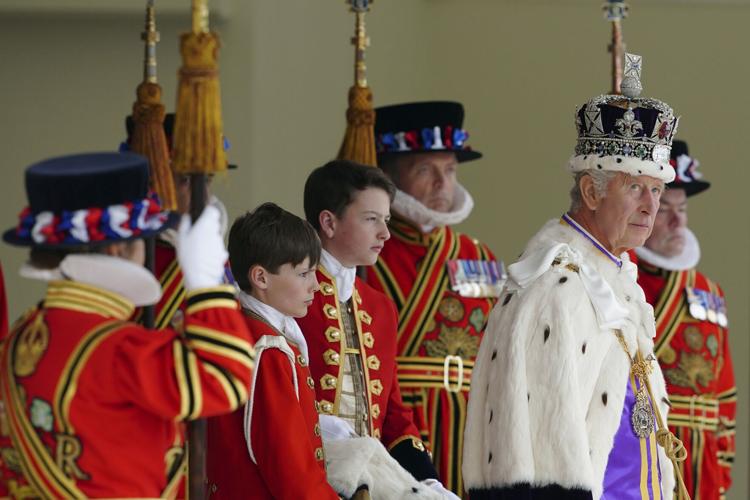
Britain's King Charles III, right, arrives May 6 to receive a royal salute from members of the military in the gardens of Buckingham Palace, following his coronation in London. A year after the death of Queen Elizabeth II, Charles has moved seamlessly into his new role.
Most people seem to have shrugged off Charles’ occasional faux pas — most publicly when he threw a hissy fit over an aide’s failure to move an ornate pen case during a signing ceremony — focusing instead on successes like his state visit to Germany, where the king wowed his audience by switching effortlessly between English and German during a speech to lawmakers.
People are also reading…
The message delivered by the new king’s first year on the throne is clear, said Sally Bedell Smith, author of “Charles: The Passions and Paradoxes of an Improbable Life.” Change will be subtle, more evolution than revolution.
“The queen was known for incremental change and his incremental change may be a little more obvious in various moments,’’ she said. “But back in the ’90s, there was a lot of talk about how he just wanted to really shake up the deck and do things in a more radical way and be more outspoken. And I think he has recognized that this is not his role.”
So while Charles has made it clear that he wants to streamline the monarchy, cut costs and reform a system of patronage seen as bloated and anachronistic, there has been no obvious overhaul of Buckingham Palace — at least not yet.

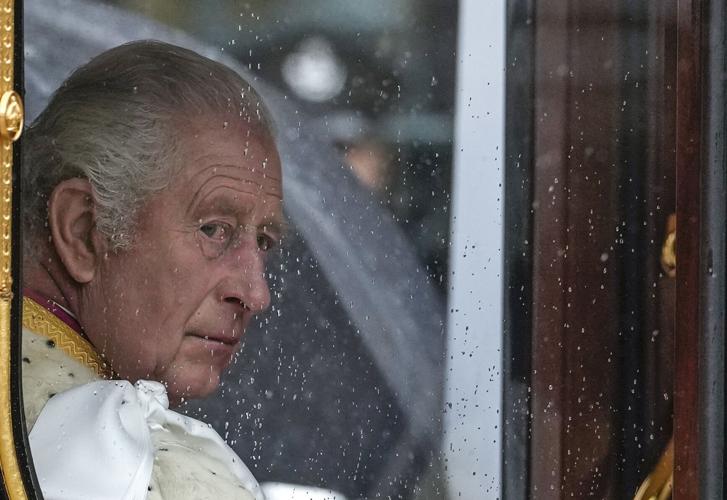
Britain’s King Charles III makes his way to Westminster Abbey prior to his May 6 coronation ceremony in London. A year after the death of Queen Elizabeth II triggered questions about the future of the British monarchy, King Charles III’s reign has been marked by changes in style rather than substance.
Instead, Charles has focused on building bridges at home and abroad as he embraces the role of diplomat-in-chief. After traveling to each of the four nations that comprise the United Kingdom, the king visited faith communities around the country, greeted Ukrainian President Volodymyr Zelensky in London and staged a successful state visit to Germany.
Charles became sovereign on Sept. 8, 2022, the day Elizabeth died after more than 70 years on the throne.
The following day, the new king telegraphed much of what has happened since in a speech that paid homage to the way his mother honored the history of a 1,000-year-old monarchy while embracing the changes that transformed Britain after World War II.
“In her life of service, we saw that abiding love of tradition, together with that fearless embrace of progress, which makes us great as a nation,” Charles said as he pledged to serve all his people, no matter where they live or what they believe.
Known for speaking his mind during his decades as heir to the throne, Charles also acknowledged that he would have to tone down his support for causes such as conservation and environmental protection.
But he immediately handed that mantle to Prince William, encouraging him to “lead our national conversation” and help “bring the marginal to the center ground, where vital help can be given.”
William accepted that challenge, continuing his fight against climate change and announcing a campaign to end homelessness in Britain.
Charles joined the nation in mourning the late queen at a state funeral that celebrated the life of the only monarch most people had ever known. After the queen’s piper played one final lament, the Westminster Abbey congregation offered a thunderous rendition of the national anthem — though for the first time in seven decades the first line was, “God save our gracious king.’’

With that, the queen seemed to slide into the background of history and Charles took center stage in a multicultural nation where schoolchildren now speak more than 300 languages.

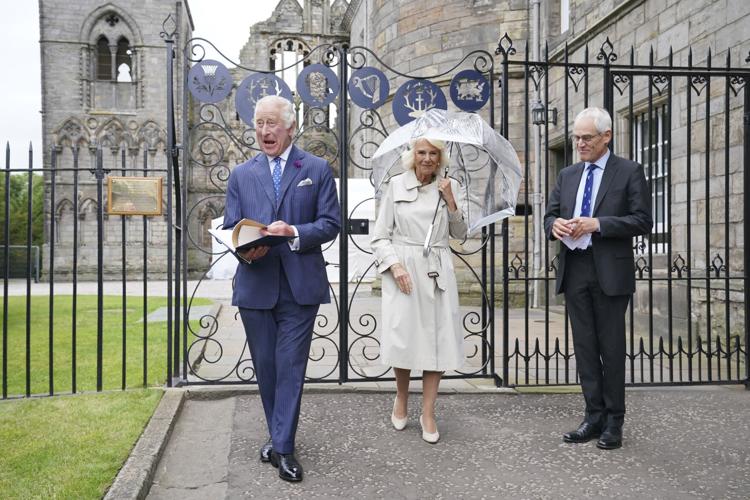
Britain's King Charles III, left, and Queen Camilla, center, accompanied by the moderator of the High Constables, Roderick Urquhart, unveil a plaque July 4 at the new Jubilee Gates to mark the Platinum Jubilee of Queen Elizabeth II at the Palace of Holyroodhouse, in Edinburgh, Scotland.
During his first Christmas Day broadcast, Charles gave a nod to the changing face of Britain, splicing in video of his travels around the kingdom, including scenes of the king meeting with food kitchen volunteers at a Sikh house of worship in Luton, a diverse community 30 miles north of London.
During the coronation ceremony in May, Charles again balanced the traditions of monarchy against the pressure for change.
As Charles sat in the 700-year-old coronation chair at Westminster Abbey, the Archbishop of Canterbury placed a jewel-encrusted crown on his head. Then he was enclosed behind a screen where he was anointed with holy oil.
But the monarch also made sure there was a role for other religions, with non-Christian faith leaders taking part in the ceremony for the first time.
More challenges are to come.
The perception of the monarchy itself has changed since Elizabeth took the throne, making it harder for the palace to stick to its mantra of “never explain, never complain” as the media demand more information about royal spending and accountability.

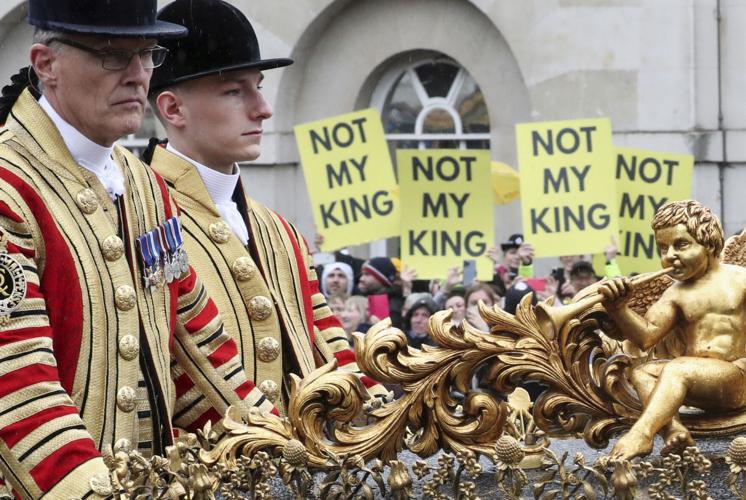
A coach carrying Britain's Prince William, Kate, Princess of Wales, and their children Prince George, Princess Charlotte and Prince Louis rides past protesters May 6 following the coronation ceremony of King Charles III at Westminster Abbey in London.
Charles is also facing demands to make the palace staff more representative of modern Britain and to acknowledge the monarchy’s role in slavery and imperialism.
Some of those calls come from within the royal family after Prince Harry, and his wife, Meghan, criticized the palace in a book and TV series released earlier this year. But there is also pressure from republican groups that want to get rid of the hereditary monarchy and some of the 14 Commonwealth realms that bridle at the idea of having an English king as their head of state.
“It seems likely that his reign will end with less realms than it started,” said Joe Little, managing editor of Majesty Magazine. “But, you know, that was also the case with Queen Elizabeth II. It’s just a natural progression, I think. But ultimately, it’s down to the people of the countries who have him as sovereign.”
Charles III: Key dates in the life of Britain’s new king
Nov. 14, 1948: Born on the royal estate at Sandringham, first child of Princess Elizabeth and Prince Philip.

Feb. 6, 1952: Princess Elizabeth becomes Queen Elizabeth II on the death of her father, King George VI.

July 1, 1969: Formally invested as Prince of Wales.

July 29, 1981: Marries Lady Diana Spencer.

He become the first royal heir since 1660 to marry an English woman.
June 21, 1982: Birth of first son, William Arthur Philip Louis.

Sept. 15, 1984: Birth of second son, Harry (Henry Charles Albert David).

June 15, 1992: Andrew Morton’s book “Diana: Her True Story” is released.

It says Charles has had a long-term affair with a married woman, Camilla Parker Bowles.
Dec. 9, 1992: He separates from Princess Diana.

Aug. 28, 1996: Charles and Diana divorce.

Aug. 31, 1997: Diana is killed in Paris automobile accident.

Feb. 10, 2004: Charles announces his engagement to marry Camilla Parker Bowles.

April 8, 2005: He marries Camilla in a civil ceremony.

She takes title of Duchess of Cornwall.
April 29, 2011: His son, Prince William, is married to Kate Middleton.

Dec. 2011: Hospitalized for treatment for a blocked coronary artery.

June 2013: Admitted to the hospital for exploratory operation on his abdomen.

July 22, 2013: Becomes grandfather for the first time with the birth of Prince George, William and Kate's oldest child.

Two more children — Charlotte and Louis — follow for the couple.
May 19, 2018: His second son, Harry, marries American Meghan Markle.

April 9, 2021: His father, Prince Philip, dies at 99.

May 10, 2022: Charles stands in for Queen Elizabeth II for the first time during the state opening of Parliament.

The queen had to pull out of the event citing mobility problems. The delegation of the role, one of the queen's most important duties, was seen by many as the clearest sign that a transition of the monarchy was underway.
Sept. 8, 2022: Becomes king upon the death of his mother, Queen Elizabeth II.