FORT MORGAN, Colo. — Magdalena Simon’s only consolation after immigration officers handcuffed and led her husband away was the contents of his wallet, a few bills.

Gaby Meza Rodriguez, 7, left, prays with other children during a Sunday school session while her parents attend a church service Dec. 17 in Fort Morgan, Colo.
The hopes that had pushed her to trudge thousands of miles from Guatemala in 2019, her son’s small frame clutched to her chest, ceded to despair and loneliness in Fort Morgan, a ranching outpost on Colorado’s eastern plains, where some locals stared at her too long and the wind howls so fiercely it once blew the doors half off a hotel.
The pregnant Simon tried to mask the despair every morning when her toddlers asked, “Where’s papa?”
To millions of migrants who have crossed the U.S. southern border in the past few years, stepping off greyhound buses in places across America, such feelings can be constant companions. What Simon would find in this unassuming city of a little more than 11,400, however, was a community that pulled her in, connecting her with legal council, charities, schools and soon friends, a unique support network built by generations of immigrants.
People are also reading…

A group of immigration organization supporters sing carols as they walk on Main Street during a Posada celebration Dec. 17 in Fort Morgan, Colo.
In this small town, migrants are building quiet lives, far from big cities like New York, Chicago and Denver that have struggled to house asylum-seekers and from the halls of Congress where their futures are bandied about in negotiations.
The Fort Morgan migrant community has become a boon for newcomers, nearly all of whom arrive from perilous journeys to new challenges: pursuing asylum cases; finding a paycheck big enough for food, an attorney and a roof; placing their kids in school; and navigating a language barrier, all while facing the threat of deportation.
The United Nations used the community, 80 miles northeast of Denver, as a case study for rural refugee integration after a thousand Somalis arrived to work in meatpacking plants in the late 2000s. In 2022, grassroots groups sent migrants living in mobile homes to Congress to tell their stories.
In the past year, hundreds more migrants have arrived in Morgan County. More than 30 languages are spoken in Fort Morgan’s only high school, which has translators for the most common languages and a phone service for others. On Sundays, Spanish is heard from the pulpits of six churches.
The demographic shift in recent decades has forced the community to adapt: Local organizations hold monthly support groups, train students and adults about their rights, teach others how to drive, ensure kids are in school and direct people to immigration attorneys.

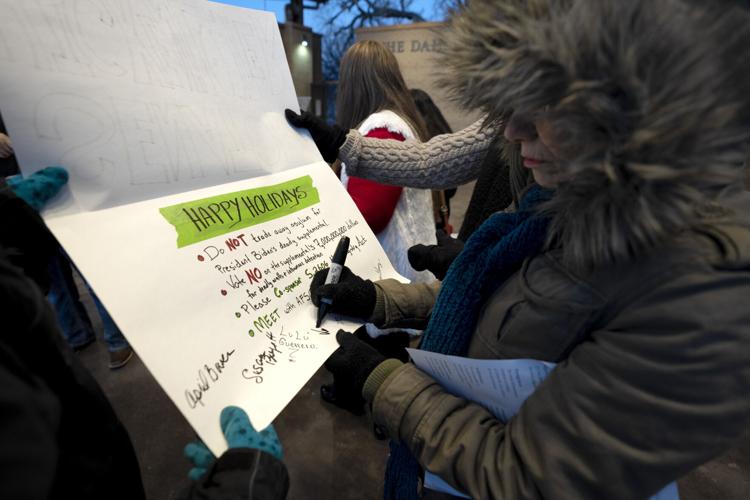
People sign a Christmas card to be delivered to U.S. Sen. John Hickenlooper, D-Colo., during a Posada celebration Dec. 17 in Fort Morgan, Colo.
Simon herself now tells her story to those stepping off buses. The community can’t wave away the burdens, but they can make them lighter.
“It’s not like home where you have your parents and all of your family around you,” Simon tells those she meets in grocery stores and school pickup lines. “If you run into a problem, you need to find your own family.”
The work has grown amid negotiations in Washington, D.C., on a deal that could toughen asylum protocols and bolster border enforcement.
On a recent Sunday, advocacy groups organized a posada, a Mexican celebration of the biblical Joseph and Mary seeking shelter for Mary to give birth and being turned away until they were given the stable.
Before marching down the street singing a song adaption in which migrants are seeking shelter instead of Joseph and Mary, participants signed letters urging Colorado’s two Democratic senators and Republican U.S. Rep. Ken Buck to reject stiffer asylum rules.
A century ago, it was sugar beet production that brought German and Russian migration to the area. Now, many migrants work inside dairy plants.

Carolina Mateo Simon, 8, left, and her brother Francisco Mateo Simon, 7, look at a nativity scene under the family's new Christmas tree Dec. 15 at their home in Fort Morgan, Colo.
When area businesses were raided several times in the 2000s, friends disappeared overnight, seats sat empty in schools and gaps opened on factory lines.
“That really changed the the understanding of how deeply embedded migrants are in community,” said Jennifer Piper of American Friends Service Committee, which organized the posada celebration.
Guadalupe “Lupe” Lopez Chavez, who arrived in the U.S. alone in 1998 from Guatemala at age 16, spends long hours working with migrants, including helping connect Simon to a lawyer after her husband was detained.
One recent Saturday, Lopez Chavez sat in the low-ceilinged office of One Morgan County, a nearly 20-year-old migration nonprofit. In a folding chair, Maria Ramirez sifted through manila folders dated November 2023, when she arrived in the U.S.
Ramirez fled central Mexico, where cartel violence claimed her younger brother’s life, and asked Lopez Chavez how she could get health care. Ramirez’s 4-year-old daughter — who pranced behind her mother, blowing bubbles and popping the ones that landed in her brown curls — has a lung condition.
Ramirez said she would work anywhere to move from the living room they sleep in, with just a blanket on the floor as cushioning.
In the offices resembling a hostel’s well-loved communal space, Lopez Chavez cautioned Ramirez to consult a lawyer before applying for health care. Sitting aside Ramirez were two settled migrants offering support and advice.
“A lot of stuff that you heard in Mexico (about the U.S.) was you couldn’t walk on the streets, you had to live in the shadows, you’d be targeted,” said Ramirez. “It’s beautiful to come into a community that’s united.”
Lopez Chavez works with new migrants because she remembers shackles snapping around her ankles after she was stopped for a traffic violation in 2012 and turned over to the U.S. immigration authorities.
“I just wanted to leave there because I’d never been in a cage before,” Lopez Chavez said in an interview, her eyes filling with tears.

Girls wearing traditional dresses from the Mexico state of Nuevo Leon perform during a Posada celebration Dec. 17 in Fort Morgan, Colo.
At her first court hearing, Lopez Chavez and her husband stood alone. At her second hearing, after Lopez Chavez was connected to the community, she was flanked by new friends. That wall of support allowed her to keep her chin up as she fought her immigration case before being granted residency last year.
Lopez Chavez now works to cultivate that strength across the community.
“I don’t want any more families to go through what we went through,” said Lopez Chavez, who also encourages others to tell their stories. “Those examples give people the idea: If they can manage their case and win, maybe I can, too.”
Photos: Migrants rush across US border in final hours before pandemic rule expires

A Texas National Guardsman stands along a stretch of razor wire as migrants try to cross into the U.S., on the banks of the Rio Grande, as seen from Matamoros, Mexico, Thursday, May 11, 2023. Migrants rushed across the Mexico border Thursday in hopes of entering the U.S. in the final hours before pandemic-related asylum restrictions are lifted. (AP Photo/Fernando Llano)

Members of the Texas National Guard prepare to deploy to the Texas-Mexico border in Austin, Texas, Monday, May 8, 2023. The Title 42 policy, a federal rule that has allowed the government to strictly regulate border entries, is set to expire this week. (AP Photo/Eric Gay)

Migrants pass through razor wire on the bank of the Rio Grande river where Texas National Guards verbally tell them not to cross, as migrants enter the U.S. to turn themselves into immigration authorities, seen from Matamoros, Mexico, Thursday, May 11, 2023. Pandemic-related U.S. asylum restrictions, known as Title 42, are to expire May 11. (AP Photo/Fernando Llano)

Migrants stand on the bank of the Rio Grande river as Texas National Guards block them from behind razor wire, seen from Matamoros, Mexico, Thursday, May 11, 2023. Pandemic-related U.S. asylum restrictions, known as Title 42, are to expire May 11. (AP Photo/Fernando Llano)

Venezuelan migrants take a break during their walk across the Darien Gap from Colombia to Panama, in hopes of reaching the U.S., Tuesday, May 9, 2023. Pandemic-related U.S. asylum restrictions, known as Title 42, are to expire Thursday, May 11. (AP Photo/Ivan Valencia)

Migrants walk across the Darien Gap from Colombia to Panama in hopes of reaching the U.S., Tuesday, May 9, 2023. Pandemic-related U.S. asylum restrictions, known as Title 42, are to expire Thursday, May 11. (AP Photo/Ivan Valencia)

Texas National Guard soldiers tie rows of barbed-wire to be installed near a gate in the border fence in El Paso, Texas, in the early hours of Thursday, May 11, 2023. Migrants rushed across the border hours before pandemic-related asylum restrictions were to expire Thursday, fearing that new policies would make it far more difficult to gain entry into the United States. (AP Photo/Andres Leighton)

A man from Colombia uses metallic fabric to keep his feet warm as he waits to apply for asylum after crossing the border from Mexico on Wednesday, May 10, 2023, near Jacumba, Calif. The Biden administration on Thursday will begin denying asylum to migrants who arrive at the U.S.-Mexico border without first applying online or seeking protection in a country they passed through, marking a fundamental shift in immigration policy as the U.S. readies for the end of a key pandemic restriction. (AP Photo/Gregory Bull)

A migrant from Colombia, center, gives a blanket to a father and son, also from Colombia, as the group waits to apply for asylum after crossing the border Wednesday, May 10, 2023, near Jacumba, Calif. The group have been camping just across the border for days, waiting to apply for asylum in the United States. As members of the group get to the front of the line to be escorted into vans, they hand off all warm clothing to those who might still have to camp overnight. (AP Photo/Gregory Bull)

Migrants cross the Rio Grande river into the U.S., seen from Matamoros, Mexico, Wednesday, May 10, 2023. Asylum seekers have been showing up at the US-Mexico border in huge numbers in anticipation of the restriction of Title 42, that had allowed the government to quickly expel migrants to Mexico. New measures were announced Wednesday creating new legal pathways for migrants. (AP Photo/Fernando Llano)

Migrants wait for U.S. authorities, between a barbed-wire barrier and the border fence at the US-Mexico border, as seen from Ciudad Juarez, Mexico, Wednesday, May 10, 2023. The U.S on May 11 will begin denying asylum to migrants who show up at the U.S.-Mexico border without first applying online or seeking protection in a country they passed through, according to a new rule released May 10. (AP Photo/Christian Chavez)

Migrants wait in line adjacent to the border fence under the watch of the Border Patrol and Texas National Guard to enter into El Paso, Texas, Wednesday, May 10, 2023. President Joe Biden’s administration on Thursday will begin denying asylum to migrants who show up at the U.S.-Mexico border without first applying online or seeking protection in a country they passed through, according to a new rule released Wednesday, as U.S. officials warned of difficult days ahead as a key limit on immigration is set to expire.(AP Photo/Andres Leighton)

Asylum-seekers wait between the double fence on U.S. soil along the U.S.-Mexico border near Tijuana, Mexico, Monday, May 8, 2023, in San Diego. The migrants wait between the fences to be processed by U.S. Border Patrol agents. (AP Photo/Denis Poroy)

Asylum-seekers wait between the double fence on U.S. soil along the U.S.-Mexico border near Tijuana, Mexico, Monday, May 8, 2023, in San Diego. The migrants wait between the fences to be processed by U.S. Border Patrol agents. (AP Photo/Denis Poroy)

Members of the Texas National Guard prepare to deploy to the Texas-Mexico border in Austin, Texas, Monday, May 8, 2023. The Title 42 policy, a federal rule that has allowed the government to strictly regulate border entries, is set to expire this week. (AP Photo/Eric Gay)

FILE - Migrants that were trying to evade U.S. Border Patrol agents, wait to be processed in Granjeno, Texas, early Thursday, May 4, 2023. A recent surge of migrants in the Brownsville area of the U.S.-Mexico border is highlighting immigration challenges as the U.S. prepares for the end of a policy linked to the coronavirus pandemic that allowed it to quickly expel many migrants. (AP Photo/Veronica G. Cardenas, File)

Migrants from El Salvador cross the Rio Grande river to the U.S. side, from Matamoros, Mexico, Thursday, May 11, 2023. Pandemic-related U.S. asylum restrictions, known as Title 42, are to expire May 11. (AP Photo/Fernando Llano)

Texas National Guards stand guard on the bank of the Rio Grande river, seen from Matamoros, Mexico, Thursday, May 11, 2023. Pandemic-related U.S. asylum restrictions, known as Title 42, are to expire May 11. (AP Photo/Fernando Llano)

A couple of migrants watch as the Texas National Guard add more rows of barbed-wire around a gate in the border fence into El Paso, Texas, in the early hours of Thursday, May 11, 2023. Migrants rushed across the border hours before pandemic-related asylum restrictions were to expire Thursday, fearing that new policies would make it far more difficult to gain entry into the United States. (AP Photo/Andres Leighton)

Migrants sit under a sign marking the Panama-Colombia border during their trek across the Darien Gap, Tuesday, May 9, 2023. Pandemic-related U.S. asylum restrictions, known as Title 42, are to expire Thursday, May 11. (AP Photo/Ivan Valencia)

A Venezuelan migrant buys an energy drink at a stall set up along the route of the Darien Gap, from Colombia into Panama, Tuesday, May 9, 2023. Pandemic-related U.S. asylum restrictions, known as Title 42, are to expire Thursday, May 11. (AP Photo/Ivan Valencia)

Migrants gather to start the walk across the Darien Gap from Colombia to Panama in hopes of reaching the U.S., at the trailhead camp in Acandi, Colombia, Tuesday, May 9, 2023. Pandemic-related U.S. asylum restrictions, known as Title 42, are to expire Thursday, May 11. (AP Photo/Ivan Valencia)

Migrants arrive at a gate in the border fence after crossing from Ciudad Juarez, Mexico into El Paso, Texas, in the early hours of Thursday, May 11, 2023. Migrants rushed across the border hours before pandemic-related asylum restrictions were to expire Thursday, fearing that new policies would make it far more difficult to gain entry into the United States. (AP Photo/Andres Leighton)

Migrants wait for U.S. authorities, between a barbed-wire barrier and the border fence at the US-Mexico border, as seen from Ciudad Juarez, Mexico, Wednesday, May 10, 2023. Asylum seekers have been showing up at the US-Mexico border in huge numbers in anticipation of the restriction of Title 42, that had allowed the government to quickly expel migrants to Mexico. New measures were announced Wednesday creating new legal pathways for migrants. (AP Photo/Christian Chavez)

Wheelchair-bound Colombian migrant Mireya Payares is helped by another migrant to cross the Rio Grande river from Matamoros, Mexico, Wednesday, May 10, 2023. Payares is part of a family group of nine Colombian migrants who are traveling together from Bucaramanga, Colombia, since February 19, 2023, to reach the United States. (AP Photo/Fernando Llano)

Migrants walk up the bank on the U.S. side of the Rio Grande river, as seen from Matamoros, Mexico, Wednesday, May 10, 2023. Asylum seekers have been showing up at the US-Mexico border in huge numbers in anticipation of the restriction of Title 42, that had allowed the government to quickly expel migrants to Mexico. New measures were announced Wednesday creating new legal pathways for migrants. (AP Photo/Fernando Llano)

A migrant crosses the Rio Grande river with a baby in a suitcase, as seen from Matamoros, Mexico, Wednesday, May 10, 2023. The U.S. on May 11 will begin denying asylum to migrants who show up at the U.S.-Mexico border without first applying online or seeking protection in a country they passed through, according to a new rule released on May 10. (AP Photo/Fernando Llano)

Venezuelan migrant Luis Parra, third right, joins other migrants crossing the Rio Grande river, seen from Matamoros, Mexico, Wednesday, May 10, 2023. Parra and his niece Leidy Arriza arrived at the border after staying overnight in the Mexican city of Monterrey. (AP Photo/Fernando Llano)

Migrants use plastic bottles as floatation devices to cross the Rio Bravo river into the United States from Matamoros, Mexico, Wednesday, May 10, 2023. The U.S. on May 11 will begin denying asylum to migrants who show up at the U.S.-Mexico border without first applying online or seeking protection in a country they passed through, according to a new rule released on May 10. (AP Photo/Fernando Llano)

Texas National Guardsmen stand along a stretch of razor wire as a migrant woman carrying a child tries to cross into the U.S, on the banks of the Rio Grande, as seen from Matamoros, Mexico, Thursday, May 11, 2023. Migrants rushed across the Mexico border Thursday in hopes of entering the U.S. in the final hours before pandemic-related asylum restrictions are lifted. (AP Photo/Fernando Llano)

Migrants walk toward immigration authorities to turn themselves in as they make their way past Texas National Guardsmen, on the bank of the Rio Grande, as seen from Matamoros, Mexico, Thursday, May 11, 2023. Migrants rushed across the Mexico border Thursday in hopes of entering the U.S. in the final hours before pandemic-related asylum restrictions are lifted. (AP Photo/Fernando Llano)

Migrants cross the Rio Grande to the U.S. side, from Matamoros, Mexico, Thursday, May 11, 2023. Migrants rushed across the Mexico border Thursday in hopes of entering the U.S. in the final hours before pandemic-related asylum restrictions are lifted. (AP Photo/Fernando Llano)

An official interviews a migrant who was deported from the United States upon his arrival on a chartered plane, at the airport in Bogota, Colombia, Thursday, May 11, 2023. Colombian migration authority said 209 Colombians were flown on a charted flight from the U.S.- Mexico border. (AP Photo/John Vizcaino)

Yised Marulanda cries after arriving with other Colombia migrants deported from the United States, at the airport in Bogota, Colombia, Thursday, May 11, 2023. Colombian migration authority said 209 Colombians were flown on a charted flight from the U.S.- Mexico border. (AP Photo/John Vizcaino)

A migrant gestures to Texas National Guards standing behind razor wire on the bank of the Rio Grande river, seen from Matamoros, Mexico, Thursday, May 11, 2023. Pandemic-related U.S. asylum restrictions, known as Title 42, are to expire May 11. (AP Photo/Fernando Llano)

A young migrant holding swimming inner tubes stands on the Mexican-side of the Rio Grande river, from where migrants swim across to the U.S. side, in Matamoros, Mexico, Thursday, May 11, 2023. Pandemic-related U.S. asylum restrictions, known as Title 42, are to expire May 11. (AP Photo/Fernando Llano)

Venezuelan migrants take a break during their walk across the Darien Gap from Colombia to Panama, in hopes of reaching the U.S., Tuesday, May 9, 2023. Pandemic-related U.S. asylum restrictions, known as Title 42, are to expire Thursday, May 11. (AP Photo/Ivan Valencia)

Texas National Guardsmen reinforce a stretch of razor wire as migrants try to cross into the U.S., on the banks of the Rio Grande, as seen from Matamoros, Mexico, Thursday, May 11, 2023. Migrants rushed across the Mexico border Thursday in hopes of entering the U.S. in the final hours before pandemic-related asylum restrictions are lifted. (AP Photo/Fernando Llano)

A young migrant swims across the Rio Grande river to the U.S. from Matamoros, Mexico, Wednesday, May 10, 2023. The U.S on May 11 will begin denying asylum to migrants who show up at the U.S.-Mexico border without first applying online or seeking protection in a country they passed through, according to a new rule released May 10. (AP Photo/Fernando Llano)

Migrants cross the Rio Grande river into the U.S. from Matamoros, Mexico, Wednesday, May 10, 2023. The U.S on May 11 will begin denying asylum to migrants who show up at the U.S.-Mexico border without first applying online or seeking protection in a country they passed through , according to a new rule released May 10. (AP Photo/Fernando Llano)

Migrants cross the Rio Bravo on an inflatable mattress into the United States from Matamoros, Mexico, Tuesday, May 9, 2023. The U.S. is preparing for the Thursday, May 11th end of the Title 42 policy, linked to the coronavirus pandemic that allowed it to quickly expel many migrants seeking asylum. (AP Photo/Fernando Llano)

Migrants walk through a barbed-wire barrier into the United States after crossing the Rio Bravo from Matamoros, Mexico, Tuesday, May 9, 2023. The U.S. is preparing for the Thursday, May 11th end of the Title 42 policy, linked to the coronavirus pandemic that allowed it to quickly expel many migrants seeking asylum. (AP Photo/Fernando Llano)

Migrants cross the Rio Grande river into the United States from Ciudad Juarez, Mexico, Tuesday, May 9, 2023. The U.S. is preparing for the May 11th end of the Title 42 policy, linked to the coronavirus pandemic that allowed it to quickly expel many migrants seeking asylum. (AP Photo/Christian Chavez)

Migrants cross a barbed-wire barrier into the United States from Ciudad Juarez, Mexico, Tuesday, May 9, 2023. The U.S. is preparing for the Thursday, May 11th end of the Title 42 policy, linked to the coronavirus pandemic that allowed it to quickly expel many migrants seeking asylum. (AP Photo/Christian Chavez)

Migrants line-up between a barbed-wire barrier and the border fence at the US-Mexico border, as seen from Ciudad Juarez, Mexico, Tuesday, May 9, 2023. The U.S. is preparing for the Thursday, May 11th end of the Title 42 policy, linked to the coronavirus pandemic that allowed it to quickly expel many migrants seeking asylum. (AP Photo/Christian Chavez)

Migrants camp at a makeshift shelter in Reynosa, Mexico, Tuesday, May 9, 2023. The U.S. is preparing for the Thursday, May 11th end of the Title 42 policy, linked to the coronavirus pandemic that allowed it to quickly expel many migrants seeking asylum. (AP Photo/Fernando Llano)

Moto taxis transport migrants to Las Tecas camp from where they will start walking across the Darien gap from Colombia to Panama in hopes of reaching the US, in Acandi, Colombia, Monday, May 8, 2023. (AP Photo/Ivan Valencia)

Venezuelan migrant Rowil Espinoza, 34, carries his son Calel on the bank of the Rio Grande river, planning to cross to the U.S., from Matamoros, Mexico, Wednesday, May 10, 2023. Espinoza said he is traveling with his wife and three children. (AP Photo/Fernando Llano)

Texas state police finish placing barbed-wire as migrants walk up the bank of the Rio Grande river, seen from Matamoros, Mexico, Wednesday, May 10, 2023. The U.S on May 11 will begin denying asylum to migrants who show up at the U.S.-Mexico border without first applying online or seeking protection in a country they passed through, according to a new rule released May 10. (AP Photo/Fernando Llano)