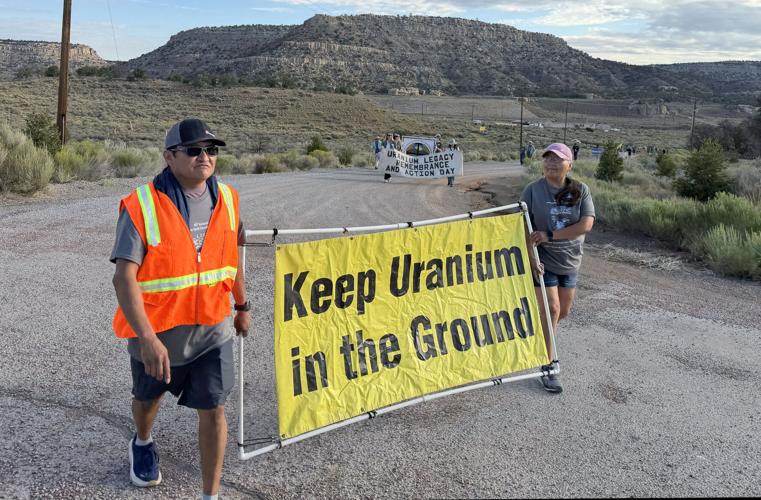
Across the road from Larry King’s house northeast of Gallup, the Navajo Nation’s uranium mining legacy meets the new demand for the metal.
In 2005, the Navajo Nation, reeling from the impacts of forty years of uranium mining on its lands and the health effects from the waste left behind, passed a law prohibiting any new uranium mining.
People are also reading…
The reservation is vast — covering more than 27,000 square miles in three states. But land in some areas is checkerboarded with other ownership, including other federal lands and private lands.
Mining companies are taking full advantage of that in order to pursue their interests in the uranium-rich region, despite the ban.
As the demand for low-carbon electricity skyrockets worldwide, driven largely by AI and data-center development as well as climate-change concerns, nuclear energy is experiencing a renaissance of sorts.
The climate-change impetus toward nuclear is not without irony. Solutions for waste disposal dog the industry at every level, from uranium extraction to milling to U.S. power plants overfilling temporary fuel-rod storage pools as long-term storage remains politically elusive after the failure to get the Yucca Mountain repository in Nevada green-lighted in 2011.
Even so, the increased interest in nuclear energy is undeniable, with decarbonization demands and new technology like small modular nuclear reactors leading the way. And that has pushed uranium prices dramatically upward. Prices have been hovering around $90 a pound most of this year, continuing a steady increase from under $20 a pound less than a decade ago. That makes it economically desirable for mining companies to find new sources, or new ways to access old ones.
19 new uranium projects
That’s why there are 19 uranium exploration and mining projects currently in New Mexico, in various stages of the planning, licensing and permitting processes, many of them right next to Navajo lands.
Near King’s place, Laramide Resources, a Canadian company active in uranium mining projects in Australia and the western United States, is proposing to use a relatively new technology called ISR — In Situ Recovery — to access the same ore body that was mined from 1960 to 1982, known as the Old Church Rock Mine.
Even as Laramide’s subsidiary, NuFuels, has won a Nuclear Regulatory Commission license to mine — just one of many steps to final approval — it is simultaneously on the hook for doing an emergency cleanup of waste from former mining, in EPA parlance, a Time Critical Removal Action, at the site.
In ISR mining, a liquid solution — either an alkaline or acidic agent — is injected underground, where it liquefies uranium, and a slurry containing the metal is then pumped to the surface, where it is processed into yellowcake, the powdered form of uranium used as the primary ingredient in nuclear fuels.
The ISR method currently accounts for about 60 percent of worldwide uranium production. Mining companies contend it “is designed with multiple layers of protection to prevent contamination of groundwater,” and says it has been used with minimal environmental impact for years elsewhere, but because uranium mining has been all but stopped for the past 30 years in the United States, it is seen as new here.
Not so fast, antinuclear activists say. “No one has proved that the technology will not contaminate groundwater,” says Ava Curtis of MASE, the Multicultural Alliance for a Safe Environment, which is fighting the resumption of uranium mining in areas near the Navajo and Nation and Laguna Pueblo.
“ISR solution excursions have the potential … to impact domestic water supplies,” the Montana Bureau of Mines and Geology says in an online description of the mining technique. “Factors that can contribute to the unintentional migration of recovery solution into groundwater include equipment failures, aquifer heterogeneity, fractures, or improper well completions.”
Mining companies insist that not only is the procedure safe, but it disturbs the surface far less than traditional underground shafts or open pits; it produces no piles of waste rock, as the other methods do; and is far cleaner and more efficient than other mining methods and also reduces carbon emissions.

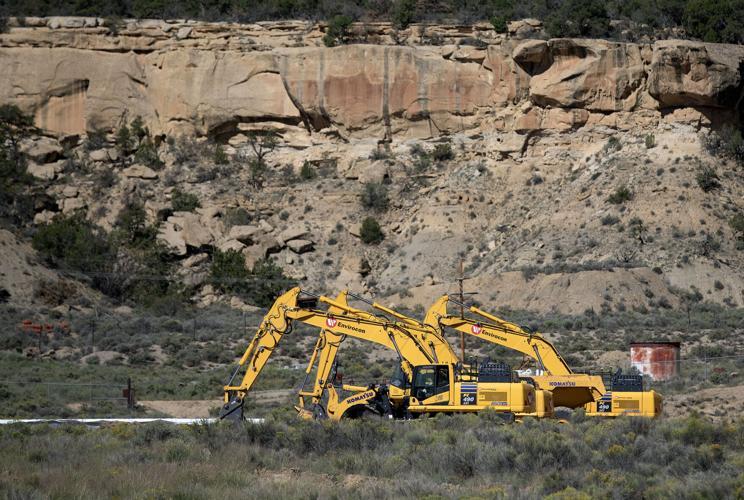
Construction equipment sits at the Church Rock mill site in New Mexico on Sept. 9 near the abandoned Northeast Church Rock mining site. The machines are expected to help move the Northeast Church Rock mine waste less than a mile to the mill site in a cleanup that has been discussed but delayed for nearly two decades.
The Laramide Church Rock project is one of four mining proposals in New Mexico that are furthest along in the lengthy regulatory process and therefore the highest priority for opponents of uranium mining resumption near the Navajo Nation. The others:
• Roca Honda, a large underground mining project from Energy Fuels, currently the largest uranium producer in the United States. Energy Fuels say their site holds an estimated 17.6 million pounds of uranium resources. Ore would be trucked to the White Mesa Mill near Blanding, Utah, for processing — potentially problematic because of restrictions on hauling ore over Navajo lands. Federal and state reviews are ongoing. The mine site is on Forest Service land.
Anti-mining activists’ concerns center on the fact that the mine is near Mount Taylor, a traditional cultural site revered as sacred by multiple indigenous peoples including the Navajo people; and that the mine would require continuous underground dewatering, resulting in a drawdown of an aquifer relied upon by many.
• La Jara Mesa, a Laramide project, also near Mount Taylor, also proposed as an underground mine. In September, the mine’s timeline was apparently paused after stiff resistance from community and tribal groups, although Laramide insists the delays in certain review steps do not signal abandonment of the project.
• Grants Precision ISR is a project of Grants Energy, an affiliate of General Atomics and Heathgate Resources. The proposed mine is on about six square miles of private land northeast of Grants, New Mexico, near the tiny town of San Mateo. The company contends it will provide 30 years’ worth of domestic uranium supply from what it calls the largest contiguous uranium deposit in the United States, in the Grants Mineral Belt.
For some tribal members, any resumption of mining nearby while the Navajo Nation still struggles with cleaning up the dangerous and voluminous legacy uranium mining waste is an outrage.
“These mining companies (planning projects next to the reservation) may be complying with the letter of the Navajo mining ban, but certainly not the spirit of it,” says Curtis of MASE.
June Lorenzo of Laguna Pueblo agrees. The pueblo is still grappling with the toxic legacy of the Jackpile Mine, at one point the largest open-pit uranium mine in the world and now a Superfund site. The village of Paguate, in particular, is vulnerable to health risks from nearby windblown wastes. Health studies are ongoing there.
“All of this (health testing) is occurring very late,” said Lorenzo, an attorney who has worked for both the Navajo Nation and the Laguna Pueblo. “The mine closed in 1982 and here we are in 2026. A lot of people have already died, miners and their family members. At the time of the mining most people here got their health care from the Indian Health Service. I understand that only one doctor with IHS started asking questions about the mine and she was transferred to Alaska.
“I mean, I’ m grateful it’s being done, but it’s late. That said, I know that many uranium-related diseases have a latency period and may not show up for many years.
“And now they’re talking about mining near Mount Taylor, which is a sacred site. That’s an insult.”