The Navajo Nation has roughly 16 million cubic yards of contaminated uranium mining waste on its land — and too little money and too few affordable disposal options to get rid of it.
Stephen B. Etsitty believes a way forward could lie in the waste itself.

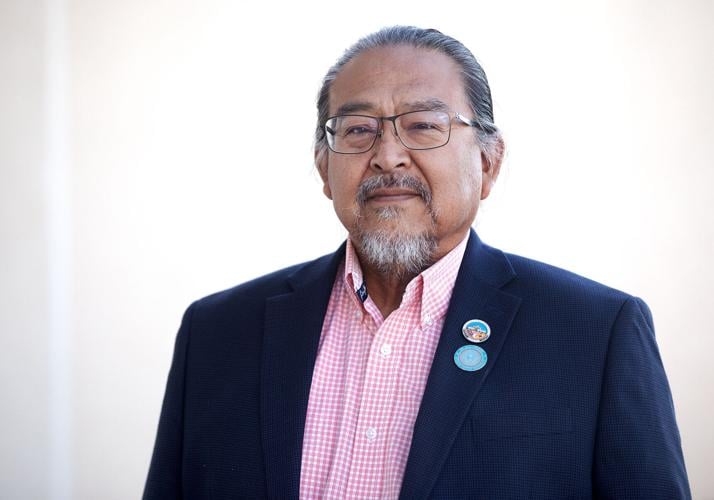
Stephen B. Etsitty, executive director of the Navajo EPA in Window Rock, New Mexico, on Sept. 10.
The executive director of the Navajo Nation Environmental Protection Agency is pursuing a strategy that would combine a new waste repository in New Mexico with technology to separate uranium and other radioactive materials from mine waste.
People are also reading…
Recovering uranium for reuse, he argues, could help pay for the cleanup while reducing the amount of material that needs disposal.
But the proposals face significant hurdles.
The repository needs state and federal approvals. An earlier test of the waste-treatment technology fell short of the tribe’s residential cleanup standards.
And some community advocates fear that recovering uranium would perpetuate the industry’s harms and shift waste to another Indigenous community.
For Etsitty, who has spent much of the past quarter-century grappling with uranium contamination, the alternative is unacceptable: a cleanup that could stretch another century, leaving radioactive waste fenced off on Navajo land for generations.

The EPA has identified 523 such sites on or adjacent to the Navajo Nation. Even if you “only” count the mines actually within the Nation's boundaries, that number is 471. And just on those sites, the EPA says, approximately 16 million cubic yards of contaminated mining waste awaits cleanup.
The two biggest challenges: Not enough money, and nowhere to put all the waste.
Etsitty is almost uniquely positioned to understand the issue.
Navajo, Stanford-educated, deeply experienced, he is in a key position as executive director of the Navajo Nation Environmental Protection Agency. He has held that position under four different Navajo Nation presidential administrations (every time the job has been vacant, he has applied for it). He knows the U.S. Environmental Protection Agency inside and out: He once worked in the Region 9 headquarters in San Francisco, which has a lead role in the cleanup.
Yet he is a polarizing figure. Many Navajo activists on the uranium issue say he is part of the problem.
Etsitty is unfazed. And despite expressing frustration at the slow pace of multiagency cleanup efforts, he is pushing hard for outside-the-box solutions. And he doesn’t shy away from being critical of U.S. EPA efforts.
“EPA told us early on that community acceptance was a pretty important criterion in all of these cleanups. Now we’re seeing through the public comment period, and EPA’s attention to public comment, that community acceptance is just a box they check off.”
'Cap in place' unsatisfactory
Further, he says, despite how slow the EPA’s evaluation process is for each site, the agency basically comes up with the same plan each time: A “cap in place” solution that leaves the waste on the site but attempts to protect public health and the environment with a cap, or cover, for the waste.
“They’re telling us that they don’t preselect remedies,” Etsitty says, “but when you put in alternatives that are too costly, and you know you’re never going to select, and you put in a no-action alternative which you’re never going to select, you’re just left with a variety of cap-in-place options that have a cost difference of, what, $5 to $10 million each, and you’re going to pick the one that’s the least costly.”
The costly alternatives are due to a lack of suitable locations where uranium mining waste can be taken.
“There aren’t too many facilities set up to take it” in the volume needed for the Navajo Nation cleanup, Etsitty says. “The one that was being worked on in the 80s and 90s at Yucca Mountain (Nevada) fizzled out, and that left a whole generation or two of people that were just like, ‘We don’t want nuclear waste anywhere, not in my backyard.’
“And the federal government has yet to really put in a concerted effort to deal with the disposal” issue, Etsitty says. “There are a couple of commercial hazardous waste facilities that can take Navajo abandoned uranium mine waste, but they’re 500 miles away, and that drives up the cost. One just south and east of Denver, at Deer Trails, Colorado, and one at Andrews, Texas. The distance makes them uneconomical.
"But they are still included in the EPA’s detailed assessments, called EE/CAs (engineering evaluation/cost assessments), but because they’re the highest cost, they’re never going to be chosen.”

Rising demand for nuclear power is fueling new uranium mining proposals near the Navajo Nation, where decades-old waste remains.
But Etsitty is excited about an emerging possibility.
“In June of 2025, we were approached by a private landowner in Grants, New Mexico, BHP, the mining company. They said, ‘We have 14,000 acres, and we think they can help you.”
And we’ve been talking to them ever since. We’ve been looking to develop a waste repository located there. It is far enough away from the Navajo Nation. It’s not near any Navajo communities and it’s close enough to make it viable, economically.”
The site is contiguous to a large waste repository used by the Department of Energy.
“We’ve also come to understand technically that the geology and the underlying hydrology situation there is … acceptable. We don’t see any threat of groundwater migrating away from the site.”
Etsitty believes there’s enough capacity for a facility large enough to accommodate “all of the Navajo Nation’s disposal needs and the Pueblo of Laguna,” which is a big deal because of the abandoned Jackpile Mine site, a huge former open-pit uranium mine on Laguna land.
The proposal would need approval from the New Mexico government as well as the federal agencies. Some say it is unlikely the state will approve the plan, but Etsitty says discussions are continuing, and the site may also be a solution for the state, which has abandoned uranium mines to clean up also.
Ava Curtis, environmental justice coordinator of the Multicultural Alliance for a Safe Environment, says that while the organization "supports offsite disposal over cap-in-place," the organization will not take a position on the Ambrosia Lake proposal until it appears more likely. "Right now we're not looking at it as a viable option," she said.
“We’ve always stated that our preferred option is complete removal,” Etsitty said. “But without developing a repository like this we’ll be forced into more cap-in-place solutions. We don’t see cap in place as the best remedy because that leaves land under institutional controls forever. It leaves radioactive constituents in the ground and subject to the changing climate conditions forever. It could potentially be a source of groundwater contamination in the future. And there’s no way for people to beneficially use the land. You know, you have to keep it behind a fence.”
Technology to reduce waste volume
The other part of Etsitty’s two-pronged strategy involves using technology to reduce the volume of waste that must be moved (or capped) at the 523 abandoned-mine sites.
That’s why the tribe has entered into a business relationship with a company called Disa Technologies Inc. Disa has developed a technology called high pressure slurry ablation, which removes metals from rock. It’s a low-tech, mechanical process in which waste is mixed with water into a slurry, and high-pressure pumps force two slurry streams into each other. The impact breaks the material down, stripping minerals into fine particles that settle out from the rock.
It’s controversial. Some activists say it’s just another form of extraction that will bring more misery to the tribe. They also question the amount of water needed to treat waste at that quantity with the technology.
It’s certainly true that it would recover uranium. To Etsitty, that’s a feature, not a bug, if it helps pay for the cleanup.

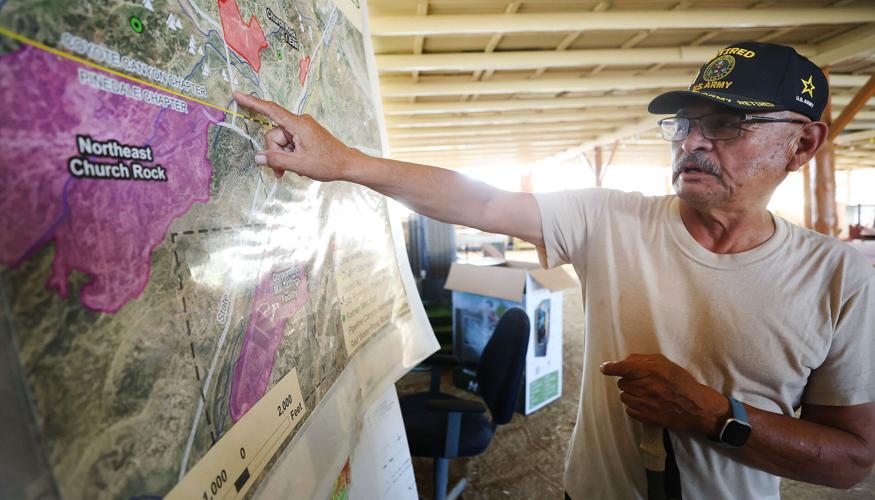
Bradley Henio talks about the impending cleanup of uranium radioactive waste while pointing to a map of the Red Water Pond Road community area on Sept. 9. Henio lives between two abandoned uranium mining sites, Quivira Mines and Northeast Church Rock Mine.
“If it takes recycling of our abandoned uranium mine waste to get the cleanup that we so much deserve, and some of that may go back into the nuclear fuel cycle to meet national energy demand and maybe even military and national security needs, all the better,” he says.
“It makes sense to recover as much resource from abandoned uranium mine waste as opposed to doing new mining,” Etsitty says with the fervor of an evangelist. “Why punch more holes in the ground in pristine areas, in green fields, when we have brown fields that we can potentially exploit? At the same time, cleaning them up to a much better environmental result?”
The EPA, working with Disa and the tribe, conducted a “treatability study” in 2022 to assess the technology’s ability to remove radium-226 and uranium from waste rock.
While the technology performed as advertised in the study, the EPA found that it “did not achieve … Navajo residential cleanup goals” for either uranium or radium-226. It did reach “from 61.0 to 94.3 percent reduction in uranium and 23.3 to 53.1 percent reduction in radium-226.”
New demonstration scheduled

In 1979, the Church Rock uranium mill was the site of the largest uranium spill of radioactive waste in United States history. The dam at United Nuclear Corporation's tailings pond breached and spilled more than 1,100 tons of solid radioactive mill waste and 94 million gallons of acidic, radioactive tailings slurry into the Puerco River.
Etsitty believes those results are very encouraging, though, and has planned a larger “field scale” demonstration on waste from Old Church Rock Mine this fall. He says Disa has improved the HPSA technology since the EPA test. “We are also … increasing the treatment time per cycle and adding more treatment cycles.”
Etsitty was critical of the U.S. EPA’s decision not to assist with the follow-up study, despite favorable findings.
“In March 2024 I requested assistance from USEPA Region 9 to do a Phase 2 verification study,” Etsitty said. “Over a year later, and after repeated requests, in May 2025, USEPA formally informed us of their decision to not provide assistance.”
So, he said, the Navajo Nation EPA decided to proceed with the further study on its own.
EPA declined to comment about their position on the potential use of the ablation technology.
As for the water issue, Etsitty pointed out that with Disa’s technology, the water is treated and reused in a closed system. He acknowledged that water will be retained in treated waste streams, though, and lost through evaporation. He estimates the water usage when the system is fully up and running at 150,000 to 200,000 gallons per month. He says other remedies also would use some water, primarily for dust suppression as waste is moved.
Etsitty lights up when he talks about the Phase 2 study — as if it were a film premiere. “Once we do this demonstration project and we get it up and running, we’re inviting the whole world to come and see,” he says. “We’ll invite local government officials, state government officials. I’ve invited members of Congress. They’re excited. They’re waiting for the date, for notification that the equipment is up and running.
“We’ll invite industry. We’ll invite the PRPs (the mining companies potentially responsible parties for various uranium-mine cleanups). We’ll invite China and Kazakhstan to come look and see what their competitors might look like. We’re open. It’s going to be transparent, open to everybody.”
Communities and scientists are yet to be convinced. “People are skeptical because nothing has been done for so long, and they are skeptical because of the potential profit motive," says Ann McCartney, an attorney with the New Mexico Environmental Law Center who has been active in opposing new uranium mining ventures.
“It’s perfectly natural, I think, under these circumstances, for people in Navajo communities to have trust issues,” McCartney adds.

Curtis of MASE says the organization "firmly opposes" the ablation technology because "the coarse stream (the cleaned material) will still contain some metals and will still need to be treated like low-level radioactive waste. And the equipment used in the process will also become contaminated and become part of the waste."
But the biggest reason for the opposition is that the uranium ore that is separated out will need to be processed at the Energy Fuels uranium mill near the White Mesa Community of the Ute Mountain Ute Tribe, the only currently operating uranium mill in the country. "We are allies of the White Mesa Concerned Community," Curtis said, "and we do not favor any waste from Navajo Nation being moved to another indigenous community."
Curtis said that while the field scale test of the technology is needed, "Enough technology has been tested on Navajo Nation. Test it somewhere else."
Etsitty said the tribe is also looking at other technological and biological solutions to cleanup, including recovering radium-226 isotopes for medical use, and employing biological agents to treat waste. “We’re looking at fungi that were found to be effective at Chernobyl,” he says, “and a certain type of bacteria that can actually accelerate the radioactivity decay process.”
Etsitty makes the point that he is statutorily required to investigate and pursue such innovation — that Navajo environmental law spells out that the Navajo Nation EPA director is to investigate solutions involving technologies to treat waste when they present themselves.
For this professor, it’s personal
Tommy Rock lives in Monument Valley, where his family has been for several generations. He is a professor of Earth and Sustainability at Northern Arizona University in Flagstaff.

Dr. Tommy Rock, a professor of earth and sustainability at Northern Arizona University, photographed in Kayenta, Arizona, August 2026.
For him, using his knowledge to help clean up the Navajo Nation is deeply personal.
As he was growing up, his grandfather, Shine Holiday, was always telling him, “Go to school. Go to school,” Rock says. “So I did.”
Holiday was a respected Navajo elder who fought in the U.S. Army in World War II. He also mined uranium in the 1950s and 60s.
And he died of bone cancer.
Holiday was not the only member of Rock’s family to die of cancer after working in the mines. Rock’s uncle Gary did, too.
Other family members got cancer and survived.
Growing up, Rock had no idea that the abandoned mines in the area were dangerous — or even that uranium mining was likely what killed his grandfather.
“The only thing we were told when I was a little kid, when the mines were open, was that it was physically dangerous — that shafts could collapse. We had no idea about the radiation.”
Now he has a bitterness that comes with full knowledge of how his family members were endangered in the mines — and others are still endangered by mine waste.
He has channeled that anger into his work. He is researching bioremediation and phytoremediation — the use of microorganisms and living plants to collect and/or degrade pollutants, like similar to the fungi from Chernobyl. Also, he’s planning to do research on biochar — a form of charcoal made from burning wood without oxygen — which has shown promise in removing pollutants from both soil and water.
“With the current administration,” he says, “It’s hard to get funding to do research. I just have to be patient and wait until that changes.”

Rock believes that Navajo fundamental law and culture must be a part of the cleanup. “Getting the community involved was the first thing. Looking at the public health and using that as a way to measure how the progress is going is important. That will help in creating policy that the tribe can use, that can align with cultural beliefs. So it can be much more effective.”
Rock also advocates involving the tribal government as opposed to bringing in outside companies to do the cleanup. “The Navajo AML (Abandoned Mine Lads) people have the engineers. They have the heavy equipment. They have the knowhow to do the cleanup.”
‘Lean in and lean out’
Stephen Etsitty says he was encouraged by a meeting he and Disa’s CEO, Greyson Buckingham, had with Lee Zeldin, EPA administrator, in August of 2025.
At that meeting, Zeldin invited him to write a letter outlining specifically where the Navajo Nation would like to see EPA “lean in and lean out” of the cleanup process.
In a letter dated Nov. 6, 2025, Etsitty and Buckingham wrote, “We ask U.S. EPA to be a supportive partner in enabling Navajo Nation-led public-private solutions.” They asked Zeldin for support for the Phase II verification study. Etsitty also asked for “greater decision-making authority” for Navajo Nation EPA, and asked that the U.S. EPA “act as an enabler, not an obstacle,” and adopt “a presumption of deference” to Navajo Nation EPA’s decisions.
He said his agency needs “more authority, funding and flexibility to lead its own cleanup efforts.”
He said that Zeldin, in response, brought in a third EPA entity, the Office of Mountains, Deserts and Plains, based in Denver, to mediate between Navajo Nation and Regions 6 and 9. He said that “seemed to be helpful, but we’re starting to get slowly back into the bureaucratic delay, inaction kind of things.”
Etsitty knows that all these potential innovations, while they might help over the long haul, still leave the cleanup process horribly mired in bureaucracy.
“We’ve come to understand that this law, CERCLA (Comprehensive Environmental Response, Compensation and Liability Act, the Superfund cleanup law) has a very complex and lengthy process by which to assess sites before deciding how to clean them up. Moving into cleanup mode also takes a number of administrative steps and a lot of legal steps now too.”
He adds that the Navajo cleanup situation is even more complicated because the federal government itself bears responsibility for much of the environmental damage.
Others echo his enumeration of the problems.
“EPA doesn’t have enough resources to do these evaluations,” says Chris Shuey of Southwest Research and Information Center, a public health expert and environmental advocate. “Look at how long they have taken. How many people do they have in Region 9 and Region 6 together?”
Those who know the facts of the cleanup on the ground agree that to accelerate the process would take an enormous commitment of cash and vigorous, consistent oversight from Congress to push the agencies to act.
EPA's balancing act
From the start, since the Waxman hearings on the Navajo Nation cleanup in 2007 spurred a multiagency response to the problem, it’s been clear that EPA and the rest of the federal government would be balancing efforts in Navajo country with all of its other responsibilities nationwide.
The agencies said as much in the first 5-year plan, cautioning that “in developing this action plan, the agencies will follow existing agency programs and policies,” adding, “Agencies will need to ensure that these activities and funding levels are consistent with other priorities and resource demands.”
Even though then-U.S. Rep. Henry Waxman and his Oversight Committee asked the agencies to estimate what funding was needed to do the job, the agencies temporized, saying that the detailed assessments needed to be done before there could be a price tag for the cleanup.
Nineteen years later, critics say, that steady-as-she-goes philosophy has produced zero cleanups to date, with 523 more to go.
Etsitty said that he believes that unless changes to the process are made, the cleanup could take another century.
“I’ve always conveyed this as a 100-year project,” Etsitty said. “And that hasn’t changed. It’s just that the cleanups haven’t really started yet.”