OMAHA, Neb. — Eighteen Americans who had been aboard a cruise ship in the Atlantic that experienced an outbreak of hantavirus arrived in Omaha early Monday.
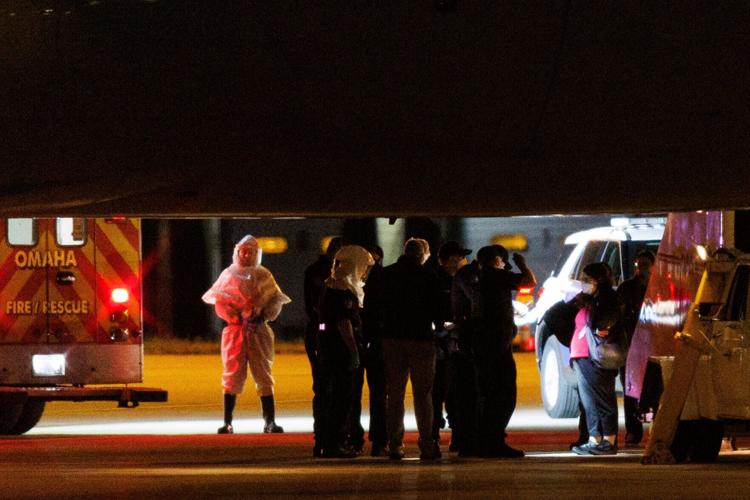
A U.S. State Department plane carrying the passengers, who had disembarked the MV Hondius in the Canary Islands, arrived at Eppley Airfield at 2:28 a.m. in a cargo area on the northwest side of the airport. Medical personnel in protective gear escorted them to vehicles.

Medical personnel escort U.S. passengers who had been aboard the cruise ship MV Hondius, which was affected by a hantavirus outbreak, to awaiting shuttles at Eppley Airfield in Omaha on Monday.
Sixteen of the passengers remain in Omaha, with 15 housed in the National Quarantine Unit, the nation's only federal funded quarantine facility, which is designed to house and monitor people who are well but may have been exposed to high-consequence infectious diseases.
One passenger who had had two tests for the Andes virus, the strain of hantavirus that has been detected on the ship, outside the U.S. — one positive and one negative — was taken to the Nebraska Biocontainment Unit. Both units are on the campus of the University of Nebraska Medical Center. A convoy of shuttles and emergency vehicles arrived at the campus at 5:14 a.m. Monday.
People are also reading…
Two others, a couple, one of whom had mild symptoms of hantavirus, were flown to a biocontainment unit at Emory University in Atlanta.
That decision was made to preserve space in the Nebraska Biocontainment Unit in the event that any passengers in the National Quarantine Unit in Omaha become ill and require a transfer to the nearby biocontainment unit, said Dr. Brendan Jackson, acting director of the division of high-consequence pathogens at the Centers for Disease Control and Prevention.
Jackson was among a handful of top U.S. health officials who spoke at a media briefing Monday morning at UNMC. They and state and local officials offered assurances that the process had gone smoothly and that everything possible was being done to ensure the well-being of the passengers and the safety of Americans.
"Let me be crystal clear: the risk of hantavirus to the general public remains very, very low," said Admiral Brian Christine, assistant secretary for Health with the U.S. Department of Health and Human Services, who is a medical doctor. "The Andes variant of this virus does not spread easily, and it requires prolonged close contact with someone who is already symptomatic. Even so, we have taken this situation very seriously from the very start."
Nebraska Gov. Jim Pillen, addressing the passengers, said he was glad that they are here and assured them that they would receive "nothing but world-class care."
"We know it's been very difficult for you, an arduous journey, one that will keep you away from your friends and your loved ones a little longer," he said.
He also said that he was satisfied, and Nebraskans and the rest of Americans can be satisfied, that "there is a strong plan in place (to) ensure the folks are secure for their initial assessment, and we are working diligently to ensure no one leaves ... in an unsecured way at an inappropriate time. No one who poses a risk to public health is walking out the front door."
Jackson said the passengers will be at the Omaha and Atlanta facilities for at least a few days while they are assessed. Each will have an individual plan to determine whether it is best for them to stay for the full 42-day incubation period of the virus or to complete that monitoring period at home.
The key question in that determination is whether they remain symptom-free, he said. Another element would be whether they have a separate area to isolate from other in their homes and can keep in contact with their local health department, get tested if they develop symptoms and have medical care options nearby.
"We want to do this in the least restrictive way possible that is still safe, that protects the health and safety of the passengers and their communities," he said.
He noted that the 42 days is the maximum and that most people who develop the illness develop symptoms sooner. Based on what scientists know about the virus, which is not a new one, transmission occurs when people have symptoms.
However, Ashley Newmyer, director of public health for Nebraska, reiterated Pillen's assurance that there is a structure in place to ensure that no one poses a public health threat.
"Safety is number one across the board here," Newmyer. "We are here to make sure there is no public health risk."
NU President Dr. Jeffrey said that if a symptom-free passenger chooses to finish their observation period somewhere else, they would be escorted there "under very appropriate circumstances, from endpoint to starting point."
Five states — Arizona, California, Georgia, Texas and Virginia — are already monitoring seven passengers who previously disembarked from the ship.
Eight hantavirus cases, all among passengers on the ship, already have been identified. Three of the eight have died.
Dr. Michael Wadman, medical director of the National Quarantine Unit, and Dr. Angela Hewlett, medical director of the Nebraska Biocontainment Unit, said the passengers were given a quick assessment.
All were doing well, including the passenger in the biocontainment unit. The patients will be assessed twice a day for symptoms, including temperature checks.
The incubation for the virus period typically starts with the last known exposure, Hewlett said. The passengers all wore protective gear on the way to the units.
Jackson said health officials typically focus on testing people who are ill when it comes to hantavirus. But they will continue to evaluate that practice.
Hewlett said the Nebraska team, working with federal health officials, will be interviewing the passengers to determine their level of exposure to the virus and make individual decisions on testing based on those discussions. The individual in the biocontainment unit will be tested.
The Nebraska team, in partnership with the Nebraska Public Health Laboratory, has developed and validated the necessary testing so it can be done quickly at the medical center.
He noted, however, that the person with mild symptoms may not have hantavirus. Many of the early symptoms are flu-like.
"We're being very, very liberal in how we're framing symptoms and monitoring for symptoms here," he said. "That's how the system is working."
According to the HHS post, two of the passengers on the flight traveled in specialized biocontainment units "out of an abundance of caution." One passenger had mild symptoms of hantavirus and another tested mildly positive by PCR testing for the Andes virus, the strain of hantavirus that has been detected on the ship.

An ambulance and shuttle buses transport U.S. passengers from the cruise ship MV Hondius to the University of Nebraska Medical Center's Davis Global Center on Monday.
The passenger who was to be taken to the biocontainment unit had tested " positive for the virus but did not have symptoms, health system officials said. The passenger will be monitored in the biocontainment unit "out of an abundance of caution" and follow-up testing will be performed.
Upon arrival at each facility, each individual will undergo clinical assessment and receive appropriate care and support based on their condition, according to HHS.
HHS officials were expected to join a Nebraska Medicine and UNMC team for a briefing about the passengers' arrival early Monday. It was unclear how long they will be quarantined in Omaha.

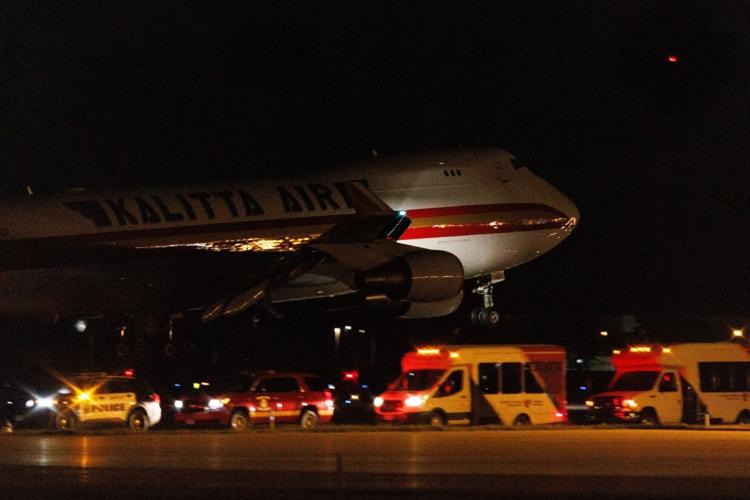
Kalitta Air 492, carrying U.S. passengers from the cruise ship MV Hondius, lands early Monday at Eppley Airfield in Omaha.
Nebraska Medicine and UNMC officials said during a briefing Friday that they are prepared for situations exactly like this.
"Our teams have trained for decades alongside federal and state partners to make sure we can safely provide care while protecting our staff and the broader community," Dr. Michael Ash, Nebraska Medicine's CEO, said in a statement. "We are proud to support this national effort."
Omaha Mayor John Ewing said in a statement late Sunday that city leadership has been briefed on the passengers' arrival, including Omaha Fire and Police Department officials.
"We are confident in the quality of care that these individuals will receive along with the protocols to keep healthcare workers safe," Ewing said in his statement.
The quarantine unit can house 20 people in individual rooms with hotel-like amenities, including Wi-Fi and exercise equipment. Negative air flow and filters are designed to limit the spread of pathogens.
The Centers for Disease Control and Prevention said Friday that the risk to the American public remains "extremely low."
For Nebraska Medicine and UNMC, the job is not a new one. The partners safely treated three patients with Ebola during the 2014 outbreak in West Africa and also cared for some of the first Americans diagnosed with COVID-19 in 2020. Those patients were evacuated from another cruise ship, the Diamond Princess, which had docked off the coast of Japan.
John Lowe, director of the Global Center for Health Security at UNMC, said Friday that the Nebraska team reached out to its federal, state and county partners as soon as they saw the notice about the outbreak and began preparing in case they were called upon to help.
In addition to awaiting passengers for quarantine, they are providing technical support, advice and guidance, much of which they created and refined during the COVID-19 pandemic and the Ebola outbreak.
Hantavirus is carried primarily by rodents. Most strains cannot be spread from person to person. But the Andes strain, the one identified in the cruise ship outbreak, can spread from person to person, Dr. Angela Hewlett, medical director of the biocontainment unit, said Friday.
However, federal health officials have said such transmission is rare and limited to close-contact settings.
Hewlett stressed that the virus is very different than the one that causes COVID-19.
"I do not see this as progressing to a worldwide pandemic, although there are still a lot of unknowns," she said.
Photos: Plane carrying passengers of the cruise ship MV Hondius arrives in Omaha

Medical personnel escort U.S. passengers from the cruise ship MV Hondius, affected by a hantavirus outbreak, to awaiting shuttles at Eppley Airfield, in Omaha on Monday, May 11, 2026.

Kalitta Air 492 carrying U.S. passengers from the cruise ship MV Hondius, affected by a hantavirus outbreak, lands at Eppley Airfield, in Omaha on Monday, May 11, 2026.

Medical personnel escort U.S. passengers from the cruise ship MV Hondius, affected by a hantavirus outbreak, to awaiting shuttles at Eppley Airfield, in Omaha on Monday, May 11, 2026.

Medical personnel escort U.S. passengers from the cruise ship MV Hondius, affected by a hantavirus outbreak, to awaiting shuttles at Eppley Airfield, in Omaha on Monday, May 11, 2026.

Medical personnel escort U.S. passengers from the cruise ship MV Hondius, affected by a hantavirus outbreak, to awaiting shuttles at Eppley Airfield, in Omaha on Monday, May 11, 2026.
An ambulance and shuttle buses transport U.S. passengers from the cruise ship MV Hondius to the University of Nebraska Medical Center's Davis Global Center on Monday.

U.S. passengers from the cruise ship MV Hondius, affected by a hantavirus outbreak, arrive at the University of Nebraska Medical Center Davis Global Center, in Omaha on Monday, May 11, 2026.

U.S. passengers from the cruise ship MV Hondius, affected by a hantavirus outbreak, arrive at the University of Nebraska Medical Center Davis Global Center, in Omaha on Monday, May 11, 2026.

U.S. passengers from the cruise ship MV Hondius, affected by a hantavirus outbreak, arrive at the University of Nebraska Medical Center Davis Global Center, in Omaha on Monday, May 11, 2026.

Gov. Jim Pillen speaks during an update about the arrival of American cruise ship passengers to Nebraska Biocontainment Unit at the University of Nebraska Medical Center Davis Global Center, in Omaha on Monday, May 11, 2026. Sixteen Americans from the cruise ship associated with a hantavirus outbreak will be monitored and assessed at the biocontainment unit in Omaha.

Gov. Jim Pillen speaks during an update about the arrival of American cruise ship passengers to Nebraska Biocontainment Unit at the University of Nebraska Medical Center Davis Global Center, in Omaha on Monday, May 11, 2026. Sixteen Americans from the cruise ship associated with a hantavirus outbreak will be monitored and assessed at the biocontainment unit in Omaha.

Adm. Brian Christine, Assistant Secretary fro Health - U.S. Department of Health and Human Services, speaks during an update about the arrival of American cruise ship passengers to Nebraska Biocontainment Unit at the University of Nebraska Medical Center Davis Global Center, in Omaha on Monday, May 11, 2026. Sixteen Americans from the cruise ship associated with a hantavirus outbreak will be monitored and assessed at the biocontainment unit in Omaha.

John Knox, principal deputy assistant secretary at the Administration for Strategic Preparedness and Response, speaks during an update about the arrival of American cruise ship passengers to Nebraska Biocontainment Unit at the University of Nebraska Medical Center Davis Global Center, in Omaha on Monday, May 11, 2026. Sixteen Americans from the cruise ship associated with a hantavirus outbreak will be monitored and assessed at the biocontainment unit in Omaha.

Dr. Brendan Jackson, CDC acting director for the division of high-consequence pathogens and pathology, speaks during an update about the arrival of American cruise ship passengers to Nebraska Biocontainment Unit at the University of Nebraska Medical Center Davis Global Center, in Omaha on Monday, May 11, 2026. Sixteen Americans from the cruise ship associated with a hantavirus outbreak will be monitored and assessed at the biocontainment unit in Omaha.

State and federal officials join University of Nebraska Medical Center and Nebraska Medicine doctors during an update about the arrival of American cruise ship passengers to Nebraska Biocontainment Unit at the University of Nebraska Medical Center Davis Global Center, in Omaha on Monday, May 11, 2026. Sixteen Americans from the cruise ship associated with a hantavirus outbreak will be monitored and assessed at the biocontainment unit in Omaha.