Israeli Prime Minister Benjamin Netanyahu chats with Defense Secretary Pete Hegseth ahead of Sen. Lindsey Graham's funeral service at Washington National Cathedral.
WASHINGTON — U.S. President Donald Trump expressed irritation with Benjamin Netanyahu ahead of their White House meeting on Tuesday, complaining that details of the Israeli prime minister's planned talking points on Iran surfaced publicly.
Asked about reports that Netanyahu wanted to talk to him about Pickaxe Mountain, a fortified facility buried deep underground near one of Iran's main nuclear sites, Trump said, using Netanyahu's nickname, "I don't need Bibi to tell me that. Bibi's telling me that because he wants me to stay involved."
"Why don't you just tell it to me? Why do you have to announce it to the world?" Trump said in an interview with "Fox & Friends."
The New York Post reported Monday that Netanyahu was expected to provide intelligence to Trump that Iran is building up its nuclear facilities at Pickaxe Mountain and is lying about wanting a peace deal, citing a source in Jerusalem.
People are also reading…

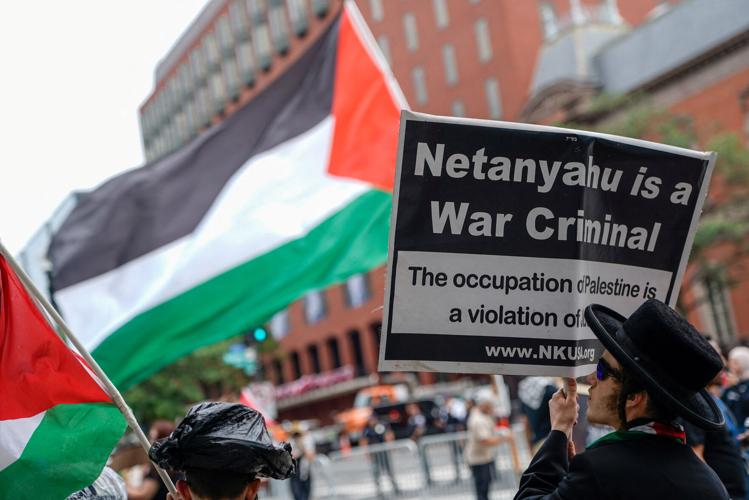
A man carries a placard against Israeli Prime Minister Benjamin Netanyahu during a protest Tuesday near the White House in Washington.
In a video released on social media, Netanyahu described the meeting as "excellent" and "one of the best conversations" he has had with Trump.
"It was a conversation marked by full partnership, mutual support and a shared understanding of our common objective: to ensure that Iran does not obtain nuclear weapons, as well as other goals," he said.
The U.S. president met with Netanyahu after first having brief closed-door talks with Ukrainian President Volodymyr Zelenskyy.
Relations with Zelenskyy have warmed as Ukraine blunted Russian advances, while Netanyahu faces growing White House frustration over the lack of progress toward a broader settlement in the Iran conflict and criticism from some of Trump's supporters who oppose deeper U.S. involvement in the Middle East.
The two men were in Washington to attend a memorial service for Sen. Lindsey Graham, a hawkish Republican who was an advocate for both Israel and Ukraine in Washington, especially in getting their views heard by Trump.
Both the Ukraine war and the widening Middle East conflict are at critical junctures. After the collapse of a ceasefire in the Iran war, Trump says he paused U.S. airstrikes to give diplomacy another chance. Zelenskyy, meanwhile, is buoyed by Ukraine's recent successes.

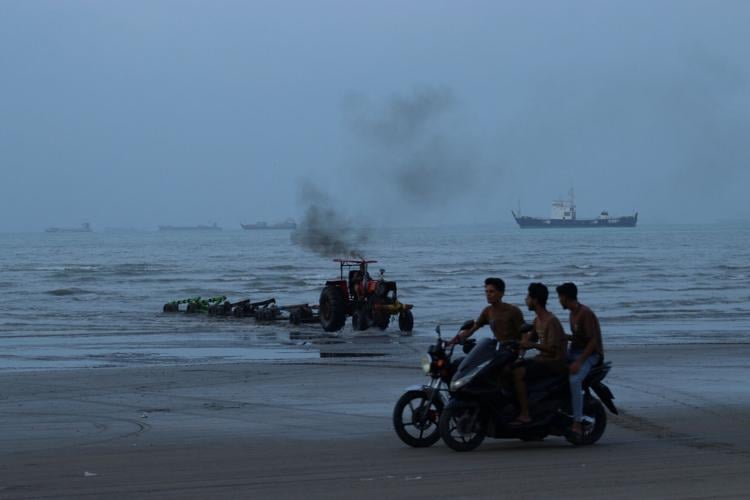
Vessels are seen Monday in the Strait of Hormuz near the beach of Bandar Abbas, Iran.
Strait of Hormuz
Oman presented a proposal to Iran for joint regional management of the Strait of Hormuz with shipping firms paying voluntary fees, a Gulf source told Reuters on Tuesday.
The Strait of Hormuz — which carried a fifth of global oil and liquefied natural gas before the Iran war — has become the main hurdle in peace talks and a flashpoint for repeated escalations in the conflict.
Iran says the strait cannot go back to its prewar status where shipping flowed freely, while Gulf States insist there be no mandatory payment of fees to Iran.
Under the Omani proposal, which has regional backing and was presented to Iranian officials over the weekend in Tehran, Iran would not exercise sole control over the strait, the source added.
The proposal is based on the Strait of Malacca, which connects the Indian and Pacific Oceans and is jointly managed by the states bordering it: Indonesia, Malaysia, and Singapore.
There, shipping firms make contributions for the upkeep of navigational safety aids including buoys and lighthouses.
Similarly under the Omani proposal, those using the Strait of Hormuz would voluntarily contribute to a fund that finances the cost of managing navigation, environmental protection and search and rescue, among other services.
An Omani foreign ministry official did not respond to a request for comment.
The U.N.'s International Maritime Organization said it was not involved in the discussions.
"Any proposal for new shipping routes or traffic management measures should be submitted to IMO for consideration by member states," an IMO spokesperson said.
Iran's Foreign Minister Abbas Araghchi discussed the Strait of Hormuz with his Omani and Saudi counterparts Monday.
"He emphasized the need to strengthen cooperation and advance joint diplomatic efforts to establish stability in the region, and lift the insecurity imposed on the Strait of Hormuz due to the aggressive actions of the United States," according to Iran's foreign ministry statement.
Adding to the challenges for shipping in the region, the Iran-aligned Houthis in Yemen opened a new front against the U.S. and its allies July 20, when they declared a blockade of Saudi ports on the Red Sea.
Late on Tuesday, the Houthis said they fired ballistic missiles at a Saudi oil tanker, which they said was forced to turn back.

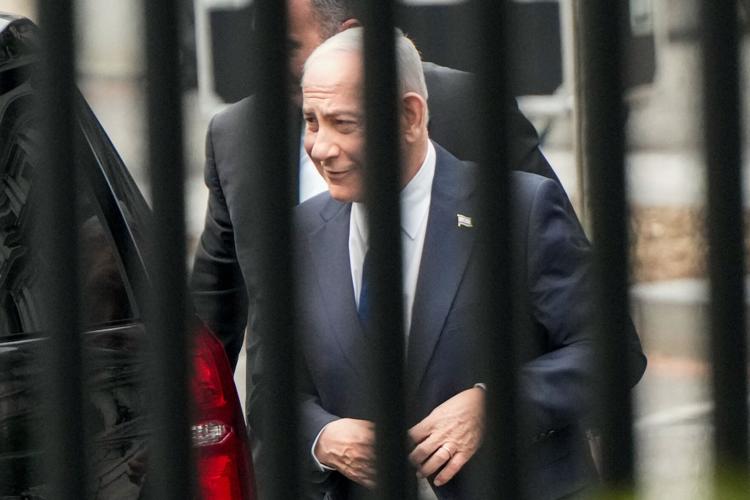
Israeli Prime Minister Benjamin Netanyahu arrives Tuesday at the White House in Washington.
Netanyahu reelection
Netanyahu has run hot and cold with Trump, who at times had to rein in the Israeli leader from attacking targets in Lebanon to try to weaken Iran-backed Hezbollah militants.
An acrimonious phone call in June in which the president called the prime minister "f***ing crazy," first leaked to the media and later publicly confirmed by Trump, laid bare the strains between the two leaders.
Sources familiar with the matter said Netanyahu aims to get Trump's support for his reelection campaign ahead of an Oct. 27 vote.
A meeting with Trump that showcases what has traditionally been a close relationship between the two leaders could help Netanyahu at home where he is struggling in the opinion polls.
They are also expected to discuss the Abraham Accords, the series of agreements Trump brokered to normalize diplomatic relations between Israel and the United Arab Emirates, Bahrain, Morocco and Sudan.
Trump wants to add Saudi Arabia to the accords and conditioned a civilian nuclear cooperation deal with the kingdom last week on Riyadh signing up. Riyadh has so far rejected joining the accords without a path toward Palestinian statehood.