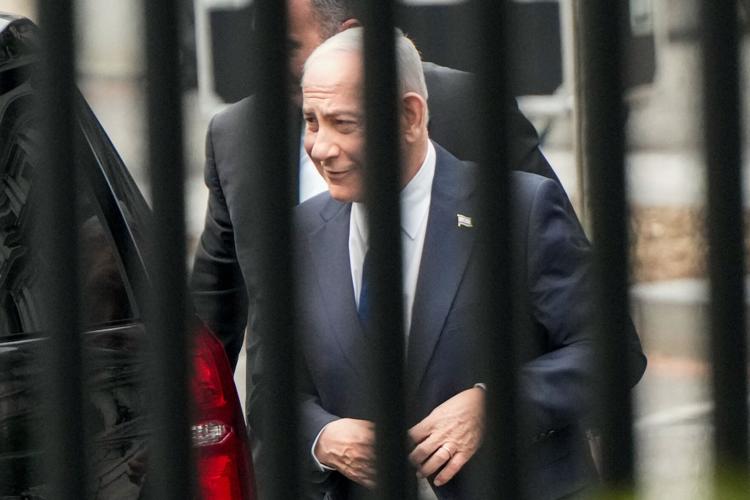
Israeli Prime Minister Benjamin Netanyahu chats with Defense Secretary Pete Hegseth ahead of Sen. Lindsey Graham's funeral service at Washington National Cathedral.
WASHINGTON — U.S. President Donald Trump expressed irritation with Benjamin Netanyahu ahead of their White House meeting on Tuesday, complaining that details of the Israeli prime minister's planned talking points on Iran surfaced publicly.
Asked about reports that Netanyahu wanted to talk to him about Pickaxe Mountain, a fortified facility buried deep underground near one of Iran's main nuclear sites, Trump said, using Netanyahu's nickname, "I don't need Bibi to tell me that. Bibi's telling me that because he wants me to stay involved."
"Why don't you just tell it to me? Why do you have to announce it to the world?" Trump said in an interview with "Fox & Friends."
The New York Post reported Monday that Netanyahu was expected to provide intelligence to Trump that Iran is building up its nuclear facilities at Pickaxe Mountain and is lying about wanting a peace deal, citing a source in Jerusalem.
People are also reading…

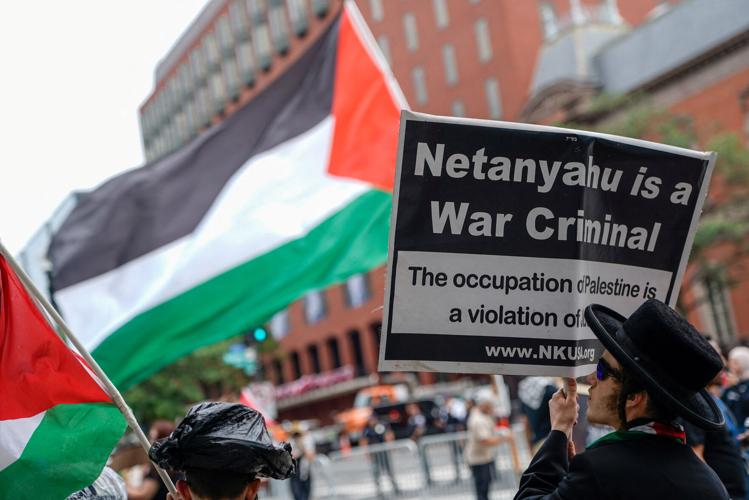
A man carries a placard against Israeli Prime Minister Benjamin Netanyahu during a protest Tuesday near the White House in Washington.
In a video released on social media, Netanyahu described the meeting as "excellent" and "one of the best conversations" he has had with Trump.
"It was a conversation marked by full partnership, mutual support and a shared understanding of our common objective: to ensure that Iran does not obtain nuclear weapons, as well as other goals," he said.
The U.S. president met with Netanyahu after first having brief closed-door talks with Ukrainian President Volodymyr Zelenskyy.
Relations with Zelenskyy have warmed as Ukraine blunted Russian advances, while Netanyahu faces growing White House frustration over the lack of progress toward a broader settlement in the Iran conflict and criticism from some of Trump's supporters who oppose deeper U.S. involvement in the Middle East.
The two men were in Washington to attend a memorial service for Sen. Lindsey Graham, a hawkish Republican who was an advocate for both Israel and Ukraine in Washington, especially in getting their views heard by Trump.
Both the Ukraine war and the widening Middle East conflict are at critical junctures. After the collapse of a ceasefire in the Iran war, Trump says he paused U.S. airstrikes to give diplomacy another chance. Zelenskyy, meanwhile, is buoyed by Ukraine's recent successes.

Vessels are seen Monday in the Strait of Hormuz near the beach of Bandar Abbas, Iran.
Strait of Hormuz
Oman presented a proposal to Iran for joint regional management of the Strait of Hormuz with shipping firms paying voluntary fees, a Gulf source told Reuters on Tuesday.
The Omani proposals are intended to serve as a basis to end the disruption to trade through the strait caused by the U.S.-Israeli war on Iran.
But a U.S. official on Tuesday again rejected the idea of tolls or fees for ships transiting the strait, reiterating that it is an international waterway that should be free of Iranian control or restrictions. The official told Reuters that the deal under discussion would not include any tolls or fees.
Trump, who abruptly called off a two-week U.S. bombing campaign over the weekend in his latest U-turn, claimed there were "good talks" underway with Iran but threatened to restart strikes unless negotiations deliver. Iran denied seeking to resume talks with the United States.
Iran has said it would hold fire as long as Washington does. But U.S. Central Command said Tuesday that Iran launched ballistic missiles "in an attempted surprise attack on U.S. forces based in the Middle East," and that the missiles were successfully intercepted.
Saudi Arabia said Tuesday its air defenses intercepted and destroyed several drones targeting oil facilities. The attacks were launched from Iraqi territory by Iran-backed terrorist militias, Saudi Defense Ministry spokesperson Turki al-Maliki said.
Drone attacks were reported in Jordan, Saudi Arabia and northern Iran on Monday, and Jordan reported another drone being downed on Tuesday.
Washington launched fresh strikes this month to break Iran's grip on the strait, through which about a fifth of global oil and liquefied natural gas flowed before the war.
Iran effectively shut the strait to ships other than its own after the United States and Israel attacked Feb. 28. A deal last month between the United States and Iran partially reopened it, with future talks planned to resolve larger issues including Iran's nuclear program. But the agreement collapsed in early July after Iran fired on ships.

Israeli Prime Minister Benjamin Netanyahu arrives Tuesday at the White House in Washington.
Netanyahu reelection
Netanyahu has run hot and cold with Trump, who at times had to rein in the Israeli leader from attacking targets in Lebanon to try to weaken Iran-backed Hezbollah militants.
An acrimonious phone call in June in which the president called the prime minister "f***ing crazy," first leaked to the media and later publicly confirmed by Trump, laid bare the strains between the two leaders.
Sources familiar with the matter said Netanyahu aims to get Trump's support for his reelection campaign ahead of an Oct. 27 vote.
A meeting with Trump that showcases what has traditionally been a close relationship between the two leaders could help Netanyahu at home where he is struggling in the opinion polls.
They are also expected to discuss the Abraham Accords, the series of agreements Trump brokered to normalize diplomatic relations between Israel and the United Arab Emirates, Bahrain, Morocco and Sudan.
Trump wants to add Saudi Arabia to the accords and conditioned a civilian nuclear cooperation deal with the kingdom last week on Riyadh signing up. Riyadh has so far rejected joining the accords without a path toward Palestinian statehood.