MILAN — During Europe's heat wave last month, Floriana Peroni’s vintage clothing store had to close for a week. A truck of rented generators blocked her door as they fed power to the central Roman neighborhood hit by a blackout as temperatures surged. The main culprit: air conditioning.

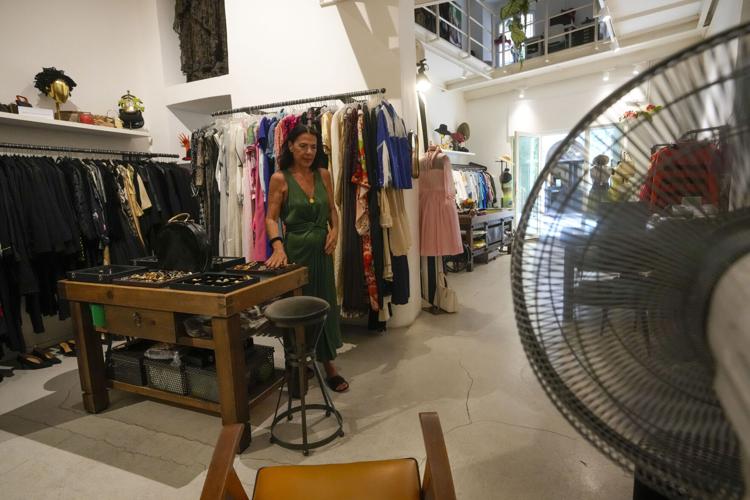
Floriana Peroni walks in her vintage clothing store in downtown Rome that was forced to shut down for a week by a truck of rented generators blocking her door as it fed power to the central Roman neighborhood hit by a localized blackout, in central Rome, Tuesday, July 25, 2023. Rising global temperatures are elevating air conditioning from a luxury to a necessity in many parts of Europe, which long has had a conflictual relationship with energy-sucking cooling systems deemed by many a U.S. indulgence. (AP Photo/Andrew Medichini)
The period — in which temperatures hit 104 degrees — coincided with peak electricity use that came close to Italy’s all-time high, hitting a peak load of more than 59 gigawatts on July 19. That neared a July 2015 record.
Intensive electricity use knocked out the network not only near the central Campo de Fiori neighborhood, where Peroni operates her shop, but elsewhere in the Italian capital. Demand in that second July week surged 30%, correlating to a heat wave that had persisted already for weeks, according to the capital’s electricity company ARETI.
Like many Romans, Peroni herself does not have AC either in her home or her shop. Rome once could count on a Mediterranean breeze to bring down nighttime temperatures, but that has become an intermittent relief at best.
People are also reading…
“At most, we turn on fans,’’ Peroni said. “We think that is enough. We tolerate the heat, as it has always been tolerated.”
In Europe, though, that is starting to change.

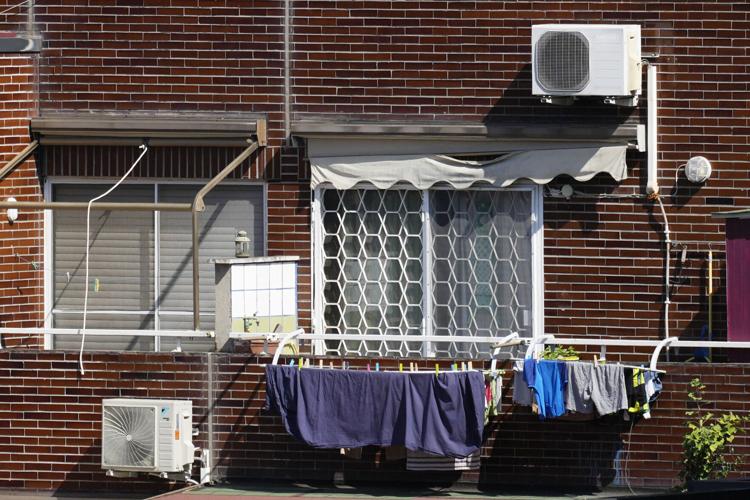
Air conditioning external units are seen on the facade of a building July 25 in Rome.
Despite holdouts like Peroni, rising global temperatures are dropping air conditioning from luxury to necessity in many parts of Europe, which long has had a conflicted relationship with energy-sucking cooling systems deemed by many to be an American indulgence.
Europeans look with disdain at overcooled U.S. buildings, kept to near meat-locker temperatures, where a blast of cold air can shoot across city sidewalks as people come and go, and where extended indoor appointments necessitate a sweater even in the height of summer.
By contrast, event organizers in Europe may offer hand fans if events are expected to overheat. Shoppers can expect to sweat in under-cooled grocery stores, and movie theaters are not guaranteed to be climate-controlled. Evening diners have typically opted for outside tables to avoid stuffy restaurants, which rarely offer AC.
To deal with the heat, Italy and Spain typically shut down for several hours after lunch, for a riposo or siesta, and most vacation in August, when many businesses shut down completely so families can enjoy a holiday at the beach or in the mountains. Italians in particular are happy to abandon overheated art cities to foreign tourists, which reduces the urgency for a home AC investment.
Still, European AC penetration has picked up from 10% in 2000 to 19% last year, according to the International Energy Agency. That is still well shy of the United States, at around 90%. Many in Europe resist due to cost, concern about environmental impact and even suspicions of adverse health impacts from cold air currents, including colds, a stiff neck or worse.
Cooling systems remain rare in Nordic countries and even Germany, where temperatures can soar into the 90s for extended periods.
But even those temperate climates may cross the threshold of discomfort if temperatures increase beyond 1.5 degrees to 2 degrees Celsius, according to a new study by the University of Cambridge. In that scenario, people living in northern climes like Britain, Norway, Finland and Switzerland will face the greatest relative increase in uncomfortably hot days.
Nicole Miranda, one of the study's authors, said their estimate, which would mean surpassing the international goal of limiting future warming to 1.5 degrees Celsius above pre-industrial times, are conservative.

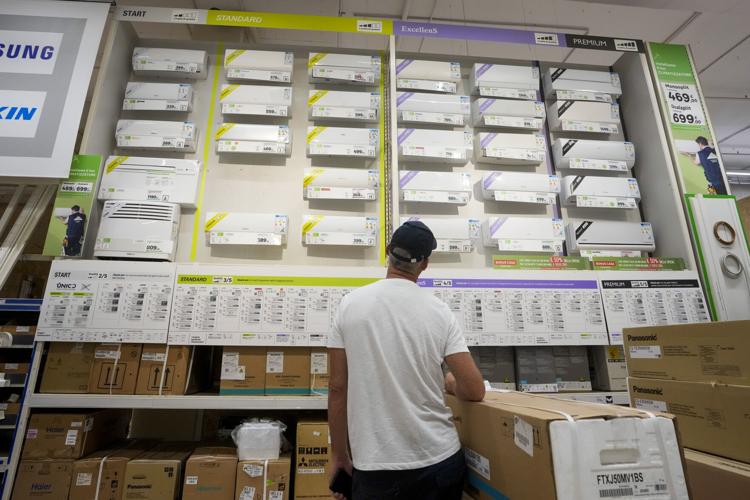
A man looks at a wall displaying air conditioning models on sale July 25 at a department store, in Rome.
“They don't take into account the urban island effects,” she said, when cities are unable to cool at night and surfaces become radiators. “From a scientific point of view, if we all run to the go-to solution, which is air conditioning, we are going to get into a different type of problem, because there is high energy consumption and high carbon emissions related to air conditioning.”
Cities should consider less intensive solutions, like shading buildings, and incorporating cooling bodies of water, she said. She also advocated a trend toward cooling individuals, instead of spaces, using personal devices like ice packs in jackets or high-tech textiles that dissipate body heat more efficiently.
In Italy, sales of air conditioning units grew from 865,000 a year in 2012 to 1.92 million in 2022, mostly for business and not residential use, with growth reported in the first quarter of this year, according to the industry association Assoclima. Most are split heat air pump systems, which can heat spaces in the winter, which Assoclima said can reduce gas consumption as prices spike during the war in Ukraine. That dual use attracts consumers.
France, with a slightly larger population, is showing more resistance, selling 1 million units a year. Air conditioning was rare in France until a 2003 heat wave killed thousands, mainly among the elderly. Still, most private homes and apartments there aren’t air conditioned, and many restaurants and other businesses aren’t either. Businesses with AC will often advertise to attract customers on hot days.
AC aversion persists, both among French conservatives who see it as a frivolous American import and French people on the left who see it as environmentally irresponsible.
Cécile de Munck and Aude Lemonsu, meteorologists at France's national weather service, warned this summer that if the number of AC units doubles in Paris by 2030, the city temperature would rise by 3.6 degrees Fahrenheit because of heat released by the pump systems.
Despite the concerns over energy costs, air conditioning is rapidly conquering homes in Spain, a country that traditionally bent toward the use of fans and drawing heavy blinds, a very Spanish fixture. A study by Ca’ Foscari University projects that half of Spanish households will have AC by 2040, up from just 5% in 1990.
No central air conditioning? These are the best fans and portable AC units
1. SereneLife 3-in-1 Portable Air Conditioner

This portable air conditioner from SereneLife works best for up to 350 square feet. It has a dehumidifier function that helps you remain cool on muggy summer days. The unit also has a fan function if you don’t want to limit the amount of electricity you use during the day. The window mount kit helps draw in some fresh air, and the remote control makes it easy to change settings without disruption.
2. Frigidaire Window AC Unit

If you’re looking for a compact window air conditioning unit, try this highly-rated model from Frigidaire. The washable filter is easy to clean and reuse. Customers also loved how cool this window unit got their room without a high power output.
3. SUMLGT Personal Mini Air Conditioner

If you work from home, it can be difficult to concentrate on hot days without air conditioning. Rather than running up a big electricity bill, try this mini AC and fan from SUMLGT. It’s the perfect addition to your home office for under $50.
4. Bionaire Window Fan

This window fan from Bionaire draws cool air in and pushes hot air out to keep your home comfortable on hot days. Unlike many window fans, this model is programmable and will automatically turn on and off to maintain the temperature you set.
5. DELLA Smart Window Air Conditioner

This smart AC unit from DELLA can help you cut down on energy costs with an easy-to-use app that lets you control your settings from your phone. The highly-rated window unit can cool about 300 to 350 square feet