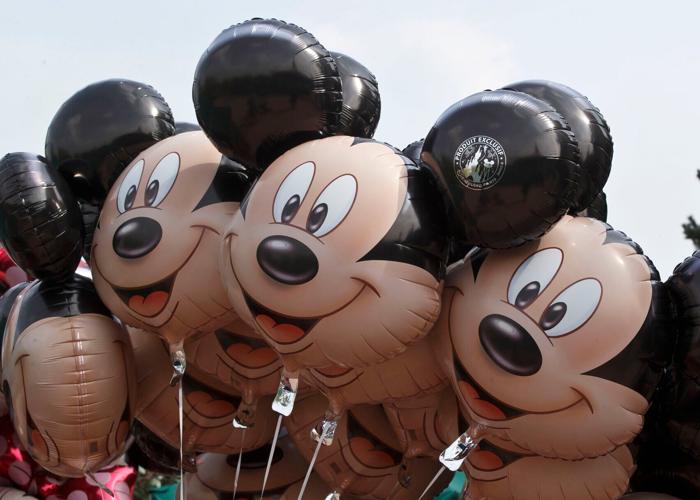
LOS ANGELES — M-I-C-K-E-Y will soon belong to you and me.
With several asterisks, qualification and caveats, Mickey Mouse in his earliest form will be the leader of the band of characters, films and books that will become public domain as the year turns to 2024.
In a moment many close observers thought might never come, at least one version of the quintessential piece of intellectual property and perhaps the most iconic character in American pop culture will be free from Disney’s copyright as his first screen release, the 1928 short “Steamboat Willie,” featuring both Mickey and Minnie Mouse, becomes available for public use.

A statue of Walt Disney and Mickey Mouse stands Jan. 15, 2020, in front of the Cinderella Castle at the Magic Kingdom theme park at Walt Disney World.
“This is it. This is Mickey Mouse. This is exciting because it’s kind of symbolic,” said Jennifer Jenkins, a professor of law and director of Duke’s Center for the Study of Public Domain, who writes an annual Jan. 1 column for “Public Domain Day.” ”I kind of feel like the pipe on the steamboat, like expelling smoke. It’s so exciting.”
People are also reading…
U.S. law allows a copyright to be held for 95 years after Congress expanded it several times during Mickey’s life.

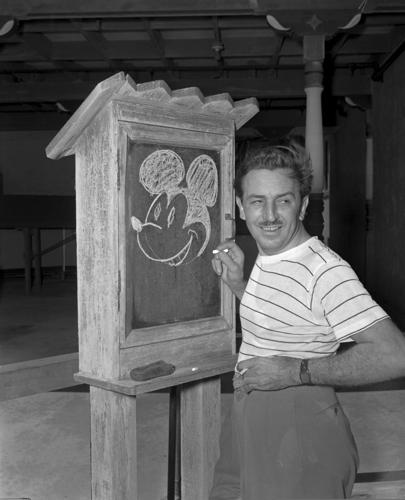
Walt Disney stands by a portrait of his famous creation Aug. 13, 1941, at the Pancoast Hotel in Miami, Fla. Another famous animal sidekick, Tigger, will join his friend Winnie the Pooh in the public domain as the book in which the bouncing tiger first appeared, “The House at Pooh Corner,” turns 96.
“It’s sometimes derisively referred to as the Mickey Mouse Protection Act,” Jenkins said. “That’s oversimplified because it wasn’t just Disney that was pushing for term extension. It was a whole group of copyright holders whose works were set to go into the public domain soon, who benefited greatly from the 20 years of extra protection.”
“Ever since Mickey Mouse’s first appearance in the 1928 short film Steamboat Willie, people have associated the character with Disney’s stories, experiences, and authentic products,” a Disney spokesperson said in a statement. “That will not change when the copyright in the Steamboat Willie film expires.”
Current artists and creators will be able to make use of Mickey, but with major limits. It is only the more mischievous, ratlike, non-speaking boat captain in “Steamboat Willie” that has become public.
“More modern versions of Mickey will remain unaffected by the expiration of the Steamboat Willie copyright, and Mickey will continue to play a leading role as a global ambassador for the Walt Disney Company in our storytelling, theme park attractions, and merchandise,” Disney’s statement said.
Not every feature or personality trait a character displays is necessarily copyrightable, however, and courts could be busy in the coming years determining what’s inside and outside Disney’s ownership.
“We will, of course, continue to protect our rights in the more modern versions of Mickey Mouse and other works that remain subject to copyright,” the company said.
A statue of Walt Disney and Mickey Mouse stands Jan. 15, 2020, in front of the Cinderella Castle at the Magic Kingdom theme park at Walt Disney World.
Disney still solidly and separately holds a trademark on Mickey as a corporate mascot and brand identifier, and the law forbids using the character deceptively to fool consumers into thinking a product is from the original creator. Anyone starting a film company or a theme park will not be free to make mouse ears their logo.
Disney’s statement said it “will work to safeguard against consumer confusion caused by unauthorized uses of Mickey and our other iconic characters.”
“Steamboat Willie,” directed by Walt Disney and his partner Ub Iwerks and among the first cartoons to have sound synced with its visuals, was actually the third cartoon featuring Mickey and Minnie the men made, but the first to be released. It features a more menacing Mickey captaining a boat and making musical instruments out of other animals.
In it, and in a clip from it used in the introduction to Disney animated films in recent years, Mickey whistles the 1910 tune “Steamboat Bill.” The song inspired the title of the Buster Keaton film “Steamboat Bill Jr.,” released just a few months before “Steamboat Willie,” which in turn may have inspired the title of the Disney short. The copyright wasn’t renewed on the Keaton film and it’s been in the public domain since 1956.
Another famous animal sidekick, Tigger, will join his friend Winnie the Pooh in the public domain as the book in which the bouncing tiger first appeared, “The House at Pooh Corner,” turns 96. Pooh, probably the most celebrated prior character to become public property, took on that status two years ago when A.A. Milne’s original “Winnie the Pooh” entered the public domain, resulting in some truly novel uses, including this year’s horror film “Winnie The Pooh: Blood and Honey.”
Young Mickey could get the same treatment.
“Now, the audience is going to set the terms,” said Cory Doctorow, an author and activist who advocates for broader public ownership of works.
Jan. 1, 2024, has long been circled on the calendars of public domain watchers, but some say it serves to show how overlong it takes for U.S. works to go public, and many properties with less pedigree than Winnie or Minnie can disappear or be forgotten with their copyrights murky.
“The fact that there are works that are still recognizable and enduring after 95 years is is frankly remarkable,” Doctorow said. “And it makes you think about the stuff that we must have lost, that would still have currency.”
Other properties entering the U.S. public domain are Charlie Chaplin’s film “Circus,” Virginia Woolf’s novel “Orlando” and Bertolt Brecht’s musical play “The Threepenny Opera.”
50 popular songs in the public domain
50 popular songs in the public domain

The year 1925 was significant in American history: Calvin Coolidge became president, the Harlem Renaissance was in full swing, the Scopes Trial began, the Chrysler Corporation was founded, and New York City officially became the largest city in the world. It was also a big year for the arts: F. Scott Fitzgerlad published “The Great Gatsby,” Virginia Woolf published “Mrs. Dalloway,” “Go West” hit theaters, and Jelly Roll Morton had audiences dancing to “Shreveport Stomps.” Now, in 2021, those works, and hundreds of others like them, are hitting the public domain.
Being in the public domain means that no one individual or corporation holds intellectual rights to the work any longer. Therefore, the work in question can be used without permission. When work enters the public domain, it becomes, essentially, owned by the public. (There are caveats, of course. If an artist repurposes works in the public domain for something new, for example, the artist’s new work won’t fall in the public domain.)
Originally, these works would have been free to use 75 years after publication, or in 2001. However, in 1998, Congress extended the copyright laws an additional 20 years, keeping these works out of the public domain for that much longer.
In honor of this year’s class of works—arguably one of the best to date—entering the public domain, Stacker compiled a list of 50 of the most-listened to songs in the Public Domain, chosen from the Public Domain's list of the 698 most popular songs within. From “Happy Birthday” to “Pomp and Circumstance,” read on to learn a bit more about these classic songs.
You may also like: #1 pop song from the year you graduated high school
"After You Get What You Want, You Don’t Want It" by Irving Berlin

Irving Berlin is widely considered to be one of the greatest songwriters in American history, with an estimated 1,500 songs and 20 original Broadway shows to his name. This particular song, “After You Get What You Want, You Don’t Want It,” was written for the film “There’s No Business Like Show Business,” and performed by the legendary Marilyn Monroe.
"Some of These Days" by Shelton Brooks

The song “Some of These Days,” written by Black ragtime and vaudeville composer Shelton Brooks, was first performed by Sophie Tucker. Brooks was inspired to write the song after overhearing a heated argument between two women in a restaurant that contained the titular line. He got the song in front of the burlesque singer’s eyes by passing it through her maid, and, when she performed it the next night, it became an instant hit, with the sheet music eventually selling more than 2 million copies.
"Darktown Strutters Ball" by Shelton Brooks

Another famous Shelton Brooks song that’s in the public domain is “Darktown Strutters Ball.” The tune, about a night out on the town, was one of the earliest crossover hits, becoming immensely popular with Black and white audiences alike. Since its release in 1917, the song has been performed and recorded by dozens of artists and bands, including Bing Crosby and The Beatles.
[Pictured: Original Dixieland Jazz Band in 1917 (L to R) Henry Ragas, Larry Shields, Eddie Edwards, Nick La Rocca and Tony Spargo.]
"Alabama Jubilee" by George L. Cobb, Jack Yellen

Despite its incredibly racist lyrics, “Alabama Jubilee” has been considered an American standard since its release in 1915. The upbeat song tells the story of an African American band preparing for a concert. In 1981, an instrumental version by Roy Clark won the Grammy Award for Best Country Instrumental Performance.
"Because" by Guy d’Hardelot, Edward Teschemacher

The overwhelming majority of the songs that are currently in the public domain were written by men, though there are a few exceptions. One such example is “Because,” a religious song composed by Guy d’Hardelot (the pen name of Helen Rhodes, a French composer and pianist). Edward Teschemacher re-wrote the words in 1902 when the song was released to English-speaking audiences.
You may also like: 50 ways music has changed in the last 50 years
"It Had to Be You" by Isham Edgar Jones, Gus Kahn

One of the most enduring ballads on our list and currently in the public domain, “It Had To Be You” is about an individual realizing that despite all of their partner’s faults there’s no one else they could have ever been with. Dozens of high-profile artists have recorded the song over the intervening decades, including Billie Holiday, Bing Crosby, Doris Day, Ella Fitzgerald, Tony Bennett, and Barbra Streisand.
[Pictured: Billie Holiday at the Downbeat in New York, February 1947.]
"Camptown Races" by Stephen Foster

Stephen Foster, the composer of well-known folk songs like “Camptown Races” and “Oh! Susanna,” is often referred to as the father of American music. This particular song of his, about a group of pre-Civil War transient workers who are betting on horses in an effort to pocket a little extra money, was written specifically for minstrel shows. In these racist minstrel shows, white performers would darken their faces and mock the culture and traditions of the Black population, hence the use of African American vernacular.
You may also like: Best Bob Dylan albums of all time
"Till We Meet Again" by Richard A. Whiting, Raymond B. Egan

Perhaps the most successful ballad to be written during the First World War, “Till We Meet Again” is about a soldier and his love saying goodbye, promising to meet again somewhere down the line. An instant hit, five versions of the song charted the year after its release, and 5 million copies of the sheet music were sold around the world.
“There’s a Long, Long Trail" by Alonzo Elliott, Stoddard King

“There’s a Long, Long Trail” is another hugely popular World War I song. Written by two Yale students in 1913, the song was a marching tune for British, American, and Canadian troops. It didn’t fade away at the close of that conflict either, gaining a second life in shows like “M*A*S*H,” “It’s the Great Pumpkin, Charlie Brown,” and in recordings by artists like Rosemary Clooney and Frank Sinatra.
"Pack Up Your Troubles in Your Old Kit Bag" by Felix Powell, George Asaf

Yet another popular marching song during WWI, “Pack Up Your Troubles in Your Old Kit Bag” was written by brothers Felix Powell and George Henry Powell (under the pen name George Asaf). The song won a Tin Pan Alley contest that was explicitly looking for a stirring, morale-building song to steady fresh, nervous troops. In the end, only one brother wound up singing the song on the front lines while the other became a conscientious objector, dodging conscription.
“It’s a Long, Long Way to Tipperary” by Jack Judge, Harry H. Williams

“It’s a Long, Long Way to Tipperary” was written in 24 hours to either satisfy a bet or win a contest, depending on which version of history you believe. As a part of a simultaneous quodlibet, the song has a complementary melody to “Pack Up Your Troubles in Your Old Kit Bag” and the two are often sung in tandem. As a result, the wildly successful song also became a popular marching tune for British and Irish troops during WWI.
“Keep the Home Fires Burning" by Ivor Novello, Lena Guilbert Ford

The final WWI classic on our list is “Keep the Home Fires Burning,” a melancholy yet hopeful song about missing our loved ones during wartime. More than 1 million copies of the sheet music were sold during the height of the war, even as money was scarce and budgets for frivolities were minuscule. The song has an enduring cultural impact, especially in its native Great Britain, where it is still frequently used in movies and TV shows about the time period.
You may also like: 40 Black artists music wouldn't be the same without
"Casey Jones" by Eddie Newton, T. Lawrence Seibert

Over the years, the lyrics to “Casey Jones” have changed a number of times, but the song’s central story—the real-life tale of a railroad engineer who gave up his life in a train crash in order to avoid even more fatalities—has remained the same. It’s thought that the first version of the song was written by a friend of Jones, but it was Eddie Newton and T. Lawrence Seibert’s version that was first copyrighted. The tune, which was famously covered by Johnny Cash, has established the real Jones as a folk hero.
"Toyland" by Victor Herbert, Glen MacDonough

Irish-American composer Victor Herbert wrote the song “Toyland” as the piece de resistance for his most successful operetta, “Babes in Toyland.” The original song is reflective and almost mournful, a sharp contrast to the upbeat march many of us remember for the 1961 Disney adaptation.
"Entry of the Gladiators" by Julius Fucik

If you’ve ever been to a circus it’s likely that you’ve heard Julius Fucik’s “Entry of the Gladiators,” or at least a version of it. The song utilizes chromatic scales to get its distinctive sound and was one of the first to use newfangled brass instruments on such a large scale.
"Charleston" by Cecil Mack, Jimmy Johnson

First appearing in the 1923 Broadway show, “Running Wild,” the song, “Charleston," was composed for the sole purpose of being played during a brand new dance called the Charleston. While the dance did exist first, this song increased its popularity and brought it to new heights.
You may also like: 50 of the best albums by LGBTQ musicians
"Beale Street Blues" by W. C. Handy

W.C. Handy, known as the Father of the Blues, is the creative mastermind behind the 1917 hit “Beale Street Blues.” The song takes its name from a street in Memphis that makes up the main drag of the Black entertainment district and served as a sort of goodbye from Handy, who was leaving his longtime home to move to New York City and Tin Pan Alley.
"Old Rugged Cross" by George Bennard

The hymn, “Old Rugged Cross,” a gospel favorite, has become a staple in the setlists of modern country music artists like Alan Jackson and Carrie Underwood. The song was first published back in 1915 by George Bennard, who was inspired to write it after attending a number of revival meetings.
"Turkey in the Straw" by Unknown

A fiddle tune that dates back to at least 1834, “Turkey in the Straw” is instantly recognizable to most Americans, whether they realize it or not, as the ice cream truck jingle. The song has come under fire in recent years for its overtly racist lyrics and cruel depictions of Black Americans, which led to ice cream brand Good Humor collaborating with Wu-Tang Clan singer RZA to create a brand-new, racism-free jingle for their trucks to use.
"Christmas Day" by Gustav Holst

At seven minutes long, Gustav Holst’s “Christmas Day” is one of the longest songs on our list. The holiday piece isn’t actually a single song, but rather an original mashup of several classic carols including “The First Noel,” “God Rest Ye Merry Gentlemen,” “Come Ye Lofty; Come Ye Lonely,” and “Good Christian Men Rejoice.” It remains a popular choral piece, often performed in year-end concerts, to this day.
[Pictured: The Hank D'Amico band in New York City 1947.]
"Elsie from Chelsea" by Harry Dacre

A Victorian-era music hall song, “Elsie from Chelsea” is about an everyday tram ride around the city of London. It utilizes parody and humor and often invites audience participation from its original listeners.
"By the Waters of Minnetonka" by Thurlow Lieurance

Though he was not Native American himself, Thurlow Lieurance spent a lot of time living among the Sioux Indians and developed a love for the culture and its folklore. A huge proponent of the Indianist movement in American music, Lieurance wrote his most famous song, “By the Waters of Minnetonka” in this style. The lilting tune is based on a Sioux legend about a brave and maiden who fall in love but are fated to die for this love thanks to the ancient laws of their tribe.
"Take Me Out to the Ball Game" by Albert Von Tilzer, Jack Norworth

The third most-frequently sung tune in the United States, behind only “Happy Birthday” and “The Star-Spangled Banner,” “Take Me Out to the Ball Game” was written by two vaudeville stars in 1908. Neither man was an avid baseball fan, and in fact, prior to writing the song neither had ever attended a game. They were inspired by a Manhattan billboard advertising the New York Giants stadium, Polo Grounds. Today, the song (or rather the chorus of the song) is traditionally sung during the seventh-inning stretch at every MLB game.
You may also like: Most famous musician born the same year as you
"Down in the Valley (Birmingham Jail)" by Unknown

Exact authorship for the folk song “Down in the Valley (Birmingham Jail)” is disputed, though many believe it was penned by Jimmie Tarlton. To hear him tell the story, he wrote the tune while locked up in the Birmingham Jail on moonshine charges. However, critics believe that he co-opted another song simply called “Down in the Valley” and only changed or added a handful of lines to make it his own.
"Baby, Won’t You Please Come Home" by Clarence Williams, Charles Warfield

A jazz standard attributed to the famed pianist Clarence Williams, “Baby, Won’t You Please Come Home” is sung from the point of view of a lonely lover begging their partner to return to their side. The most famous version of the tune was performed by Bessie Smith and spent four weeks on the charts, peaking at #6.
[Pictured: Singer Bessie Smith 1936.]
You may also like: 100 best albums of the 21st century, according to critics
"Look for the Silver Lining" by Jerome Kern, Buddy DeSylva

Some songs fare better in their second lives than their first, which was certainly the case for “Look for the Silver Lining.” Originally written for the flop of a musical, “Zip Goes a Million,” the track didn’t have any success until it was repurposed for the show, “Sally," and sung by Broadway darling Marilyn Miller. Eventually, the song was recorded by other powerful voices including Judy Garland and Chet Baker.
“Everybody Loves My Baby" by Jack Palmer, Spencer Williams

Jazz is a genre of improvisation, which means very few of the old jazz standards are played exactly the same way today as they were 100 years ago. “Everybody Loves My Baby” may be the exception to that, at least according to jazz scholars and bloggers. The song’s well-known lyrics and repetitive melody have led many modern-day bands to hold pretty close to the original recording.
[Pictured: Louis Armstrong and Velma Middleton, Carnegie Hall, New York City, circa February 1947.]
"Give My Regards to Broadway" by George M. Cohan

The song “Give My Regards to Broadway” first appeared in the 1904 musical, “Little Johnny Jones.” The show was not a hit, but the song was, eventually reappearing in the film “Yankee Doodle Dandy,” a 1942 box office smash about the life of composer and actor George M. Cohan. Its upbeat, catchy tempo has made it a perennial favorite with American audiences.
"National Emblem March" by E.E. Bagley

Considered to be one of America’s best military marches, and the only one not written by John Philip Sousa, “National Emblem March” was first published in 1906. Written by a private citizen, and not a member of the military, the march was able to be copyrighted, though Bagley reportedly didn’t hang on to the rights for all that long. Today, portions of the song are used when the color guard presents and retires the flag.
[Pictured: Composer John Philip Sousa in front of marching band.]
"Japanese Sandman" by Richard Whiting, Raymond Egan

One of the very first songs to sell over one million copies of its sheet music was “Japanese Sandman.” Described as an escapist song, the tune tells the story of the Japanese Sandman who takes away your old days and replaces them with new ones, allowing you to start life over anew. Massively popular in the 1920s, the song was recorded by both the Paul Whiteman Orchestra and Nora Bayes.
[Pictured: Band leader and recording star Paul Samuel Whiteman (1890-1967) and his band on a temporary stage on the steps of Federal Hall, 26 Wall Street, New York.]
"Happy Birthday to You" by Mildred and Patty Hill

According to the “Guinness Book of World Records,” “Happy Birthday to You” is one of the most popular, and commonly sung, songs in the world. Surprisingly, this simple celebratory tune didn’t actually start out as a birthday song but as a classroom greeting song. Kindergarten teacher Patty Hill, and her sister Mildred Hill, set out to write a simple tune that her students could sing together each morning to start their day. Occasionally, the class would swap out their “good mornings” for “happy birthdays,” and the rest is history.
"Carolina in the Morning" by Walter Donaldson, Gus Kahn

Originally written for a Broadway musical revue, “Carolina in the Morning” has become the unofficial state song of both North and South Carolina. The upbeat standard was first written in 1922, but remained popular well into the 1950s, with artists like Bing Crosby, Dean Martin, Danny Kaye, and Judy Garland making recordings of their own.
"Ain’t We Got Fun" by Richard Whiting, Gus Kahn, Raymond Egan

No other song encompasses the carefree, hedonistic attitude of the 1920s like “Ain’t We Got Fun.” The foxtrot was so immensely popular a century ago that portions of its lyrics were even included in some of the decade’s greatest literary works like “The Great Gatsby” (which entered the public domain this year!) and Dorothy Parker’s short story “Big Blonde.”
"Jeanie with the Light Brown Hair" by Stephen Collins Foster

It is rumored that Stephen Collins Foster wrote his biggest parlor hit, “Jeanie with the Light Brown Hair,” in an attempt to win back his estranged wife Jane (who went by Jeanie). Unfortunately, it seems that the song, which begins each verse with the lines “I dream of Jeanie…,” “I long for Jeanie…,” “I sigh for Jeanie…,” didn’t have the desired effect and the couple remained permanently separated.
"Memphis Blues" by W.C. Handy

The song of 1912, “Memphis Blues” was written and self-published by a Black composer and bandleader named W.C. Handy. The upbeat, “weird” tune was hugely significant, launching blues as a genre and becoming one of the most requested songs in dance halls around the country. In fact, the song was so influential that George Gershwin publicly thanked Handy for inspiring him to write his own masterpiece, “Rhapsody in Blue.”
"Rhapsody in Blue" by George Gershwin

A hallmark in American music, George Gershwin’s “Rhapsody in Blue” was a hastily composed piece for a 1924 concert called “Experiment in Modern Music,” which was intended to demonstrate that music could be both respectable and jazzy. Beginning with an iconic clarinet glissando, the song established Gershwin as a serious composer and remains a frequently performed song to this day.