Gautam Dongre’s two children in India and Pascazia Mazeze’s son in Tanzania live with an inherited blood disorder that turns blood cells into instruments of pain.
New gene therapies promise a cure for sickle cell disease, and Dongre says he’s “praying the treatment should come to us.”
But experts say the one-time treatment is out of reach in India and Africa — places where the disease is most common. Vast inequities cut much of the world off from gene therapy in general.
While access to all sorts of medicine is limited in developing countries, the problem is especially acute with these therapies, some of the most expensive treatments in the world.

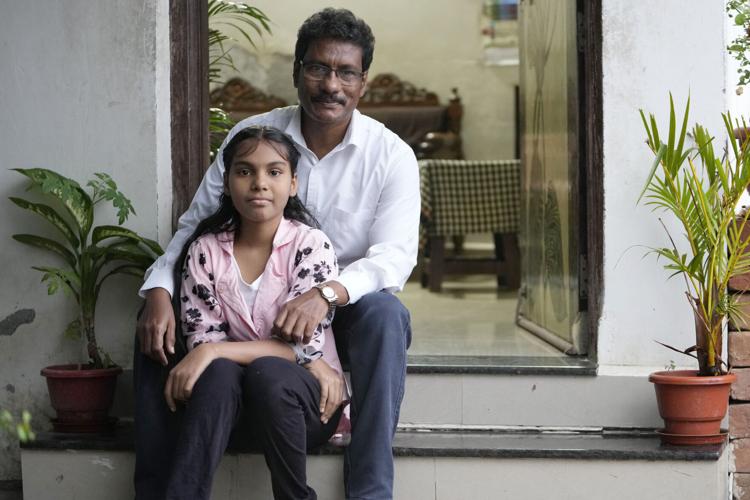
Gautam Dongre of the National Alliance of Sickle Cell Organizations sits Dec. 6 with his daughter, Sumedha, 13, at their residence in Nagpur, India. Dongre’s two children have sickle cell, a painful inherited blood disorder.
Beyond their sky-high prices, these therapies are extremely complex to give patients because they require long hospitalizations, sophisticated medical equipment and specially trained doctors. So far, the two gene therapies for sickle cell have only been approved in wealthier countries: both in the U.S., and one in Britain and Bahrain as well.
People are also reading…
“The vast, vast majority of patients live in an area where they have no access to this kind of therapy,” said Dr. Benjamin Watkins, who treats sickle cell at Children's Hospital New Orleans. “We as medical professionals, and as a society, have to think about that.”
Access to gene therapies was a major focus of this year’s international summit on human genome editing in London. A subsequent editorial in the journal Nature said high prices leave low- and middle-income countries “entirely in the lurch” and could stymie progress across the field.
Some scientists worry that new cures won’t reach their potential, future treatments may never be invented and the prospect of wiping out diseases like sickle cell will remain a distant dream.

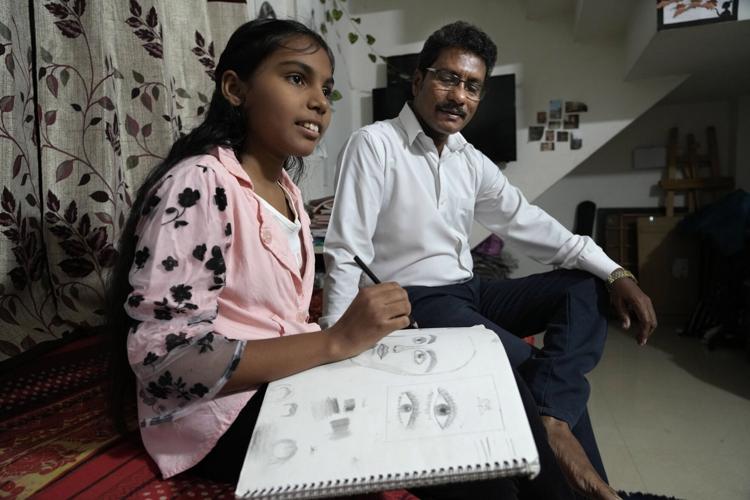
Gautam Dongre, right, sits Dec. 6 with his daughter, Sumedha, a patient of sickle cell disease, at their residence in Nagpur, India. In July, Prime Minister Narendra Modi launched a sickle cell “elimination mission” that combines awareness, education, screening, early detection and treatment. Dongre lauded the effort but said the country faces huge obstacles to meet its goals.
For gene therapy to even be an option, people in developing nations must stay alive long enough to get it. There, sickle cell disease is more likely to disable or kill than in wealthy regions. Late diagnosis is common and basic care can be hard to come by.
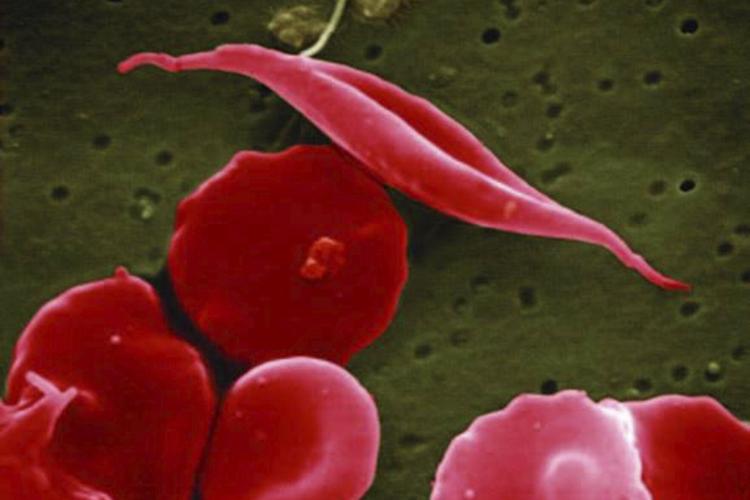
Sickle cell disease affects hemoglobin, the protein in red blood cells that carries oxygen. A genetic mutation causes the cells to become crescent-shaped, which can block blood flow and cause problems such as excruciating pain and organ damage.
Global estimates of how many people have the disease vary, but some researchers put the number between 6 million and 8 million — with more than 1 million in India and more than 5 million in sub-Saharan Africa.
Dongre, who lives in Nagpur in central India, has seen the struggles in his own family and among people he’s met as a leader of India's National Alliance of Sickle Cell Organizations.

An electron microscope image shows a blood cell altered by sickle cell disease, top. Between 6 million and 8 million are estimated to have the painful disease, with more than 1 million in India and more than 5 million in sub-Saharan Africa.
He recalled how his newborn son Girish cried constantly from stomach and leg pain. Doctors didn’t diagnose him with sickle cell for 2 1/2 years. When their daughter Sumedha was born, he and his wife had her tested immediately and learned she had the disease too.
Available treatments can reduce the bouts of pain known as “crises.” Dongre’s children, now 19 and 13, take hydroxyurea, a decades-old chemo drug that helps prevent the formation of sickle-shaped red blood cells and control the disease.
Other patients in rural areas are dying at very young ages without getting the right treatments, Dongre said.
The situation is much the same in East Africa's Tanzania.
Mazeze scrambled for information after her son, Ian Harely, was diagnosed.
“I Googled and Googled and I couldn’t sleep,” said Mazeze, executive director of the Tanzania Sickle Cell Warriors Organization. “After that, I was praying. It was God and Google.”
Her son is now 10 and takes hydroxyurea and folic acid for anemia. They’ve helped, but haven’t eliminated pain episodes.
Still, Mazeze counts herself lucky she can afford treatment at all. She said some in Tanzania can't even pay for folic acid, which costs less than a dollar.
Such stark realities make the cost of gene therapies an insurmountable obstacle, experts say. The price tags for the two sickle cell therapies in the U.S. are $3.1 million and $2.2 million although costs can vary by country.
The process of giving the therapies is just as big a hurdle.
Patients must go to the hospital, where stem cells are removed from their blood. One treatment, made by Vertex Pharmaceuticals and CRISPR Therapeutics, involves quickly sending the cells to a lab and using a gene-editing tool called CRISPR to knock out a gene.
The other therapy, made by Bluebird Bio, doesn’t use CRISPR but involves the same process for patients. They must undergo chemotherapy before they get back their altered cells, and spend weeks in the hospital. The process can stretch on for months.
“There’s great unmet need, but there are also significant challenges,” said Dr. David Altshuler, chief scientific officer at Vertex.
Scientists are working to make easier-to-administer versions of the new therapies. Altshuler's team is trying to develop a pill that wouldn’t edit genes but would have the same goal: helping the body produce a fetal form of hemoglobin since the adult form is defective in people with sickle cell.
But experts say simpler cures will likely still be unaffordable to many, so foundations and governments will be instrumental in getting them to patients.
If the gene therapy eventually makes it to India, Dongre would like his children to be among the first to get it. Mazeze said she may wait to see how other patients fare but will consider it for her son too.
Both agreed it should be an option in all countries — rich or poor.
“We all are part of one single planet,” Dongre said.
10 traits you may not know can be tied to genetics
10 traits you may not know can be tied to genetics

Although the longstanding debate between nature versus nurture is often framed as one being dominant over the other, scientists today know it’s not that simple: Nature and nurture interact in complex ways.
You probably already know that your parents and family history play a big role in determining your physical features, from the color of your hair to your height. But did you know that genetics also has an influence on some of your personality traits too? To create a list of traits that have some of their origins in genetics, Top10.com collected information from scientific journals such as Nature Genetics and the Proceedings of the National Academy of Sciences.
Today, more is often known about the genetic component of inheritable medical conditions such as hemophilia, a blood clotting disorder, and Huntington’s disease, a degenerative condition affecting the brain’s nerve cells. But according to a study published in Nature Genetics, more is being discovered about how traits like extraversion, creativity, and compassion, may also have correlations to specific genetic variants.
We’ve only scratched the surface of what genetics can tell us about who we are, but researchers are hopeful that with more study, we’ll unlock more about how psychological traits are impacted by genetics and environmental factors. Here are 10 physical and psychological traits that researchers have determined have some of their origins linked to genetics.

Facial expressions

A 2006 study conducted in Israel found facial expressions associated with concentration, sadness, and anger can be inherited. Researchers videotaped 21 people born blind and 30 of their relatives born sighted. Participants were asked to solve challenging puzzles, listen to a disgusting story, recount a sad or joyful personal experience, and respond to a silly question. Those who were blind had very similar facial expressions to their sighted relatives when concentrating or feeling angry or sad. Moreover, a computer program able to recognize similar facial expressions correctly matched blind participants with their relatives 80% of the time.
Deviated septum

The septum is the bone and cartilage in the nasal cavity that divides it into two nostrils. The septum can become deviated, or crooked, making it difficult to breathe. A deviated septum is most commonly the result of trauma, such as a blow to the face. However, it is also associated with conditions that affect connective tissue, such as Marfan syndrome and Ehlers-Danlos syndrome, both of which are genetic.
Children’s insomnia

A team led by researchers at the University of Basel in Switzerland found maternal symptoms of insomnia were associated with a child’s sleep pattern as objectively measured by in-home electroencephalography. Maternal insomnia was associated with less total sleep time, more stage 2 sleep, less slow-wave sleep, a later time to sleep onset, and a later wake time for their child. The insomnia symptoms of both parents influenced their perceptions of their children’s refusal to adhere to a designated bedtime, duration of sleep, sleep anxiety, incidents of waking up during the night, and/or daytime sleepiness.
Widow’s peak

A V-shaped frontal hairline, often called a widow’s peak, is a morphogenetic trait inherited by people from their parents. It has also been associated with a number of inherited genetic conditions. Reports also exist of a link between a widow’s peak and craniofacial clefts, or malformations of part of the face. However, the association between a widow’s peak and the severity of these conditions has not yet been defined.
Caffeine response

Every person responds differently to caffeine. Scientific evidence that these responses may be genetic is increasing. Genetic factors may directly influence individual responses by changing acute or chronic reactions to caffeine. These factors may also play an indirect role by altering the psychological or physiological processes related to the effects of caffeine, such as sensitivity to anxiety and the generally reinforcing effects of substance use. Genes can also affect the body’s response to long-term caffeine use.
Sensitivity to bitter food

About one-fourth of the population has a taste receptor gene, TAS2R38, that can make foods such as leafy greens and hoppy beers taste bitter. The perceived bitterness of these foods varies among individuals and depends on how strongly compounds in foods bind to the receptor. In a 2014 study of 93 Caucasian participants, TAS2R38 was associated with a bitter taste on the papillae of the tongue when it was swabbed with ethyl alcohol. The researchers concluded that genetic variations in the TAS2Rs gene may explain why alcoholic beverages taste bitter to some people but not to others.
Sneezing in the sun

Autosomal Dominant Compelling Helioopthalmic Outburst syndrome, appropriately known as ACHOO syndrome, is characterized by sneezing after sudden exposure to bright light, usually strong sunlight. The cause of ACHOO syndrome is not well understood. However, researchers do know it is inherited as an autosomal dominant trait, so if one parent is affected, a child has half a chance of inheriting ACHOO syndrome.
Optimism

The oxytocin receptor gene, also known as the OXTR gene, codes for the oxytocin receptor, to which the hormone oxytocin binds and exerts its effects throughout the body. Studies have linked part of the OXTR gene to psychological resources including optimism. The findings of a 2011 study suggest those who inherited a certain variation of the OXTR gene from both parents are more optimistic than those who inherited the variation from one parent or not at all.
Pain tolerance

In 2014, researchers presented a paper at the American Academy of Neurology’s annual meeting identifying four genes associated with pain perception: DRD1, DRD2, COMT, and OPRK1. The researchers enrolled almost 2,800 people who took opioids for chronic pain in their study. The DRD1 gene was 33% more prevalent among those with low pain perception than those with high pain perception. The COMT gene was 25% more common among those with moderate pain perception compared to those with high pain perception, and the OPRK1 gene was 19% more common. Among those with high pain perception, the DRD2 gene was 25% more prevalent compared to those with moderate pain perception.
Identifying these genes can help physicians better understand why some of their patients perceive pain differently than others, according to author Tobore Onojighofia, a member of the American Academy of Neurology and scientist with Proove Biosciences.
Life satisfaction

A study of twins published in 2012 by an international team of researchers found genetics explain about 33% of the variation in reported life satisfaction. Although at first the researchers found people with a certain variant of the 5-HTT serotonin transporter gene reported greater life satisfaction, they had difficulty replicating their results in an independent sample. The researchers said their findings suggest more work is necessary to better understand the relationship between the 5-HTT gene variant and life satisfaction.
This story originally appeared on Top10.com and was produced and distributed in partnership with Stacker Studio.