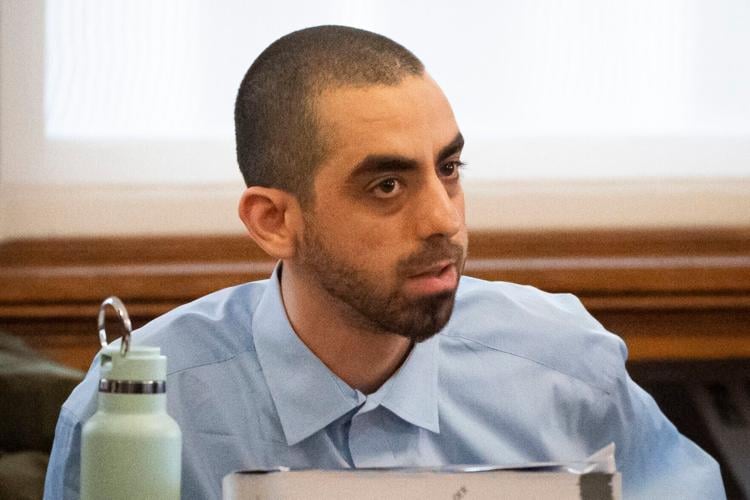
A jury took about two hours Wednesday to find author Salman Rushdie's attacker guilty of all three terrorism counts he faced.
With the verdict, Hadi Matar, 28, could spend the rest of his life in prison.

Hadi Matar was convicted Wednesday of all three terrorism counts he faced in the 2022 attack on author Salman Rushdie.
Matar, 28, a dual American and Lebanese citizen who was born and raised in this country, faced three terrorism charges for his assault against Rushdie. By carrying out a 1989 fatwa, or religious ruling, that called for Rushdie’s death, the New Jersey resident provided material support to Hezbollah, considered a terrorist group by the United States, prosecutors said.
A grand jury indicted Matar on three counts: attempt to provide material support to a foreign terrorist organization, act of terrorism transcending national boundaries and providing material support to terrorists.
Matar rushed across the stage at the Chautauqua Institution Amphitheater, where Rushdie was about to speak, on Aug. 12, 2022, inflicting stab wounds in a 27-second attack that blinded Rushdie in his right eye, severed all the tendons and most of the nerves in his left hand and left deep wounds to his torso in front of a horrified audience.
People are also reading…
"He slashed him. He sliced him. He indiscriminately stabbed him over his entire body," Assistant U.S. Attorney Timothy Lynch told jurors during his closing argument.
Defense attorney Nathaniel Barone sought an acquittal by stressing what he called the government's lack of direct evidence against Matar, and he also accused the prosecution of creating an atmosphere of fear to induce a guilty verdict from jurors.
"Fear has no place in this courtroom," Barone told jurors during his closing argument. "The government is using fear to ask each of you to convict Hadi Matar, an innocent man, of the indictment in this case."
Prosecutors replayed the video of Rushdie's stabbing many times throughout the trial and during Wednesday's closing arguments, as well as the video that Matar created that included the voice over of the menacing words of the Iranian supreme leader's religious decree in 1989 ordering Muslims around the world to kill Rushdie.
"It's fear mongering," Barone said.
"Everything Hadi Matar did on Aug. 12 was because of his religious beliefs," Barone said, adding he "acted completely independently" of any terrorist group.
Lynch rejected the accusation. "I didn't talk about fear," he told jurors. "I gave you the facts. I'm not asking you to speculate. I'm asking you to look at the evidence."
Matar already is serving a 25-year prison sentence for trying to kill Rushdie, convicted in a state trial last year that focused mostly on the knife attack. The federal trial focused on Matar's intent — not simply the violent act he carried out — and whether he received and obeyed direction from Hezbollah terrorists.
Barone told jurors there was no direct communication with Hezbollah, adding Matar's text messages and emails introduced as prosecution evidence dealt with his beliefs and practices and had "nothing to do with Hezbollah or any foreign terrorist organization." He said the government lacked documentation or evidence specifically tying Matar to Hezbollah.
Lynch and Assistant U.S. Attorney Charles Kruly spent four days questioning 15 witnesses, playing Matar's videos and showing jurors Matar's text messages that they said provided more than enough evidence to prove Matar offered material support to Hezbollah beyond a reasonable doubt.
"We don't have them calling Matar on Aug. 11 and saying, 'We hope you kill Salman Rushdie on Aug. 12,'" Lynch said. But he reminded jurors that direction from a terrorist group can come in many forms.
Matar included snippets of a 2006 speech by Hezbollah’s then-secretary general, Hassan Nasrallah, in a video Matar created about the fatwa against Rushdie.
In the speech, the Hezbollah leader condemned cartoons of the prophet Muhammad in a Danish newspaper that outraged many Muslims, who regarded them as blasphemous. Nasrallah also mentioned Rushdie, condemned to death by the then-Iranian Supreme Leader Ayatollah Ruhollah Khomeini for what he viewed as blaspheming Muhammad in his 1988 novel “The Satanic Verses.”
"If any Muslim had carried out the fatwa of Imam Khomeini against the apostate Salman Rushdie, those despicable people would not have dared to insult the Prophet Muhammad — not in Denmark, not in Norway, and not in France," Nasrallah said in his speech.
"I am certain that not only millions, but hundreds of millions of Muslims, are ready and willing to sacrifice their lives in order to defend the honor of their Prophet," he added. "And you are among them."
Matar took that as a signal to enforce the fatwa against Rushdie, prosecutors said.
Matthew Levitt, who previously served as a counterterrorism intelligence analyst with the FBI, was called as a prosecution witness to explain why terrorist experts view Nasrallah's speech as a pivotal moment.
"This was by no means just propaganda," Levitt testified about Nasrallah's speech last week. "It's a call to action" to a global audience.
"The defendant is the one who answered that call," Lynch said in his closing argument about Matar's attack on Rushdie.
Hezbollah relies on people to make sacrifices to carry out the organization's aims, even at the cost of their own lives.
Prosecutors say Hadi Matar kept a notebook that included a list of the pros and cons of trying to kill Salman Rushdie. Although his journal en…
Matar's notebook seized by the FBI included his list the pros and cons of trying to kill Rushdie, Lynch said. "Finally get this over with," was listed as one of the pros.
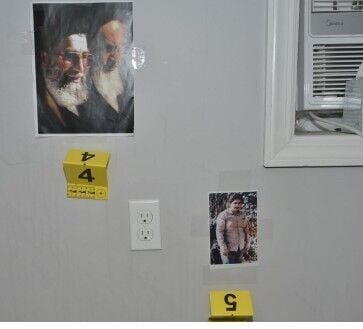
The photo on the left depicts Ruhollah Khomeini, the former supreme leader of Iran, and Ali Khamenei, who at the time of the attack on Salman …
Matar, who lived in the basement of a home shared by his mother, three sisters and another relative, had a photo on his bedroom wall showing Ruhollah Khomeini, the first supreme leader of Iran from 1979 until his death in 1989, and Ali Khamenei, who at the time of the attack was the supreme leader of Iran but was killed in U.S.-Israeli airstrikes Feb. 28.
Another photo showed Hezbollah suicide bomber Ahmed Kassir, who carried out a suicide bombing in 1982 against an Israeli headquarters building in Lebanon and is recognized as the first Hezbollah martyr.
Matar had screenshots of Hezbollah martyrs on his phone, as well as one on his lock screen.
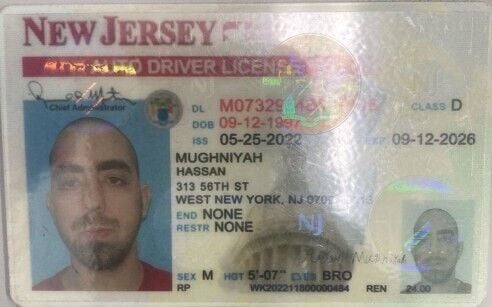
Several pieces of information on Hadi Matar's fake driver’s license show that he attempted to associate himself with Hezbollah, prosecutors said. The issue date is May 25, 2022. May 25 is celebrated by Hezbollah as the day of resistance in remembrance of the withdrawal of Israeli forces from Lebanon. Also, the name on the driver’s license is comprised of two names that are significant to Hezbollah. The first name, “Hassan,” is the first name of Hezbollah’s then-Secretary General Hassan Nasrallah. The last name, Mughniyah, is an apparent reference to Imad Mughniyah, the former leader of Hezbollah’s External Security Organization.
Even Matar's fake driver's license has dates and names connected to Hezbollah, the prosecutor said.
"He wrapped himself up in Hezbollah symbols prior to his attack on Salman Rushdie," Lynch said.
Matar planned and prepared to attack Rushdie for two years, Lynch said.
"This wasn't something he thought of at the last minute," Lynch said. "He didn't just wake up up on his own one day and decide he didn't like Salman Rushdie."