DENVER — Can former President Donald Trump run for his old job again after his role in the Jan. 6, 2021, attack on the U.S. Capitol? The answer may depend on the definition of insurrection.
Liberal groups filed lawsuits in Colorado, Minnesota and other states to bar Trump from the ballot, citing a rarely used constitutional prohibition against holding office for those who swore an oath to uphold the Constitution but then "engaged in insurrection" against it. The two-sentence clause in the 14th Amendment has been used only a handful of times since the years after the Civil War.
Because of that, there's almost no case law defining its terms, including what would constitute an "insurrection." While people have argued about whether to call the Jan. 6 riot an insurrection, debate in court last week was different: whether those who ratified the amendment in 1868 would call it one.
People are also reading…

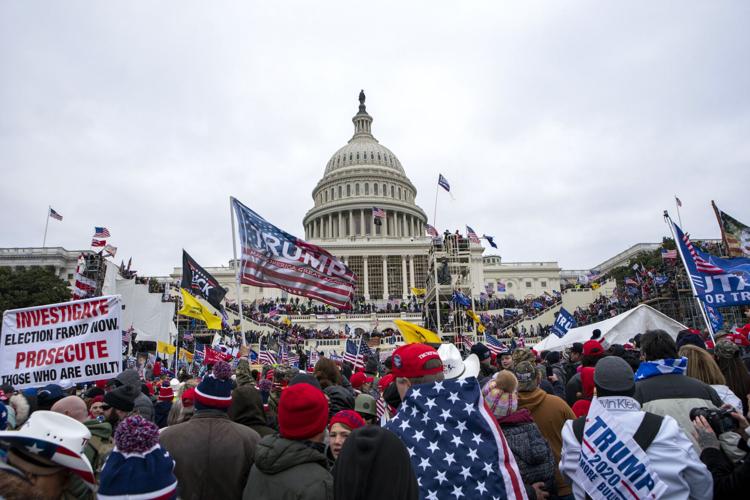
Insurrectionists loyal to President Donald Trump rally Jan. 6, 2021, at the U.S. Capitol in Washington.
There are a myriad of legal reasons why the long-shot legal bids to bar the former president and current Republican primary front-runner from the ballot could fail, from limits on the role of state courts to whether Section Three applies to the president. But perhaps none resonate like the debate over whether the Jan. 6 attack should be considered an insurrection.
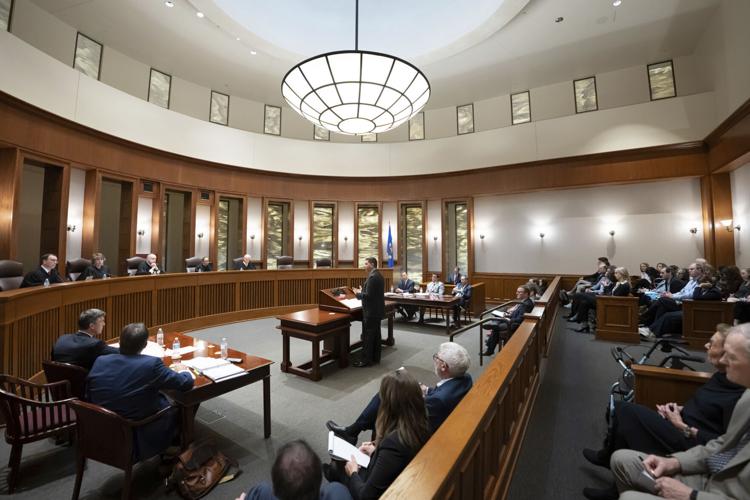
In a hearing Thursday before the Minnesota Supreme Court, the question was part of the reason the justices seemed skeptical that states have the authority to throw Trump off the ballot.
"What does it mean in your estimation to have engaged in insurrection or rebellion against the Constitution?" Justice Gordon Moore asked the lawyers for each side.

Ronald Fein, attorney for Free Speech for People, gives his ending rebuttal to his case Thursday before the Minnesota Supreme Court in St. Paul.
Nicholas Nelson, representing Trump, defined an insurrection as "some sort of organized form of warfare or violence … that is oriented toward breaking away from or overthrowing the United States government." He added that nothing in the past 50 years met that criteria.
Ronald Fein, an attorney for the group Free Speech For People, which is representing the petitioners, said an insurrection against the Constitution is "a concerted, forcible effort to prevent or obstruct execution of a central Constitutional function," which he said describes Trump's actions surrounding the January 2021 assault on the Capitol, an attack intended to halt certification of Democrat Joe Biden's election win.
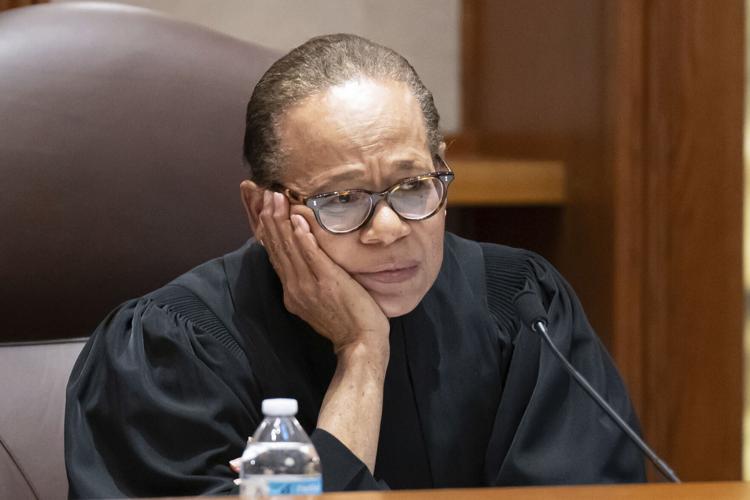
"Insurrection might be in the eye of the beholder," Minnesota Supreme Court Chief Justice Natalie Hudson concluded.

Minnesota Supreme Court Chief Justice Natalie Hudson questions Ronald Fein, attorney for Free Speech for People, as he argues his case Thursday in St. Paul, Minn.
A day earlier, Indiana University law professor Gerard Magliocca sat in a Denver courtroom and described his research into Section Three, a subject few delved into before late 2020.
He dug into dictionary definitions of insurrection from 150 years ago — one was "the rising of people in arms against their government, or against a portion of it, or against a portion or one of its laws."
He found an opinion from the U.S. attorney general in 1867 that former Confederates should be barred from certain offices even if they simply bought bonds in the rebel government. He also found instances where Congress refused to seat elected representatives whose only violation was writing a letter to the editor backing the Confederate cause or paying a son $100 to help cover his costs to join the Confederate army.
Congress also passed a law in 1862 making insurrection a crime that used different language. Some critics of the Section Three lawsuits noted no one has been charged with the crime of insurrection in the Jan. 6 riot — though several far-right extremists were convicted of seditious conspiracy.
Magliocca noted that constitutional language is different than far more technical and detailed criminal statutes, and Section Three says nothing about the person barred from office having to be first convicted of a crime. He testified it was understood the goal of the provision was to keep former Confederates out of public office after the war.
In 1872, Congress lifted the ban for most former Confederates, which it is able to do under the terms of Section Three.

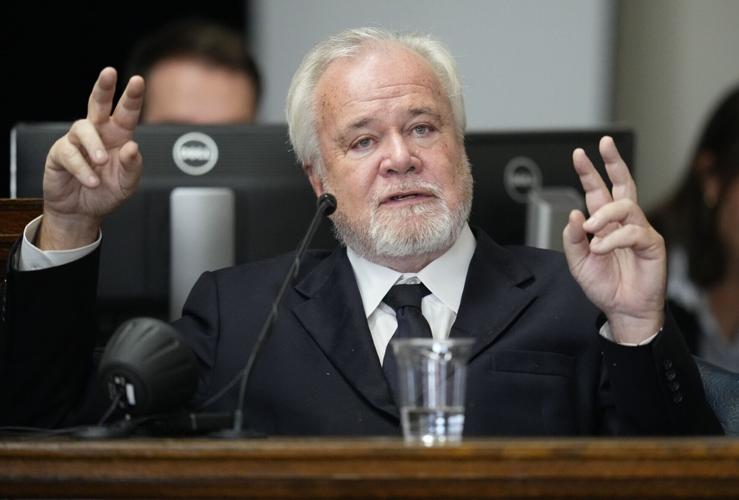
Robert Delahunty testifies Friday during a hearing in Denver on a lawsuit seeking to keep former President Donald Trump off the state ballot.
On Friday in the Colorado hearing, Trump's lawyers put on their own constitutional expert, Robert Delahunty, to note that some of Magliocca's definitions were contradictory. Some required the use of "arms" in insurrection while others did not.
Delahunty, a retired law professor who is a fellow at the conservative Claremont Institute, said the more important question is the unique requirement in Section Three that it be an insurrection against the Constitution.
"What really needs to be explicated is not the plain vanilla meaning of insurrection but the whole phrase — insurrection against the United States Constitution," he testified Friday.
The lawyers seeking to disqualify Trump in Colorado noted that even the former president's own attorney in his impeachment trial for the Jan. 6 attack described it as an insurrection.
"The question before us is not whether there was a violent insurrection of the Capitol — on that point everyone agrees," Trump attorney Michael van der Veen said during impeachment proceedings in the Senate.
Legal scholars were able to find just one example of the amendment used in the last century: it was cited to deny a seat in the House of Representatives to an anti-war socialist elected after World War I.
5 takeaways from the Jan. 6 report
1. Eight chapters

From the "Big Lie" of Trump's November 2020 election night claims of a stolen election to the bloody Jan. 6, 2021, siege, the report spells out the start and finish of the mob attack that played out for the world to see.
It details how Trump and his allies engaged in a "multi-part" scheme to overturn Joe Biden's presidential election victory — first through court challenges, then, when those failed, by compiling slates of electors to challenge Joe Biden's victory.
As Congress prepared to convene Jan. 6 to certify the election, Trump summoned a mob to Washington for his "Stop the Steal" rally at the White House.
"When Donald Trump pointed them toward the Capitol and told them to 'fight like hell,' that's exactly what they did," Thompson wrote. "Donald Trump lit that fire. But in the weeks beforehand, the kindling he ultimately ignited was amassed in plain sight."
2. New details, pressures

After blockbuster public hearings, the report and its accompanying materials are providing more detailed accounts of key aspects of the Trump team's plan to overturn the election, join the mob at the Capitol and, once the committee began investigating, pressure those who would testify against him.
Among dozens of new witness transcripts was Thursday's release of a previously unseen account from former White House aide Cassidy Hutchinson (pictured) detailing a stunning campaign by Trump's allies encouraging her to stay "loyal" as she testified before the panel.
The report said the committee estimates that in the two months between the November election and the Jan. 6 attack, "Trump or his inner circle engaged in at least 200 apparent acts of public or private outreach, pressure, or condemnation, targeting either State legislators or State or local election administrators, to overturn State election results."
3. Behind the scenes

The report also details Trump's inaction as his loyalists were violently storming the building.
One Secret Service employee testified to the committee that Trump's determination to go to the Capitol put agents on high alert.
"(We) all knew ... that this was going to move to something else if he physically walked to the Capitol," a unidentified employee said. "I don't know if you want to use the word 'insurrection,' 'coup,' whatever. We all knew that this would move from a normal democratic ... public event into something else."
Once the president arrived back at the White House after delivering a speech to his supporters, he asked an employee if they had seen his remarks on television.
"Sir, they cut it off because they're rioting down at the Capitol," the staffer said, according to the report.
Trump asked what that meant, and was given the same answer. "Oh really?" Trump then asked. "All right, let's go see."
4. Safeguarding democracy

The report makes 11 recommendations for Congress and others to safeguard American democracy and its tradition of the peaceful transfer of presidential power from one leader to the next.
The first, an overhaul of the Electoral Count Act, is on its way to becoming law in the year-end spending bill heading toward final passage this week in Congress.
The committee also made recommendations to the Justice Department to prosecute Trump and others for conspiracy to commit fraud on the public, and other potential charges. It also referred the former president for prosecution for "assisting and providing aid and comfort to an insurrection."
Other changes may be within reach or prove more elusive. Among them, the report recommends beefing up security around key congressional events, overhauling oversight of the Capitol Police and enhancing federal penalties for certain types of threats against election workers.
One recommendation is for Congress to create a formal mechanism to consider barring individuals from public office if they engage in insurrection or rebellion under the Fourteenth Amendment. It holds that those who have taken an oath to support the Constitution can be disqualified from holding future federal or state office if they back an insurrection.
5. Record for history

The Jan. 6 committee was created after Congress rebuked an effort to form an independent 9/11-style commission to investigate the Capitol attack. Republicans blocked the idea.
Instead, Speaker Nancy Pelosi led the House to form the committee. In her foreword to the report, she said it "must be a clarion call to all Americans: to vigilantly guard our Democracy."
Led by Thompson and Vice Chair Liz Cheney, R-Wyo., the panel's work is intended to stand as a record for history of what happened during the most serious attack on the Capitol since the War of 1812.
Five people died in the riot and its aftermath, including Ashli Babbitt, a Trump supporter shot and killed by police, and Brian Sicknick, a police officer who died the day after battling the mob.
Cheney noted the committee decided most of its witnesses needed to be Republicans — the president's own team and allies. In the report's foreword, she wrote that history will remember the "bravery of a handful of Americans" and those who withstood Trump's "corrupt pressure."
For all of them, the committee and report held personal weight.
Thompson, a Black leader in Congress, noted that the iconic U.S. Capitol, built with enslaved labor, "itself is a fixture in our country's history, of both good and bad ... a symbol of our journey toward a more perfect union."