ALEXANDRIA, Va. — Kit Vontz mulled how others her age feel about the nation's future.
"There’s so much going on right now, and it’s kind of overwhelming," the 18-year-old recently told the small group of other seniors slouched over their desks in the Alexandria City High School government class.
They discussed research on Generation Z's attitudes toward democracy.
Classmate David George Fite said he'd found it hard to avoid a "hopeless mindset." A history buff, Fite added he'd become dismayed by the political "chaos" he saw in the news.

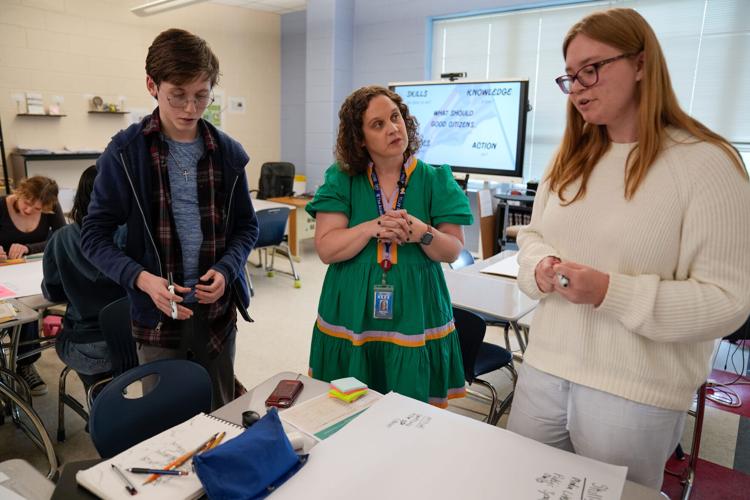
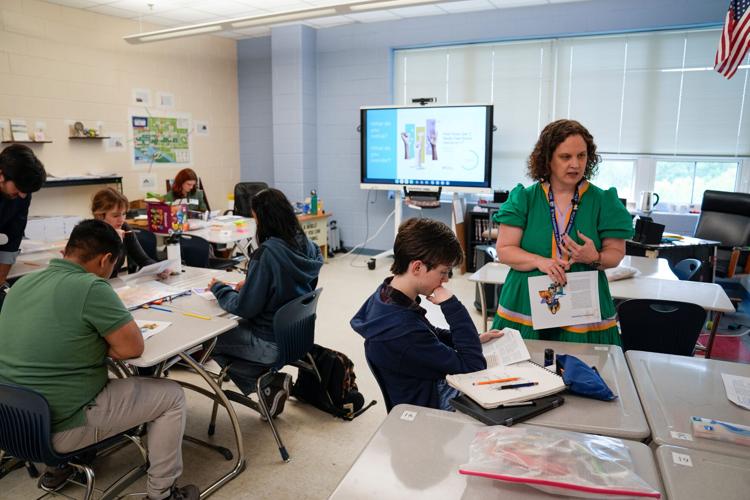
Students work with government instructor Amanda Kropp at Alexandria City High School in Virginia.
Trust in the government among young Americans is at a record low, according to the most recent Harvard Youth Poll. The survey, published in April, found just 26% of 18- to 29-year-olds felt hopeful about the country's future.
People are also reading…
The results reflect an erosion of faith in the nation’s democratic systems among young Americans across partisan lines.
As federal and state lawmakers seek to bolster civics education, experts believe boosting young people's understanding of government and citizens' rights and responsibilities could help reduce political divisions and vitriol.
They see the country’s 250th birthday as the start of a potential decadelong civic renaissance. This year’s kindergartners will have their education bookended by the anniversaries of the Declaration of Independence and ratification of the Constitution.
"This really is a runway," said Shawn Healy, chief policy and advocacy officer at iCivics, a nonpartisan group providing civics resources to students and teachers.
However, educators say the country's deep divisions make it more difficult than ever to teach students about the government.

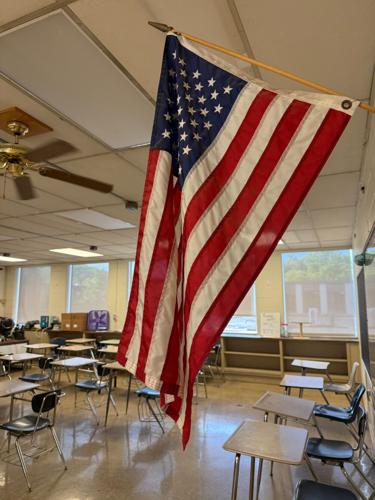
The American flag hangs May 13 in a Lancaster, Ohio, High School classroom.
Classrooms in turmoil
Community members used to stop and commend Kimberly Huffman for educating children about the Constitution. Now, her neighbors question whether she's teaching the "right Constitution."
At a parent conference last fall, Huffman said, a mother asked if Huffman was teaching her child to be a Democrat — the first time she’d received that question in her 32 years as an American government instructor.
Her community in Wayne County, Ohio, is a Republican stronghold that voted for President Donald Trump in the last three presidential elections. Until the past few years, political rancor never seeped into Huffman's classroom.
Now, once matter-of-fact lessons are tense.
The curriculum for juniors and seniors at the county’s vocational high school, where Huffman teaches, covers four founding documents: the Constitution, the Bill of Rights, the Declaration of Independence and Ohio's state Constitution.
Huffman sticks steadfastly to the words of the documents. She doesn’t belong to either political party and encourages students to check her voter registration. Still, they routinely interrogate her treatment of topics like presidential powers.
"I still face hints of accusations of being biased," she said, "even though I feel like I'm tiptoeing. I feel like I'm being meticulously cautious."

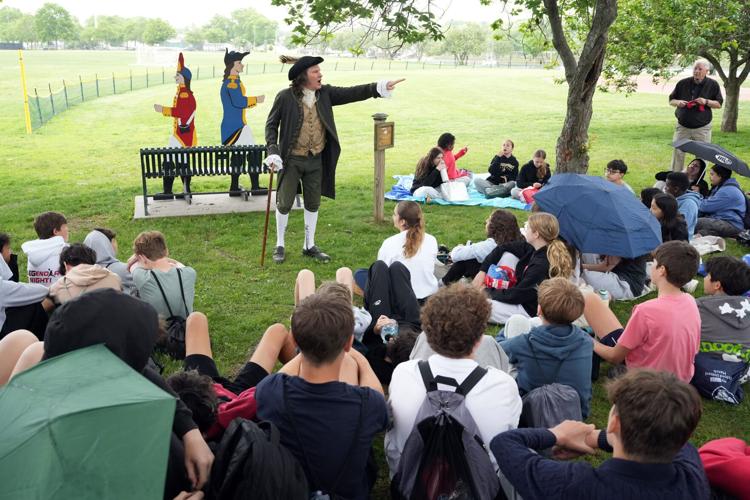
Professional Storyteller Jonathan Kruk presents Revolutionary War history to seventh graders from Hommocks Middle School during a class trip May 21, 2026, at Harbor Island Park in Mamaroneck, N.Y.
Tense climate
In an iCivics survey published in January, more than half of teachers reported a fear of backlash for covering something the "wrong way," and said basic civics concepts became difficult to teach.
David Bobb, president of the Bill of Rights Institute, a civics-focused educational organization founded by libertarian Charles Koch, pointed to the country’s antagonistic political climate. Over the past decade, deep political divisions influenced the way people view the nation’s history.
Democratic lawmakers at the state and federal levels pushed to expand history curricula to include more on the slave trade, treatment of Native Americans and other marginalized groups. Republican lawmakers argued these efforts unnecessarily disparage Americans. They moved to ban the telling of "divisive or anti-American ideology."
Policymakers from both parties also introduced proposals to invest in civics education, but many of those ideas also are split along ideological lines.
Conservative politicians criticized civics initiatives that encourage students to participate in their communities, saying these tactics push activism. Meanwhile, Democrats accused the Trump administration of presenting a biased view in its programs.
The Department of Education last year emphasized a focus on "patriotic education" and awarded more than $150 million in history and civics grants. The agency also helped launch the America 250 Civics Education Coalition, bringing together predominantly conservative organizations to create K-12 and higher-education programming.

Government instructor Amanda Kropp works with students at Alexandria City High School in Virginia.
.
Seeing eye to eye
When students sit down in Jennifer Klein's classroom each semester, they forecast American politics.
Some say it’s sunny and bright; others say it's cloudy with a chance of torrential rain.
Over the past few years, Klein said, the answers in her Pittsburgh school trended "gloomier." She also saw the change in sentiment reflected in students' increasing hesitancy to express their opinions at the start of every school year.
It’s a trend Josh Dunn, a professor at the University of Tennessee, Knoxville, also witnessed in his college classes.
"For the students, so many of them fear saying something that might get them, for lack of a better word, canceled," said Dunn, who also serves as executive director of the school’s Institute of American Civics.
Educators like Klein and Dunn see their classes playing a fundamental role in helping the next generation learn how to effectively — and politely — communicate disagreements.
During a recent lesson on Federalist Paper No. 70, Klein watched her once-timid students begin to relish debating with one another. They discussed Alexander Hamilton’s defense of a strong executive branch in the 1788 document.
To defend their positions, students shouted across the room examples from history and current events. Some laughed as their classmates persuaded them.
"Once they know they don't have to be right all the time, once they realize that there's more than just one other point of view, it kind of opens their mind," Klein said.
At Alexandria City High School, the students researched federal agencies, interpreted judicial opinions based on their understanding of the Constitution, staged a mock Congress and met with city officials about public policy issues.
Fite said the assignments helped him "reconcile" his fears with a deeper understanding of the country’s systems.