A NASA spacecraft has set sail for Jupiter and its moon Europa, one of the best bets for finding life beyond Earth.
Europa Clipper will peer beneath the moon's icy crust where an ocean is thought to be sloshing fairly close to the surface. It won't search for life, but rather determine whether conditions there could support it. Another mission would be needed to flush out any microorganisms lurking there.

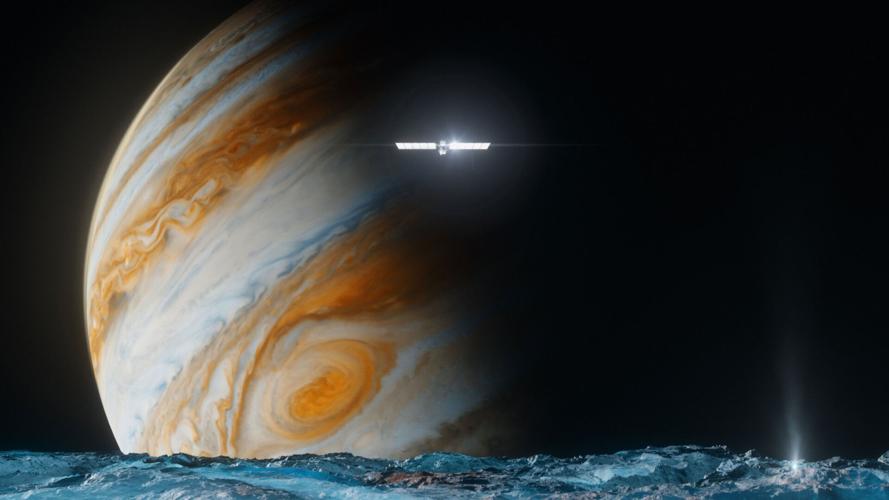
The Europa Clipper spacecraft is depicted above the surface of the moon Europa, foreground, and Jupiter behind.
"It's a chance for us to explore not a world that might have been habitable billions of years ago, but a world that might be habitable today — right now," said program scientist Curt Niebur.
Its massive solar panels make Clipper the biggest craft built by NASA to investigate another planet. It will take 5 ½ years to reach Jupiter and will sneak within 16 miles of Europa's surface — considerably closer than any other spacecraft.
People are also reading…
Clipper lifted off Monday aboard SpaceX's Falcon Heavy rocket from NASA's Kennedy Space Center. Mission cost: $5.2 billion.
Europa, the superstar among Jupiter's many moons
One of Jupiter's 95 known moons, Europa is almost the size of our own moon. It's encased in an ice sheet estimated to be 10 miles to 15 miles or more thick. Scientists believe this frozen crust hides an ocean that could be 80 miles or more deep. The Hubble Space Telescope has spotted what appear to be geysers erupting from the surface. Discovered by Galileo in 1610, Europa is one of the four so-called Galilean moons of Jupiter, along with Ganymede, Io and Callisto.

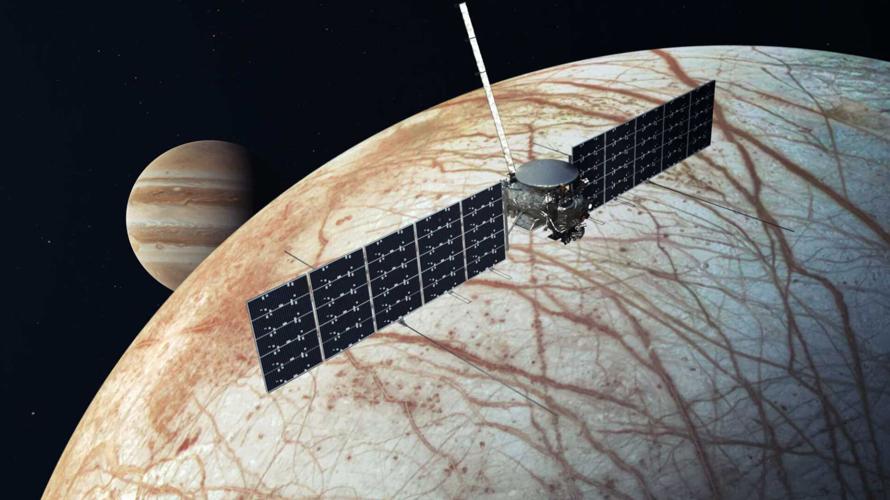
The Europa Clipper spacecraft is depicted over the moon, Europa, with Jupiter at background left.
Seeking conditions that support life
What type of life might Europa harbor? Besides water, organic compounds are needed for life as we know it, plus an energy source. In Europa's case that could be thermal vents on the ocean floor. Deputy project scientist Bonnie Buratti imagines any life would be primitive like the bacterial life that originated in Earth's deep ocean vents. "We will not know from this mission because we can't see that deep," she said. Unlike missions to Mars where habitability is one of many questions, Clipper's sole job is to establish whether the moon could support life in its ocean or possibly in any pockets of water in the ice.
Supersized spacecraft
When its solar wings and antennas are unfurled, Clipper is about the size of a basketball court — more than 100 feet (30 meters) end to end — and weighs nearly 13,000 pounds (6,000 kilograms). The supersized solar panels are needed because of Jupiter's distance from the sun. The main body — about the size of a camper — is packed with nine science instruments, including radar that will penetrate the ice, cameras that will map virtually the entire moon and tools to tease out the contents of Europa's surface and tenuous atmosphere. The name hearkens to the swift sailing ships of centuries past.

Circling Jupiter to fly by Europa
The roundabout trip to Jupiter will span 1.8 billion miles (3 billion kilometers). For extra oomph, the spacecraft will swing past Mars early next year and then Earth in late 2026. It arrives at Jupiter in 2030 and begins science work the next year. While orbiting Jupiter, it will cross paths with Europa 49 times. The mission ends in 2034 with a planned crash into Ganymede — Jupiter's biggest moon and the solar system's too.
Europa flybys pose huge radiation risk
There's more radiation around Jupiter than anywhere else in our solar system, besides the sun. Europa passes through Jupiter's bands of radiation as it orbits the gas giant, making it especially menacing for spacecraft. That's why Clipper's electronics are inside a vault with dense aluminum and zinc walls. All this radiation would nix any life on Europa's surface. But it could break down water molecules and, perhaps, release oxygen all the way down into the ocean that could possibly fuel sea life.
Earlier this year, NASA was in a panic that the spacecraft's many transistors might not withstand the intense radiation. But after months of analysis, engineers concluded the mission could proceed as planned.

Ganymede and other possible ocean worlds
Like Europa, Jupiter's jumbo moon Ganymede is thought to host an underground ocean. But its frozen shell is much thicker — possibly 100 miles thick — making it tougher to probe the environment below. Callisto's ice sheet may be even thicker, possibly hiding an ocean. Saturn's moon Enceladus has geysers shooting up, but it's much farther than Jupiter. Ditto for Saturn's moon Titan, also suspected of having a subterranean sea. While no ocean worlds have been confirmed beyond our solar system, scientists believe they're out there — and may even be relatively common.
Messages in a cosmic bottle
Like many robotic explorers before it, Clipper bears messages from Earth. Attached to the electronics vault is a triangular metal plate. On one side is a design labeled "water words" with representations of the word for water in 104 languages. On the opposite side: a poem about the moon by U.S. poet laureate Ada Limon and a silicon chip containing the names of 2.6 million people who signed up to vicariously ride along.
Solar eclipse wowed millions 2 years ago today. (Seems just like yesterday.)

People watch as the moon partially covers the sun during a total solar eclipse Monday in Eagle Pass, Texas.

The moon covers the sun during a total solar eclipse Monday in Mazatlan, Mexico.

The moon partially covers the sun during a total solar eclipse Monday in Eagle Pass, Texas.

Didier Timothy-Mondesir watches the solar eclipse Monday from Prince Edward County, Ontario.

People watch as the moon partially covers the sun during a total solar eclipse Monday in Eagle Pass, Texas.

Josh Bonkowsky and his daughter, Lucy, from Utah, use homemade viewers made from cardboard boxes and welding lenses as they take in Monday's eclipse in McGregor.

Isabel Franco, left, and her parrot Alex watch the solar eclipse from Griffith Observatory on Monday in Los Angeles.

Visitors watch and take photos as the sky darkens during a total solar eclipse at Niagara Falls State Park on Monday, April 8, 2024. (Joshua Bessex/Buffalo News)

Visitors watch and take photos as the sky darkens during a total solar eclipse at Niagara Falls State Park on Monday, April 8, 2024. (Joshua Bessex/Buffalo News)

Visitors watch and take photos as the sky darkens during a total solar eclipse at Niagara Falls State Park on Monday, April 8, 2024.

The moon covers the sun during a total solar eclipse Monday in Mazatlan, Mexico.

The light of the sun forms a diamond effect during the total solar eclipse over Niagara Falls State Park on Monday, April 8, 2024. (Joshua Bessex/Buffalo News)

The light of the sun forms a diamond effect during the total solar eclipse over Niagara Falls State Park on Monday, April 8, 2024. (Joshua Bessex/Buffalo News)

The light of the sun forms a diamond effect during the total solar eclipse over Niagara Falls State Park on Monday, April 8, 2024. (Joshua Bessex/Buffalo News)

The light of the sun forms a diamond effect during the total solar eclipse over Niagara Falls State Park on Monday, April 8, 2024. (Joshua Bessex/Buffalo News)

St. Louis Public Schools employees, from left, Brenetta Underwood, Natasha Winston, Aja McCoy, and Pamela Bryant, take in the view of the maximum stage of the partial solar eclipse around 2 p.m. on Monday, April 8, 2024.

Monday's eclipse hangs over the ALICO Building in downtown Waco.

The total eclipse of the sun is seen in Historic Ste. Genevieve on Monday, April 8, 2024.

The total eclipse of the sun is seen in Historic Ste. Genevieve on Monday, April 8, 2024.

Solar prominences and Baily's Beads can be seen coming off of the sun during the total eclipse, as seen from historic Ste. Genevieve on Monday, April 8, 2024.

Karine Rodriquez, right, sits with her son Yurem, left, and daughter Aranza, center, as the moon partially covers the sun during a total solar eclipse, as seen Monday from Eagle Pass, Texas.

Visitors to Wendt Beach in Angola create “Eclipse 2024” using stones in the beach sand.

Crowds gather at Niagara Falls State Park to watch as the solar eclipse begins on Monday, April 8, 2024. (Joshua Bessex/Buffalo News)

A park visitor takes a selfie while wearing the eclipse glasses as the eclipse begins at Niagara Falls State Park on Monday, April 8, 2024. (Joshua Bessex/Buffalo News)

Planes perform a flyover as the solar eclipse begins at Niagara Falls State Park on Monday, April 8, 2024. (Joshua Bessex/Buffalo News)

The eclipse breaks through the clouds at Niagara Falls State Park on Monday, April 8, 2024. (Joshua Bessex/Buffalo News)

The eclipse breaks through the clouds at Niagara Falls State Park on Monday, April 8, 2024. (Joshua Bessex/Buffalo News)

A spectator looks through eclipse glasses at Niagara Falls State Park on Monday. About 45,000 visitors came to the iconic wonder to view the celestial event.

The eclipse breaks through the clouds at Niagara Falls State Park on Monday, April 8, 2024. (Joshua Bessex/Buffalo News)

The eclipse breaks through the clouds at Niagara Falls State Park on Monday, April 8, 2024. (Joshua Bessex/Buffalo News)

The eclipse breaks through the clouds at Niagara Falls State Park on Monday, April 8, 2024. (Joshua Bessex/Buffalo News)

Mariah Marks, clad in intergalactic-themed pants, reads a copy of "The Great Gatsby" as clouds cover the eclipse at Sahlen Field in Buffalo, April 8, 2024. (Libby March/Buffalo News)

Miesha Saharan of Amherst, 4, poses for a selfie with her her parents, Lokesh and Mamta Saharan, during the total solar eclipse viewing at Sahlen Field in Buffalo, April 8, 2024. (Libby March/Buffalo News)

The moon covers the sun during a total solar eclipse Monday in Luna Pier, Mich.

Cameras on tripods are set up to photograph the total solar eclipse Monday in Niagara Falls, Ontario.