WASHINGTON — At 12 years old, Naia Butler-Craig decided she wanted to be an astronaut. Each time she walked into St. Mark AME Church in Orlando, Florida, and saw the framed photo of Mae Jemison, the first Black woman to travel into space, she knew space was her ultimate goal.
About 16 years later as a NASA aerospace engineer with a Ph.D. in the same field, she shook the hand of Victor Glover, the first Black man who would pilot a spacecraft around the moon, and told him she was following in his footsteps.

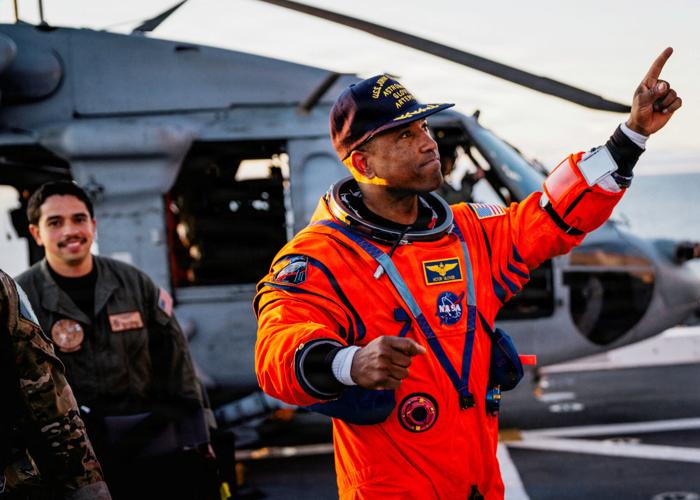
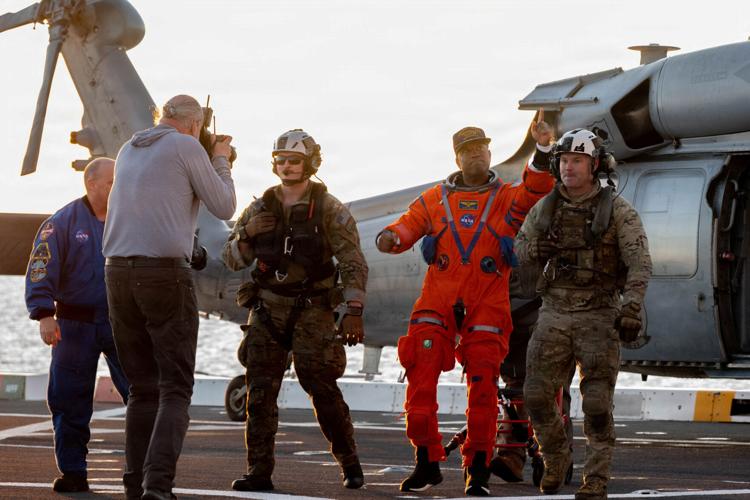
NASA astronaut Victor Glover reacts on the flight deck of the U.S. Navy's USS John P. Murtha after returning from the crew's Artemis II moon flyby mission's Orion capsule, which splashed down in the Pacific Ocean off the coast of California on Friday.
“Most people worry about making the right choice,” Butler-Craig recalled Glover's response on Jan. 17. “Make the choice right.”
Almost three months later, Glover launched into space, becoming one of four people to travel farther from Earth than any human being in history as part of NASA’s Artemis II mission around the moon.
People are also reading…

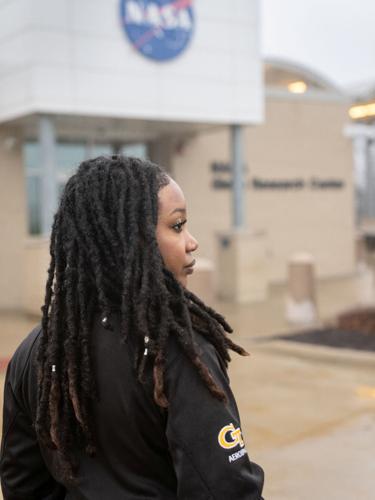
NASA engineer Naia Butler-Craig stands at the entrance to the NASA Glenn Research Center in Cleveland, Ohio, on April 10.
For Butler-Craig, it was an affirmation that her path, and the aspirations for millions of Black Americans who were once denied access to the highest echelons of academic and human achievement because of the color of their skin, are possible.
“To see him live all of those facets of identity at the same time when that's exactly the tension and the constant dichotomies I'm facing is incredibly validating,” she said of Glover. “It just makes me feel like he's paved the exact road for someone like me.”

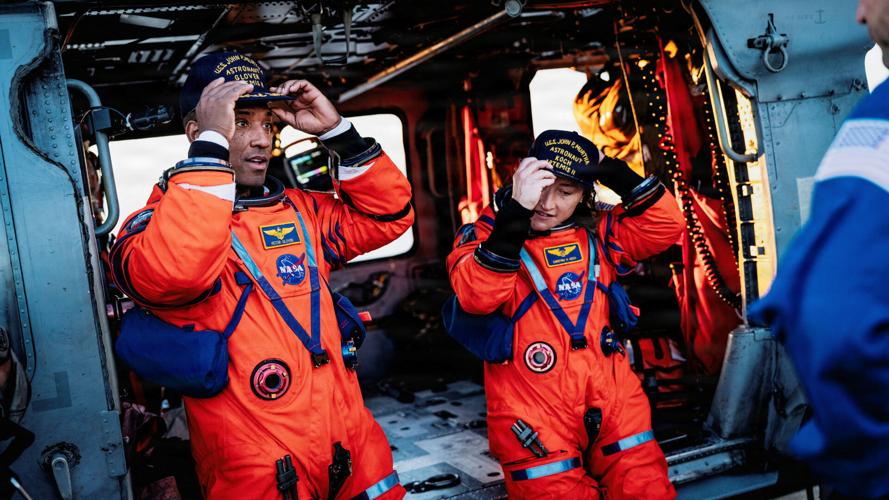
NASA astronauts Victor Glover and Christina Koch put on ship hats on the flight deck of the U.S. Navy's USS John P. Murtha after returning from their Artemis II moon flyby mission's Orion capsule, which splashed down in the Pacific Ocean off the coast of California on Friday.
As President Donald Trump’s administration works to dismantle diversity, equity and inclusion programs across government and the private sector, Glover's historic flight has sparked an outpouring of support across social media. Many cited its symbolic power and historical weight in a long arc of Black achievement in aviation and space exploration — and proof that not even the sky is the limit.
“It's a source of pride and joy because when you look at aerospace and space exploration, yes, we have some representation, but we don't have enough representation,” said Tennesse Garvey, a United Airlines Boeing 777 pilot.

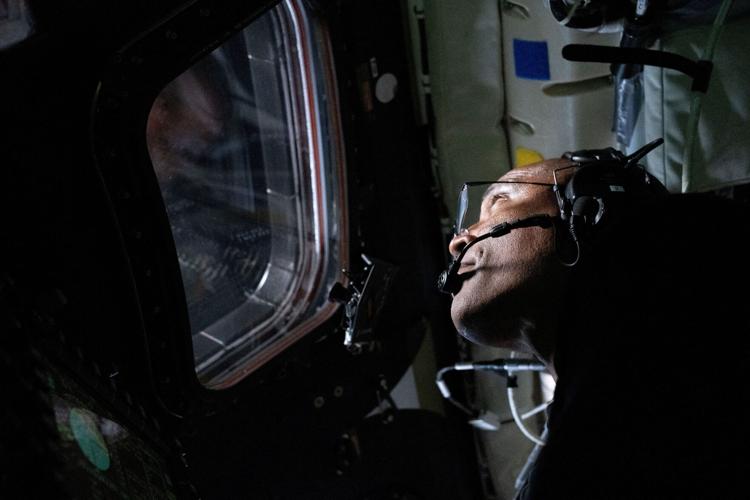
NASA astronaut and Artemis II pilot Victor Glover is pictured in the Orion spacecraft during the Artemis II lunar flyby on April 6.
Garvey chairs the board of directors of the Organization of Black Aerospace Professionals, a nonprofit group that has trained and encouraged minorities to pursue careers in aerospace and aviation since 1976. Two of Glover's daughters attended the organization's first week-long space academy program in Houston when they were younger, Garvey said.
"It's really inspirational to many other young children that are actually dreaming that dream," he said.

NASA astronaut Victor Glover reacts as he walks across the flight deck of the U.S. Navy ship USS John P. Murtha following extraction from the Artemis II mission's Orion crew module in the Pacific Ocean off the coast of California on Friday.
Glover is among 20 Black astronauts selected by NASA since its first class of seven Mercury astronauts was announced in 1959, representing roughly 6% of all astronauts the agency has chosen.
Even before Glover's lunar trip, he had spent nearly five and a half months in orbit, beginning in 2020 as pilot of NASA's Crew-1 flight, the first operational International Space Station mission using SpaceX's Crew Dragon capsule.

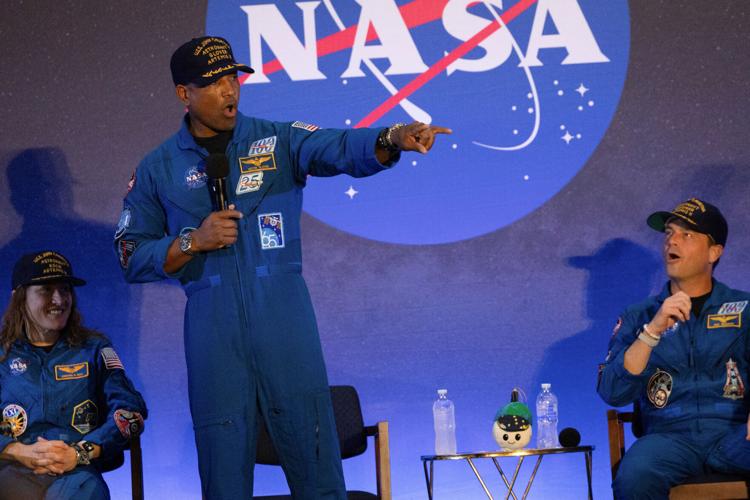
Artemis II NASA astronaut Victor Glover speaks during a press conference on Saturday at Ellington Field Joint Reserve Base in Houston.
Before joining NASA, he flew more than 40 aircraft during a U.S. Navy career, including combat deployments in Iraq. In his career, he accumulated roughly 3,000 flight hours and completed over 400 aircraft carrier landings and 24 combat missions.
But even as the first among firsts, Glover, before the Artemis launch, said, "I also hope that we are pushing the other direction, that one day we don't have to talk about these firsts."
Glover follows the legacy of earlier Black aviators like Lieutenant Colonel John William Mosley Jr., a member of the storied Tuskegee Airmen, a segregated military unit that helped pave the way for Black Americans in U.S. military aviation.
“We're all standing on the shoulders of the previous generation,” said William Eric Mosley, John’s son and a former United Airlines pilot. “In my case, and I believe also in Captain Glover's case, he would believe the same.”
Glover and his crew splashed down on Friday in the Pacific Ocean off the coast of San Diego, completing a mission that paves the way for the first crewed moon landing since 1972 planned for 2028, and beyond.
While awaiting the crew's safe return to Earth, Butler-Craig said she would be reciting the Bible verse tattooed on her arm from James 1:12.
“Blessed is the one who perseveres under trial because having stood the test, they will receive the crown of life.”
Artemis II astronauts conduct historic NASA mission

In this photo provided by NASA, the Orion spacecraft with Artemis II crewmembers aboard approaches the surface of the Pacific Ocean for splashdown off the coast of California, Friday, April 10, 2026. (Bill Ingalls/NASA via AP)

In this photo provided by NASA, U.S. Navy divers prepare to deploy in small boats from the well deck of USS John P. Murtha to recover Artemis II crew members NASA astronauts Reid Wiseman, commander; Victor Glover, pilot; Christina Koch, mission specialist; and CSA (Canadian Space Agency) astronaut Jeremy Hansen, mission specialist and NASA's Orion spacecraft in the Pacific Ocean off the coast of California, Friday, April 10, 2026. (Bill Ingalls/NASA via AP)

Employees of the Canadian Space Agency react during the successful launch of the Artemis II moon mission, at the Canadian Space Agency, in Longueuil, Quebec, on Wednesday, April 1, 2026. (Christopher Katsarov/The Canadian Press via AP)

Ottawa city councillor Tim Tierney wears a costume astronaut helmet as he joins others watching the launch of Artemis II on a livestream displayed on the Kipnes Lantern of the National Arts Centre in Ottawa, Ontario, Wednesday, April 1, 2026. (Justin Tang/The Canadian Press via AP)

People react on Elgin Street as the Artemis II moon rocket lifts off, on a livestream displayed on the Kipnes Lantern of the National Arts Centre in Ottawa, Ontario, Wednesday, April 1, 2026. (Justin Tang/The Canadian Press via AP)

In this photo provided by NASA, guests watch the launch of the Space Launch System (SLS) rocket and Orion spacecraft for the Artemis II mission to the moon at NASA's Kennedy Space Center in Florida on Wednesday, April 1, 2026. (Bill Ingalls/NASA via AP)

This photo provided by NASA shows the exterior of the Orion spacecraft Integrity during the Artemis II mission en route to the moon on Friday, April 3, 2026. (NASA via AP)

In this image provided by NASA, Artemis II Pilot Victor Glover is photographed in the Orion spacecraft during the Artemis II lunar flyby on Monday, April 6, 2026. (NASA via AP)

In this image provided by NASA, the Artemis II crew photographed the Moon's crater on Monday, April 6, 2026. (NASA via AP)

This image from video provided by NASA shows the Artemis II crew, from left, Commander Reid Wiseman, mission specialist Christina Koch, pilot Victor Glover and Canadian astronaut and mission specialist Jeremy Hansen as they answer media questions during a video conference Wednesday, April 8, 2026. (NASA via AP)

In this image provided by NASA, the Artemis II crew captured this image of Orion spacecraft pictured from one of the cameras mounted on its solar array wings on Tuesday, April 7, 2026. (NASA via AP)

In this image provided by NASA, the Artemis II crew, counterclockwise from top left, Mission Specialist Christina Koch, Mission Specialist Jeremy Hansen, Commander Reid Wiseman, and Pilot Victor Glover pose with eclipse viewers during a lunar flyby, Monday, April 6, 2026. (NASA via AP)

In this image provided by NASA, The Artemis II crew captured this view of an Earthset on Monday, April 6, 2026, as they flew around the Moon. (NASA via AP)