After much fanfare, the first total solar eclipse to cross the United States since 2017 will begin on Monday afternoon.
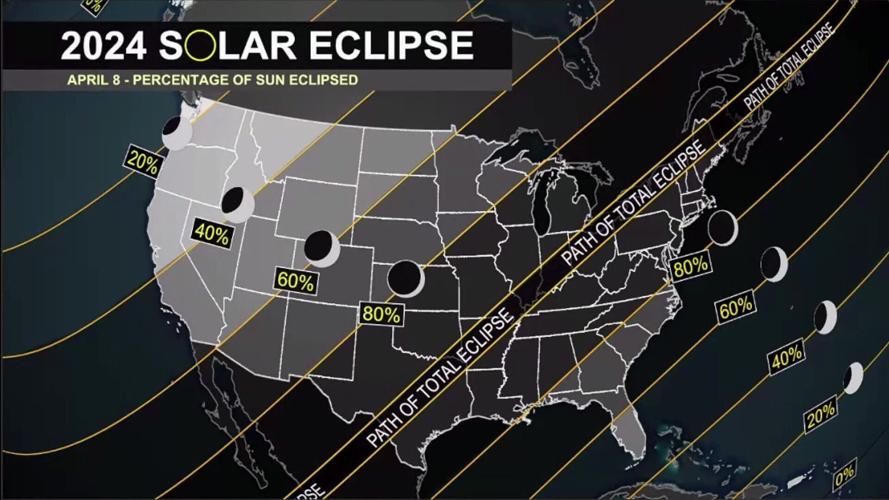
The shadow of totality will move from Mexico into south Texas around 2:30 p.m. EDT, and continue quickly northeast across the Mississippi Valley, Midwest and eastern Great Lakes before exiting eastward out of Maine just one hour later.
Having two total eclipses cross the continental United States only seven years apart is a rarity. Before 2017, the last total eclipse to cover this much American territory was in 1970, when the moon's shadow moved out of the Gulf of Mexico, across the Florida Panhandle, and up the East Coast.
And it will not happen again until 2045, when the shadow comes ashore on the northern California coast and races southeast across the Great Plains and over the Florida peninsula.
People are also reading…
A total solar eclipse occurs when the moon passes directly and entirely in front of the sun, and it is rare because the orbit of the moon is not a perfect circle around Earth, and it does not orbit Earth in the same plane as Earth orbits the sun.
On average, the moon is 239,000 miles from Earth, but the orbit is slightly elliptical. As a result, it is not the same distance away from Earth all the time. The variation is not large, about 10 percent, but this is why the moon sometimes looks a little bit larger — or smaller — in the night sky.

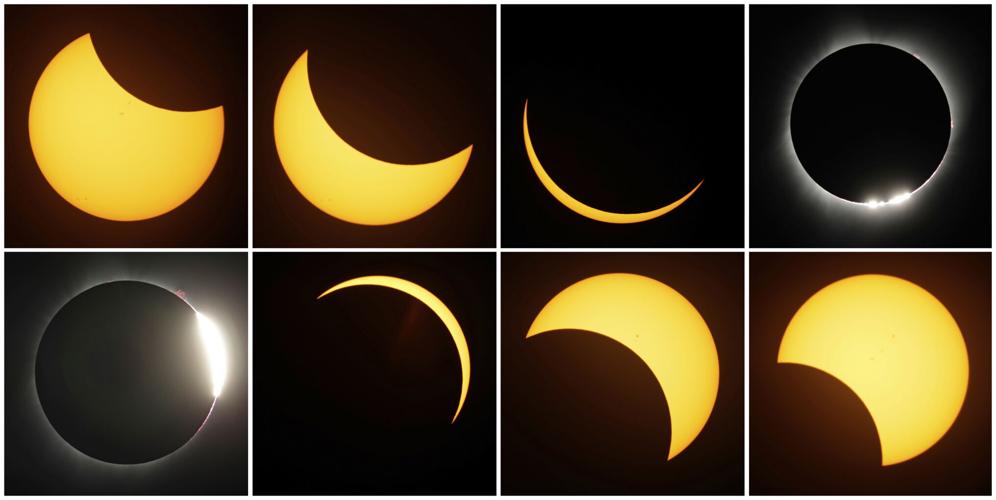
This combination of photos shows the path of the sun during a total eclipse by the moon Aug. 21, 2017, near Redmond, Ore.
That difference explains a special type of partial eclipse called an annular eclipse. When the moon is slightly farther away, it will appear smaller in the sky. If the geometry still allows the moon to cross the sun’s disc in the sky, it may not cover it entirely, creating a bright circular ring in the sky known as an annulus.
Complicating matters further, the lunar orbit is not in the same plane as Earth’s orbit around the sun, it is inclined about 5 degrees. The moon does pass through this plane — known as the ecliptic — about two times a month, and a solar eclipse can happen when that crossing of the ecliptic occurs.
Plus, solar eclipses only happen during a new moon phase, when the moon rises and sets at about the same time as the sun. During the rest of the lunar cycle, the moon is nowhere close to the sun as they each move across the sky. You have probably noticed this difference as the full moon rises in the eastern sky at around sunset, but you can sometimes catch a waxing crescent moon setting in the western sky shortly after sunset.
Over a long enough time frame, there is a pattern to these eclipses, called the Saros Cycle, which is a period of about 18 years and 11 days. But even this cycle does not take into account the rotation of Earth, so while the shapes of the shadows on the ground are similar in these cycles, the location of the shadows changes.
This all makes a total solar eclipse a once-in-a-lifetime experience for many people. But for those who have the means to travel, the chances come around more frequently. The next total eclipse is in 2026, visible from Greenland, the North Atlantic, and southwestern Europe.
Wherever you may be this year for the eclipse, enjoy the celestial show!
Sean Sublette is the chief meteorologist for the Richmond Times-Dispatch in Virginia.

Meteorologist Sean Sublette shows you how to quickly put one together


Justin Coleman, of Birmingham, Ala., holds his glasses up to his eyes as he watches the solar eclipse atop a parking structure Aug. 21, 2017, in Birmingham.

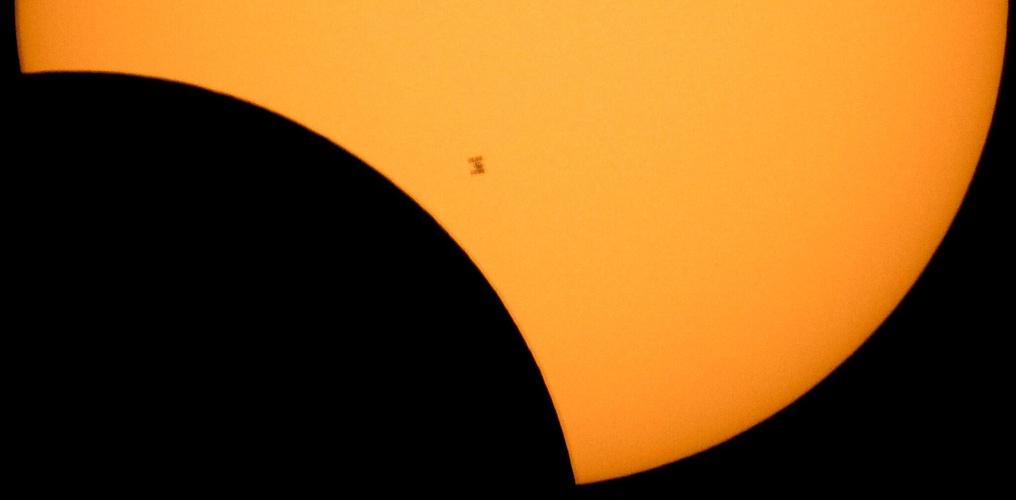
The International Space Station is silhouetted against the sun during the 2017 solar eclipse as seen from Ross Lake, Northern Cascades National Park in Washington.