

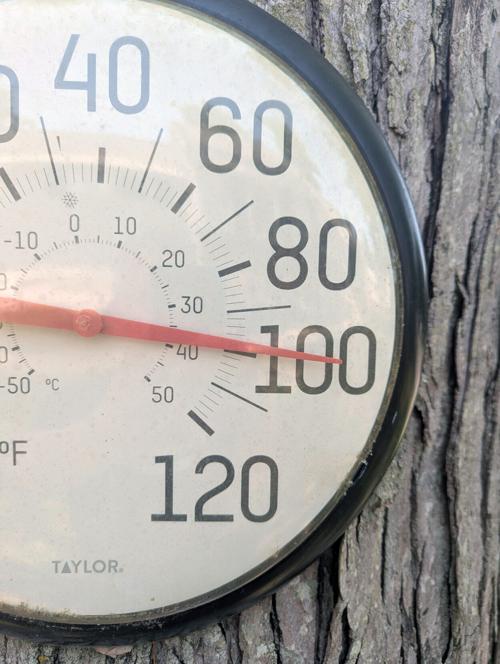
Early July brought historic extreme weather for the fourth year in a row, and scientists again see the "fingerprints" of climate change in a deadly Fourth of July.
In 2023, it was a record-smashing heat wave. In 2024, history-making Hurricane Beryl ripped through the Caribbean. In 2025, a shockingly deadly flood. And in 2026? Another deadly heat wave.
Days later, the heat warnings have finally faded for much of the eastern United States, but the grim number of heat-related deaths continues to rise.
At least 44 deaths have been reported as a result of the July 1 to July 4 heat wave, but it will be weeks or months before researchers finalize an estimate of the number of people who died or suffered injuries as a result of the extreme heat.
More than 1,300 heat records were matched or broken for maximum high temperatures and warm overnight lows across 40 states and territories over the four days.
People are also reading…
Though summer heat isn't new, the heat wave of July 2026 is something different.
From June 29 to July 5, 201 million Americans experienced at least one day when climate change made high temperatures at least three times more likely, Shel Winkley, chief meteorologist at Climate Central, told USA Today. Temperatures on July 3 had "a very strong fingerprint of climate change," he said, affecting 136 million Americans.
How many heat deaths were there?
By July 7, New Jersey authorities had reported 29 deaths related to the heat and the complications it created for people with preexisting conditions. A heat-related death was reported July 2 in Jackson, Mississippi.
Multiple media outlets reported the Cook County, Illinois, Medical Examiner's Office attributed heat as a contributing factor to four deaths, and in New York City, officials blamed the heat for three deaths. In Philadelphia, the city reported seven heat-related deaths since July 1, according to NBC10 Philadelphia.
The total does not include other deaths blamed on the heat since late June. In Bolton, Mississippi, a tragedy unfolded June 27 when 83-year-old Irene Van Egmond died of heat exposure while tending a flower bed, officials said. The high that day was about 92, but the heat index was in the triple digits, the Clarion Ledger, part of the USA Today Network, reported.
In a Facebook post, her husband, Rick Egmond, described how she fell first, and then he fell while trying to help her up. The couple remained on the ground in the extreme heat until neighbors saw them three hours later.
Climate change makes extreme heat 'more likely now'
It's not new or novel that summer is hot, that temperatures reach triple digits, or that we have heat waves, Winkley said. With climate change, Winkley said that "these heat waves are not only getting more intense, we're seeing higher temperatures because of them."
Climate Central reported in a recent study using its Climate Shift Index that summer nights have warmed across 231 U.S. cities by 3.1 degrees since 1971.
World Weather Attribution, an international science consortium, said the July heat wave would have been "virtually impossible" without climate change.
While daytime highs are bad enough on their own, when they linger for several days, the resulting overnight high temperatures offer little relief for people and their surroundings, researchers at Duke University said during a July 7 webinar.
"We're experiencing more records or at least near-record conditions than what we would have in heat waves just a couple of decades ago," Winkley said. "We expect these heat waves to become more frequent. Even though we've broken this heat wave, we're likely going to see another one set up pretty quickly."
In Philadelphia, the city set a record on July 4, 2026. It was the first time in the city's history that three consecutive days topped temperatures of 101 degrees or more, the weather service said.
"That doesn't mean it's going to happen every July 3rd, July 4th, July 5th this exact way, but we know that these types of Independence Day weekends are more likely now because of climate change," Winkley said.
Many – but not all – of the heat records set in early July were driven by a high-pressure system that settled over the country, bringing in heat and moisture from the Gulf of Mexico, renamed by the U.S. government as the Gulf of America. Sea surface temperatures in the Gulf have climbed steadily since late June and are just below records set during the summers of 2023-2025, according to the Climate Reanalyzer by the Climate Change Institute at the University of Maine.
Many records broken
Among the preliminary observations from the weather service are the following:
- 150 – Records matched or broken in Virginia, the state where the most records were set, including six records, 16 monthly, and 128 daily.
- 127 – Pennsylvania was a close second, with 127 daily records matched or broken. New York (102) and North Carolina (101) each saw more than 100 daily records reached or broken.
- 106 – Preliminary high temperature in Atlantic City, New Jersey, on July 4, tied its record high.
- 92 – Locations in 22 states across the United States where a monthly warm record was set or broken over the three days.
- 15 – Locations across 10 states that broke at least one record high, either for warm high or warm overnight low.
Independence Day weather in Philadelphia
On the day the Declaration of Independence was approved by the Continental Congress, Thomas Jefferson wrote in a notebook that the high temperature at 1 p.m. was 76 degrees.
In 1976, 200 years later, the high was 81 degrees, and the daily average was 71.5. That was about 4 degrees cooler than the 30-year average, according to weather service records.
On July 4, 2026, the 101-degree high capped three consecutive days of temperatures greater than 101 degrees for the first time in Philadelphia's history. It was only the third time the city had seen temperatures exceed 100 for three straight days, the weather service said.
The current 30-year average for Independence Day in Philadelphia is about 78.2, roughly three degrees warmer than in 1976. Three of the 11 warmest temperatures in city history have occurred over the past 16 years, including the 103 recorded on July 2.


