
Every winter has its cold spells, and this winter was no exception. But from December through February, the coldest months of the year, no place in the continental United States had a winter that was significantly colder than normal.
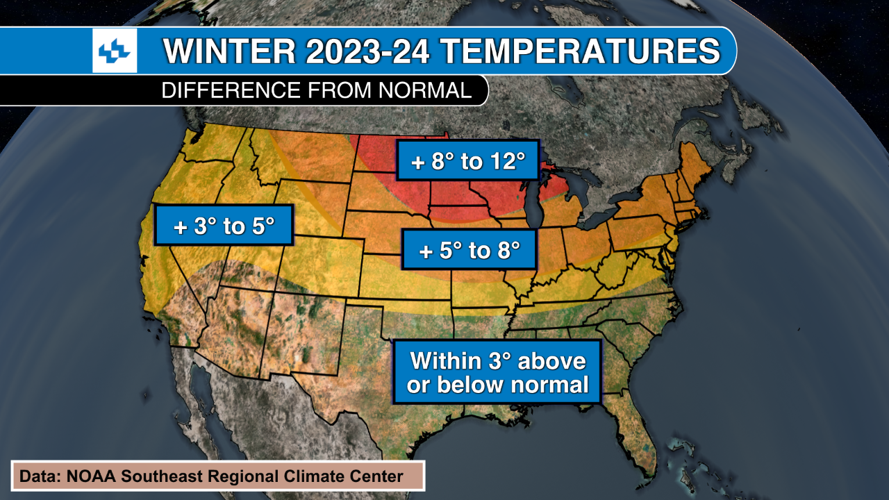
Although the official National Oceanic and Atmospheric Administration's report comes out next week, a preliminary look at the data suggests 2023-24 will be the warmest winter in the U.S. since regular records began in 1895.

Data comes from National Oceanic and Atmospheric Administration.
Compared to normal, the warmth increased from south to north across the country, with a broad area from the western Great Lakes into the eastern Dakotas having their warmest winter on record. Minnesota stood out the most, as most of the state was 10 to 12 degrees warmer than normal for the entire winter.
People are also reading…
The one marquee cold spell this winter came in mid-January. Cold like that still happens in a warming climate, but it does not last as long as in decades past. For example, during an 11-day period in Des Moines, four consecutive nights dropped below -10 degrees.
But during the last nine days of the month, every day was more than 10 degrees warmer than normal. Averaged out, January was very close to normal in Des Moines.
As the global climate warms, winters in the U.S. have followed suit. This was the 10th consecutive winter warmer than the full 20th century average, and only four winters this century have been colder than that average.
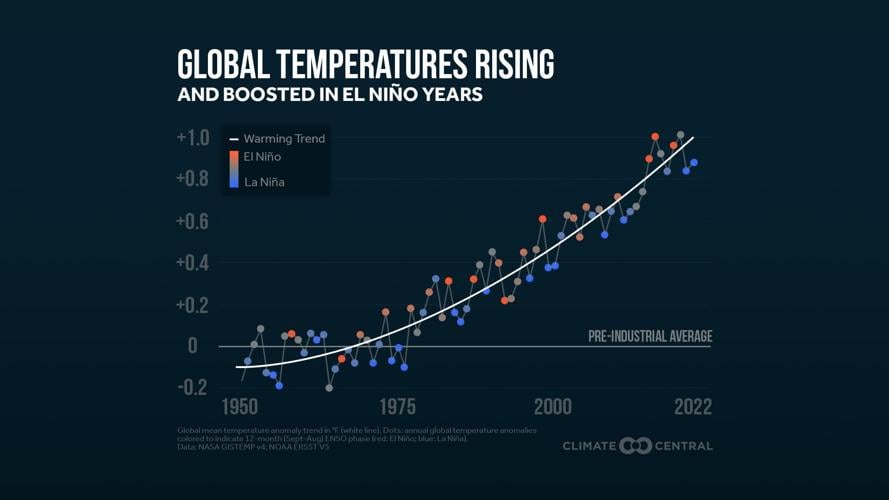
The warming climate — a result of increasing atmospheric greenhouse gases from burning fossil fuels — remains the primary driver of the warming winters. However, there is a secondary effect that likely helped give the temperature a nudge toward the top of the record book.
As winter began, a strong El Niño was underway. This periodic warming of the central and eastern Pacific Ocean along the equator alters the jet stream pattern and favors winters warmer than normal across the northern part of the country — precisely what was observed.

Data comes from NASA.
But turning the calendar back to the mid-to-late 20th century, those El Niño years were much cooler than today, indicating that the presence of El Niño was a contributor to the peak of the warmth this year, but it was not the driver.
Not surprisingly, snow also suffered, with most areas east of the Rockies getting far less than normal. The lack of snow was especially pronounced from Minnesota and Wisconsin across the Great Lakes into Upstate New York and New England. Some of these locations had 3 to 4 feet less snow than normal.
A running total of snow with respect to normal for the 2023-24 winter via NOAA NOHRSC (National Operational Hydrological Remote Sensing Center).
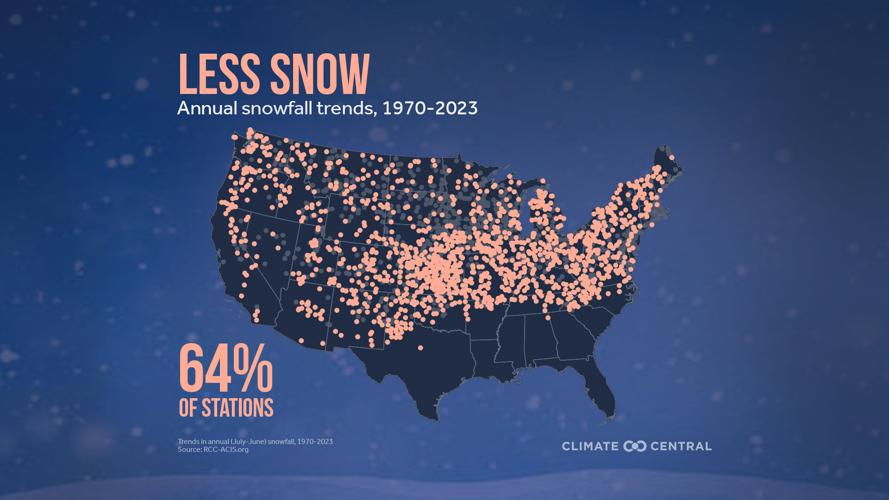
Snow trends are decreasing for much of the country, as the biggest losses have come where snow happens but is not a regular occurrence. From the plains of Colorado, across Kansas and Missouri, eastward into Kentucky and Virginia, snow has been in decline over the last half century.

Data comes from the National Oceanic and Atmospheric Administration.
Although this may sound great for heating bills, we generally give that money back in higher cooling bills during the summer. Plus, there is another economic dimension to the lack of snow in the country’s colder climates, like those along the Great Lakes.
We want to hear from you! Have a question for the meteorologists? Call 609-272-7099 and leave a message. You might hear your question and get an answer on a future episode! You can also email questions or comments to podcasts@lee.net. About the Across the Sky podcast The weekly weather podcast is hosted on a rotation by the Lee Weather team: Matt Holiner of Lee Enterprises' Midwest group in Chicago, Kirsten Lang of the Tulsa World in Oklahoma, Joe Martucci of the Press of Atlantic City, N.J., and Sean Sublette of the Richmond Times-Dispatch in Virginia.
Bryan Mroczka, a physical scientist at the NOAA Great Lakes Environmental Research Lab, sees it firsthand: “Two of the big recreational, tourist economic drivers here in the lakes are ice fishing and snowmobiling. Both of them have been adversely affected by winters like this. Both of those aspects have been very negative economic drivers.”
This does not suggest that this winter is the beginning of a new normal, but it is the kind of winter that will become more common in the years and decades to come. By contrast, cold and snowy winters will continue to become more rare as the climate warms.
The end result will be more green Christmases and less ice skating.
It also means an earlier return to pollen and insects as winter yields to spring a bit earlier in the year in the decades to come.
Sean Sublette is the chief meteorologist for the Richmond Times-Dispatch in Virginia.