

ATLANTA — The number of Americans infected by the AIDS virus each year is much higher than the government has been estimating, U.S. health officials reported, acknowledging that their numbers have understated the level of the epidemic.
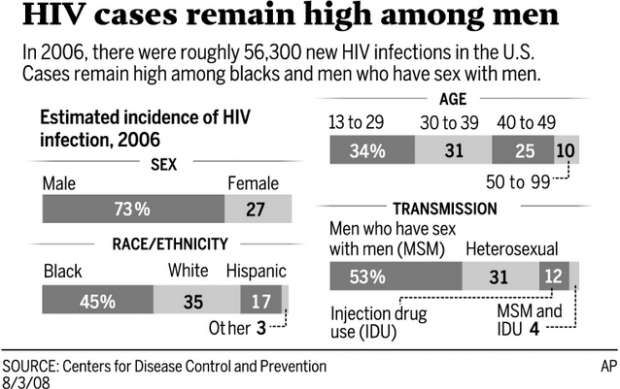
The country had roughly 56,300 new HIV infections in 2006 — about a 40 percent increase from the 40,000 annual estimate used for the past dozen years. The new figure is due to a better blood test and new statistical methods, and not a worsening of the epidemic, officials said.
But it likely will refocus U.S. attention from the effect of AIDS overseas to what the disease is doing to this country, said public health researchers and officials.
"This is the biggest news for public health and HIV/AIDS that we've had in a while," said Julie Scofield, executive director of the National Alliance of State and Territorial AIDS Directors.
People are also reading…
Experts in the field, advocates and a former surgeon general called for more aggressive testing and other prevention efforts, noting that spending on preventing HIV has been flat for seven years.
The revised estimate by the Centers for Disease Control and Prevention and the methodology behind it were to be presented today, the opening day of the international AIDS conference in Mexico City.
Since AIDS surfaced in 1981, health officials have struggled to estimate how many people are infected each year. It can take a decade or more for an infection to cause symptoms and illness.
Judging by the new calculations, officials believe annual HIV infections have been hovering around 55,000 for several years.
According to current estimates, around 1.1 million Americans are living with the AIDS virus. Officials plan to update that number with the new calculations but don't think it will change dramatically, a CDC spokeswoman said.
The new infection estimate is based on a blood test that for the first time can tell how recently an HIV infection occurred.
The improved science will allow more real-time monitoring of HIV infections. Now, CDC officials say, the estimate will likely be updated every year. Yearly estimates allow better recognition of trends. For example, the report found that infections down among heterosexuals and injection-drug users.
Some experts celebrated that finding, saying it's a tribute to prevention efforts, including nearly 200 syringe exchange programs in 36 states despite a federal ban on funding for such projects. But they also lamented the CDC's finding that infections continue to increase in gay and bisexual men, who accounted for more than half of HIV infections in 2006. Also, more than a third of those with HIV are younger than 30.
Some advocates say that suggests a need for more prevention efforts, particularly targeting younger gay and bisexual men. Some said more attention needs to focus on blacks, who account for nearly half of annual HIV infections.
On the Net
CDC HIV fact sheets: www.cdc.gov/hiv/resources/ factsheets/
JAMA: jama.ama-assn.org


