Less than a year after losing her daughter Emilia at five days old, Jillian Phillips suffered a miscarriage.
It was Halloween weekend in 2016, and her doctor said she could wait for it to end naturally, have a surgical procedure or take medication. She chose the medicine, passed the remains of her nine-week pregnancy at home and buried them in a memorial garden, near some of Emilia’s ashes.
“Once I found out that the baby inside me was no longer viable, I didn’t want to just walk around carrying the emotional trauma of that,” said Phillips, a 41-year-old single mother of three from North Brookfield, Mass. “You just kind of want it finished. And the medication works pretty quickly.”

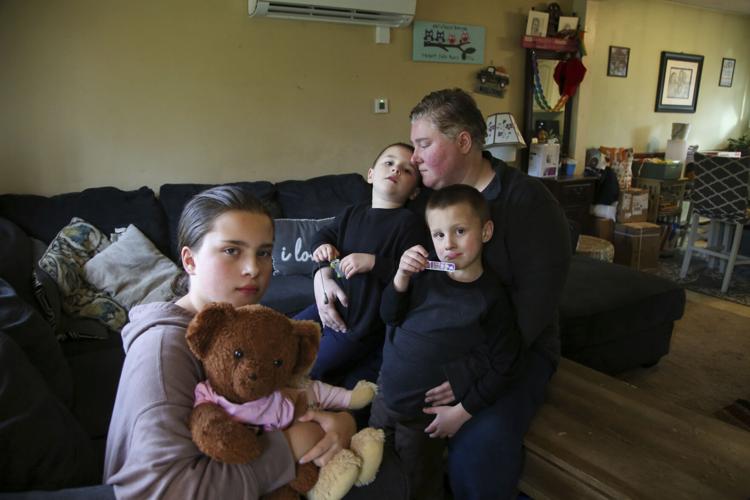
Jillian Phillips, right, sits with her children Macy, 10, and 4-year-old twins, Emmett and Jude, right, on May 2 in their home in North Brookfield, Mass. Macy holds a teddy bear that houses a silver heart-shaped urn with some of the ashes of her deceased sister, Emilia, who died at 5 days old in 2015.
The future of this common miscarriage treatment is in peril. The pill, mifepristone, is used in abortions, making it a target.
People are also reading…
Last month, a federal judge in Texas ruled to block mifepristone’s approval by the Food and Drug Administration. The Supreme Court later preserved access to the drug while the lawsuit winds through the courts, a long road that continues with arguments before an appeals court on May 17.
Doctors and patients fear mifepristone could be pulled off the market when the legal wrangling ends. Already, they say, a chilling effect keeps some doctors from prescribing it.
A million U.S. women a year suffer miscarriages, which occur in at least 15% of known pregnancies. Mifepristone was approved in 2000 for early abortions, but it is often used “off label” to treat early pregnancy loss or to speed up delivery when a fetus dies later in pregnancy. These uses are so common that U.S. senators urged manufacturer Danco to apply to the FDA to add miscarriage to the label of its drug, Mifeprex.
Denise Harle, an attorney for the group that filed the Texas lawsuit on behalf of anti-abortion doctors and health-care organizations, said they aren’t challenging uses of the drug beyond abortion. However, legal experts say if it’s taken off the market for its approved use, it wouldn’t be available for pregnancy loss.

Jillian Phillips and her sons, Jude and Emmett, hold an urn containing some of the ashes of her daughter, Emilia, on May 2 in North Brookfield, Mass.
Dr. Kristyn Brandi said that would take away “the gold standard of miscarriage management,” the two-drug combination of mifepristone and misoprostol that helps empty the uterus and reduce the chance of a dangerous infection.
“I offer it to every single patient whose miscarriage I manage,” said Brandi, an OB-GYN in Newark, New Jersey. “There will be a big impact if I am no longer able to use that medication.”
Brandi said medication speeds up the miscarriage process at a time when women are already suffering physically and emotionally.
Most patients naturally pass pregnancy tissue within two weeks of their diagnosis, but it can take several weeks, according to the American College of Obstetricians and Gynecologists. Tissue generally passes within 48 hours when women take the medication, which studies show is about 80% to 90% effective.
Brandi gives mifepristone to patients in her office. It blocks the hormone progesterone and primes the uterus to respond to the contraction-causing effect of misoprostol, which is taken later at home.
Phillips, a social worker, said the medicine made a horrible situation a little more bearable.
At her second ultrasound, doctors couldn’t detect cardiac activity in the fetus. Phillips considered getting a “dilation and curettage” procedure but didn’t like that she would need general anesthesia and couldn’t take the remains home. Medication seemed a better option.
She took mifepristone and wound up needing two doses of misoprostol. “But the miscarriage itself was not really any more significant than my worst periods,” she said. “And I was in the comfort of my home with my family.”
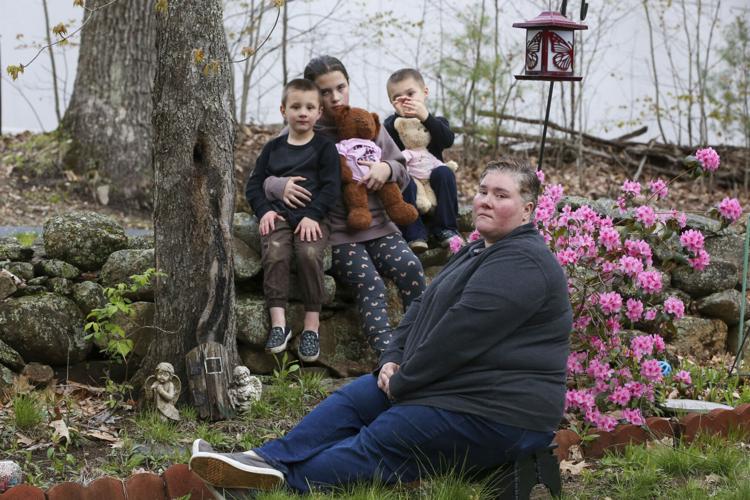
Today, she finds solace in her memorial garden, where small angel figurines are arranged near a tree in her front yard.

Jillian Phillips, front, poses with her children, Macy, 10, and 4-year-old twins, Jude and Emmett, in a memorial garden May 2 at her home in North Brookfield, Mass.
Mifepristone has long been subject to special restrictions, though experts say it’s as safe as the over-the-counter painkiller ibuprofen. For example, the FDA requires it to be dispensed by, or under the supervision of, a certified prescriber.
Doctors say the current legal climate is tightening access further.
“It’s kind of creating this chilling effect” where even though it’s still approved and available, doctors “aren’t going to give it because they’re too worried about whatever ramifications are coming afterward,” Brandi said.
“Facilities that don’t want to have anything to do with abortion have chosen not to carry mifepristone on site,” said Dr. Sarah Prager, an OB-GYN at the University of Washington School of Medicine. That includes Catholic facilities, which house a growing percentage of acute care hospital beds.
As doctors wait to learn mifepristone’s fate, they’re making backup plans for miscarriage care.
One involves using only misoprostol. While it’s safe, research shows it’s not as effective at helping expel pregnancy tissue. The treatment success rate for miscarriage patients who got only misoprostol was 67%, compared with 84% for those who took the two drugs, a 2018 study in the New England Journal of Medicine found.
That means misoprostol-only patients are more likely to need a follow-up surgical procedure or additional doses. It also leads to “significantly more discomfort,” Prager said.
During a miscarriage, “you already feel completely traumatized and devastated,” Phillips said. “It’s frightening to think that people may be in the same situation that I was and would not be able to get appropriate health care.”