

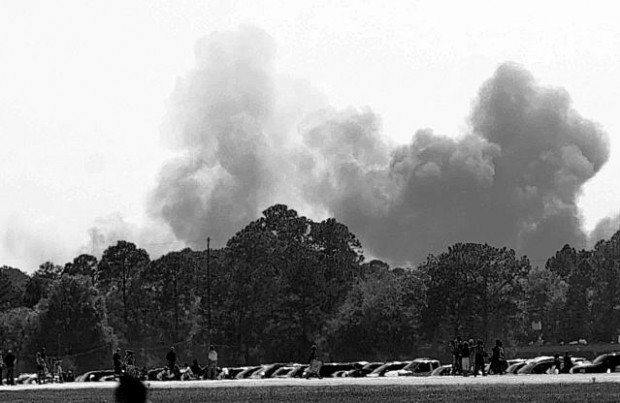
BEAUFORT, S.C. — A Navy Blue Angel jet crashed during an air show Saturday, plunging into a neighborhood of small homes and trailers and killing the pilot.
Witnesses said the planes were flying in formation during the show at the Marine Corps Air Station at about 4 p.m. and one dropped below the trees and crashed, sending up clouds of smoke.
Raymond Voegeli, a plumber, was backing out of a driveway when the plane ripped through a grove of pine trees, dousing his truck in flames and debris. He said wreckage hit "plenty of houses and mobile homes."
"It was just a big fireball coming at me," said Voegeli, 37. "It was just taking pine trees and just clipping them."
Witnesses said metal and plastic wreckage — some of it on fire — hit homes in the neighborhood, about 35 miles northwest of Hilton Head Island. William Winn, the county emergency-management director, said several homes were damaged. Eight people on the ground were injured.
People are also reading…
The crash took place in the final minutes of the air show, said Lt. Cmdr. Anthony Walley, a Blue Angel pilot. He said the name of the pilot would not be released until relatives were notified of the death.
The pilots were doing a maneuver that involved all six planes joining from behind the crowd to form a Delta triangle, said Lt. Cmdr. Garrett D. Kas-per, spokesman for the Blue Angels.
"Our squadron and the entire U.S. Navy are grieving the loss of a great American, a great Naval officer and a great friend," Walley said.
A Navy statement said the pilot had been on the team for two years and it was his first as a demonstration pilot.
John Sauls, who lives near the crash site, said the planes were banking back and forth before one disappeared, and a plume of smoke shot up.
"It's one of those surreal moments when you go, 'No, I didn't just see what I saw,' " Sauls said.
Joe Farrell, who had a plane on display at Saturday's air show, said the jet largely appeared in control.
"It looked like it was in absolute control all the way into the ground," he said. "We watched the guys try to reform. He made the turn and slid right into the ground."
The Blue Angels fly F/A-18 Hornets at high speeds in close formations, and their pilots are considered the Navy's elite. They don't wear the G-suits that most jet pilots use to avoid blacking out during maneuvers. The suits inflate around the lower body to keep blood in the brain, but they could cause a pilot to bump the control stick — a potentially deadly move when flying inches from other planes.
Instead, Blue Angels manage G-forces by tensing their abdominal muscles.
Saturday's show was six weeks into the team's flight season, and more than 100,000 people were expected to attend. The elite team, which is based at Pensacola Naval Air Station, recently celebrated its 60th anniversary.
The last Blue Angel crash that killed a pilot took place in 1999, when a pilot and his crewmate were killed while practicing with the five other Blue Angels jets at a base in Georgia.
Including Saturday's crash, 24 Blue Angels Navy flight squadron pilots have been killed during air shows or training since the group was formed in 1946.
LOCaL ANGLE
The Blue Angels were a popular attraction in Tucson just last month during the 2007 Aerospace & Arizona Days air show at Davis-Monthan Air Force Base.
While no official count was made, D-M officials estimated at least 200,000 spectators turned out, many of them to see the Blue Angels team, which hadn't performed in Tucson for years.
The Blue Angels' public affairs office would not confirm Saturday evening if the plane and pilot involved in the fatal South Carolina crash had also performed in the Tucson show, although an official did say that nearly a dozen different jets are flown in the performances.
D-M has never had an air show crash in more than 40 years of putting on the events, a spokesman said Saturday.


