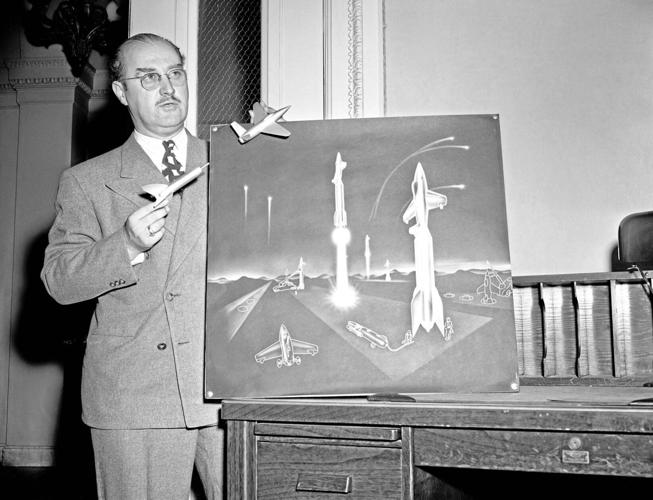

Rep. Chet Holifield, D-Calif., exhibits models and an Army chart on Oct. 22, 1945, in Washington of what he describes as a possible adaptation of the atomic principle: a rocket-propelled missile with atomic bomb head.
Aug. 1 marks the 75th anniversary of the signing of the Atomic Energy Act of 1946, which was the first law addressing the development and control of nuclear power in the United States.
The quiz below, from the Ashbrook Center at Ashland University, Ashland, Ohio, provides an opportunity for you to test your knowledge of the Atomic Energy Act, the history of nuclear power and weapons in the United States and the advent of the atomic age.
1) Which explosion of an atomic weapon ushered in what was referred to as “the atomic age”?
A. The Trinity explosion
B. The Hiroshima explosion
C. The Nagasaki explosion
D. The Castle Bravo explosion
People are also reading…
2) What federal government organization was established by the Atomic Energy Act of 1946?
A. The Strategic Air Command
B. Department of Energy
C. Atomic Energy Commission
D. Nuclear Regulatory Commission
3) The Atomic Energy Act of 1946 was updated to allow for the development of commercial nuclear power in what year?
A. 1954
B. 1959
C. 1964
D. 1970
4) Which of the following famous American scientists was involved in nuclear physics?
A. Enrico Fermi
B. J. Robert Oppenheimer
C. James Rainwater
D. All of the above
5) Which of the following historic events brought the United States and Soviet Union to the brink of nuclear war?
A. Falkland Islands War
B. Cuban Missile Crisis
C. Vietnam War
D. Strategic Arms Limitation Talks
6) In an effort to stem the spread of nuclear weapons, 62 countries, including the US, signed the Nuclear Nonproliferation Treaty in what year?
A. 1960
B. 1968
C. 1995
D. 2007
7) The largest nuclear accident in the United States took place in 1979 at what nuclear plant?
A. Crystal River
B. Indian Point
C. Hoop Creek
D. Three Mile Island
8) Which of the following countries does not possess nuclear weapons?
A. Germany
B. China
C. Russia
D. Pakistan
9) Which U.S. president studied nuclear physics and was a trained nuclear engineer?
A. Gerald Ford
B. George W. Bush
C. Jimmy Carter
D. Barack Obama
10) As of 2021, how many commercially operating nuclear power plants are operating and in how many states?
A. 32 plants in 19 states
B. 46 plants in 24 states
C. 56 plants in 28 states
D. 93 plants in 34 states
ANSWERS: 1-A, 2-C, 3-A, 4-D, 5-B, 6-B, 7-D, 8-A, 9-C, 10-C

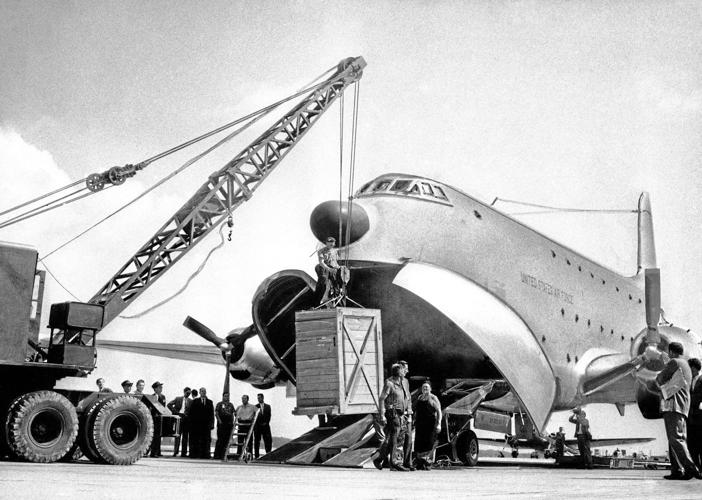
Parts for the first atomic reactor to reach Switzerland arrived in Geneva on July 2, 1944, from Knoxville, Tenn. The cargo, weighing 15 tons and packed in 100 crates, was transported in two aircraft of the U.S. Air Force: a C-124 Globe Master and a C-54.
ABOUT THE WRITER: David Hadley is a member of the Ashbrook Center faculty. He wrote this for InsideSources.com.
Photos: See historic photos of the Hiroshima atomic bombing 75 years ago

FILE - In this Aug. 6, 1945, file photo released by US Air Force, a column of smoke rises 20,000 feet over Hiroshima, western Japan, after the first atomic 5-ton "Little Boy" bomb was released. Hiroshima was targeted because it was a major Japanese military hub filled with military bases and ammunition facilities. The city of Hiroshima on Thursday, Aug. 6, 2020 marks the 75th anniversary of the world’s first nuclear attack. (George R. Caron/US Air Force via AP, File)

On Aug. 6, 1945, smoke rises 20,000 feet above Hiroshima, western Japan, after the first atomic bomb was dropped during warfare.

FILE - This Aug. 6, 1945, file photo released by the U.S. Air Force shows the total destruction of Hiroshima, western Japan, as the result of the first atomic bomb dropped. An estimated 140,000 people, including those with radiation-related injuries and illnesses, died through Dec. 31, 1945. That was 40% of Hiroshima’s population of 350,000 before the attack. (U.S. Air Force via AP, File)

FILE - In this Aug. 6, 1945, file photo released by the U.S. Air Force, white smoke rises from detonation of the atomic bomb over Hiroshima, western Japan. At 8:15 a.m., the U.S. B-29 bomber Enola Gay dropped the 4-ton “Little Boy” uranium bomb from a height of 9,600 meters (31,500 feet) on the city center, targeting the Aioi Bridge. The bomb exploded 43 seconds later, 600 meters (2,000 feet) above the ground. (U.S. Air Force via AP, File)

FILE - In this Sept. 5, 1945, file aerial photo, the landscape of Hiroshima, western Japan, shows widespread rubble and debris, one month after the atomic bomb was dropped. An estimated 140,000 people, including those with radiation-related injuries and illnesses, died through Dec. 31, 1945. That was 40% of Hiroshima’s population of 350,000 before the attack. (AP Photo/Max Desfor, File)

FILE - In this Aug. 6, 1945, file photo, survivors are seen as they receive emergency treatment by military medics shortly after the first atomic bomb ever used in warfare was dropped by the United States over Hiroshima, western Japan. Many people exposed to radiation developed symptoms such as vomiting and hair loss. Most of those with severe radiation symptoms died within three to six weeks. Others who lived beyond that developed health problems related to burns and radiation-induced cancers and other illnesses. (AP Photo, File)

FILE - In this Sept. 8, 1945, file photo, an allied correspondent stands in a sea of rubble before the shell of a building that once was a movie theater in Hiroshima, western Japan, a month after the first atomic bomb ever used in warfare was dropped by the U.S. to hasten Japan's surrender. Many people exposed to radiation developed symptoms such as vomiting and hair loss. Most of those with severe radiation symptoms died within three to six weeks. Others who lived beyond that developed health problems related to burns and radiation-induced cancers and other illnesses. (AP Photo/Stanley Troutman, Pool, File)

FILE - In this Aug 8, 1945, photo, soldiers and civilians walk through the grim remains of Hiroshima, western Japan, two days after the atomic bomb explosion. The building on left with columned facade was the Hiroshima Bank. To its right, with arched front entrance, was the Sumitomo Bank. An estimated 140,000 people, including those with radiation-related injuries and illnesses, died through Dec. 31, 1945. That was 40% of Hiroshima’s population of 350,000 before the attack. (AP Photo, File)

FILE - In this Sept. 7, 1945, file photo, an unidentified man stands next to a tiled fireplace where a house once stood in Hiroshima, western Japan. The Aug. 6, 1945, bombing was the world’s first nuclear attack. An estimated 140,000 people, including those with radiation-related injuries and illnesses, died through Dec. 31, 1945. That was 40% of Hiroshima’s population of 350,000 before the attack. (AP Photo/Stanley Troutman, Pool, File)

FILE - In this Sept. 8, 1945, file photo released by U.S. Air Force, two people walk on a cleared path through the destruction resulting from the Aug. 6 detonation of the first atomic bomb in Hiroshima, Japan. An estimated 140,000 people, including those with radiation-related injuries and illnesses, died through Dec. 31, 1945. That was 40% of Hiroshima’s population of 350,000 before the attack. (U.S. Air Force via AP, File)

FILE - In this Aug. 6, 1945, file photo, the "Enola Gay" Boeing B-29 Superfortress lands at Tinian, Northern Mariana Islands, after the U.S. atomic bombing mission against the Japanese city of Hiroshima. Enola Gay dropped the 4-ton “Little Boy” uranium bomb from a height of 9,600 meters (31,500 feet) on the city center, targeting the Aioi Bridge. (AP Photo/Max Desfor, File)

FILE - In this Aug. 7, 1945, file photo, Col. Paul W. Tibbets, standing, pilot of the B-29 Enola Gay which dropped the atomic bomb on Hiroshima, western Japan, describes the flight during a news conference at Strategic Air Force headquarters on Guam, one day after the atomic bombing. At 8:15 a.m., the U.S. B-29 bomber Enola Gay dropped the 4-ton “Little Boy” uranium bomb from a height of 9,600 meters (31,500 feet) on the city center, targeting the Aioi Bridge. (AP Photo/Max Desfor, File)

The Atomic Bomb Dome is seen at dusk in Hiroshima, western Japan, Sunday, Aug. 2, 2020. The city of Hiroshima on Thursday, Aug. 6 marks the 75th anniversary of the world’s first nuclear attack. (AP Photo/Eugene Hoshiko)

The Atomic Bomb Dome is seen at dusk in Hiroshima, western Japan, Monday, Aug. 3, 2020. The city of Hiroshima on Thursday, Aug. 6 marks the 75th anniversary of the world’s first nuclear attack. (AP Photo/Eugene Hoshiko)

The Atomic Bomb Dome is seen at dusk in Hiroshima, western Japan, Sunday, Aug. 2, 2020. The city of Hiroshima on Thursday, Aug. 6 marks the 75th anniversary of the world’s first nuclear attack. (AP Photo/Eugene Hoshiko)

A man looks at the Atomic Bomb Dome in Hiroshima, western Japan, Sunday, Aug. 2, 2020. The city of Hiroshima on Thursday, Aug. 6 marks the 75th anniversary of the world’s first nuclear attack. (AP Photo/Eugene Hoshiko)

Hatsue Onda, center, is helped by Kengo Onda to offer strings of colorful paper cranes to the victims of the 1945 Atomic bombing near Hiroshima Peace Memorial Museum in Hiroshima, western Japan, Monday, Aug. 3, 2020. The origami cranes that can be seen throughout the city became a symbol of peace because of atomic bomb survivor Sadako Sasaki, who, while battling leukemia, folded similar cranes using medicine wrappers after hearing an old Japanese story that those who fold a thousand cranes are granted one wish. (AP Photo/Eugene Hoshiko)

People pray in front of the cenotaph for the atomic bombing victims before the start of a ceremony to mark the 75th anniversary of the U.S. bombing in Hiroshima, western Japan, early Thursday, Aug. 6, 2020. (AP Photo/Eugene Hoshiko)

People pray in front of the cenotaph for the atomic bombing victims before the start of a ceremony to mark the 75th anniversary of the U.S. bombing in Hiroshima, western Japan, early Thursday, Aug. 6, 2020. (AP Photo/Eugene Hoshiko)

Kazumi Matsui, right, mayor of Hiroshima, and the family of the deceased bow before they place the victims list of the Atomic Bomb at Hiroshima Memorial Cenotaph during the ceremony to mark the 75th anniversary of the bombing at the Hiroshima Peace Memorial Park Thursday, Aug. 6, 2020, in Hiroshima, western Japan. (AP Photo/Eugene Hoshiko)

Visitors observe a minute of silence for the victims of the atomic bombing, at 8:15am, the time atomic bomb exploded over the city, at the Hiroshima Peace Memorial Park during the ceremony to mark the 75th anniversary of the bombing Thursday, Aug. 6, 2020, in Hiroshima, western Japan. (AP Photo/Eugene Hoshiko)

Visitors observe a minute of silence for the victims of the atomic bombing, at 8:15am, the time atomic bomb exploded over the city, at the Hiroshima Peace Memorial Park during the ceremony to mark the 75th anniversary of the bombing Thursday, Aug. 6, 2020, in Hiroshima, western Japan. (AP Photo/Eugene Hoshiko)