

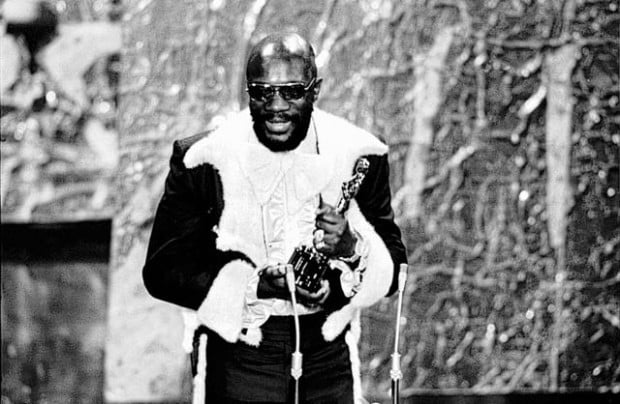
With its riveting orchestration, definitive guitar playing and signature sensual baritone vocals, Isaac Hayes' theme song for the 1971 movie "Shaft" not only became one of pop music's iconic songs but also the defining work of Hayes' career.
Yet "Theme From Shaft," which would earn both Grammys and an Oscar, was just a snippet of the groundbreaking music for which Hayes — who died Sunday at age 65 — was responsible.
He wrote soul classics such as "Hold On, I'm Comin' " for Sam & Dave, helped usher in the era of disco and was a gold mine for countless hip-hop and R&B artists who used his illustrious arrangements as the focal point for their songs decades later.
"Isaac Hayes embodies everything that's soul music," Collin Stanback, an artist and repertoire executive at the Stax record label, told The Associated Press on Sunday. "When you think of soul music, you think of Isaac Hayes — the expression . . . the sound and the creativity that goes along with it."
People are also reading…
His influence also extended beyond music. His trademarked bald head, full beard and muscular frame, often adorned with a multitude of gold chains, made him a fashion trendsetter at a time when most of his contemporaries were sporting big Afros. He was also a symbol of black pride and an activist for civil rights.
The Rev. Al Sharpton called Hayes a "creative genius" and added: "Even in his later years, he never hesitated to appear for a cause or endorse something that he felt was for the good of mankind. He will be sorely missed."
Hayes also acted in movies, including "Tough Guys," "I'm Gonna Get You Sucka" and "Hustle & Flow." He had recently completed the movie "Soul Men," in which he played himself. The film also starred Samuel Jackson and Bernie Mac, who died Saturday after a bout with pneumonia.
And a new generation of fans discovered the man behind "Shaft" when, in 1997, he became the voice of Chef on the Comedy Central's "South Park" show.
Hayes, a member of the Rock and Roll Hall of Fame, was pronounced dead at Baptist Memorial Hospital-Memphis in Memphis, Tenn., after collapsing Sunday afternoon near a treadmill in his home nearby.
Sheriff's Department spokesman Steve Shular said authorities received a 911 call after Hayes' wife and young son and his wife's cousin returned home from a grocery store and found him collapsed in a downstairs bedroom. A sheriff's deputy administered cardiopulmonary resuscitation until paramedics arrived.
Stanback said he was shocked to learn of the death of the singer, who was about to start work on a new record for Stax, the label Hayes helped make legendary. In an industry filled with colorful and dynamic figures, Hayes was a standout on several levels, from his smooth baritone to his flamboyant style.
But Hayes spent the early part of his career firmly in the musical background. A self-taught musician from Covington, Tenn., he made a name for himself playing with various bands around Memphis. In 1964, he was hired by Stax Records to be a backup pianist, working as a session musician for Otis Redding and others.
He began writing songs, establishing a songwriting partnership with David Porter, and in the 1960s they wrote classic hits for Sam and Dave such as "Hold On, I'm Comin'," "Soul Man" and "When Something Is Wrong With My Baby."
Hayes' work as a composer helped him secure a deal as a solo artist. His first album, "Presenting Isaac Hayes," was a poor seller, the result of an impromptu jam session. But after getting creative control, he delivered his next album, "Hot Buttered Soul," in 1969, and it made him a star.
Hayes offered something completely different to the musical world. In an era of straightened hair or Afros, Hayes was bald: "His look was just so profound," Stanback said. "He was like a superhero."
When other contemporary soul shouters showed their passion through wails, Hayes' delivery was calm, cool — almost subdued. He prefaced songs with "raps," and they ran longer than typical standard of three minutes: One song, a remake of Glen Campbell's "By the Time I Get to Phoenix," ran 18 minutes.
Next came "Theme From Shaft," a No. 1 hit from the "blaxploitation" film starring Richard Roundtree.
"That was like the shot heard round the world," Hayes said in a 1999 interview.
At the Oscar ceremony in 1972, Hayes performed the song wearing an eye-popping amount of gold and received a standing ovation. TV Guide later chose it as No. 18 in its list of television's 25 most memorable moments. He won an Academy Award for the song and was nominated for another one for the score. The song and score also won him two Grammys.
In 1972, he won another Grammy for his album "Black Moses" and earned a nickname he reluctantly embraced.
On the Net


