

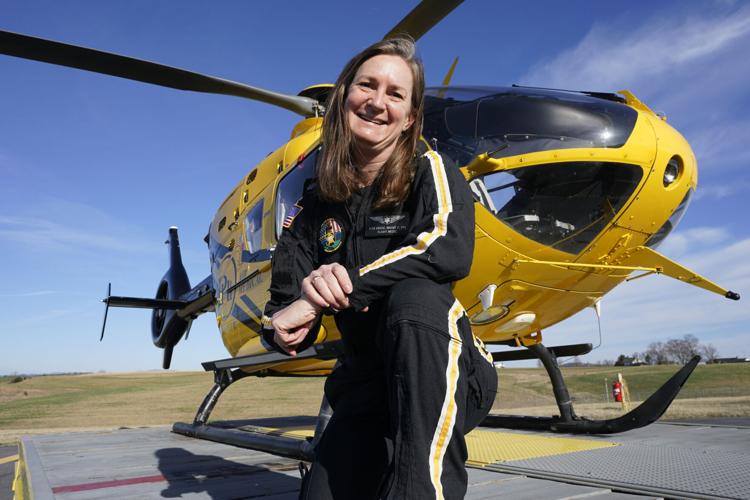

When flight paramedic Rita Krenz boards a helicopter, she knows her patients are about to face problems she can't fix — a health care system that buries people in debt after a car accident or stroke.
So she decided to do something about it. She turned for help to RIP Medical Debt, a nonprofit that buys and forgives medical debt.
Krenz started a fundraising campaign that brought in more than $18,000 for the charity. That money has helped RIP Medical Debt forgive the debt of more than 900 people so far, with the average bill abolished totaling around $1,340.
Krenz has no way of knowing if she will help anyone she's treated. But it's enough to know that her campaign will help somebody.
"A lot of my friends in health care are worn down by this broken system," the Charlottesville, Virginia, resident said. "This, it helps give some relief to that weariness."
People are also reading…
Krenz flies several times a week during her 24-hour shifts, responding to emergencies like car accidents or transporting patients from hospital to hospital. The 47-year-old said she started her career focused idealistically on the help she could provide.
Pennywise Episode 5: How to prioritize your debt payments
"Years in the system now fill me with doubt," Krenz wrote on her fundraiser's webpage, noting that she wonders how life-saving care can lead to financial ruin. "How can this be our system, in this amazing country?"
Rising care costs and shrinking insurance or a lack of coverage can swamp patients with debt, especially if they need a helicopter, which can result in bills topping $20,000 in some cases. More than one in seven U.S. residents with a credit record has overdue medical debt on it, according to the Urban Institute, a nonpartisan think tank.
It's one of the most common forms of debt in collections.
RIP Medical Debt relies on individual donations, corporate sponsors and fundraising campaigns to attack this problem. Krenz started her campaign last September after first hearing about the nonprofit.
She asked friends, family and co-workers for help. RIP Medical Debt promoted her campaign as well, but donations stalled at around $10,000.
Then they picked up again toward the year's end. A church Krenz has no connection to gave $1,000. A couple she doesn't know contributed $2,500.
That run, Krenz said, was so "uplifting and reaffirming that there are good people in the world."
She also threw in money from her pandemic relief stimulus checks, and the campaign climbed past its goal of $15,000.
RIP Medical Debt buys blocks of older debt it can get cheaply and aims to help people with low incomes. It can buy debt in a particular area or market, but it cannot target specific people.
The nonprofit estimates that it has erased more than $3 billion in medical debt since two former debt collections executives started it in 2014. Much work remains.
About $140 billion in medical debt was in collections last year, according to Stanford economist Neale Mahoney.
Erasing debt can make it easier for patients to buy a car or get a job. It also can encourage them to keep up with their care since they don't have to worry about medical bills they still owe.
Once RIP Medical Debt buys and forgives debt, it sends patients a yellow letter telling them things are resolved. For Krenz, that made what she was doing feel more real than simply writing a check to a charity.
"I can picture a person going to the mailbox and getting that letter," she said.
SOME TALES OF KINDNESS IN 2020
Tales of kindness in 2020
The tutu girls

In this photo provided by Johns Hopkins All Children’s Hospital, security guard David Dean dances with McKinley Moore, Avalynn Luciano, Lauren Glynn and Chloe Grimes at the hospital in St. Petersburg, Fla., on Aug. 9, 2018. The girls, who were diagnosed with cancer in 2016 and became fast friends while undergoing treatment, reunite every year.
Four young cancer survivors who met, became fast friends and supported each other while in treatment at a hospital in Florida four years ago didn’t let the pandemic keep them from their annual reunion. Known as the “tutu girls” for their matching outfits, the 6- and 7-year-olds held their meetup on Zoom. One of the moms got the idea for the dance costumes to raise awareness about childhood cancer, and a tradition was born.
A birthday parade

In this April 10, 2020, photo provided by Ashley Johnson, a birthday sign and a cluster of balloons hang on a car window ready for an impromptu, surprise birthday parade for 6-year-old Jessiah Lee, in Arlington, Va.
A fire truck blared its sirens, police flashed lights on cruisers and dozens of families in a car parade honked horns, raised signs and yelled: “Happy birthday, Jessiah!” None of them knew 6-year-old Jessiah Lee, but they all showed up for the surprise drive-by birthday party in Arlington, Virginia, organized on social media and inspired by similar celebrations that have brought joy to many children and adults during the quarantine.
Classroom on wheels

Gerardo Ixcoy teaches 12-year-old student Paola Ximena Conoz about fractions from his mobile classroom, parked just outside the door to her home in Santa Cruz del Quiche, Guatemala.
When Guatemala’s schools in closed mid-March, teacher Gerardo Ixcoy invested his savings in a secondhand tricycle that he and his brother converted into a mobile classroom. Each day the 27-year-old set out pedaling among the cornfields of Santa Cruz del Quiché to bring socially distanced lessons to his sixth-graders' homes and yards.
Making sweet music

Members of the National Orchestra of France filmed themselves playing Ravel's “Bolero” alone at home during lockdown. Then, like building a musical jigsaw puzzle, a sound engineer stitched together their individual clips into a seamless and rousing whole. Posted online, the performance helped the musicians keep in touch with each other and with the audiences they sorely missed.
Newlyweds giving back

Darshana Kumara Wijenarayana and his bride Pawani Rasanga walk with packets of food to distribute in the small town of Malimbada, about 99 miles south of the Sri Lankan capital Colombo.
Darshana Kumara Wijenarayana and Pawani Rasanga spent months planning a grand wedding only to see it derailed by the pandemic. Family and friends urged the Sri Lankan couple to postpone the party, but instead they chose to celebrate their love by marrying simply and then spending the day feeding the poor.
Cheers for heroes

Health workers react as people applaud from their houses in support of the medical staff working in the COVID-19 outbreak in Barcelona, Spain, on March 16, 2020.
In hard-hit European cities, residents took a moment each night to express gratitude to doctors, nurses and other health care workers. From Athens and Amsterdam to Rome and Madrid, people stood at windows or on balconies singing, cheering and applauding those on the front lines.
Teenage supply pilot

TJ Kim, 16, loads medical supplies into a plane in Leesburg, Va., before flying to a hospital.
TJ Kim doesn’t even have his driver’s license yet, but he’s already flying across Virginia delivering medical supplies to small, rural hospitals in need. The 16-year-old turned his weekly flight lessons into relief missions carrying precious pandemic cargo like gloves, masks, gowns and other equipment.
Trumpeting on high

Backdropped by Maracana stadium, firefighter Elielson Silva plays his trumpet from the top of a ladder for residents at home during a lockdown to help contain the spread of the new coronavirus in Rio de Janeiro, Brazil.
Rio de Janeiro firefighter Elielson Silva devised a novel approach to curing the coronavirus blues. Riding a fire truck’s retractable ladder as high as 200 feet, he played Brazilian tunes from that lofty perch as residents in isolation watch from their windows and applaud, flush with a restored sense of community.
Take my land

South Korean shoe repairman Kim Byung-rok shows his land in Paju, South Korea.
The acreage that Kim Byung-rok bought on a quiet mountain in South Korea a few years ago was meant for farming and fresh air. But after the pandemic hit, he offered a big chunk of it to the local government, figuring it could be put to good use helping others.
Tutoring the world

Mathematics teacher Basirat Olamide Ajayi, 36, teaches probability theory with the aid of playing cards online via her mobile phone from her house in Lagos, Nigeria.
A teacher at a public school in Lagos, Nigeria, helped students across the country and abroad learn math remotely during coronavirus lockdowns. Basirat Olamide Ajayi's free online classes became a lifeline for many children who were kept away from classrooms for months.
"One Good Thing" is a series that highlights individuals whose actions provide glimmers of joy in hard times — stories of people who find a way to make a difference, no matter how small. Read the collection of stories at https://apnews.com/hub/one-good-thing


