

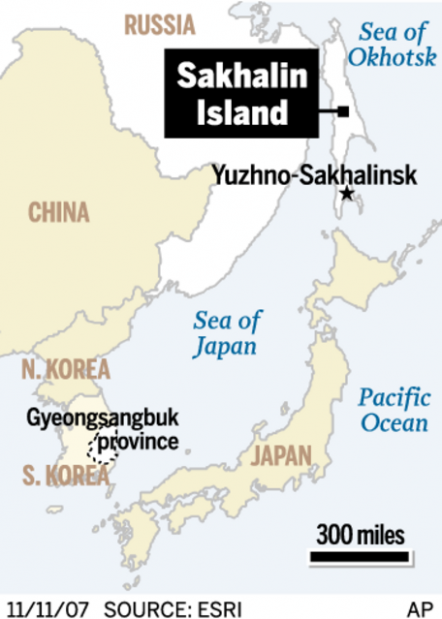
YUZHNO-SAKHALINSK, Russia — Pak Den Dya has lived as an outsider in this hardscrabble land in the frigid North Pacific — never taking Soviet or Russian citizenship in the 68 years since the Japanese empire uprooted her from her native Korea.
"I didn't want to get citizenship because I wanted to go back to Korea," said Pak, leafing through faded family photos of picnics and weddings on Sakhalin Island, where she was brought with her parents from Japanese-occupied Korea when she was just a year old.
"Now I will go there to die."
Pak, 69, is in the last group of Koreans heading home under a program that aims to write the final chapter in an often-overlooked tragedy that befell tens of thousands of Koreans. But the ending is bittersweet at best.
Only Koreans born before World War II ended in August 1945 are eligible for relocation and financial support under the three-year repatriation program funded by South Korea and Japan.
People are also reading…
As a result, families are being torn apart again, much as they were by their forced move decades ago.
"I'm confused between happiness and sorrow," said Pak, a widow who will leave behind four grown children and their families.
Starting in the 1920s, 150,000 Koreans were brought 1,000 miles from Gyeongsangbuk province in Korea to the southern half of Sakhalin, off Siberia, then controlled by Japan.
The province was chosen possibly to prevent the Koreans living near Japan from inundating the Japanese mainland to work.
The Koreans were pressed into coal mining, logging and construction.
They worked in harsh conditions amid the forests and mountains, where bears roam and rivers teem with salmon.
After Japan lost World War II, the Soviet Union took over all of Sakhalin, including about 23,500 remaining Korean residents. Some of the Koreans had died in the war or from hard labor, while others had left.
Those still here were effectively stranded, since the Soviets had no diplomatic relations with what became South Korea, the U.S.-aligned country now home to their old province.
Sakhalin during the Soviet era was a "closed" border area, meaning outsiders needed special permission to enter.
In the 1950s and 1960s, the Soviets allowed communist North Korea to lure away several hundred Korean youths. Some of the brightest are believed to have gone, in the false hope they could get back to South Korea.
Sakhalin Koreans got a glimpse of their former homeland on television during the 1988 Seoul Olympics.
Its broad highways and high-rise buildings amazed a people who had left the poor, agrarian peninsula, said Chi Bok I, an announcer for Sakhalin's Korean-language TV station who returned to Korea in October.
Only after the Soviet reforms known as perestroika in the 1980s were the Koreans allowed again to start learning their own language.
On Sakhalin, the quality of life has improved due to massive oil and gas projects exploiting offshore fields. As a result, younger Sakhalin Koreans express more willingness to stay, questioning what opportunities they would have in South Korea without fluency in the language.


