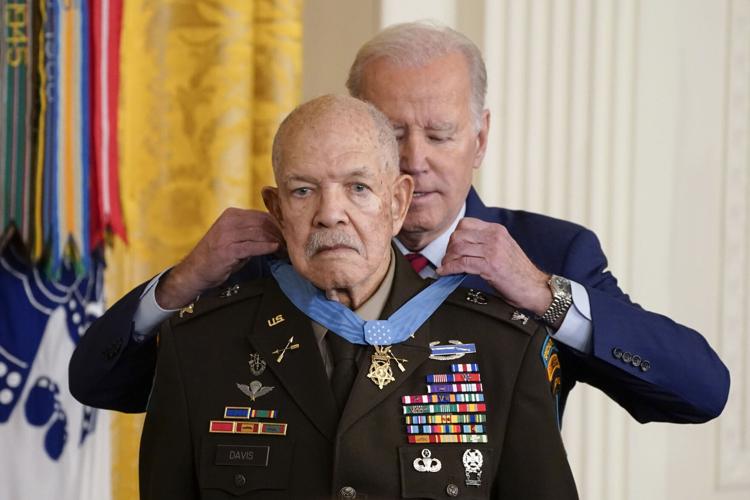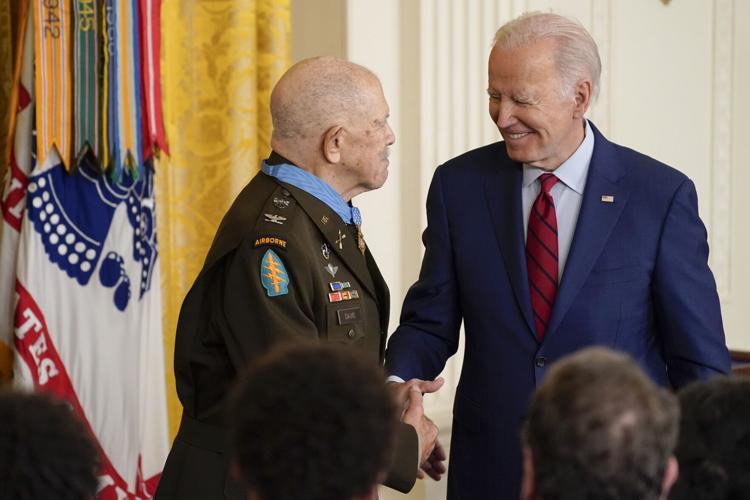
WASHINGTON — Nearly 60 years after he was recommended for the nation’s highest military award, retired Col. Paris Davis, one of the first Black officers to lead a Special Forces team in combat, received the Medal of Honor on Friday for his bravery in the Vietnam War.
After a crowded White House ceremony, a grateful Davis emphasized the positive of the honor rather than negative of the delay, saying, “It is in the best interests of America that we do things like this.”
Thanking President Joe Biden, who draped a ribbon with the medal around Davis’ neck, he said, “God bless you, God bless all, God bless America.”
The belated recognition for the 83-year-old Virginia resident came after the recommendation for his medal was lost, resubmitted — and then lost again.
It wasn’t until 2016 — half a century after Davis risked his life to save some of his men under fire — that advocates painstakingly recreated and resubmitted the paperwork.
People are also reading…

President Joe Biden awards the Medal of Honor on Friday to retired Army Col. Paris Davis for his heroism during the Vietnam War, in the East Room of the White House in Washington.
Biden described Davis as a “true hero” for risking his life amid heavy enemy fire to haul injured soldiers under his command to safety. When a superior ordered him to safety, according to Biden, Davis replied, “Sir, I’m just not going to leave. I still have an American out there.” He went back into the firefight to retrieve an injured medic.
“You are everything this medal means,” Biden told Davis. “You’re everything our nation is at our best. Brave and big hearted, determined and devoted, selfless and steadfast.”
Biden said Davis should have received the honor years ago, describing segregation in the U.S. when he returned home and questioning the delay in awarding him the medal.
“Somehow the paperwork was never processed,” Biden said. “Not just once. But twice.”
Davis doesn’t dwell on the delayed honor and says he doesn’t know why decades had to pass before it finally arrived.
“Right now I’m overwhelmed,” he said in an interview Thursday.
“When you’re fighting, you’re not thinking about this moment,” Davis said. “You’re just trying to get through that moment.”
“That moment” stretched over nearly 19 hours and two days in mid-June 1965.
Davis, then a captain and commander with the 5th Special Forces Group, engaged in nearly continuous combat during a pre-dawn raid on a North Vietnamese army camp in the village of Bong Son in Binh Dinh province.
He engaged in hand-to-hand combat with the North Vietnamese, called for precision artillery fire and thwarted the capture of three American soldiers — all while suffering wounds from gunshots and grenade fragments. He used his pinkie finger to fire his rifle after his hand was shattered by an enemy grenade, according to reports.
Davis repeatedly sprinted into an open rice paddy to rescue members of his team, according to the ArmyTimes. His entire team survived.
“That word ‘gallantry’ is not much used these days,” Biden said. “But I can think of no better word to describe Paris.”

President Joe Biden shakes hands Friday with retired Army Col. Paris Davis after awarding Davis the Medal of Honor for his heroism during the Vietnam War, in the East Room of the White House in Washington.
Davis, from Cleveland, retired in 1985 at the rank of colonel and now lives in Alexandria, Virginia, just outside Washington. Biden called him several weeks ago to deliver the news.
He says the wait in no way lessens the honor.
“It heightens the thing, if you’ve got to wait that long,” he said. “It’s like someone promised you an ice cream cone. You know what it looks like, what it smells like. You just haven’t licked it.”
Davis’ commanding officer recommended him for the military’s top honor, but the paperwork disappeared. He eventually was awarded a Silver Star, the military’s third-highest combat medal, but members of Davis’ team argued that his skin color was a factor in the disappearance of his Medal of Honor recommendation.
“I believe that someone purposely lost the paperwork,” Ron Deis, a junior member of Davis’ team in Bong Son, told the AP in a separate interview.
Deis, now 79, helped compile the recommendation that was submitted in 2016. He said he knew Davis had been recommended for the Medal of Honor shortly after the battle in 1965, and he spent years wondering why it hadn’t been awarded. Nine years ago he learned that a second nomination had been submitted “and that also was somehow, quote, lost.”
“But I don’t believe they were lost,” Deis said. “I believe they were intentionally discarded. They were discarded because he was Black, and that’s the only conclusion that I can come to.”
Army officials say there is no evidence of racism in Davis’ case.
“We’re here to celebrate the fact that he got the award, long time coming,” Maj. Gen. Patrick Roberson, deputy commanding general, U.S. Army Special Operations Command, told the AP. “We, the Army, you know, we haven’t been able to see anything that would say, ‘Hey, this is racism.’”
In early 2021, Christopher Miller, then the acting defense secretary, ordered an expedited review of Davis’ case. He argued in an opinion column later that year that awarding Davis the Medal of Honor would address an injustice.
Davis’ daughter, Regan Davis Hopper, a mom of two teenage sons, told the AP that she only learned of her dad’s heroism in 2019. Like him, she said she tries not to dwell on her disappointment over how the situation was handled.
“I think that’s most important, to just look ahead and think about how exciting it is for America to meet my dad for the first time,” she said. “I’m just proud of him.”
Photos: Iconic images from the Vietnam War era
John Kennedy, JFK 1962

President John F. Kennedy reviews the First Air Commando Group at a demonstration at Eglin Air Force Base, Florida on May 4, 1962. The outfit has trained for guerilla warfare and some of its members returned from action in Vietnam. (AP Photo)
Thich Quang Duc 1963

EDS NOTE: GRAPHIC CONTENT - The flaming body of a Buddhist monk, the Rev. Thich Quang Duc, is shown as it fell over on the pavement of a main intersection in Saigon, Vietnam, June 11, 1963. The elderly monk set fire to his clothing and burned himself to death in protest of alleged government persecution of Buddhists. Other monks kneel with hands clasped in prayer. (AP Photo/Malcolm Browne)
VIETNAM U.S. WAR IS HELL 1965
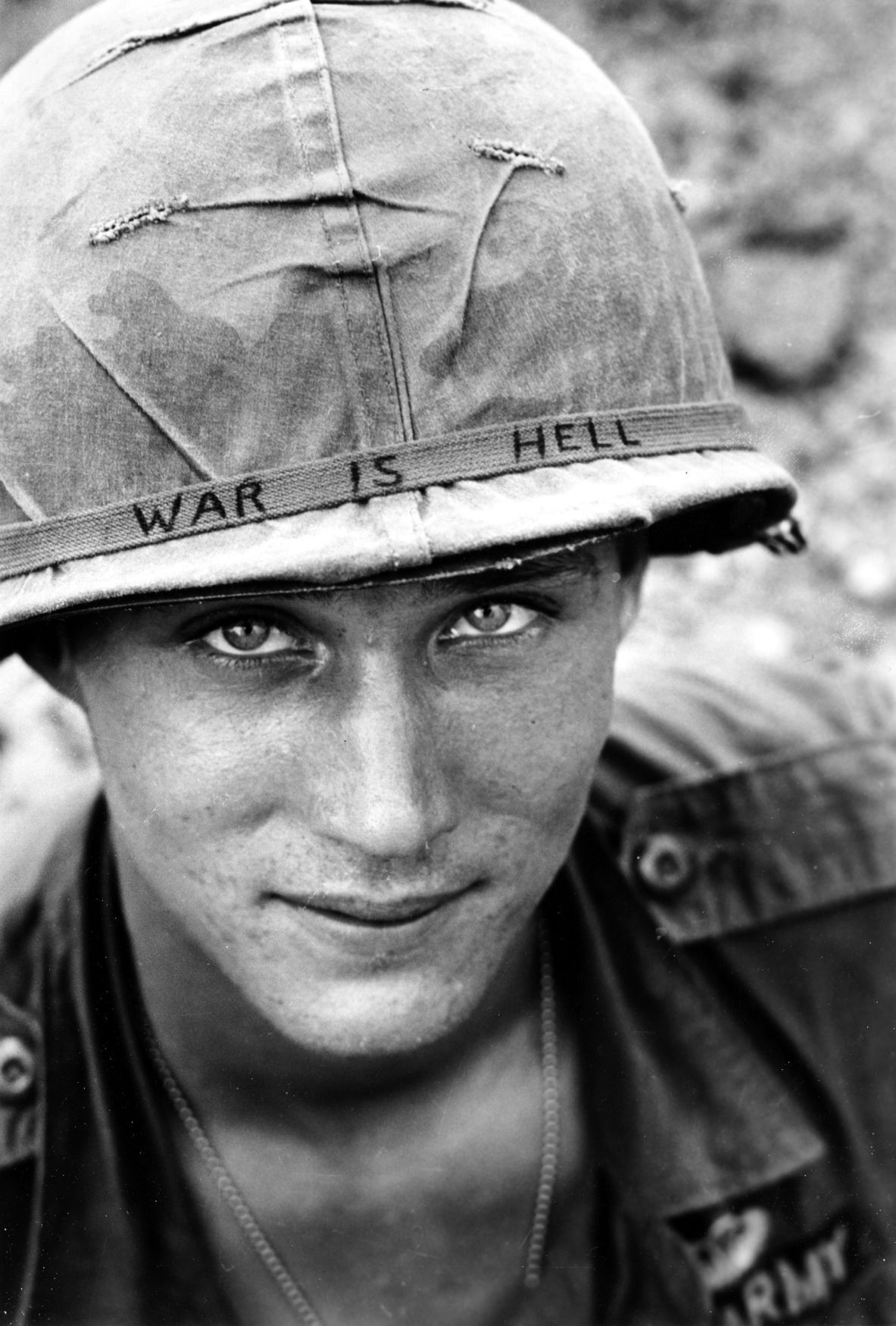
An unidentified U.S. Army personnel wears a hand lettered "War Is Hell" slogan on his helmet, June 18, 1965, during the Vietnam War. He was with the 173rd Airborne Brigade Battalion on defense duty at Phouc Vinh airstrip in South Vietnam. (AP Photo/Horst Faas)
VIETNAM TREATING WOUNDED 1965

U.S. advisers use a poncho tied to a pole to carry a wounded South Vietnamese soldier to a U.S. helicopter for evacuation to Saigon, September 1965. (AP Photo)
U.S. PARATROOPERS 1965

Paratroopers of the U.S. 2nd Battalion, 173rd Airborne Brigade hold their automatic weapons above water as they cross a river in the rain during a search for Viet Cong positions in the jungle area of Ben Cat, South Vietnam, Sept. 25, 1965. The paratroopers had been searching the area for 12 days with no enemy contact. (AP Photo/Henri Huet)
Vietnam War Michelin Battle 1965

A Vietnamese litter bearer wears a face mask to keep out the smell as he passes the bodies of U.S. and Vietnamese soldiers killed in fighting against the Viet Cong at the Michelin rubber plantation, about 45 miles northeast of Saigon, Nov. 27, 1965. More than 100 bodies were recovered after a human wave assault by guerrillas. (AP Photo/Horst Faas)
VIETNAM WAR U.S. MEMORIAL 1965

U.S. soldiers hold a memorial service for seven men of the U.S. 101st Airborne Brigade in a clearing near a former French rubber plantation in Lai Khe, Vietnam, Dec. 17, 1965. Their boots, helmets and M16 rifles are set up with a field altar. The seven paratroopers were killed in action during a search-and-destroy mission against the Viet Cong in the jungles and plantation areas of Lai Khe, about 40 miles north of Saigon, during the Vietnam War. (AP Photo/Henri Huet)
Hope Baker USS Ticonderoga 1965

Actress Carroll Baker snaps her fingers at sailors cheering from bridge of aircraft carrier USS Ticonderoga as Bob Hope leads her across stage set up on flight deck. More than 2,500 sailors saw the Hope troupe's show on the carrier off the coast of Vietnam December 27, 1965. (AP Photo)
Vietnam War Civilians 1966

Women and children crouch in a muddy canal as they take cover from intense Viet Cong fire at Bao Trai, about 20 miles west of Saigon, Jan. 1, 1966. Paratroopers, background, of the U.S. 173rd Airborne Brigade escorted the South Vietnamese civilians through a series of firefights during the U.S. assault on a Viet Cong stronghold. (AP Photo/Horst Faas)
NAPALM STRIKE 1966

A napalm strike erupts in a fireball near U.S. troops on patrol in South Vietnam, 1966 during the Vietnam War. (AP Photo)
VIETNAM WAR U.S. HELICOPTERS GAS 1966

U.S. Army helicopters providing support for U.S. ground troops fly into a staging area fifty miles northeast of Saigon, Vietnam, August 28, 1966. Helicopter fuel is stored in the large rubber tanks, foreground. (AP Photo/Henri Huet)
VIETNAM WAR EVACUATION REFUGEE 1967

A Vietnamese woman carries her two children and household goods in two baskets attached to a stick she holds over her shoulder as she travels barefoot during evacuation from Ben Suc, Vietnam, June 1967 during the Vietnam War. A third child walks in front carrying pots and pans. They are among 10,000 Vietnamese villagers evacuated from areas on the fringe of the Iron Triangle, Viet Cong stonghold, and will be resettled in refugee settlements. (AP Photo/Henri Huet)
Vietnam War Religion 1967

A chaplain gives communion to U.S. soldiers of the 1st Infantry Division, standing in a trench during services at Bu Dop, Tuesday evening, Dec. 5, 1967. The area was under constant threat of mortar and rocket attack, so services were held in the trench for protection from incoming rounds. (AP Photo/Horst Faas)
Nguyen Van Lem; Bay Lop 1968

** EDS NOTE: GRAPHIC CONTENT ** South Vietnamese Gen. Nguyen Ngoc Loan, chief of the National Police, fires his pistol into the head of suspected Viet Cong officer Nguyen Van Lem (also known as Bay Lop) on a Saigon street Feb. 1, 1968, early in the Tet Offensive. (AP Photo/Eddie Adams)
VIETNAM SUBMERGED GUNNER 1968

A 6-foot-5-inch machine gunner with the U.S. 9th. Infantry Division is completely submerged except for his rifle as he crosses a muddy stream on the Mekong Delta south of Saigon, Sept. 10, 1968. (AP Photo/Henri Huet)
South Vietnamese woman 1969

FILE - In this April 1969 file photo shot by Associated Press photographer Horst Faas, a South Vietnamese woman mourns over the body of her husband, found with 47 others in a mass grave near Hue, Vietnam. (AP Photo/Horst Faas, File)
Vietnamese AF Skyraider bombers 1972

Bombs with a mixture of napalm and white phosphorus jelly dropped by Vietnamese AF Skyraider bombers explode across Route-1, amidst homes and in front of the Cao Dai temple in the outskirts of Trang Bang, June 8, 1972. In the foreground are Vietnamese soldiers and news and cameramen from various international news organizations who watch the scene. The towers of the Trang Bang Cao Dai temple are visible in the centre of the explosions. (AP Photo / Nick Ut)
Vietnam Napalm 1972

South Vietnamese forces follow after terrified children, including 9-year-old Kim Phuc, center, as they run down Route 1 near Trang Bang after an aerial napalm attack on suspected Viet Cong hiding places on June 8, 1972. A South Vietnamese plane accidentally dropped its flaming napalm on South Vietnamese troops and civilians. The terrified girl had ripped off her burning clothes while fleeing. The children from left to right are: Phan Thanh Tam, younger brother of Kim Phuc, who lost an eye, Phan Thanh Phouc, youngest brother of Kim Phuc, Kim Phuc, and Kim's cousins Ho Van Bon, and Ho Thi Ting. Behind them are soldiers of the Vietnam Army 25th Division. (AP Photo/Nick Ut)
Vietnam Napalm 1972

Anguished Vietnamese woman carries her napalm burned child down route one, moments after a misplaced napalm bomb strike injured and killed a score civilians and soldiers. Vietnamese troops were fighting two battalions of North Vietnamese troops on route one at the outskirts of Trang Bang, 25 miles NW of Saigon, South Vietnam on June 8, 1972. (AP Phot/Nick Ut )
VIETNAM NAPALM GIRL 1972

Nine-year-old Phan Tai Kim Phuc is comforted by her mother in a Saigon hospital June 10, 1972, two days after she was severely burned during a misplaced napalm attack on her village. (AP Photo/Robinson)
VIETNAM ORPHAN U.S. AID 1973

Tran Thie Het Nhanny lies in a cardboard box next to her brother, who begged on the streets of Saigon, Vietnam, in 1973. When the photo was distributed in Feb. 1973, it inspired Americans to raise money to bring the baby to the U.S. to undergo surgery to correct a congenital heart defect. The project was sponsored by Vietnamese-American Children's Fund. A couple in Houston, Texas, cared for the baby and in 1976 was involved in proceedings to adopt the healthy 4-year-old girl. (AP Photo/Chick Harrity)
Vietnam War US POWs 1973

U.S. prisoners of war stand in the yard at Hanoi’s Nga Tu So prison during an inspection visit by international observers and invited Western journalists, March 1973. The prison, surrounded by a high brick wall topped with barbed wire, had been a government building before the war. Each cell housed about a dozen POWs, and beds consisted of wooden platforms with mats. (AP Photo/Horst Faas)
VIETNAM RELEASED POW 1973

Released prisoner of war Lt. Col. Robert L. Stirm is greeted by his family at Travis Air Force Base in Fairfield, Calif., as he returns home from the Vietnam War, March 17, 1973. In the lead is Stirm's daughter Lori, 15; followed by son Robert, 14; daughter Cynthia, 11; wife Loretta and son Roger, 12. (AP Photo/Sal Veder)