
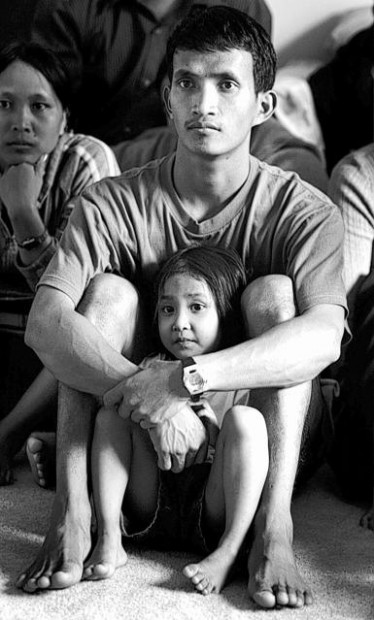
INDIANAPOLIS — The modest apartment where Van Tin Lian Zathang, his wife, Biak, and their two daughters live sits in a tidy, sprawling complex of brick town houses that other refugees from Myanmar also call home.
Zathang gets a lift to his job at a pharmaceutical warehouse because he doesn't speak enough English to pass a driver's license exam. His ethnic Chin family picks through donated clothes in the basement of a Catholic church.
"It is not easy," Zathang said through an interpreter. "Although we get some support, it's not enough."
The number of Myanmar refugees settling in the U.S. has grown exponentially this year, threatening to overwhelm local aid groups and government services.
The deluge has inundated local health departments who screen the thousands of arrivals for the growing problem of tuberculosis and other ailments.
People are also reading…
It also has flooded schools that must overcome language barriers, and public and private aid agencies that house, feed and clothe the newcomers.
Tuberculosis among concerns
Resettlement agency Exodus Refugee has doubled its Indianapolis staff to eight people over the past 11 months but still can't keep up, job specialist Zach Tennant said recently while handing out envelopes with $25 spending money to each adult refugee arriving at Indianapolis International Airport. "We're still way behind. It's a hurricane," he said.
The Rev. Thlaawr Bawihrin of Zophei Christian Church says his Chin congregation — one of four clustered on the south side of Indianapolis — has doubled to more than 200 members in five months.
Since many refugees speak little English and lack driver's licenses, Bawihrin — who has been in the U.S. since 1996 — shuttles them to jobs, doctors' appointments, welfare offices and other errands.
"I love my people. I love my community, so I must be available whenever they need me," Bawihrin said earlier this month.
The Zathangs' living room is furnished with secondhand items. On a wall, there are four single-spaced, typed pages of Chin contacts they can call for help. Their daughters, ages 8 and 6, attend Perry Township schools, where the number of students who need English lessons has risen by 150 this school year to more than 1,000, program coordinator Marsha Manning said. The district has hired five Chin to ease the transition and help teachers.
Two hours northeast of Indianapolis along Interstate 69, Fort Wayne is home to some 3,000 expatriate Myanmar, one of the largest communities in the U.S.
The arrival of 70 refugees in one week, and 559 over the first nine months of this year, prompted the head of the local Catholic Charities agency to turn to Congress for help.
"We are receiving complaints on many levels within the community," Debbie Schmidt wrote Rep. Mark Souder, R-Ind., on Sept. 13. "Health has become a serious issue in this community because a large percentage of the arriving refugees are testing positive for tuberculosis."
The State Department admitted 13,896 Myanmar refugees during the federal fiscal year that ended Sept. 30, a more than sevenfold increase from 1,612 in 2006. Nearly 5,000 arrived in September alone, sometimes with as little as 10 days notice.
Patriot Act provisions waived
State Department spokesman Curtis Cooper said Myanmar expatriates resettling in the U.S. spiked this year at the request of the U.N. High Commissioner for Refugees.
The department has waived provisions of the Patriot Act that barred 9,300 ethnic Karen from entering the U.S. because of their association with Myanmar rebels. It also lifted material support restrictions for certain ethnic groups such as the Karen and Chin.
Also, this is the first full year for a refugee processing center in Thailand run by the International Rescue Committee under contract with the State Department, said Christine Petrie, the committee's U.S. resettlement director.