

FORT JACKSON, S.C. - New soldiers are grunting through the kind of stretches and twists found in "ab blaster" classes at suburban gyms as the Army revamps its basic training regimen for the first time in three decades.
Heeding the advice of Iraq and Afghanistan combat veterans, commanders are dropping five-mile runs and bayonet drills in favor of zigzag sprints and exercises that hone core muscles.
Battlefield sergeants say that's the kind of fitness needed to dodge across alleys, walk patrol with heavy packs and body armor or haul a buddy out of a burning vehicle.
"Soldiers need to be able to move quickly under load, to be mobile under load, with your body armor, your weapons and your helmet, in a stressful situation," said Frank Palkoska, head of the Army's Fitness School at Fort Jackson, which has worked several years on overhauling the regime.
People are also reading…
"We geared all of our calisthenics, all of our running movements, all of our warrior skills, so soldiers can become stronger, more powerful and more speed driven," Palkoska said.
The exercises are part of the first major overhaul in Army basic fitness training since men and women began training together in 1980, he said.
The new plan is being expanded this month at the Army's four other basic training installations - Fort Leonard Wood, Mo., Fort Sill, Okla., Fort Benning, Ga., and Fort Knox, Ky.
Drill sergeants with experience in the current wars are credited with urging the Army to change training, in particular to build up core muscle strength. One of them is 1st Sgt. Michael Todd, a veteran of seven deployments to Iraq and Afghanistan.
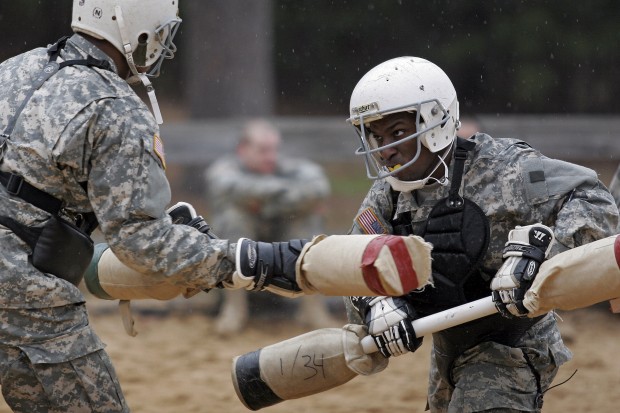
On a recent training day Todd was spinning recruits around to give them the feel of rolling out of a tumbled Humvee. Then he tossed on the ground pugil sticks made of plastic pipe and foam, forcing trainees to crawl for their weapons before they pounded away on each other.
"They have to understand hand-to-hand combat, to use something other than their weapon, a piece of wood, a knife, anything they can pick up," Todd said.
The new training also uses "more calisthenics to build core body power, strength and agility," Palkoska said. Over the 10 weeks of basic, a strict schedule of exercises is done on a varied sequence of days so muscles rest, recover and strengthen.
Another aim is to toughen recruits from a more obese and sedentary generation, trainers said.
Many recruits didn't have physical education in elementary, middle or high school and therefore tend to lack bone and muscle strength. When they ditch diets replete with soda and fast food for healthier meals and physical training, they drop excess weight and build stronger muscles and denser bones, Palkoska said.
Lt. Gen. Mark Hertling of the Army's Training and Doctrine Command, the three-star general in charge of revamping all aspects of initial training, said his overall goal is to drop outmoded drills and focus on what soldiers need today and in the future.


