

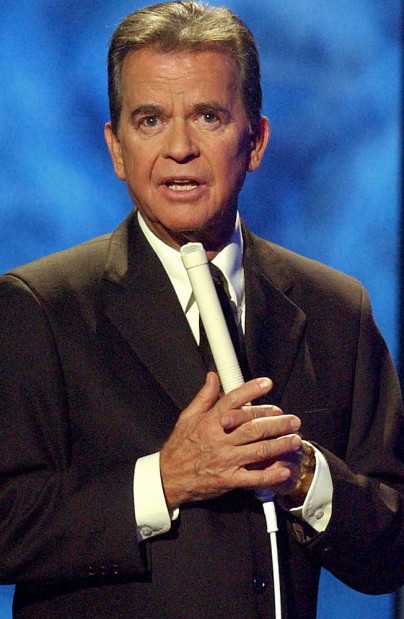
LOS ANGELES - Dick Clark, the youthful-looking television personality who literally introduced rock 'n' roll to much of the nation on "American Bandstand" and for four decades was the first and last voice many Americans heard each year with his New Year's Eve countdowns, died Wednesday. He was 82.
Clark died after suffering a heart attack following an outpatient procedure at St. John's Hospital in Santa Monica, according to a statement by his longtime publicist, Paul Shefrin. Clark's health had been in question since a 2004 stroke affected his speech and mobility, but that year's Dec. 31 countdown was the only one he missed since he started the annual rite during the Nixon years.
With the exception of Elvis Presley, Clark was considered by many to be the person most responsible for the bonfire spread of rock 'n' roll across the country in the late 1950s. "Bandstand" gave fans a way to hear and see rock's emerging idols in a way that radio and magazines could not. It made Clark a household name and gave him the foundation for a shrewdly pursued broadcasting career that made him wealthy, powerful and present in American television for half a century.
People are also reading…
Nicknamed "America's oldest teenager" for his fresh-scrubbed look, Clark and "American Bandstand" not only gave young fans what they wanted, it gave their parents a measure of assurance that this new music craze was not as scruffy or as scary as they feared. Buttoned-down and always upbeat, polite and polished, Clark came across more like an articulate graduate student than a carnival barker.
He helped transform rock 'n' roll into a cultural force, and in the beginning he did it by introducing artists such as Chuck Berry, Bill Haley and the Comets, James Brown, Buddy Holly and the Everly Brothers for the first time. All made their national television debuts on "Bandstand."
As the music matured through the years, Clark played a potent role in star-shaping, and the Mamas and the Papas and Madonna would join the long and eclectic list of performers who got that first big boost on "Bandstand." Clark himself joined many of his show's guests in 1993 when he was inducted into the Rock and Roll Hall of Fame.
On Aug. 5, 1957, from the no-frills Studio B of WFIL-TV on Market Street in Philadelphia, Clark greeted a national audience for the first time with the backdrop of a faux record store, a concrete floor and crowd of giddy teens in clean-cut mode: Ties for boys, no slacks for girls and no gum chewing were the rules from the first day.
That 3 p.m. show, broadcast locally, quickly became the first hour and a half of national airtime devoted to teenagers, their music and their fashions. By the end of 1958, it was a full-fledged sensation with 40 million viewers tuning in to ABC to learn about the newest dance step, rock star or fashion style.
The first record on the premiere show was the then-shocking single "Whole Lotta Shakin' Going On" by the ribald Jerry Lee Lewis. The juxtaposition of bracing music such as that with the show's tame trappings - party games, a roll call of giggling kids, viewer voting on the best couple - would do more to put the emerging music into the mainstream than any other forum of the day.
While Clark embodied a "safe" aura on camera, off camera he was the prototype for the fledgling music scene's new-model impresario. Clark huddled constantly with record executives and his own staff to decide which tunes got the highly coveted airtime.
By 1959, there was grumbling in the industry that "Bandstand" was too beholden to Philadelphia interests, particularly those that intersected with Clark's growing portfolio of companies. From a hit record's birth in the vinyl-pressing shop to its christening on the radio station turntable, Clark had a stake in its business life.
For the fans watching at home, Clark was simply the chaperon on their first date with rock 'n' roll.
Clark would host "Bandstand" until 1989, leaving just a few months before the show ended.


