

WASHINGTON — Sandra Senda wanted a free private tutor for her kids, just like the No Child Left Behind law promised. She had no idea the deal came with a big headache.
She couldn't get an answer about when the program would start. By the time it did, half the school year was gone. Her son was accepted but her daughter wasn't, without explanation.
Exasperated, Senda went to her school board with a message: "It's not fair. Our tax dollars are going to this stuff. I want help for my daughter. I expect to get it."
She finally did. And as the new school year begins in Hialeah, Fla., Senda is determined to get her daughter, Genesis, into tutoring right away this time — without the hassle.
As ideas go, the federal promise of free tutoring was bold. It's also proving hard to keep.
People are also reading…
Sluggish enrollment, local resistance, questionable oversight, poor outreach to parents — all of it has hampered a program that Congress adopted nearly five years ago.
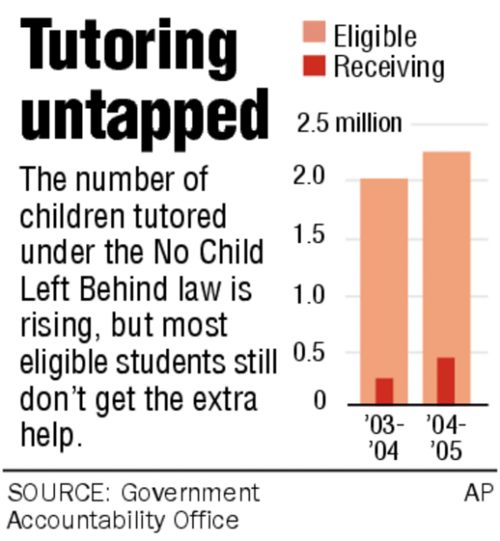
Of more than 2.2 million children eligible for tutoring, only 19 percent of them got it in 2004-05, according to auditors at the congressional Government Accountability Office.
Enrollment is rising, but still fewer than two of 10 eligible kids take part.
"It's appalling," said Michael Petrilli, who helped oversee the first years of the program for the Education Department.
"There are places in this country where poor parents have no idea that free tutoring is even available for them," said Petrilli, now a policy leader for the Fordham Foundation, a conservative education think tank.
Participation is the best gauge of the program because there is no firm data yet about what matters most — whether tutoring is helping students do better in math and reading.
There are encouraging signs.
The number of students in tutoring almost quadrupled from 2003 to 2005. Some districts have used aggressive, creative means to reach out to parents.
But even optimistic observers concede progress has been slow. In one-fifth of districts where tutoring was required, not a single student received services, the GAO found.
"At the very least, we should be reaching half the kids," said Jeanne Allen, president of The Center for Education Reform, which lobbies to expand choices for parents.
"We should be able to do that with very little effort," she said.
President Bush's education law promises choices. If a school receives federal poverty aid and does not make its goals for two straight years, students can transfer to a better school.
But many parents skip that offer and chose tutoring instead. The option of a free tutor for poor children kicks in when a school falls short for three straight years.
Parents can pick any tutor from a list approved by their state. That often includes private tutors who would be too expensive for parents if they had to pay out of pocket.
Yet there have been snags everywhere. Among the familiar ones:
● Schools that can't recruit tutors for students in highly rural areas, or for students with disabilities, no matter where they live.
● School districts that don't tell parents that tutoring is available. Some letters sent home to parents come too late, or they are written in jargon that's hard to understand.
● Tutors who aren't allowed into schools, limiting their access to students.
● States that don't evaluate the quality of tutors as the law requires.
On StarNet: Find school test results, lists of schools' performance and more at
● In Arizona, students who fail any part of the AIMS test aren't required to participate in any kind of state-funded tutoring, state Superintendent of Public Instruction Tom Horne said.
According to state Department of Education estimates, 6,000 of the 20,000 students who needed tutoring for AIMS — Arizona's Instrument to Measure Standards — in the 2004-05 school year did not use it.
In January, Horne announced the creation of an AIMS hotline, the availability of help on the department's Web site and $9 million available to districts that most needed the help.
The hotline received about 300 calls in its first three months.
Horne said he wouldn't push to make tutoring mandatory but would like to see districts stepping up efforts to promote the tutoring sessions.
AIMS became a high-school graduation requirement last year.


