

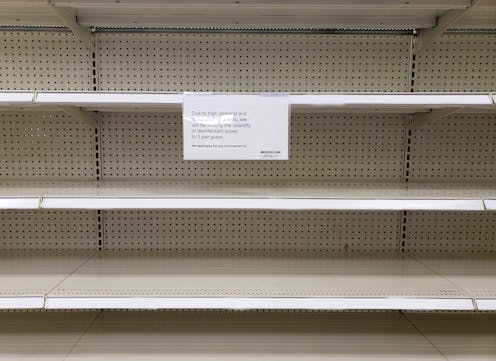
 Consumers have been seeing empty shelves throughout the pandemic. Diana Haronis/Moment
Shortages of basic goods still plague the U.S. economy — 2½ years after the pandemic’s onset turned global supply chains upside down.
Want a new car? You may have to wait as long as six months, depending on the model you order. Looking for a spicy condiment? Supplies of Sriracha hot sauce have been running dangerously low. And if you feed your cat or dog dry pet food, expect empty shelves or elevated prices.
People are also reading…
These aren’t isolated products. Baby formula, wine and spirits, lawn chairs, garage doors, butter, cream cheese, breakfast cereal and many more items have also been facing shortages in the U.S. during 2022 — and popcorn and tomatoes are expected to be in short supply soon.
In fact, global supply chains have been under the most strain in at least a quarter-century, and have been pretty much ever since the COVID-19 pandemic began.
I have been immersed in supply chain management for over 35 years, both as a manager and consultant in the private sector and as an adjunct professor at Colorado State University — Global Campus.
While each product experiencing a shortage has its own story as to what went wrong, at the root of most is a concept people in my field call the “bullwhip effect.”
What is the ‘bullwhip effect’?
The term bullwhip effect was coined in 1961 by MIT computer scientist Jay Forrester in his seminal book “Industrial Dynamics.” It describes what happens when fluctuations in demand reverberate and amplify throughout the supply chain, leading to worsening problems and shortages.
Imagine the physics of cracking a whip. It starts with a small flick of the wrist, but the whip’s wave patterns grow exponentially in a chain reaction, leading to the tip, a snap — and a sharp pain for anyone on the receiving end.
The same thing can happen in supply chains when orders for a product from a retailer, say, go up or down by some amount and that gets amplified by wholesalers, distributors and raw material suppliers.
The onset of the COVID-19 pandemic, which led to lengthy lockdowns, massive unemployment and a whole host of other effects that messed up global supply chains, essentially supercharged the bullwhip’s snap.
How the bullwhip effect works.
Cars and chips
The supply of autos is one such example.
New as well as used vehicles have been in short supply throughout the pandemic, at times forcing consumers to wait as long as a year for the most popular models.
In early 2020, when the pandemic put most Americans in lockdown, carmakers began to anticipate a fall in demand, so they significantly scaled back production. This sent a signal to suppliers, especially of computer chips, that they would need to find different buyers for their products.
Computer chips aren’t one size fits all; they are designed differently depending on their end use. So chipmakers began making fewer chips intended for use in cars and trucks and more for computers and smart refrigerators.
So when demand for vehicles suddenly returned in early 2021, carmakers were unable to secure enough chips to ramp up production. Production last year was down about 13% from 2019 levels. Since then, chipmakers have begun to produce more car-specific chips, and Congress even passed a law to beef up U.S. manufacturing of semiconductors. Some carmakers, such as Ford and General Motors, have decided to sell incomplete cars, without chips and the special features they power like touchscreens, to relieve delays.
But shortages remain. You could chalk this up to poor planning, but it’s also the bullwhip effect in action.
The bullwhip is everywhere
And this is a problem for a heck of a lot of goods and parts, especially if they, like semiconductors, come from Asia.
In fact, pretty much everything Americans get from Asia — about 40% of all U.S. imports — could be affected by the bullwhip effect.
Most of this stuff travels to the U.S. by container ships, the cheapest means of transportation. That means goods must typically spend a week or longer traversing the Pacific Ocean.
The bullwhip effect comes in when a disruption in the information flow from customer to supplier happens.
For example, let’s say a customer sees that an order of lawn chairs has not been delivered by the expected date, perhaps because of a minor transportation delay. So the customer complains to the retailer, which in turn orders more from the manufacturer. Manufacturers see orders increase and pass the orders on to the suppliers with a little added, just in case.
What started out as a delay in transportation now has become a major increase in orders all down the supply chain. Now the retailer gets delivery of all the products it overordered and reduces the next order to the factory, which reduces its order to suppliers, and so on.
Now try to visualize the bullwhip of orders going up and down at the suppliers’ end.
The pandemic caused all kinds of transportation disruptions — whether due to a lack of workers, problems at a port or something else — most of which triggered the bullwhip effect.
The end isn’t nigh
When will these problems end? The answer will likely disappoint you.
As the world continues to become more interconnected, a minor problem can become larger if information is not available. Even with the right information at the right time, life happens. A storm might cause a ship carrying new cars from Europe to be lost at sea. Having only a few sources of baby formula causes a shortage when a safety issue shuts down the largest producer. Russia invades Ukraine, and 10% of the world’s grain is held hostage.
The early effects of the pandemic in 2020 led to a sharp drop in demand, which rippled through supply chains and decreased production. A strong U.S. economy and consumers flush with coronavirus cash led to a surge in demand in 2021, and the system had a hard time catching up. Now the impact of soaring inflation and a looming recession will reverse that effect, leading to a glut of stuff and a drop in orders. And the cycle will repeat.
As best as I can tell, these disruptions will take many years to recover from. And as recent inflation reduces demand for goods, and consumers begin cutting back, the bullwhip will again work its way through the supply chain — and you’ll see more shortages as it does.
Michael Okrent does not work for, consult, own shares in or receive funding from any company or organization that would benefit from this article, and has disclosed no relevant affiliations beyond their academic appointment.
This article is republished from The Conversation under a Creative Commons license.
Explainer: What to know about 'buy now, pay later'
Q: How does buy now, pay later work?
Answer: Branded as “interest-free loans,” buy now, pay later services require you to download an app, link a bank account or debit or credit card, and sign up to pay in weekly or monthly installments. Some companies, such as Klarna and Afterpay, do soft credit checks, which aren't reported to credit bureaus, before approving borrowers. Most are approved in minutes. Scheduled payments are then automatically deducted from your account or charged to your card.

FILE - A 65-inch television is shown at a warehouse, Thursday, June 17, 2021, in Lone Tree, Colo. Buy now, pay later loans allow users to pay for items such as new sneakers, electronics or luxury goods in installments.
The services generally don't charge you more than you would have paid up front, meaning there's technically no interest, so long as you make the payments on time.
But if you pay late, you may be subject to a flat fee or a fee calculated as a percentage of the total you owe. These can run as high as $34 plus interest. If you miss multiple payments, you may be shut out from using the service in the future, and the delinquency could hurt your credit score.
Q: Are my purchases protected?
Answer: In the U.S., buy now, pay later services are not currently covered by the Truth in Lending Act, which regulates credit cards and other types of loans (those paid back in more than four installments).
That means you could find it more difficult to settle disputes with merchants, return items, or get your money back in cases of fraud. Companies can offer protections, but they don't have to.
Lauren Saunders, associate director at the National Consumer Law Center, advises borrowers to avoid linking a credit card to buy now, pay later apps whenever possible. If you do, you lose the protections you get from using the credit card while also opening yourself to owing interest to the card company.
“Use the credit card directly and get those protections,” she said. “Otherwise, it’s the worst of both worlds.”
Q: What are the other risks?
Answer: Because there's no centralized reporting of buy now, pay later purchases, those debts won't necessarily appear on your credit profile with major credit rating agencies.
That means more companies may let you buy more items, even if you can't afford them, because the lenders don't know how many loans you have set up with other companies.
Payments you make on time aren't reported to credit rating agencies, but missed payments are.
“Right now, buy now, pay later can’t generally help you build credit, but it can hurt,” said Saunders.
Elyse Hicks, consumer policy counsel at Americans for Financial Reform, a progressive nonprofit, said people may not consider seriously enough whether they'll still be able to afford payments down the road.
“Because of inflation, people may think, ‘I’m going to have to get what I need and pay for it later in these installments,’” she said. “But are you still going to be able to afford the things you’re affording now six months from now?”
Q: Why do retailers offer buy now, pay later?
Answer: Retailers accept the backend fees of buy now, pay later services because the products increase cart sizes. When shoppers are given the option to pay off purchases in installments, they're more likely to buy more goods in one go.
When Apple recently announced it will be creating its own buy now, pay later service, Josiah Herndon, 23, joked on Twitter about “paying off 6 carts of (things) I can’t afford with Apple, Klarna, Afterpay, PayPal Pay in 4, Shop Pay in 4, & Affirm.”
Herndon, who works in insurance in Indianapolis, said he started using the services because it was taking a long time for him to be approved for a credit card, since his age meant he didn’t have an extensive credit history. He’s since used them to pay for high-end clothes, shoes, and other luxury goods. Herndon said he lines the payment schedules up with his paychecks so he doesn’t miss installments, and called the option “very convenient."
Q: Who should use buy now, pay later?
Answer: If you have the ability to make all payments on time, buy now, pay later loans are a relatively healthy, interest-free form of consumer credit.
“If (the loans) work as promised, and if people can avoid late fees and don’t have trouble managing their finances, they have a place,” said Saunders, of the National Consumer Law Center.
But if you're looking to build your credit score, and you’re able to make payments on time, a credit card is a better choice. The same goes if you want strong legal protections from fraud, and clear, centralized reporting of loans.
If you're uncertain whether you'll be able to make payments on time, consider whether the fees charged by buy now, pay later companies will add up to higher charges than the penalties and interest a credit card company or other lender would charge.
Q: How will economic instability affect buy now, pay later?
Answer: As the cost of living increases, some shoppers have started breaking up payments on essentials, rather than just big-ticket items like electronics or designer clothes. A poll by Morning Consult released this week found 15% of buy now, pay later customers are using the service for routine purchases, such as groceries and gas, sounding alarm bells among financial advisors.
Hicks points to the rising number of delinquent payments as a sign that buy now, pay later could already be contributing to unmanageable debt for consumers. A July report from the Fitch ratings agency found delinquencies on the apps increased sharply in the 12 months that ended March 31, to as high as 4.1% for Afterpay, while credit card delinquencies held relatively steady at 1.4%.
“The increasing popularity of this is going to be interesting to see over these different economic waves,” Hicks said. “The immediate fallout is what’s happening now.”
The Ethical Life: Why do Americans have so much respect for small businesses?


